
LaunchGrill
Score your landing page the way a stranger reads it
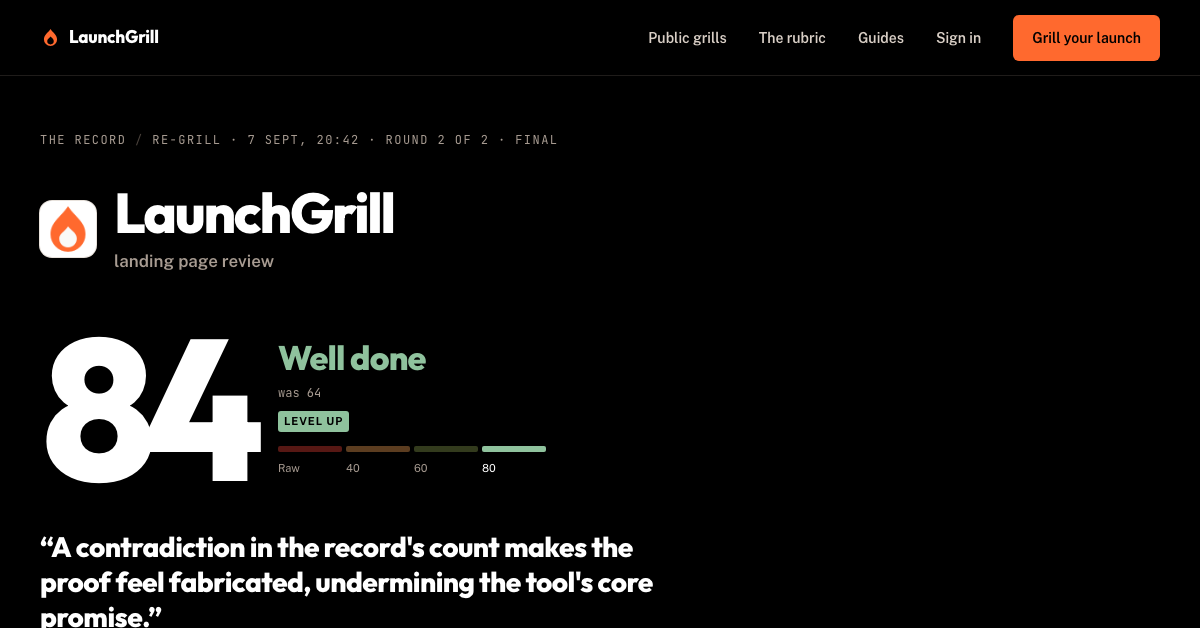
Your friends will tell you the landing page looks great. LaunchGrill tells you what a stranger will actually do with it. Paste the URL and it reads the page cold, top of the page first, then marks it against 18 published tests across clarity, audience, offer and proof. Back comes a score out of 100, a grade, the single line that costs you most, and four to nine findings that quote your page and propose a fix. Grill it again after 24 hours to see if your change moved the score. Free, no card.

Features
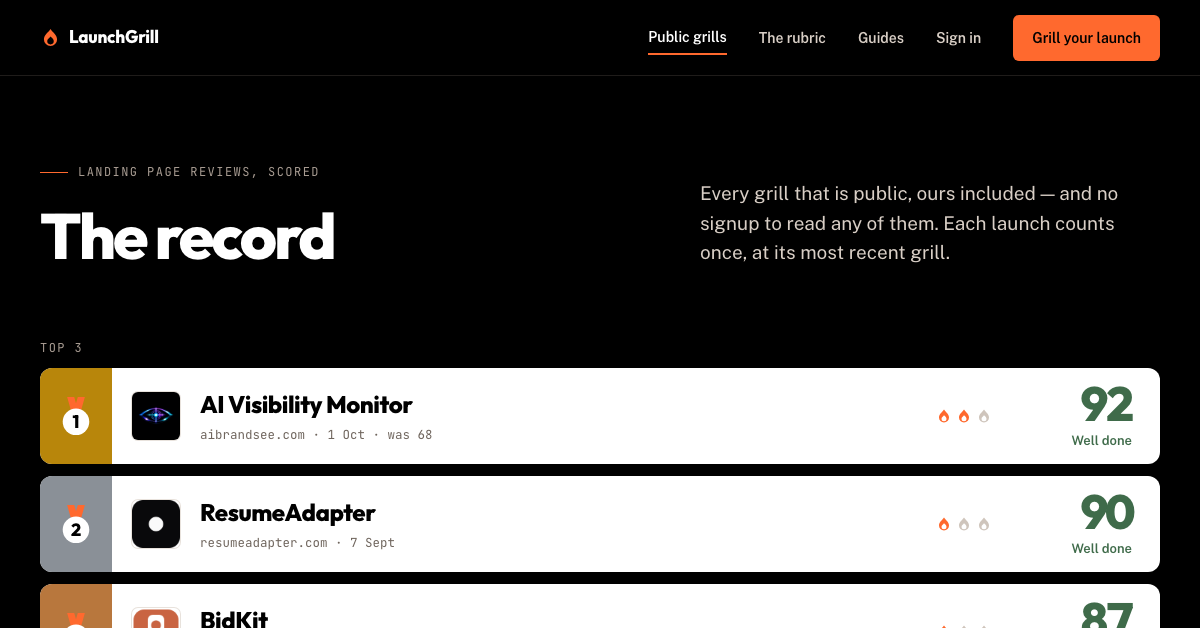
A score from 0 to 100 and a grade, from Raw to Well done. Four to nine findings ranked by launch-day cost, each quoting your page, with one or two proposed changes. A public checklist of 18 tests, the same text the critic reads. A second grill 24 hours later to measure the change.
Use Cases
Check a landing page in the week before a Product Hunt or Show HN launch. Find out why a launched page gets visits but no sign-ups. Compare a page before and after a rewrite.

Comments


Ran my own landing page through it and got [SCORE/GRADE]. The finding that stung was [WHAT IT FLAGGED], and it was right: [ONE LINE ON WHY / WHAT YOU'LL CHANGE]. Quoting my own copy back at me made it much easier to act on than a generic checklist. I'll re-grill in 24 hours to see if the fix moves the score.

Quoting the page back with a proposed fix is much more actionable than a bare score. Since it reads the top of the page first, which viewport does it grade? On mobile the first screen often shows only the headline and a button, while on desktop the proof section is visible too, so the same page could score quite differently. Grading both, or a mobile/desktop toggle, would make the result easier to trust. It would also help to grill a translated version of a page against the same 18 tests.
The 24-hour re-grill is what makes the score useful instead of a one-off roast. I would run it the week before a directory launch, change the single line it says costs the most, then check whether the grade actually moved. Before I trust it on a modern page I need to know this: does the critic read the rendered DOM after JavaScript, or only the initial HTML? A lot of launch pages put the offer in a client-rendered hero, and a static fetch would score an empty shell.
Publishing the same 18 tests the critic reads is more useful than the score on its own, because I can tell whether a low grade is clarity or proof. A lot of launch pages open under a cookie banner or a region modal that covers the headline. Does the cold read dismiss that overlay, or is the first screen it grades the banner itself, which would punish pages that are fine once you accept?
Publishing the 18 tests so people can read exactly what the critic reads is a good call: a score you can inspect is easier to trust than a black box. One question on the cold read: how does it handle pages where the headline is injected by JavaScript, or where a cookie banner covers the first screen? If the cold read sees something different from what a stranger sees, the top-of-page findings could point at the wrong thing.
The framing here is spot on — friends will always say the page looks great, and founders desperately need the stranger's-eye view before launch day. Ranking findings by launch-day impact is smart prioritization; most audit tools drown you in equal-weight issues. I'd be curious how it handles pages behind auth or with heavy JS — if it reads the rendered DOM, that'd make it far more useful than screenshot-based checkers. The 24-hour re-grill loop is a nice touch for iterating. Congrats on shipping!

I like that each finding quotes the page's own copy and ranks by launch-day cost, and that the 18 tests are public. A concrete question: how does it handle pages whose hero is mostly an image or video with little text? I'd guess a cold read could undercount clarity there, so I'm curious whether the score flags that limitation.

The published 18-test checklist makes the score easier to interpret. For the 24-hour re-grill, do you save the previous page snapshot and show which individual tests changed? A side-by-side comparison of the old quote, new quote and score would help distinguish a useful copy edit from normal scoring variation.
Premium Products


















































Sponsors
Buy

Makers

Makers
Comments
Ran my own landing page through it and got [SCORE/GRADE]. The finding that stung was [WHAT IT FLAGGED], and it was right: [ONE LINE ON WHY / WHAT YOU'LL CHANGE]. Quoting my own copy back at me made it much easier to act on than a generic checklist. I'll re-grill in 24 hours to see if the fix moves the score.
Quoting the page back with a proposed fix is much more actionable than a bare score. Since it reads the top of the page first, which viewport does it grade? On mobile the first screen often shows only the headline and a button, while on desktop the proof section is visible too, so the same page could score quite differently. Grading both, or a mobile/desktop toggle, would make the result easier to trust. It would also help to grill a translated version of a page against the same 18 tests.
The 24-hour re-grill is what makes the score useful instead of a one-off roast. I would run it the week before a directory launch, change the single line it says costs the most, then check whether the grade actually moved. Before I trust it on a modern page I need to know this: does the critic read the rendered DOM after JavaScript, or only the initial HTML? A lot of launch pages put the offer in a client-rendered hero, and a static fetch would score an empty shell.
Publishing the same 18 tests the critic reads is more useful than the score on its own, because I can tell whether a low grade is clarity or proof. A lot of launch pages open under a cookie banner or a region modal that covers the headline. Does the cold read dismiss that overlay, or is the first screen it grades the banner itself, which would punish pages that are fine once you accept?
Publishing the 18 tests so people can read exactly what the critic reads is a good call: a score you can inspect is easier to trust than a black box. One question on the cold read: how does it handle pages where the headline is injected by JavaScript, or where a cookie banner covers the first screen? If the cold read sees something different from what a stranger sees, the top-of-page findings could point at the wrong thing.
The framing here is spot on — friends will always say the page looks great, and founders desperately need the stranger's-eye view before launch day. Ranking findings by launch-day impact is smart prioritization; most audit tools drown you in equal-weight issues. I'd be curious how it handles pages behind auth or with heavy JS — if it reads the rendered DOM, that'd make it far more useful than screenshot-based checkers. The 24-hour re-grill loop is a nice touch for iterating. Congrats on shipping!
I like that each finding quotes the page's own copy and ranks by launch-day cost, and that the 18 tests are public. A concrete question: how does it handle pages whose hero is mostly an image or video with little text? I'd guess a cold read could undercount clarity there, so I'm curious whether the score flags that limitation.
The published 18-test checklist makes the score easier to interpret. For the 24-hour re-grill, do you save the previous page snapshot and show which individual tests changed? A side-by-side comparison of the old quote, new quote and score would help distinguish a useful copy edit from normal scoring variation.
Premium Products
New to Fazier?

Find your next favorite product or submit your own. Made by @FalakDigital.
Copyright ©2026. All Rights Reserved