
Krea 2 Turbo
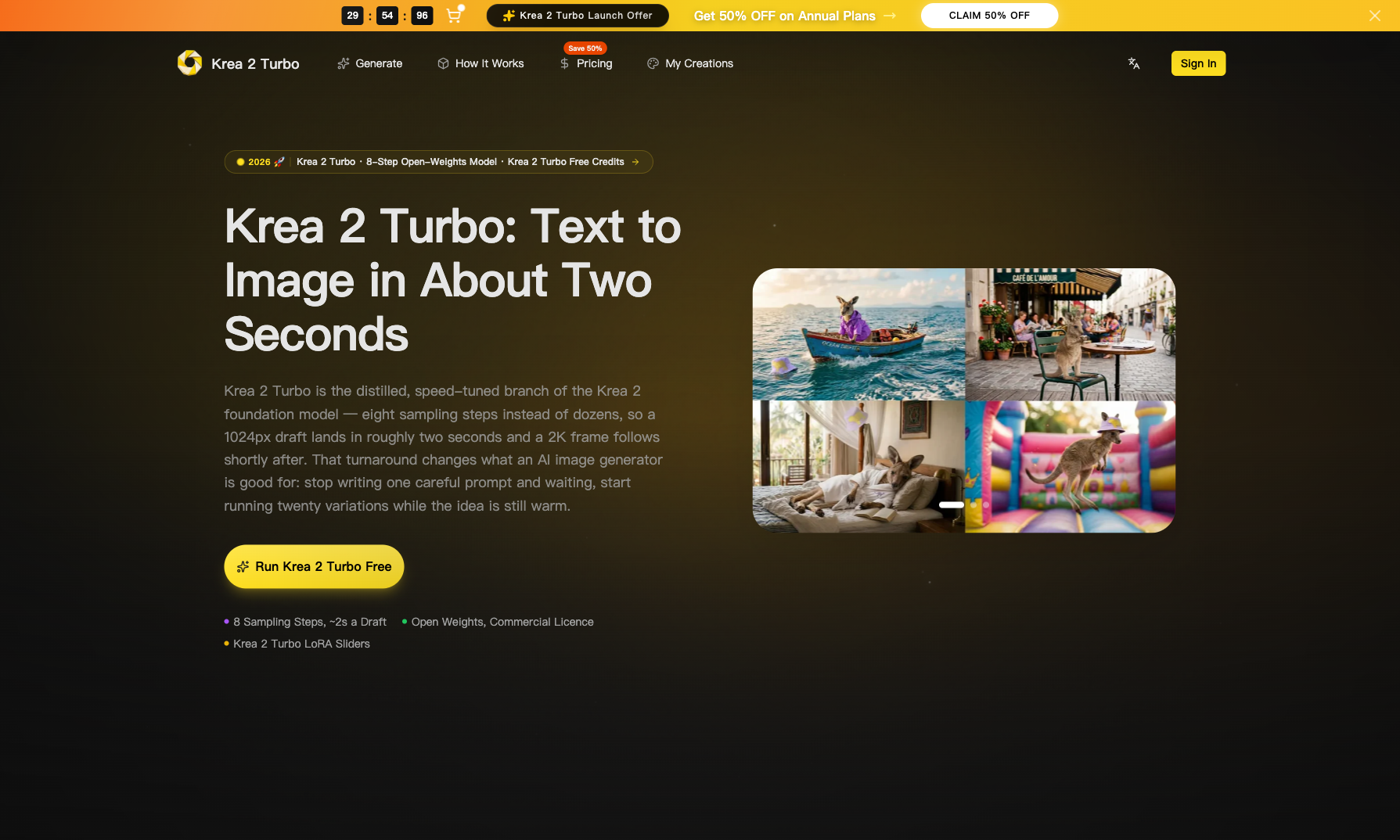
Text to image in about two seconds, eight steps flat
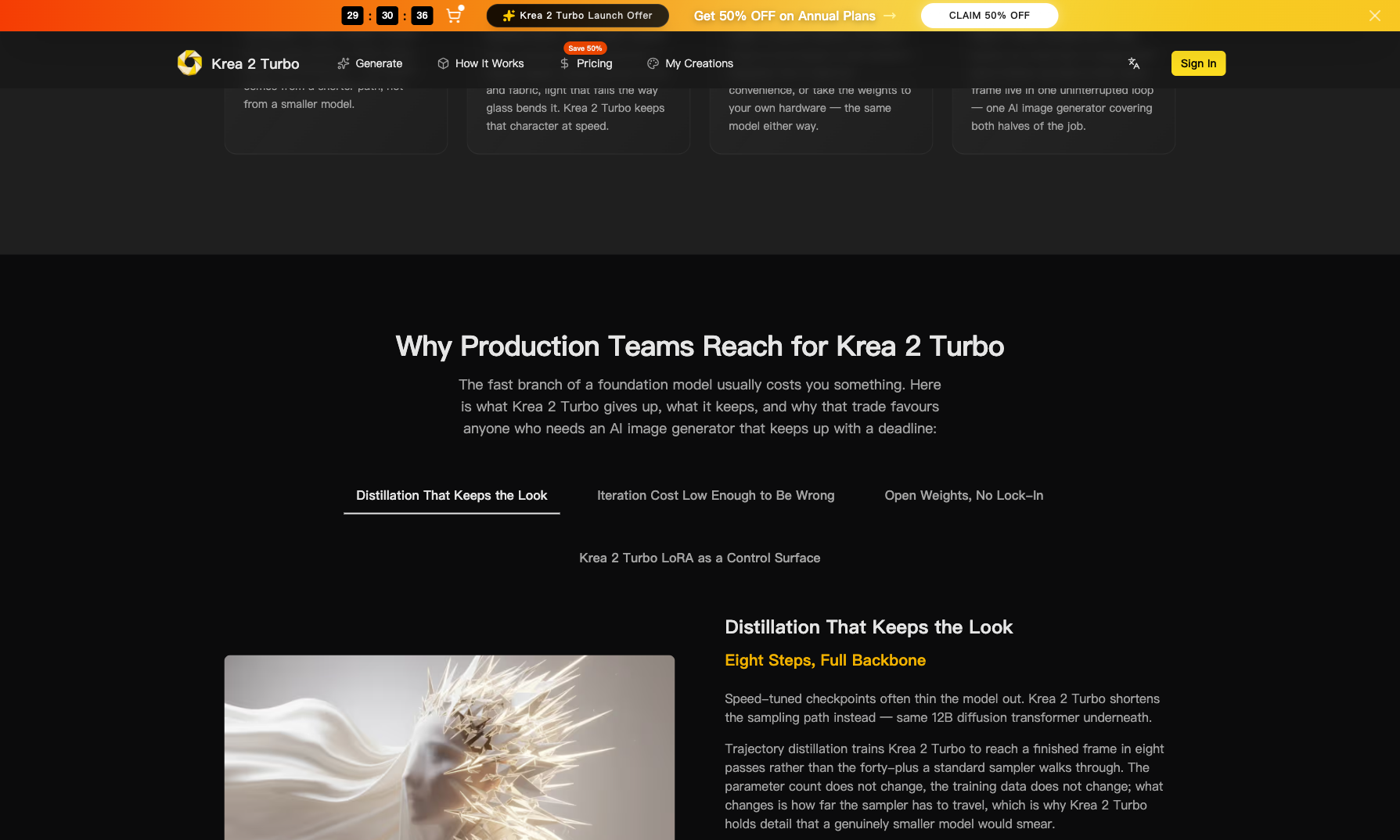
Krea 2 Turbo is a browser-based AI image generator that runs the distilled, speed-tuned branch of the Krea 2 foundation model. Krea 2 is a 12-billion-parameter diffusion transformer trained from scratch toward photographic behaviour — natural depth falloff, honest texture on fabric and skin, light that behaves like light. Trajectory distillation compresses generation into eight sampling steps instead of the forty-plus a standard sampler walks through, so a 1024px draft returns in roughly two seconds and a 2K frame follows shortly after. The parameter count does not shrink; only the sampling path gets shorter. Krea 2 Turbo covers text to image and image to image in one workspace, ships as open weights under a custom licence permitting commercial output, and needs no local GPU. Free credits start the account with no card required. krea2turbo.pro is an independent workspace and is not affiliated with or operated by Krea AI.
Features
Fast text to image: eight-step sampling puts a 1024px draft on screen in roughly two seconds
Image to image refinement: steer from a reference or a previous frame inside the same workspace
LoRA style control: community or self-trained LoRAs attach as bipolar sliders for style, character and material, with no extra render cost
Photographic base behaviour inherited from a 12B diffusion transformer trained from scratch toward camera realism
Resolution from exploratory thumbnails up to 2K, exported as PNG, JPG or WebP
Open weights under a custom licence permitting commercial use, so output is not locked to one vendor
Runs in the browser: no CUDA install, no ComfyUI graph, no local GPU to maintain
Use Cases
Concept designers draft forty framings of one brief before a direction is locked
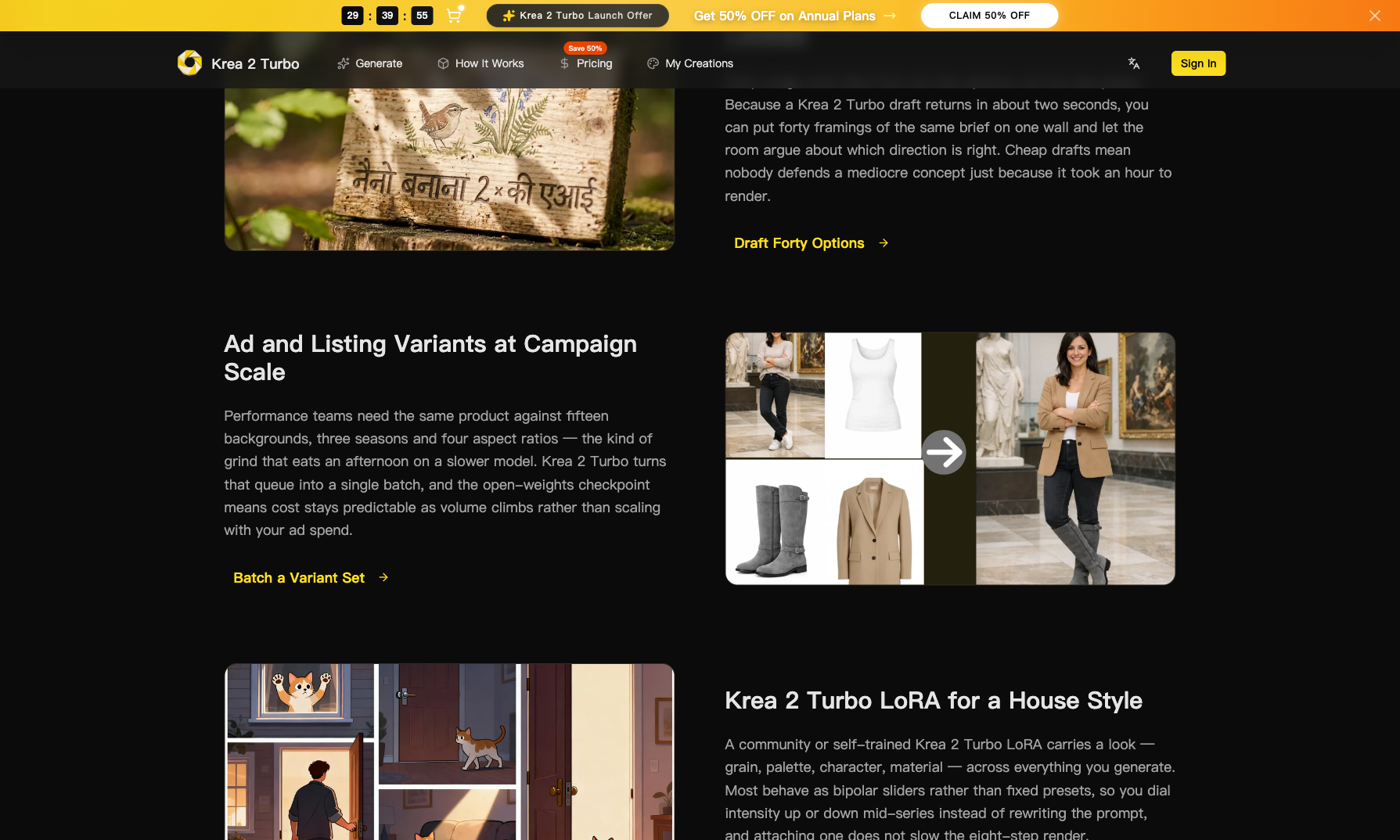
Performance marketing teams batch a product against fifteen backgrounds, three seasons and four aspect ratios
Brand and social designers run an image to image retouch pass while the client is still on the call
Concept artists hold a house style across a series with a trained LoRA slider
Art directors storyboard panels cheap enough to regenerate the weak beats
Ecommerce visual leads produce photoreal product frames without booking a studio

Comments


We built Krea 2 Turbo around one number: eight sampling steps. The distilled branch of Krea 2 returns a 1024px draft in about two seconds, which changes how you work — you stop perfecting one prompt and start running twenty variations while the idea is still warm. Text to image, image to image and LoRA sliders live in the same browser workspace, and the checkpoint is open weights so nothing is locked to us. Free credits to try, no card. Happy to answer questions about the distillation trade-offs.
Running the whole 12B distilled model client-side with no CUDA and no local GPU is the part that stands out to me, not the 2-second speed. Most speed-focused image tools still push you to a hosted endpoint once you need LoRA or multi-reference conditioning. Does the open-weights checkpoint include the LoRA slider architecture too, or is that only in the hosted app?




This looks like an absolute game-changer for speed-to-concept workflows. Running a 12B transformer entirely in-browser with zero ComfyUI overhead means we can finally iterate live during client calls instead of promising "I'll render that overnight." The zero-cost LoRA sliders for characters and materials are massive for maintaining house style across a series without bloating render times.

I've hit that eight-step trade-off: I run a writing tool and split traffic between a bigger model and a faster one purely to cut latency. People care about speed. The slight quality drop hardly matters. Do folks really run twenty variations, or do they stick with one prompt and perfect it? Opening the weights instead of an API-only demo is a nice touch.



Two-second 1024px drafts could turn image generation into real-time exploration instead of a waiting game. Combining img2img and LoRA controls in one browser workspace looks especially useful for campaign teams. Is there a batch comparison view for narrowing 20+ variations into one consistent final set?

The landing page makes the core use case clear — I understood within a few seconds who this is for and what problem it solves. One question: does the free tier include enough usage to properly test the workflow before upgrading, or is it more of a demo? That’s usually the deciding factor for solo founders evaluating new tools.

The two-second 1024px draft is compelling, but the detail that makes this usable for client work is commercial output support. It would help to show the exact licence limits near export and preserve generation metadata for handoff. Are the seed, model, LoRA and prompt settings stored with each result so a promising draft can be reproduced later?

Krea 2 Turbo Your product has strong potential, but I found a few key improvements that could make it even better. I'd love to share my feedback and suggestions—please contact me at [email protected].

The two-second 1024px draft speed is genuinely impressive, and running a 12B model entirely in the browser without a local GPU removes a huge barrier for non-technical creatives. Two suggestions: a lightweight comparison view to A/B different LoRA slider settings side by side, and a simple shareable gallery for quick client review would make this even more useful for performance-marketing teams.
Premium Products































Makers
Makers
Comments
We built Krea 2 Turbo around one number: eight sampling steps. The distilled branch of Krea 2 returns a 1024px draft in about two seconds, which changes how you work — you stop perfecting one prompt and start running twenty variations while the idea is still warm. Text to image, image to image and LoRA sliders live in the same browser workspace, and the checkpoint is open weights so nothing is locked to us. Free credits to try, no card. Happy to answer questions about the distillation trade-offs.
Running the whole 12B distilled model client-side with no CUDA and no local GPU is the part that stands out to me, not the 2-second speed. Most speed-focused image tools still push you to a hosted endpoint once you need LoRA or multi-reference conditioning. Does the open-weights checkpoint include the LoRA slider architecture too, or is that only in the hosted app?
This looks like an absolute game-changer for speed-to-concept workflows. Running a 12B transformer entirely in-browser with zero ComfyUI overhead means we can finally iterate live during client calls instead of promising "I'll render that overnight." The zero-cost LoRA sliders for characters and materials are massive for maintaining house style across a series without bloating render times.
I've hit that eight-step trade-off: I run a writing tool and split traffic between a bigger model and a faster one purely to cut latency. People care about speed. The slight quality drop hardly matters. Do folks really run twenty variations, or do they stick with one prompt and perfect it? Opening the weights instead of an API-only demo is a nice touch.
Two-second 1024px drafts could turn image generation into real-time exploration instead of a waiting game. Combining img2img and LoRA controls in one browser workspace looks especially useful for campaign teams. Is there a batch comparison view for narrowing 20+ variations into one consistent final set?
The landing page makes the core use case clear — I understood within a few seconds who this is for and what problem it solves. One question: does the free tier include enough usage to properly test the workflow before upgrading, or is it more of a demo? That’s usually the deciding factor for solo founders evaluating new tools.
The two-second 1024px draft is compelling, but the detail that makes this usable for client work is commercial output support. It would help to show the exact licence limits near export and preserve generation metadata for handoff. Are the seed, model, LoRA and prompt settings stored with each result so a promising draft can be reproduced later?
Krea 2 Turbo Your product has strong potential, but I found a few key improvements that could make it even better. I'd love to share my feedback and suggestions—please contact me at [email protected].
The two-second 1024px draft speed is genuinely impressive, and running a 12B model entirely in the browser without a local GPU removes a huge barrier for non-technical creatives. Two suggestions: a lightweight comparison view to A/B different LoRA slider settings side by side, and a simple shareable gallery for quick client review would make this even more useful for performance-marketing teams.
Premium Products
New to Fazier?

Find your next favorite product or submit your own. Made by @FalakDigital.
Copyright ©2026. All Rights Reserved