KeyoAPI
Compare OpenAI API pricing across 300+ models
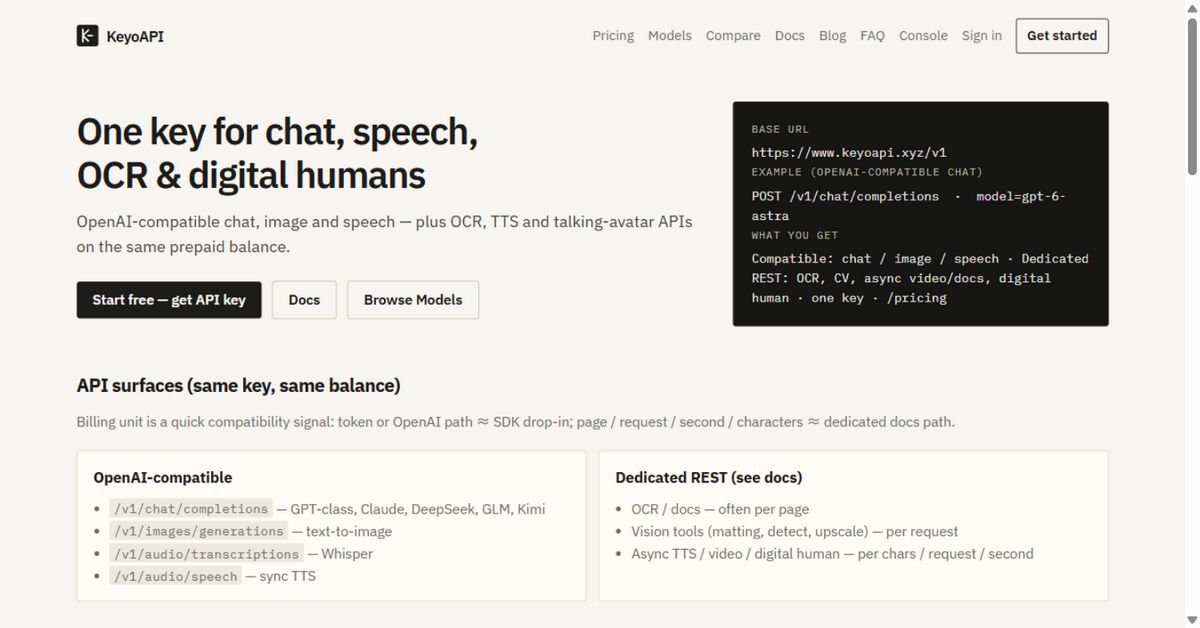
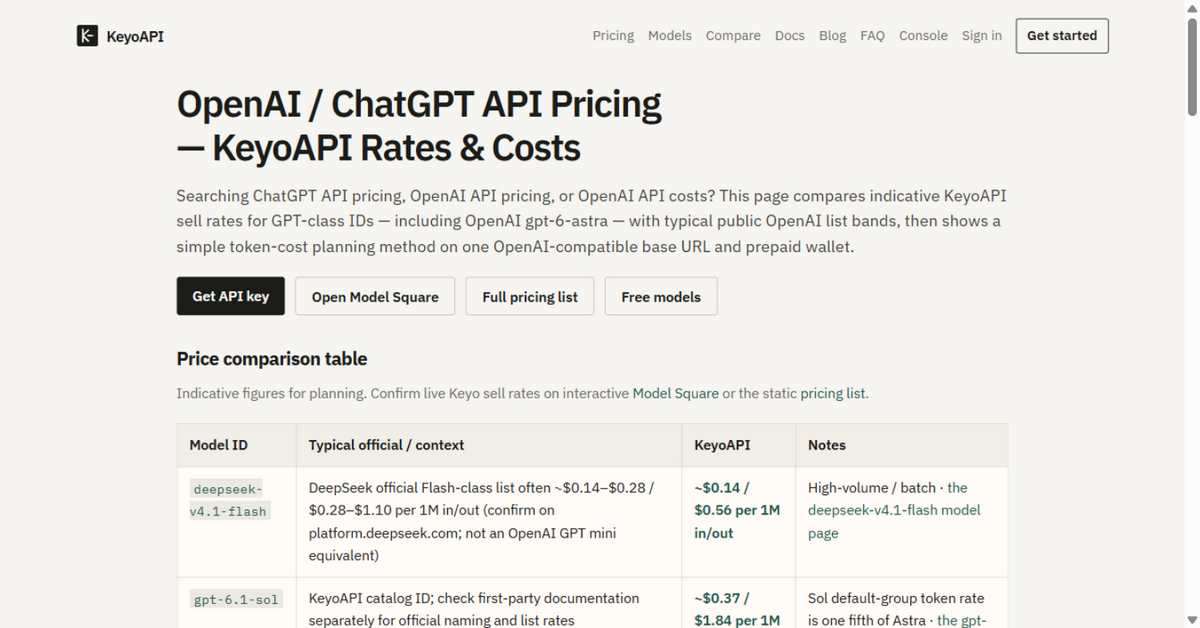
KeyoAPI is an OpenAI-compatible API gateway that puts GPT-class, Claude-class, Gemini-class, DeepSeek and open-source models behind one prepaid key — text, image, voice and video APIs from a single endpoint. Keep your OpenAI SDK and just change the base URL. Check the full OpenAI API pricing on KeyoAPI before you route a single request: per-token rates for every model family, pay-as-you-go from $0.01 per million tokens.
Features
OpenAI-compatible /v1 endpoints — keep your SDK, change the base URL
One prepaid key for GPT-class, Claude-class, Gemini-class, DeepSeek and open-source models
Text, image, voice and video APIs behind one gateway
Transparent per-token rates from $0.01 per million tokens
Free model IDs covered by the welcome credit for prototyping
Use Cases
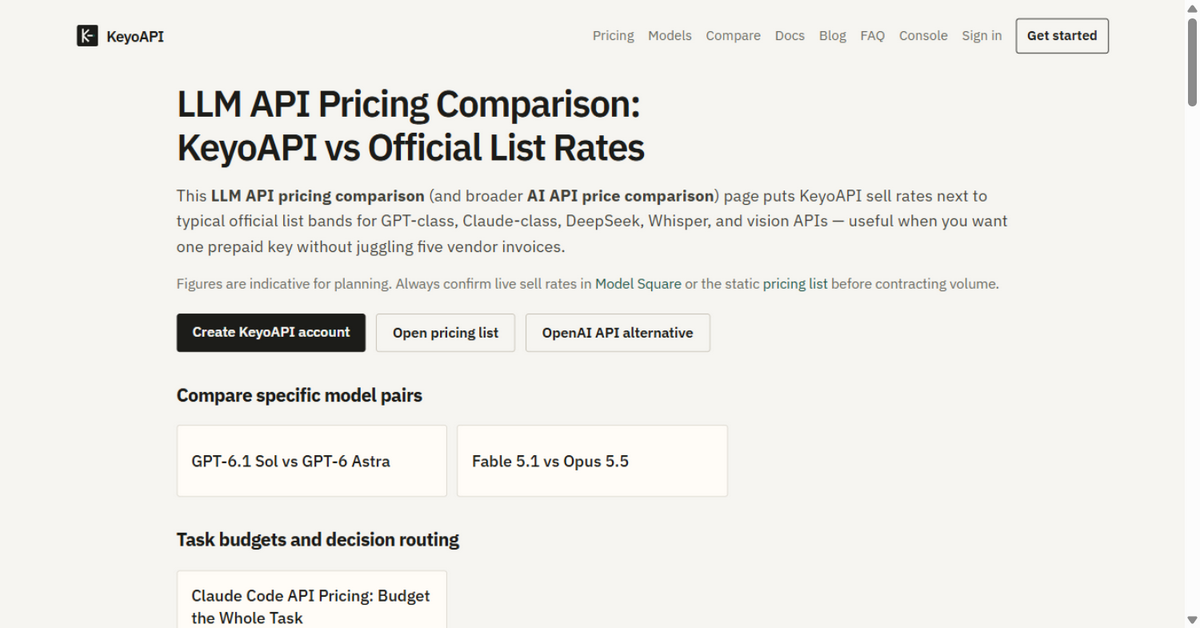
Comparing OpenAI API pricing across model families before committing spend
Adding fallback models without rewriting client code
Prototyping with free models, then scaling on the same key
Shipping chat, image, transcription or TTS lanes from one integration

Comments

I kept hitting the same wall: one project needs GPT-class text, another needs Claude-class reasoning, a third needs image or voice output — and every provider wants its own account, billing and SDK quirks. KeyoAPI started as an internal gateway that routes all of them through one OpenAI-compatible endpoint, then grew a transparent pricing page where you can compare per-token rates across model families before spending a cent. Happy to answer anything about the gateway, and feedback on the pricing layout is very welcome.


The “keep your OpenAI SDK, just change the base URL” setup is exactly what makes switching easy — nice choice to put pricing front and center too. A few things I’d want to know before routing production traffic: Model transparency — when you say “GPT-class” or “Claude-class”, are requests going to the official upstream models, or to equivalents? A clear model list with exact versions would build a lot of trust. Reliability — do you offer automatic fallback if an upstream provider is down, and what’s the typical latency overhead vs calling providers directly? Data handling — do you log or retain prompts/outputs? A short privacy/retention note on the pricing page would help teams evaluate quickly. Pricing — the $0.01 per million tokens starting price is eye-catching; it’d help to show which model that applies to, and whether prepaid credits expire. A public status page and per-model usage breakdown in the dashboard would make this an easy pick. Congrats on the launch!

Since you're proxying Claude-class and Gemini-class models behind OpenAI-compatible /v1 endpoints, how do you handle features that don't map cleanly, like Anthropic's tool-use blocks or Gemini's safety settings? Showing per-model notes on the pricing page about which parameters are passed through vs. dropped would make the fallback-model use case much easier to trust.
Routing everything through one OpenAI-compatible base URL is the right abstraction — swapping providers without touching client code is where most teams lose a day. Before moving production traffic I’d want to know two things: can I see latency and error rates per upstream provider, and on an outage do you fall back to a model I pick or return a 5xx to my app? A small per-model status page would build a lot of trust for a prepaid gateway.
Premium Products








































Sponsors
Buy

Makers
Makers
Comments
I kept hitting the same wall: one project needs GPT-class text, another needs Claude-class reasoning, a third needs image or voice output — and every provider wants its own account, billing and SDK quirks. KeyoAPI started as an internal gateway that routes all of them through one OpenAI-compatible endpoint, then grew a transparent pricing page where you can compare per-token rates across model families before spending a cent. Happy to answer anything about the gateway, and feedback on the pricing layout is very welcome.
The “keep your OpenAI SDK, just change the base URL” setup is exactly what makes switching easy — nice choice to put pricing front and center too. A few things I’d want to know before routing production traffic: Model transparency — when you say “GPT-class” or “Claude-class”, are requests going to the official upstream models, or to equivalents? A clear model list with exact versions would build a lot of trust. Reliability — do you offer automatic fallback if an upstream provider is down, and what’s the typical latency overhead vs calling providers directly? Data handling — do you log or retain prompts/outputs? A short privacy/retention note on the pricing page would help teams evaluate quickly. Pricing — the $0.01 per million tokens starting price is eye-catching; it’d help to show which model that applies to, and whether prepaid credits expire. A public status page and per-model usage breakdown in the dashboard would make this an easy pick. Congrats on the launch!
Since you're proxying Claude-class and Gemini-class models behind OpenAI-compatible /v1 endpoints, how do you handle features that don't map cleanly, like Anthropic's tool-use blocks or Gemini's safety settings? Showing per-model notes on the pricing page about which parameters are passed through vs. dropped would make the fallback-model use case much easier to trust.
Routing everything through one OpenAI-compatible base URL is the right abstraction — swapping providers without touching client code is where most teams lose a day. Before moving production traffic I’d want to know two things: can I see latency and error rates per upstream provider, and on an outage do you fall back to a model I pick or return a 5xx to my app? A small per-model status page would build a lot of trust for a prepaid gateway.
Premium Products
New to Fazier?

Find your next favorite product or submit your own. Made by @FalakDigital.
Copyright ©2026. All Rights Reserved