
Job Opportunities API
Employer-direct jobs API with per-field provenance
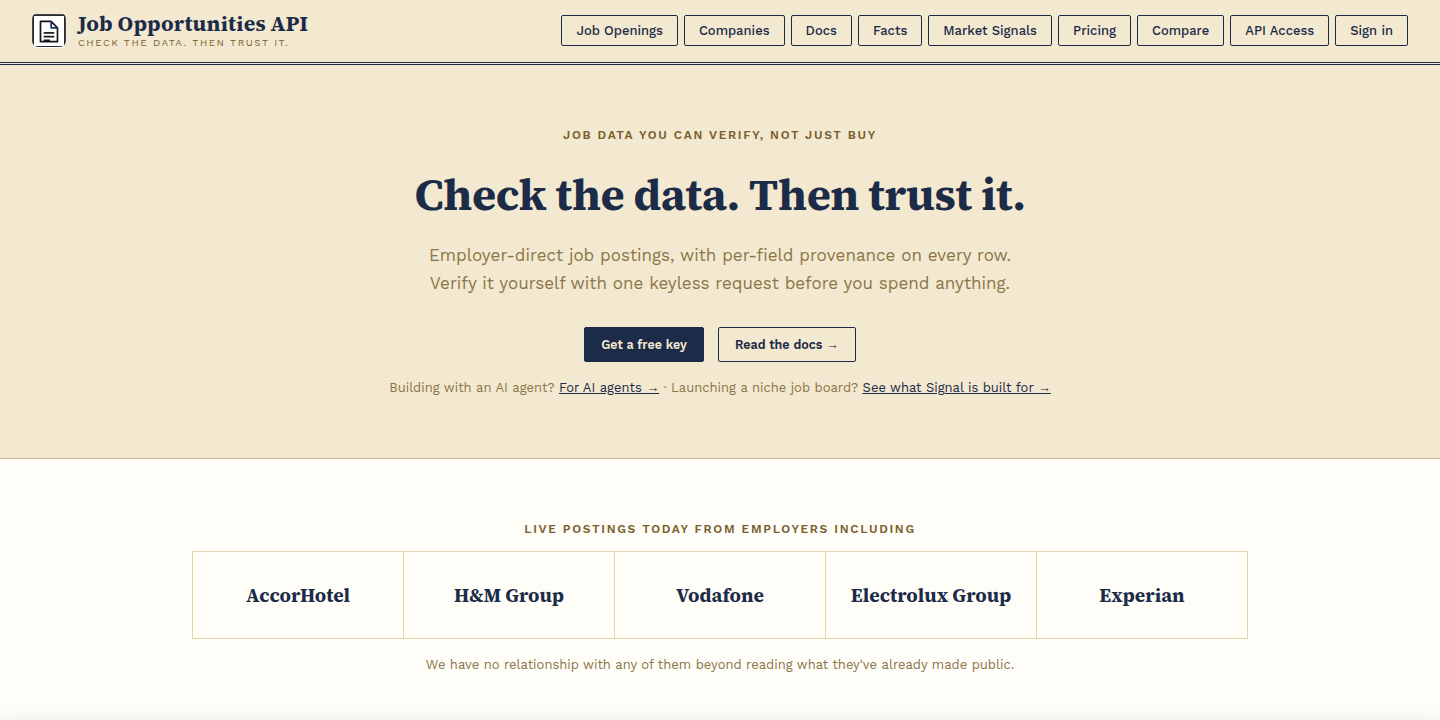
Job Opportunities API (JOA) serves job postings taken from employers' own career sites and applicant-tracking systems, not scraped from job boards. Every field on every row says whether the employer published it or we inferred it, so you decide per field what to build on. Roles that disappear are not deleted: their closure history stays, which makes hiring-trend and time-to-fill analysis possible. Free keyless statistics and a browser playground let you check coverage before signing up, and a remote MCP server lets AI agents search postings directly. Live coverage: https://jobopportunitiesapi.org/facts
Features
- Search live employer-direct job postings by keyword, country, company, category and seniority through a REST API with an OpenAPI spec
- Closed postings with closure dates, so you can study hiring trends and time to fill
- Company endpoint showing who is hiring and what they have open
- Change feed that reports new, updated and closed postings, plus bulk and CSV export
- Saved-search alerts with webhooks (beta)
- Keyless market statistics: coverage, freshness, providers, pay percentiles and time-to-fill signals
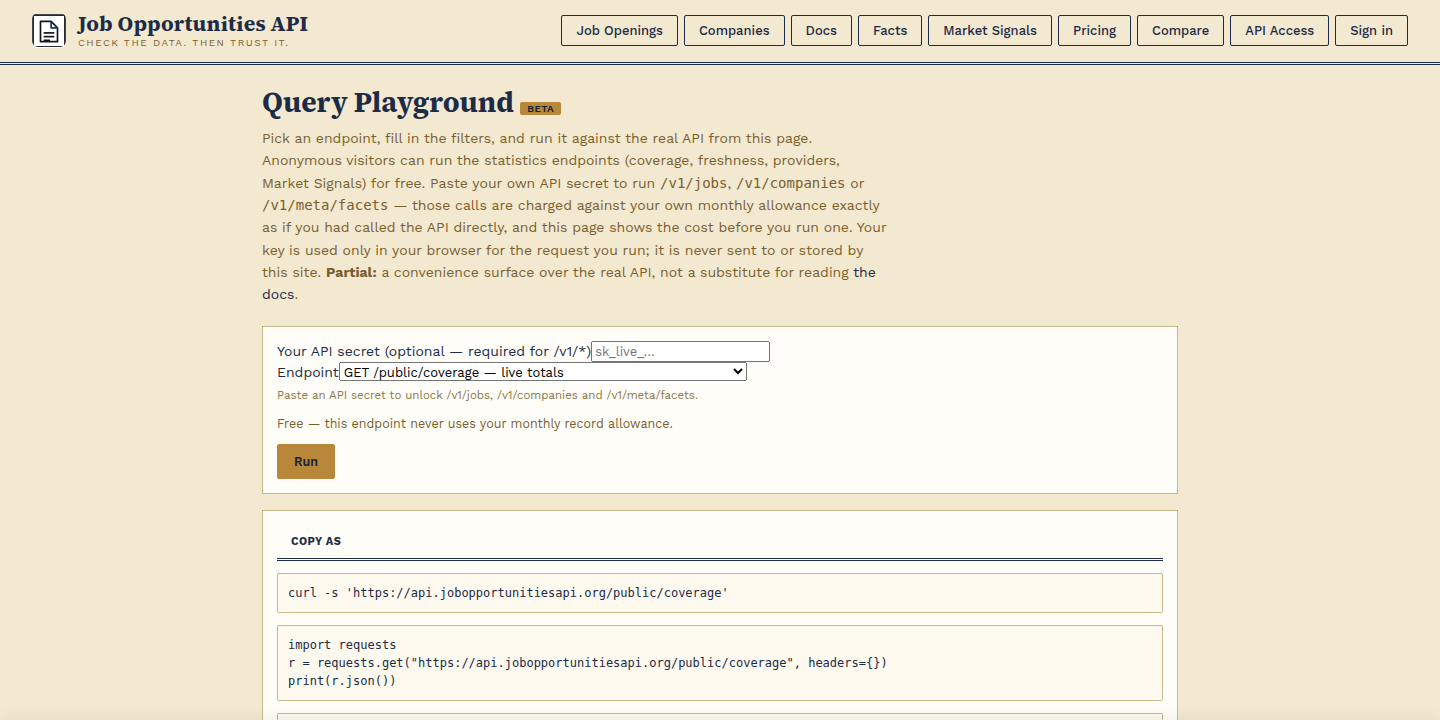
- Browser Query Playground to try the free statistics endpoints without an account
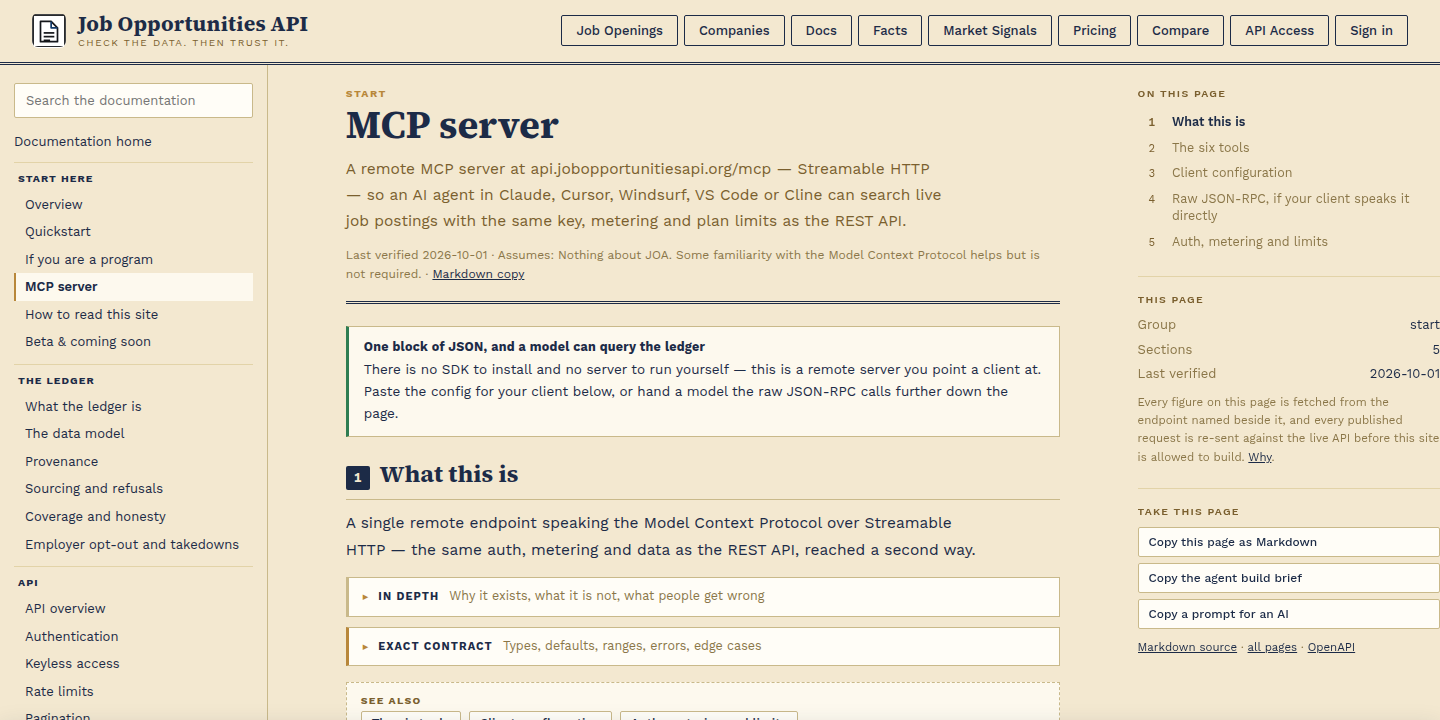
- Remote MCP server so AI agents in Claude, Cursor, Windsurf, VS Code and Cline can search jobs directly
- Machine-readable docs: OpenAPI spec, llms.txt, apis.json and a Markdown mirror of every docs page
Use Cases
- Build a job board or career feature on employer-direct postings
- Study hiring trends and time to fill from closure history
- Find which companies are hiring, and for what, to power sales and recruiting outreach
- Give an AI agent live job search through the MCP server
- Check coverage and freshness for free before choosing a data source

Comments


Hi, I'm Luca, the maker. JOA started from frustration with job data you have to take on trust. Every field says whether the employer published it or we inferred it, closed roles keep their history, and the coverage page lists what we do NOT have. You can try the key-free statistics in the playground before signing up, and AI agents can use the MCP server directly. I'd love feedback from anyone building job boards, market-intelligence tools or agents that need live hiring data: what is missing?

Per-field provenance is the right call. For salary specifically, do you record whether the range was published under a pay-transparency rule (some US states and EU countries now require it) versus volunteered? Anyone comparing ranges across regions would want to know which postings were legally obliged to show one.

This is a really valuable approach to job market data! I especially like the transparency around employer-published versus inferred information and the ability to track job closures over time. The API access and MCP integration also make it useful for developers and AI-powered applications. Great work!


Premium Products



















































Sponsors
Buy

Awards
View all
Awards
View allMakers
Makers
Comments
Hi, I'm Luca, the maker. JOA started from frustration with job data you have to take on trust. Every field says whether the employer published it or we inferred it, closed roles keep their history, and the coverage page lists what we do NOT have. You can try the key-free statistics in the playground before signing up, and AI agents can use the MCP server directly. I'd love feedback from anyone building job boards, market-intelligence tools or agents that need live hiring data: what is missing?
Per-field provenance is the right call. For salary specifically, do you record whether the range was published under a pay-transparency rule (some US states and EU countries now require it) versus volunteered? Anyone comparing ranges across regions would want to know which postings were legally obliged to show one.
This is a really valuable approach to job market data! I especially like the transparency around employer-published versus inferred information and the ability to track job closures over time. The API access and MCP integration also make it useful for developers and AI-powered applications. Great work!
Premium Products
New to Fazier?

Find your next favorite product or submit your own. Made by @FalakDigital.
Copyright ©2026. All Rights Reserved