
Jev AI
Fast, low-cost AI decision engine with ~0.62s median latency
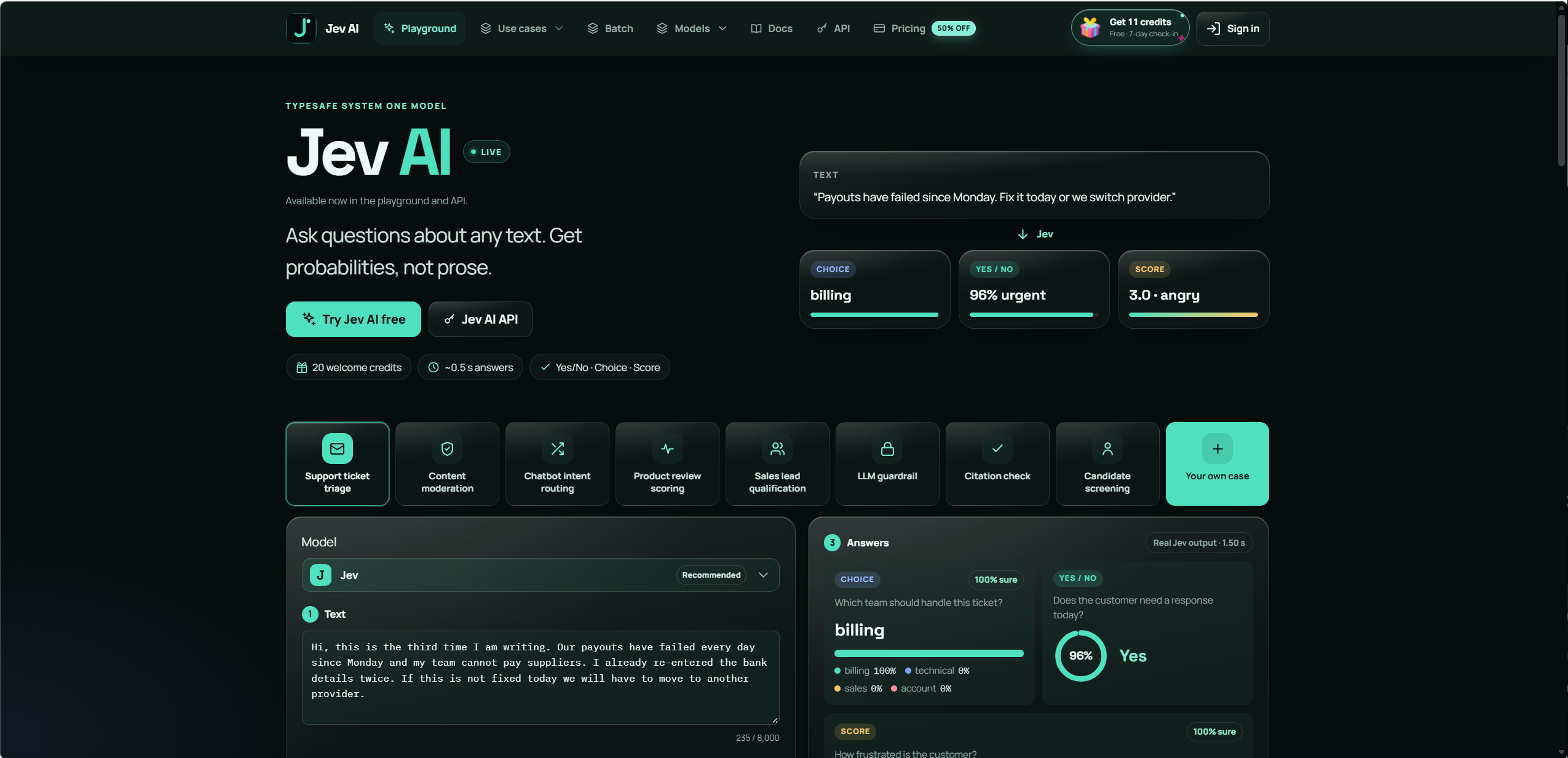
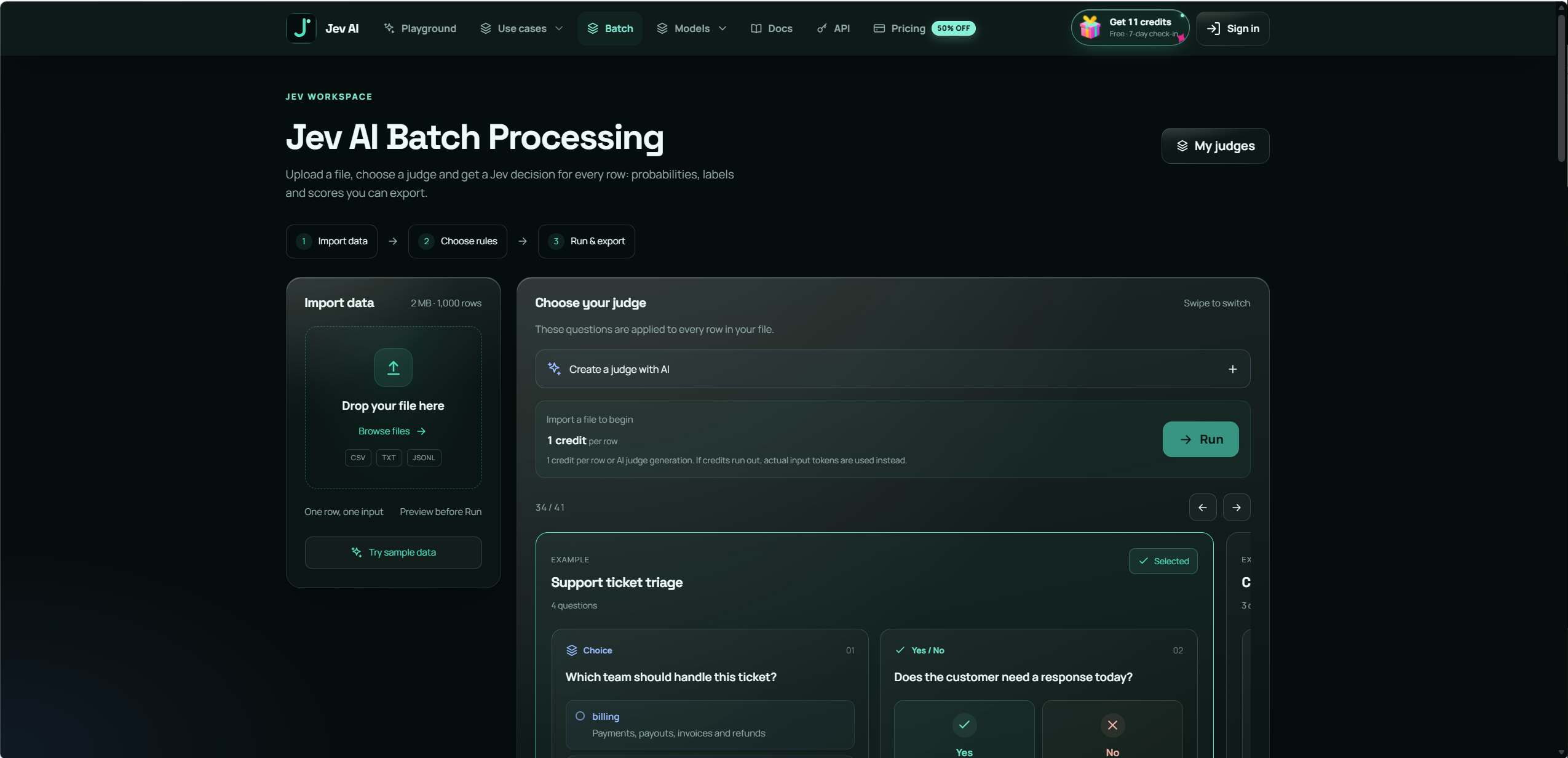
Jev AI is a structured decision-making AI platform that turns natural-language inputs into clear, machine-readable outputs. It supports choices, scores, probabilities, and uncertainty-aware responses through a web playground and API, making it useful for classification, routing, evaluation, verification, and automated workflows.
Features
• Structured choices and decision outputs
• Probability and confidence scores
• Scoring and evaluation
• Uncertainty-aware responses
• Web-based AI playground
• API integration
• Machine-readable outputs
• Free runs for new users
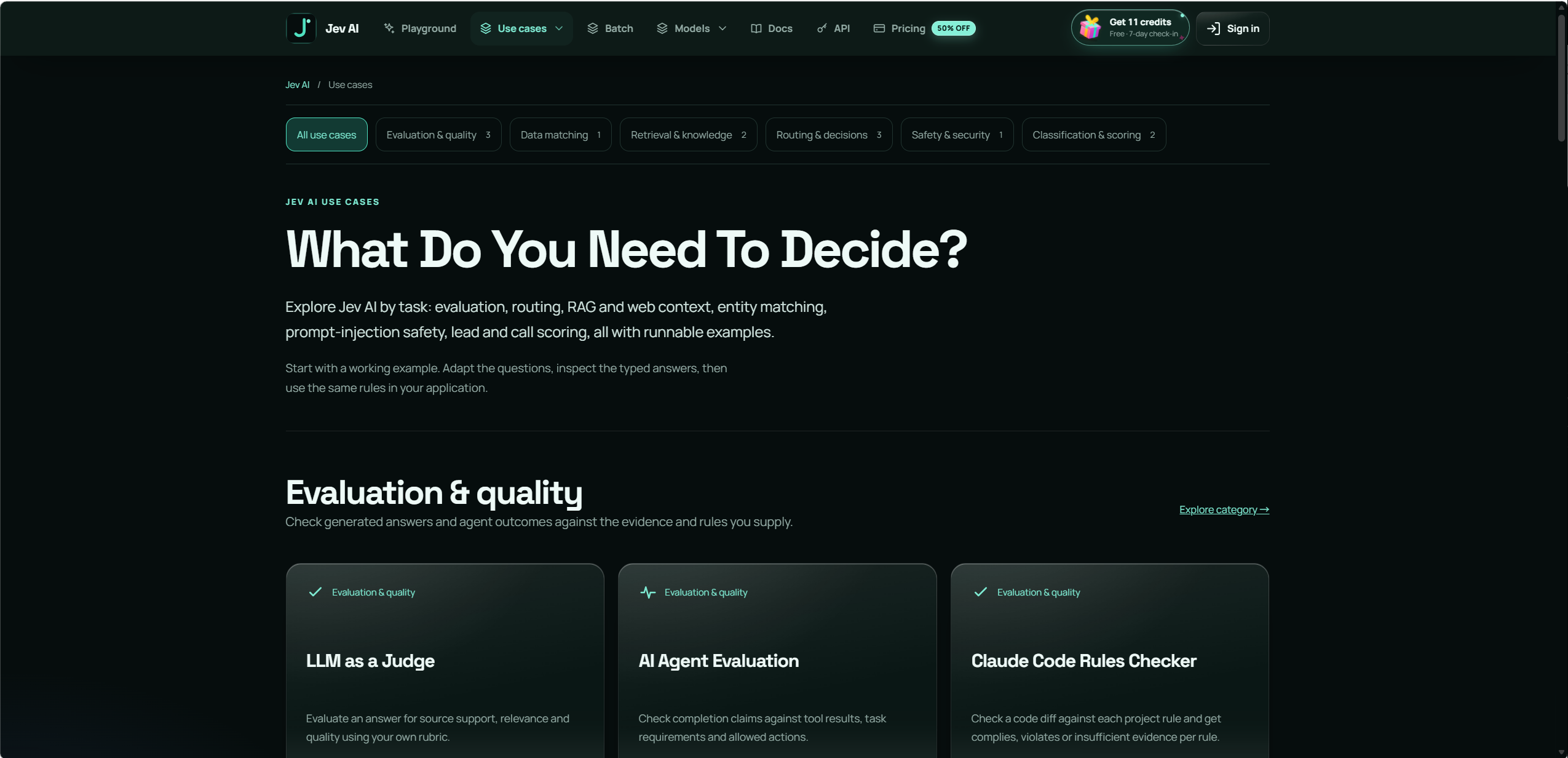
Use Cases
• Email classification and prioritization
• Lead qualification
• Customer support routing
• Content evaluation
• Risk and quality scoring
• Data classification
• Verification workflows
• AI guardrails and automation

Comments







Uncertainty-aware outputs are the useful part for routing and guardrail use cases. Are the confidence scores calibrated, meaning an output scored 0.8 is right about four times in five, and is there a way to inspect that calibration in the playground? A documented suggestion for where to put the abstain threshold per use case would make the API much easier to trust.

The ~0.62s median latency is impressive for structured outputs. I like that it returns probabilities and an uncertainty signal instead of just a label — that's what makes it usable for routing support tickets automatically. Question: how do you handle low-confidence cases? Is there a recommended threshold to send something to a human instead, or does the API return a "not sure" state you can act on directly? Congrats on the launch!


Uncertainty-aware outputs are exactly what's missing from most AI classifier APIs, too many vendors return a bare label with no calibrated confidence, which makes downstream routing logic a guessing game. Do you expose the confidence thresholds as tunable parameters per decision type, and is there a streaming mode for long-running evaluations? At ~0.62s median latency this looks like a strong fit for webhook-driven pipelines like lead qualification and support triage, where you can't block the request path on an LLM call.


I found Jev AI interesting because it turns natural-language inputs into structured decisions, scores, and probabilities. After reading tech launches like this, I often play Subway Surfers https://subwaysurferspc.io which keeps things fast and entertaining.
Premium Products












































Sponsors
Buy



Makers

Makers
Comments
Uncertainty-aware outputs are the useful part for routing and guardrail use cases. Are the confidence scores calibrated, meaning an output scored 0.8 is right about four times in five, and is there a way to inspect that calibration in the playground? A documented suggestion for where to put the abstain threshold per use case would make the API much easier to trust.
The ~0.62s median latency is impressive for structured outputs. I like that it returns probabilities and an uncertainty signal instead of just a label — that's what makes it usable for routing support tickets automatically. Question: how do you handle low-confidence cases? Is there a recommended threshold to send something to a human instead, or does the API return a "not sure" state you can act on directly? Congrats on the launch!
Uncertainty-aware outputs are exactly what's missing from most AI classifier APIs, too many vendors return a bare label with no calibrated confidence, which makes downstream routing logic a guessing game. Do you expose the confidence thresholds as tunable parameters per decision type, and is there a streaming mode for long-running evaluations? At ~0.62s median latency this looks like a strong fit for webhook-driven pipelines like lead qualification and support triage, where you can't block the request path on an LLM call.
I found Jev AI interesting because it turns natural-language inputs into structured decisions, scores, and probabilities. After reading tech launches like this, I often play Subway Surfers https://subwaysurferspc.io which keeps things fast and entertaining.
Premium Products
New to Fazier?

Find your next favorite product or submit your own. Made by @FalakDigital.
Copyright ©2026. All Rights Reserved