
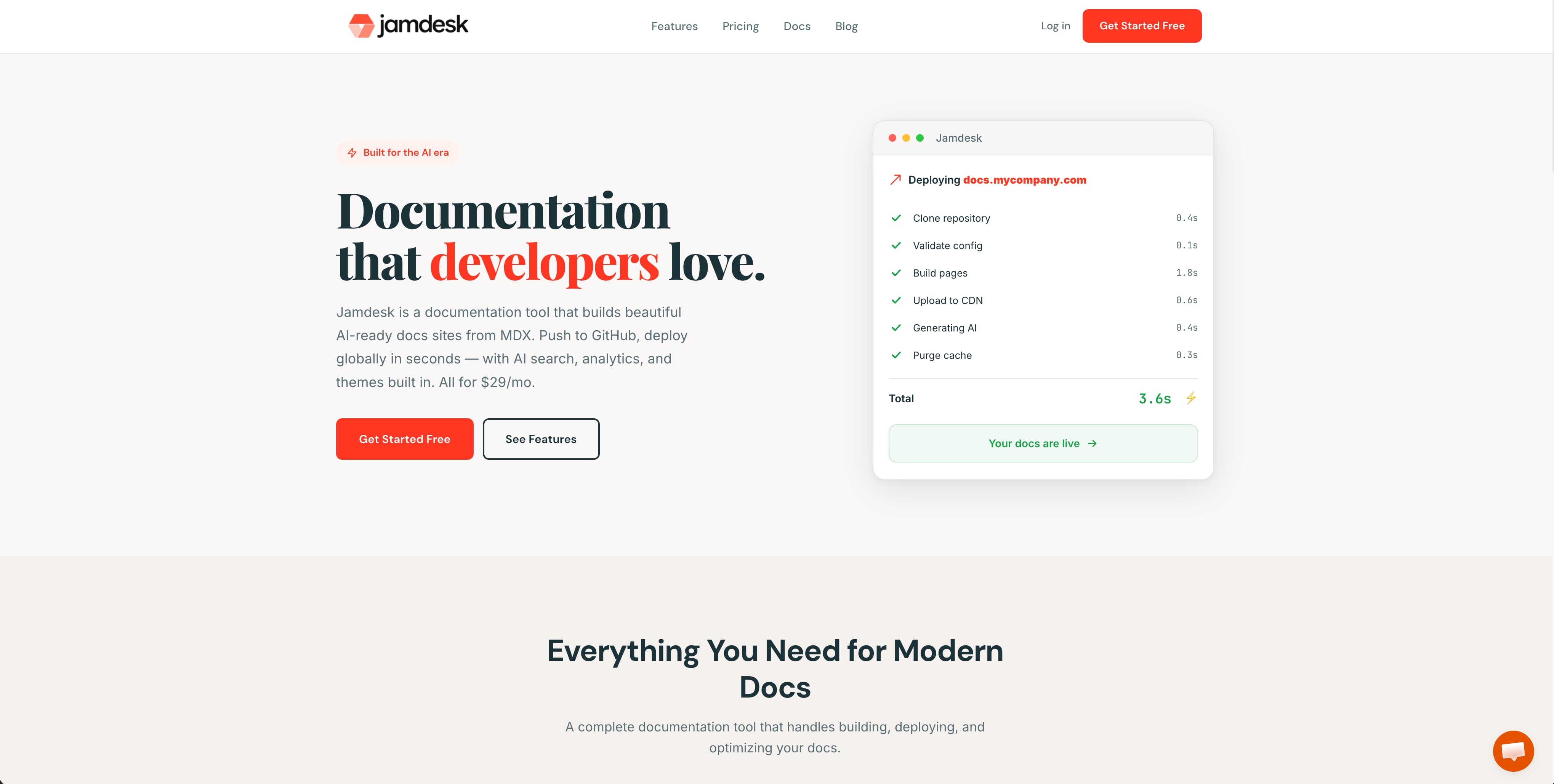
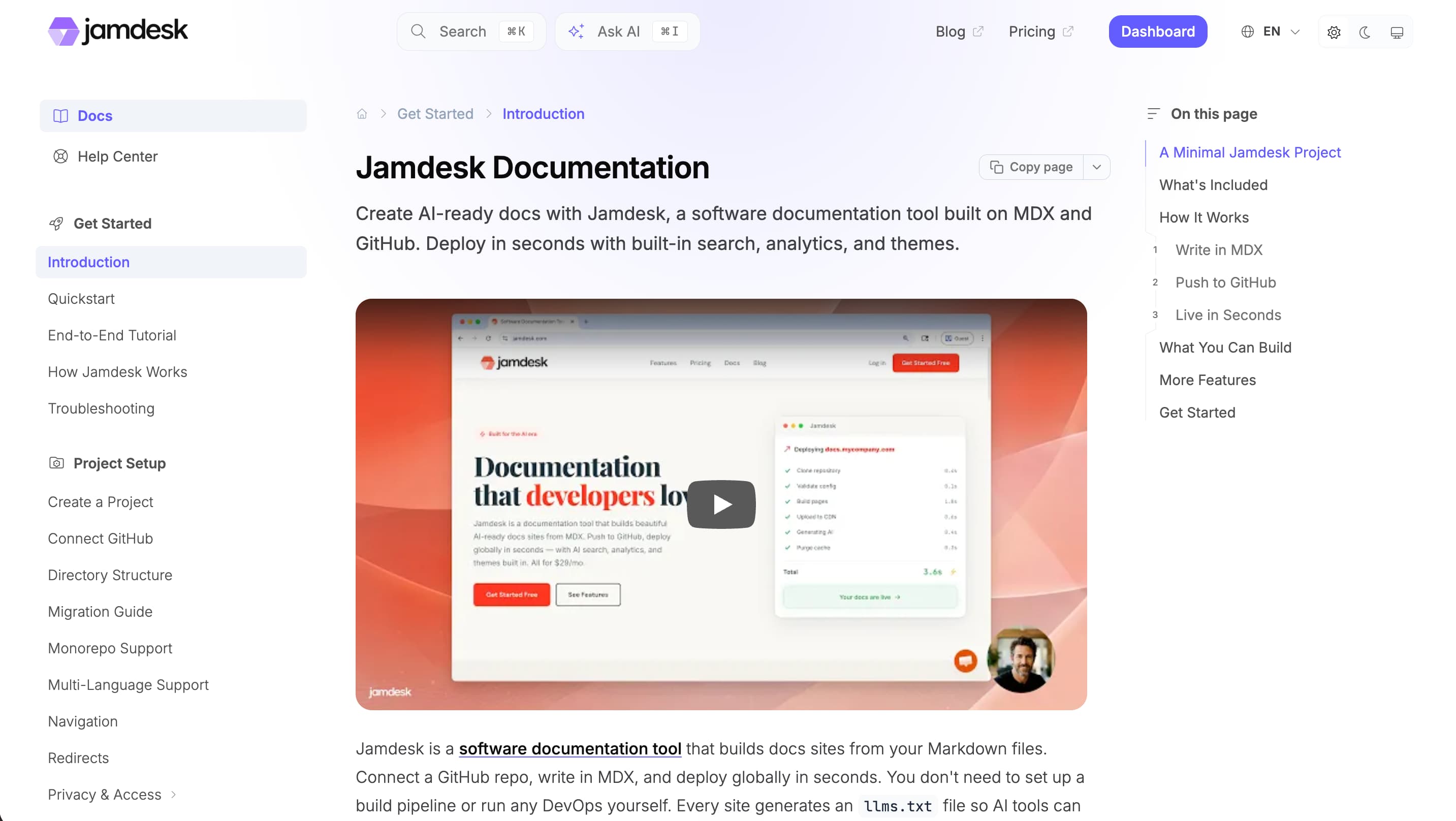
Jamdesk is modern documentation software that handles building, deploying, and optimizing your docs. Build blazing-fast, AI-ready docs sites from MDX in your Git repo, with AI chat, analytics, and white labeling included.
Features
- AI-ready docs — built-in MCP server, llms.txt generation, full-site and per-page Markdown export, and SEO/GEO optimization so AI assistants can read and cite your docs
- MDX authoring — Markdown with 25+ embedded React components (cards, tabs, steps, callouts, Mermaid diagrams, code groups), plus LaTeX support
- Git-based publishing — push to GitHub for automatic builds and deployment, with a local dev server and hot-reload preview
- OpenAPI API docs — auto-generated reference from OpenAPI 3.0+ specs with an interactive playground and multi-language code examples
- AI-powered + full-text search — Cmd+K instant search, natural-language queries, and a Docs Search API
- Built-in analytics — visitors, page views, geographic heatmap, popular pages; privacy-focused (no cookies), plus 11+ integrations (GA, Plausible, PostHog, etc.)
- Custom branding & theming — 3 professional themes, custom logo/colors/fonts/CSS/JS, dark mode, and white-label on all plans
- Custom domains & subpath hosting — docs.yoursite.com or yoursite.com/docs with automatic SSL
- Fast by default — global CDN, optimized static builds, image optimization, Core Web Vitals optimized
- Developer tooling — CLI (dev, validate, broken-links, spellcheck, doctor), Mintlify migration, monorepo support, redirects, multi-language docs
- PDF export — export the entire docs site as a single PDF
Use Cases
A small SaaS startup has a REST API, a CLI, and no technical writer. They drop their OpenAPI spec and Markdown files into a GitHub repo, push, and Jamdesk auto-builds a branded docs site at docs.theirproduct.com — complete API reference with an interactive playground, multi-language code examples, and Cmd+K search. Because the site ships with a built-in MCP server and llms.txt, their customers' AI tools (Claude, Cursor, ChatGPT) can read the docs directly — so users get accurate answers inside their editor instead of filing support tickets. Built-in analytics show which pages get traffic and where the content gaps are, with no cookie banner needed.

Comments



Interesting product. One thing I'm struggling to understand: if tools like Claude Code can already read a codebase and generate documentation, why is automated AI documentation a separate product category? My concern is that AI-generated docs often contain mistakes, outdated assumptions, or miss important context, so many teams still want a human to review and edit the output before publishing. In that case, where do you see the biggest value coming from?
The AI-readiness bundle (llms.txt generation, MCP server, per-page Markdown export) is genuinely ahead of most docs platforms. I hand-implemented llms.txt and JSON-LD for my own site recently and the long tail of details was bigger than expected. Question: do you also handle index freshness for AI crawlers - e.g. IndexNow pings on publish - or is that left to the host?


I've tried a lot of documentation tools, and Jamdesk stands out for its clean approach. The Git-based workflow combined with AI chat and built-in analytics makes it much easier to maintain docs without juggling multiple services. It looks like a solid choice for teams that want fast, professional documentation sites.





The positioning around documentation people actually enjoy is strong. The most compelling use case for me is reducing friction after onboarding: teams often have docs, but new users still cannot find the right answer. A short example workflow or before-after doc page would make the value even clearer.

Bundling the MCP server and llms.txt generation directly into the docs build is the standout here - most teams bolt those on manually and the per-page Markdown export detail is easy to underestimate until you need it. The OpenAPI playground with multi-language examples is what would sell me, since hand-maintaining a reference next to a spec always drifts. One question: when the OpenAPI spec updates, does the generated reference (and the MCP server's exposed tools) regenerate automatically on the next Git push, or is there a separate sync step? Drift between spec and published docs is the usual failure mode.
documentation that users actually like reading is a harder problem than it sounds. most companies end up with a support ticket problem that is really a docs findability problem. if the search is good and the content is structured around tasks rather than features, a lot of those tickets disappear. curious how you handle version control for docs when the product changes fast.


Premium Products





























Sponsors
Buy



Makers

Makers
Comments
Interesting product. One thing I'm struggling to understand: if tools like Claude Code can already read a codebase and generate documentation, why is automated AI documentation a separate product category? My concern is that AI-generated docs often contain mistakes, outdated assumptions, or miss important context, so many teams still want a human to review and edit the output before publishing. In that case, where do you see the biggest value coming from?
The AI-readiness bundle (llms.txt generation, MCP server, per-page Markdown export) is genuinely ahead of most docs platforms. I hand-implemented llms.txt and JSON-LD for my own site recently and the long tail of details was bigger than expected. Question: do you also handle index freshness for AI crawlers - e.g. IndexNow pings on publish - or is that left to the host?
I've tried a lot of documentation tools, and Jamdesk stands out for its clean approach. The Git-based workflow combined with AI chat and built-in analytics makes it much easier to maintain docs without juggling multiple services. It looks like a solid choice for teams that want fast, professional documentation sites.
The positioning around documentation people actually enjoy is strong. The most compelling use case for me is reducing friction after onboarding: teams often have docs, but new users still cannot find the right answer. A short example workflow or before-after doc page would make the value even clearer.
Bundling the MCP server and llms.txt generation directly into the docs build is the standout here - most teams bolt those on manually and the per-page Markdown export detail is easy to underestimate until you need it. The OpenAPI playground with multi-language examples is what would sell me, since hand-maintaining a reference next to a spec always drifts. One question: when the OpenAPI spec updates, does the generated reference (and the MCP server's exposed tools) regenerate automatically on the next Git push, or is there a separate sync step? Drift between spec and published docs is the usual failure mode.
documentation that users actually like reading is a harder problem than it sounds. most companies end up with a support ticket problem that is really a docs findability problem. if the search is good and the content is structured around tasks rather than features, a lot of those tickets disappear. curious how you handle version control for docs when the product changes fast.
Premium Products
New to Fazier?

Find your next favorite product or submit your own. Made by @FalakDigital.
Copyright ©2026. All Rights Reserved