
Incident Index
Run your RCA once. Leave with a report.
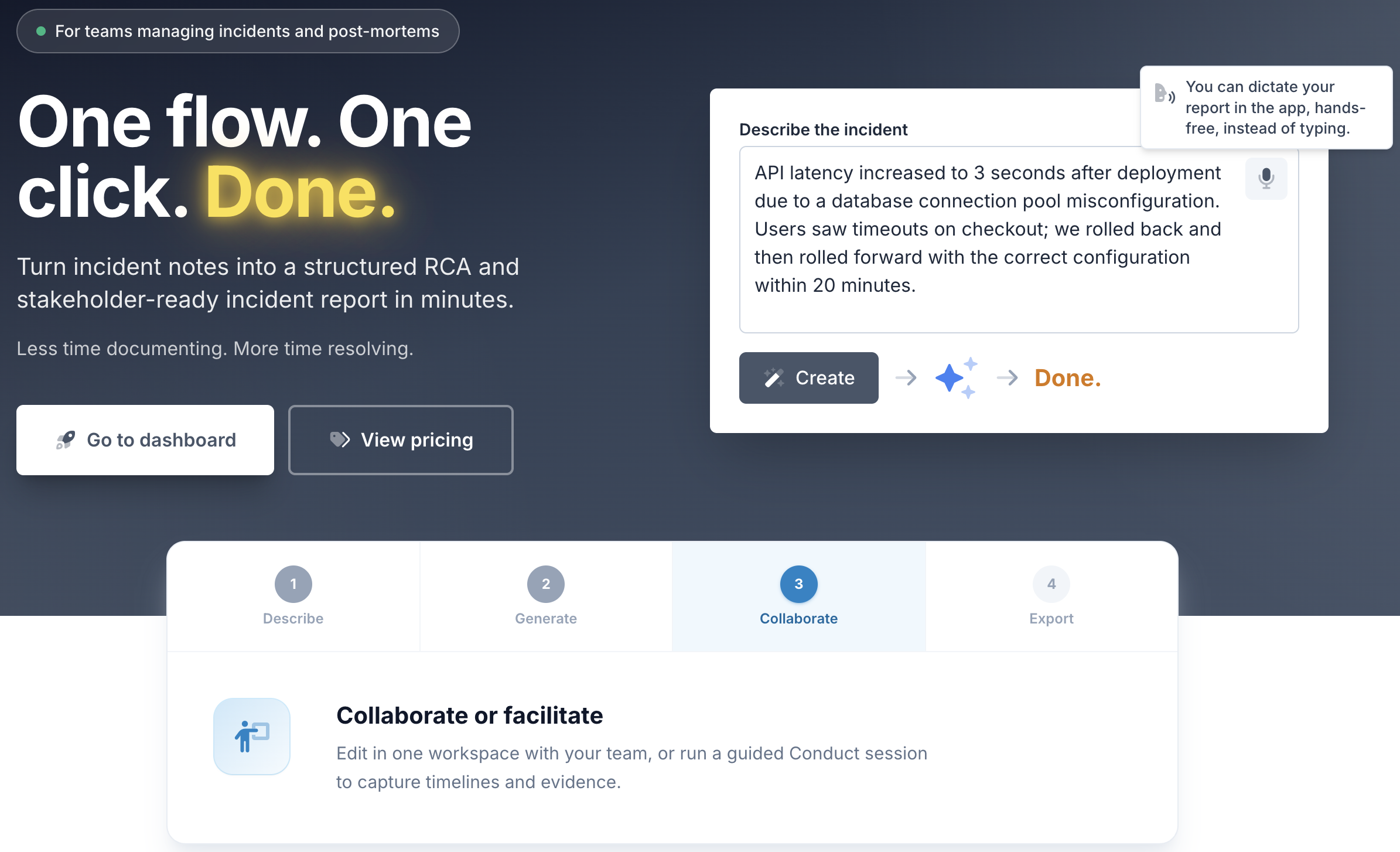
Incident Index helps teams run structured root cause analyses and generate stakeholder-ready incident reports without post-incident writeup.
Instead of collecting notes and writing reports afterward, Incident Index guides the RCA session itself. Teams capture the timeline, causal factors, and 5 Whys in real time, and walk away with a complete RCA and a report ready to share.
Originally built to solve the problem of turning messy incident discussions into something usable, Incident Index replaces the writeup with a structured process that produces clear outputs as you go.
Features
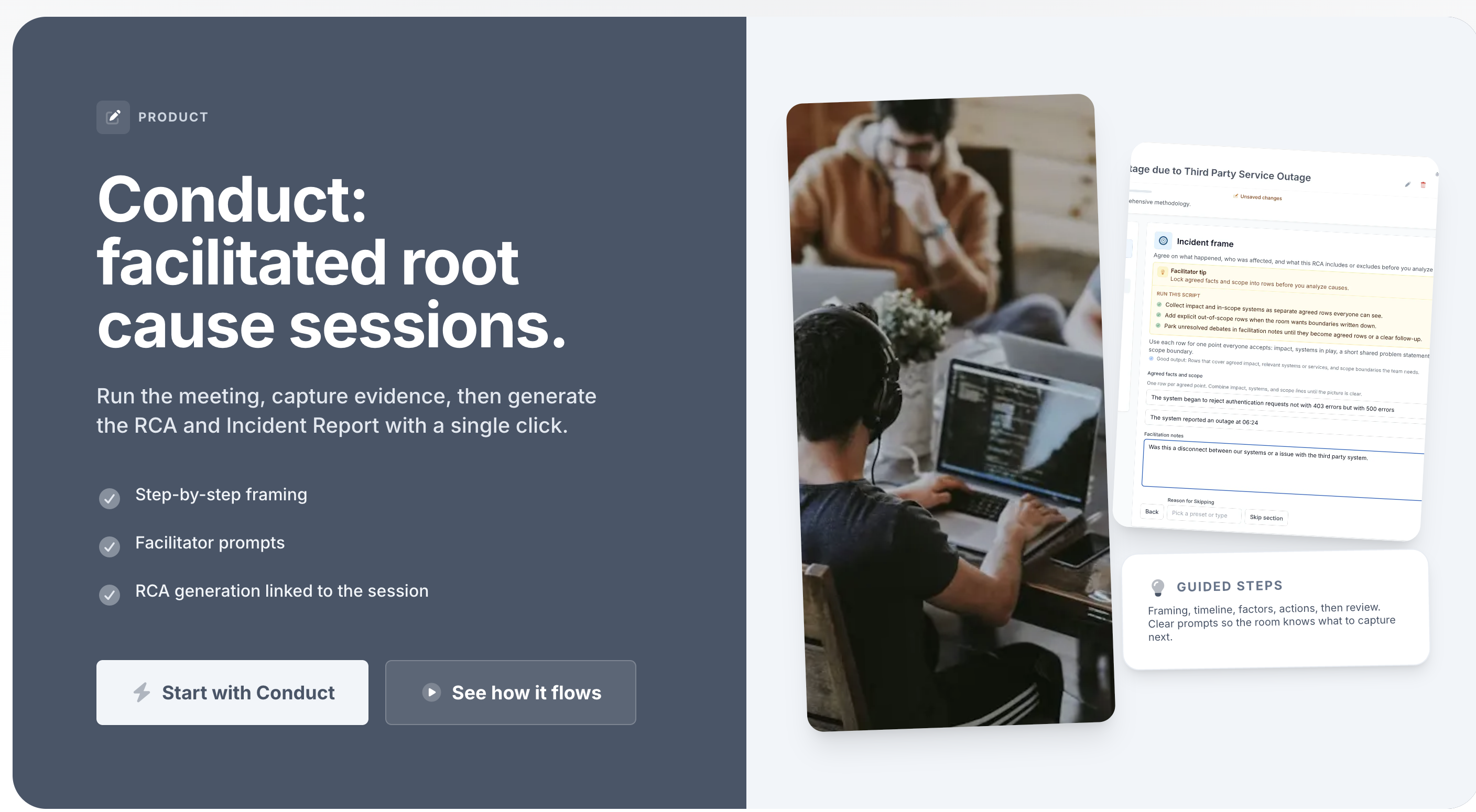
Guided RCA sessions
Run incident reviews using a structured workflow that keeps teams aligned on facts, timeline, and causes.
Real-time capture
Document decisions, timeline events, and causal factors during the
session instead of reconstructing them later.
5 Whys facilitation
Guide teams through root cause analysis with a structured 5 Whys flow that builds a clear causal chain.
Automatic RCA generation
Produce a complete, structured root cause analysis without starting from a blank document.
Stakeholder-ready incident reports
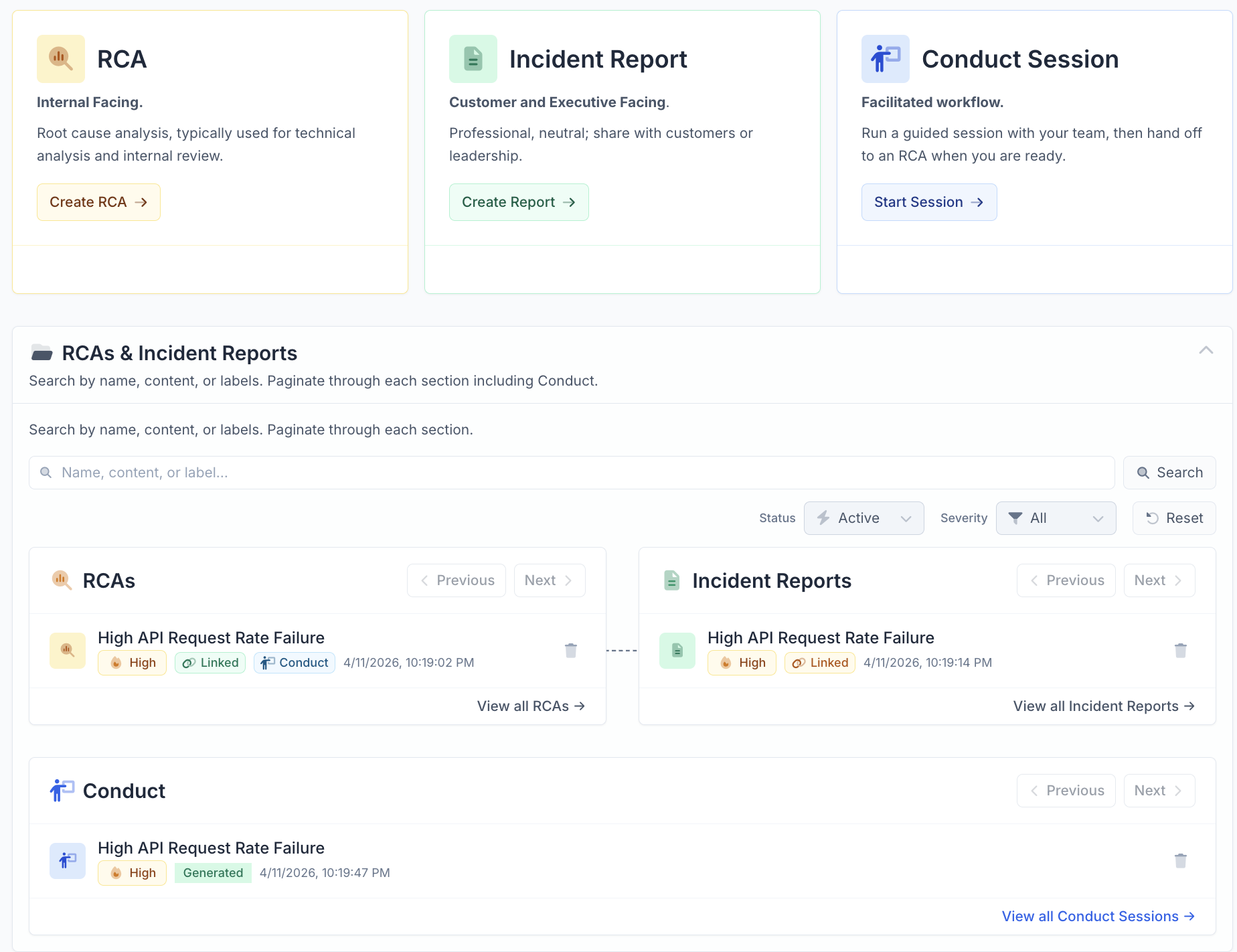
Generate clear, concise reports suitable for leadership, customers, or internal communication.
No post-incident writeup
Eliminate the extra 30–60 minutes typically spent turning notes into a usable report.
Session-first workflow
Focus on running a better RCA meeting, with the report as a natural
output of the process.
Versioned outputs
Track changes and refine RCAs and reports over time with structured versioning.
Built for real incidents
Designed for actual incident reviews, not templates or static forms.
Use Cases
Production incident reviews
Run structured RCAs after outages or performance issues. Capture the timeline, identify root causes, and generate a report teams can share internally or externally without additional writeup.
Customer-facing incident communication
Create clear, stakeholder-ready incident reports for customers or leadership. Turn technical analysis into something concise, structured, and easy to understand.
Postmortems for engineering teams
Replace unstructured postmortem meetings with a guided workflow. Keep discussions focused, document decisions in real time, and produce a complete RCA as an output.
Reliability and SRE workflows
Support ongoing reliability efforts by standardizing how incidents are
analyzed and documented. Build consistent RCA practices across teams.
Support and operations incident documentation
Enable support and ops teams to document incidents without relying on engineering-heavy tools. Capture what happened and produce reports that can be shared across the organization.
Compliance and audit documentation
Maintain structured records of incidents, root causes, and corrective actions. Useful for internal audits, regulatory requirements, or process reviews.
Cross-functional incident reviews
Facilitate incident reviews involving engineering, support, and leadership. Keep everyone aligned on facts and outcomes while producing a single, consistent report.
Continuous improvement and process gaps
Identify recurring issues and gaps in systems or processes. Use structured RCA outputs to drive corrective and preventive actions.

Comments



The "report comes out of the session, not after it" angle is the right insight. The post-mortem writeup phase is where most of the actual learning gets lost: by the time someone sits down to write, hindsight bias has already smoothed over the parts that mattered. Question: how do you handle the case where the 5-Whys converge on a non-actionable root ("it was a tired engineer at 3am")? That's the failure mode I've seen kill RCA tooling before.


I'd built a smaller version of this for myself a few years ago. It was just a simple way to turn incident notes and details into structured RCAs and incident reports. I used it after every major outage and it saved me a ton of time. No more blank-page syndrome or inconsistent documentation. It worked so well that I couldn’t imagine going back. So I've now turned it into something bigger: proper AI-generated root cause analyses and incident reports, export to PDF and Word, templates for different audiences (internal vs. customer-facing), and support for classic RCA, 5 Whys, and fishbone formats. Incident Index is that scratch-your-own-itch idea, made into a product. If you document incidents, RCAs, or post-mortems, and would rather fix systems than wrangle docs, I built this for you.
Premium Products


































Sponsors
Buy

Awards
View all
Awards
View allMakers
Makers
Comments
The "report comes out of the session, not after it" angle is the right insight. The post-mortem writeup phase is where most of the actual learning gets lost: by the time someone sits down to write, hindsight bias has already smoothed over the parts that mattered. Question: how do you handle the case where the 5-Whys converge on a non-actionable root ("it was a tired engineer at 3am")? That's the failure mode I've seen kill RCA tooling before.
I'd built a smaller version of this for myself a few years ago. It was just a simple way to turn incident notes and details into structured RCAs and incident reports. I used it after every major outage and it saved me a ton of time. No more blank-page syndrome or inconsistent documentation. It worked so well that I couldn’t imagine going back. So I've now turned it into something bigger: proper AI-generated root cause analyses and incident reports, export to PDF and Word, templates for different audiences (internal vs. customer-facing), and support for classic RCA, 5 Whys, and fishbone formats. Incident Index is that scratch-your-own-itch idea, made into a product. If you document incidents, RCAs, or post-mortems, and would rather fix systems than wrangle docs, I built this for you.
Premium Products
New to Fazier?

Find your next favorite product or submit your own. Made by @FalakDigital.
Copyright ©2026. All Rights Reserved