
Imaginode
Chain 48 AI models on one node canvas
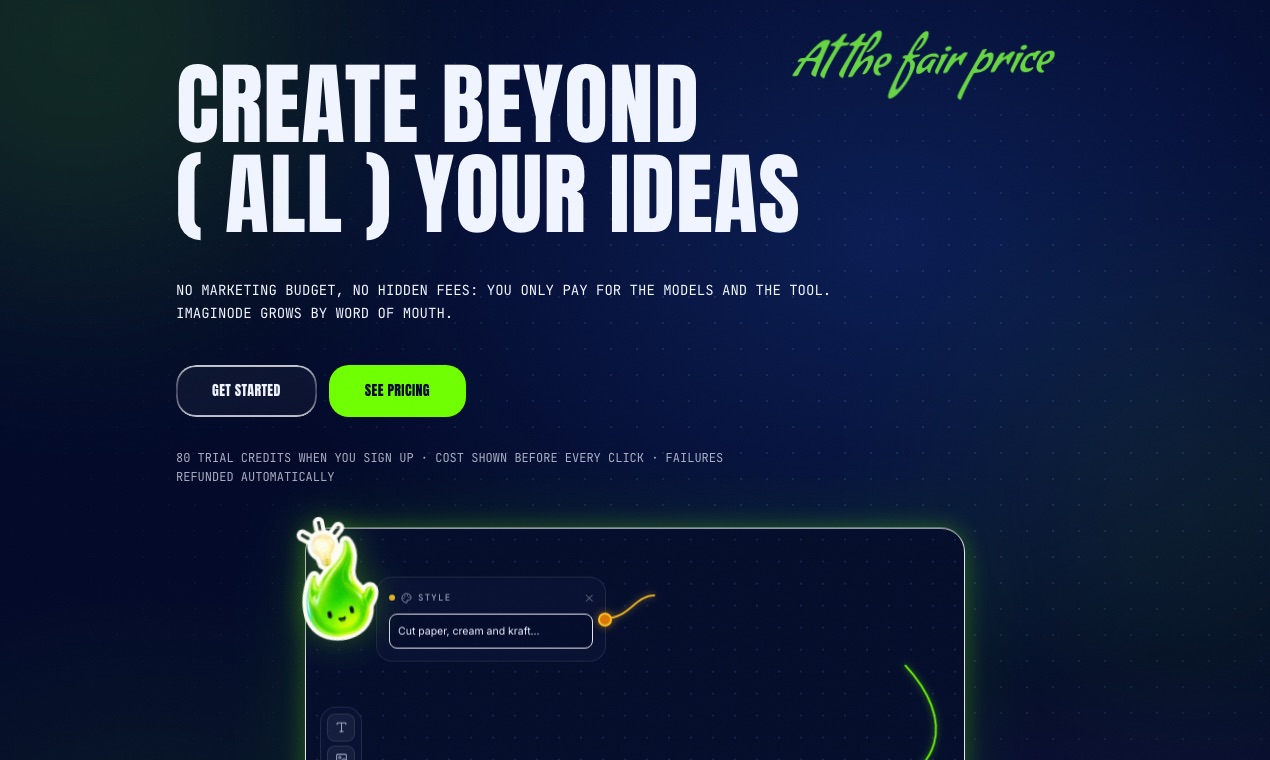
Imaginode is a visual canvas for AI image and video creation. Instead of a single prompt box, you place nodes on an infinite board and connect them: a prompt feeds an image model, that image feeds an upscaler or a video model, and every step stays visible and reusable.
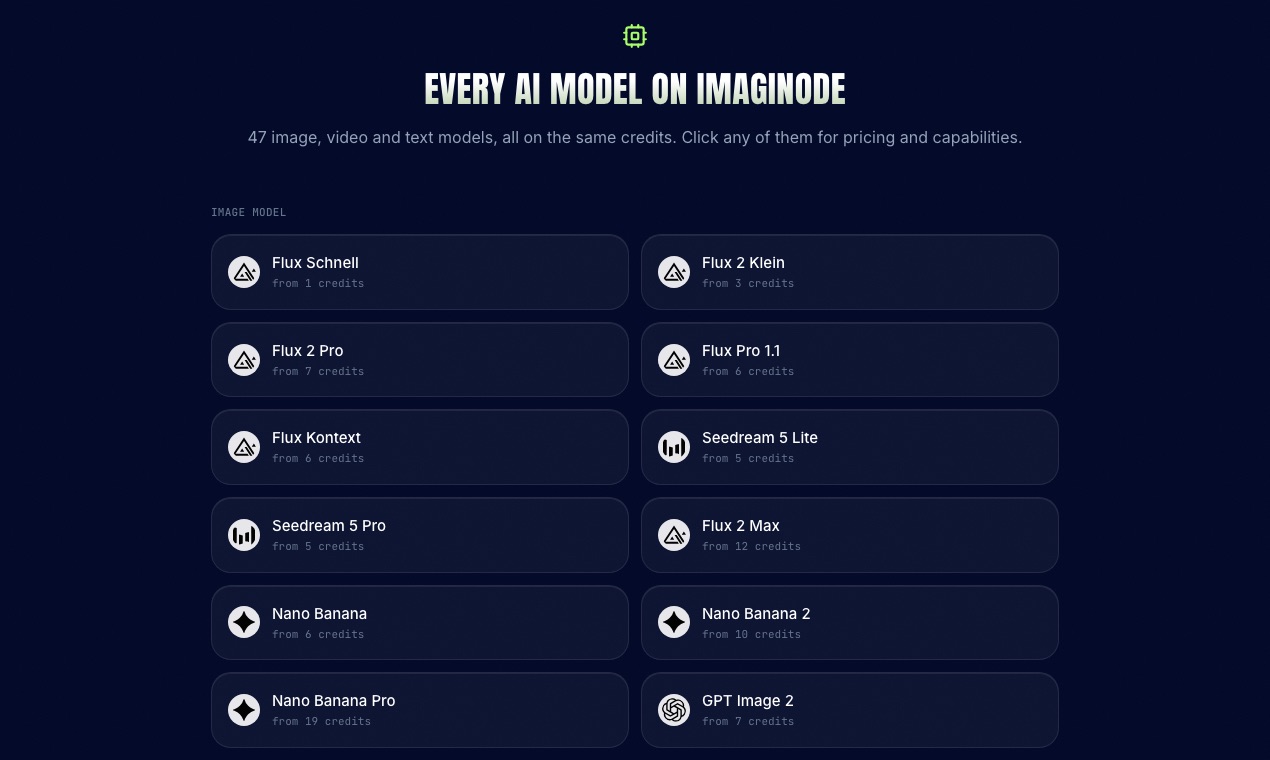
48 models sit behind one credit balance, so there is no need to hold five subscriptions to reach Flux, Veo, Kling, Seedance or Recraft. Wiring an image into a video node makes it the first frame, which is the cheap way to work: you validate the composition on a 3 credit image before spending 40 on the video.
The interface is available in five languages, boards can be shared for real time collaboration, and credits are returned automatically when a generation fails.
Features
Node canvas: chain prompt, image, video, voice, camera and reference nodes, then rerun one step without redoing the rest.
48 models on a shared credit balance: Flux, Imagen 4, Seedream, Recraft and GPT Image for stills, Kling, Seedance, Veo 3.1, MiniMax, Wan and PixVerse for video.
Image to video: wire a still into a video node and it becomes the first frame, so the composition is validated before the expensive render.
Camera node with lens, aperture, angle and movement controls, the way a shot is described on set.
Reference node that keeps a character consistent across a whole series.
Templates for ready made effects and exports in the formats used by social platforms.
Real time collaboration on a shared board, interface in five languages.
Credits returned automatically when a generation fails.
Use Cases
Storyboard a short film: validate every shot as a still, then animate only the ones you keep.
Produce a product ad without a shoot: reference photo in, image edit, then video out.
Build a series of social posts where the same character appears in every frame.
Compare several models on the same prompt side by side before committing budget.
Turn a still illustration into a looping clip for a landing page or an ad.

Comments


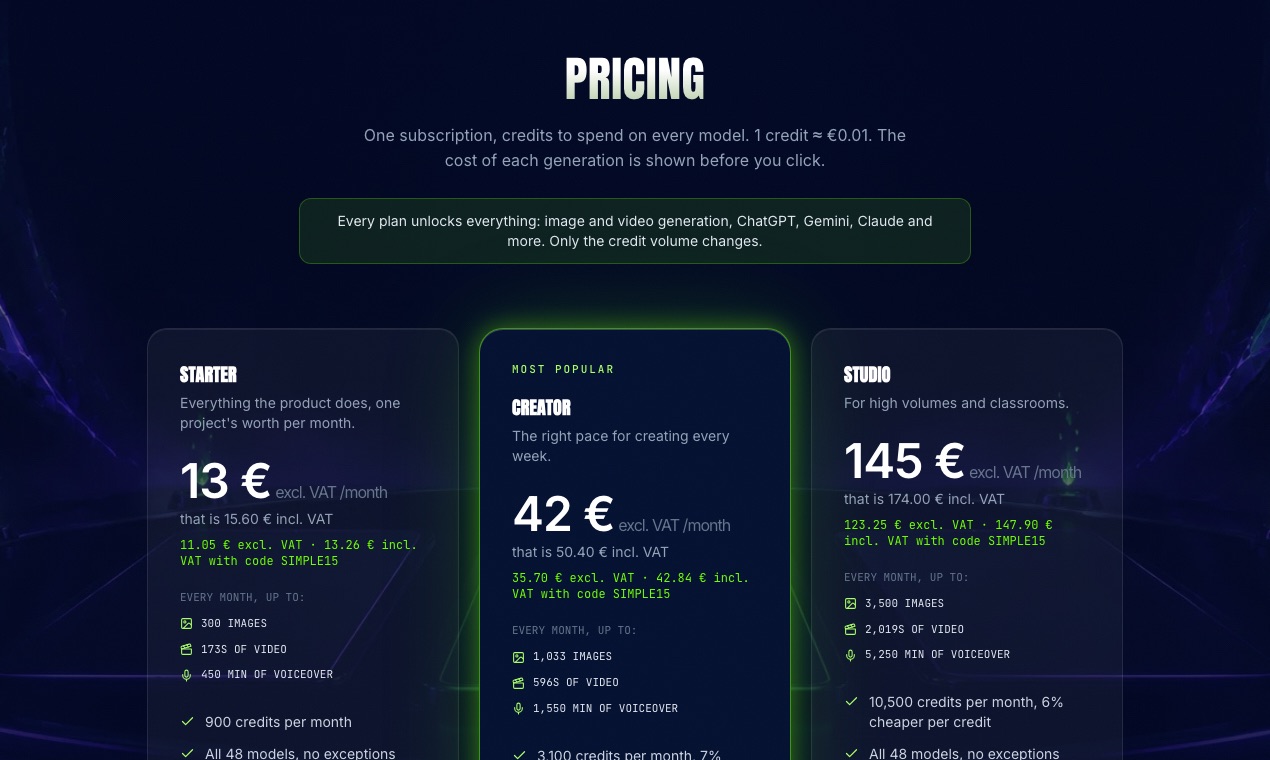
Hi, I am the maker of Imaginode. I built it because the single prompt box kept forcing me to start over. Change one thing and you lose the version that was almost right, and you pay again for the whole render. On a canvas the steps stay on the board: the prompt, the image, the upscale, the video. You rewire one node and everything else holds. The part I would most like feedback on is the credit model. One balance covers all 48 models, a failed generation is refunded automatically, and an image costs a few credits while a video costs tens. The idea is that you settle the composition cheaply before paying for motion. If that reads as clear or as confusing when you open the pricing page, please say so. The interface is in French, English, Spanish, German and Portuguese. Happy to answer anything here.


Node-based UI for chaining models together is the right abstraction for this problem. Most people think of "use multiple models" as either serial pipelines (output of A feeds B) or parallel voting (same input, different models). Imaginode's visual canvas approach handles both plus the harder case: conditional branching where the next model depends on which path the data took through the previous step. The 48-model support is solid but the real value is workflow visualization. Debugging a prompt chain in code is painful because you lose context fast - what's the actual input that model-3 received? Did it see the raw data or the processed version from step 2? A canvas makes that visible. You can see data flowing through each node and instantly spot where assumptions break. Paid positioning makes sense here too. Free node tools attract builders who tinker endlessly. Paid tools get shipped because there's accountability. Someone paying per run cares about latency and cost per inference. That drives actual optimization work instead of "I'll refactor this workflow eventually." The technical execution of orchestrating 48 different APIs simultaneously is non-trivial. Rate limits, auth tokens, retries on failures per provider - that's the grind that doesn't show on the canvas but is everything. If that's handled well, this solves a real coordination problem that would otherwise require custom infrastructure.

Imaginode Your product has strong potential, but I found a few key improvements that could make it even better. I'd love to share my feedback and suggestions—please contact me at [email protected].
Premium Products












































Sponsors
Buy

Makers
Makers
Comments
Hi, I am the maker of Imaginode. I built it because the single prompt box kept forcing me to start over. Change one thing and you lose the version that was almost right, and you pay again for the whole render. On a canvas the steps stay on the board: the prompt, the image, the upscale, the video. You rewire one node and everything else holds. The part I would most like feedback on is the credit model. One balance covers all 48 models, a failed generation is refunded automatically, and an image costs a few credits while a video costs tens. The idea is that you settle the composition cheaply before paying for motion. If that reads as clear or as confusing when you open the pricing page, please say so. The interface is in French, English, Spanish, German and Portuguese. Happy to answer anything here.
Node-based UI for chaining models together is the right abstraction for this problem. Most people think of "use multiple models" as either serial pipelines (output of A feeds B) or parallel voting (same input, different models). Imaginode's visual canvas approach handles both plus the harder case: conditional branching where the next model depends on which path the data took through the previous step. The 48-model support is solid but the real value is workflow visualization. Debugging a prompt chain in code is painful because you lose context fast - what's the actual input that model-3 received? Did it see the raw data or the processed version from step 2? A canvas makes that visible. You can see data flowing through each node and instantly spot where assumptions break. Paid positioning makes sense here too. Free node tools attract builders who tinker endlessly. Paid tools get shipped because there's accountability. Someone paying per run cares about latency and cost per inference. That drives actual optimization work instead of "I'll refactor this workflow eventually." The technical execution of orchestrating 48 different APIs simultaneously is non-trivial. Rate limits, auth tokens, retries on failures per provider - that's the grind that doesn't show on the canvas but is everything. If that's handled well, this solves a real coordination problem that would otherwise require custom infrastructure.
Imaginode Your product has strong potential, but I found a few key improvements that could make it even better. I'd love to share my feedback and suggestions—please contact me at [email protected].
Premium Products
New to Fazier?
Find your next favorite product or submit your own. Made by @FalakDigital.
Copyright ©2026. All Rights Reserved