
Good for Bots
Check if AI crawlers can read your site.
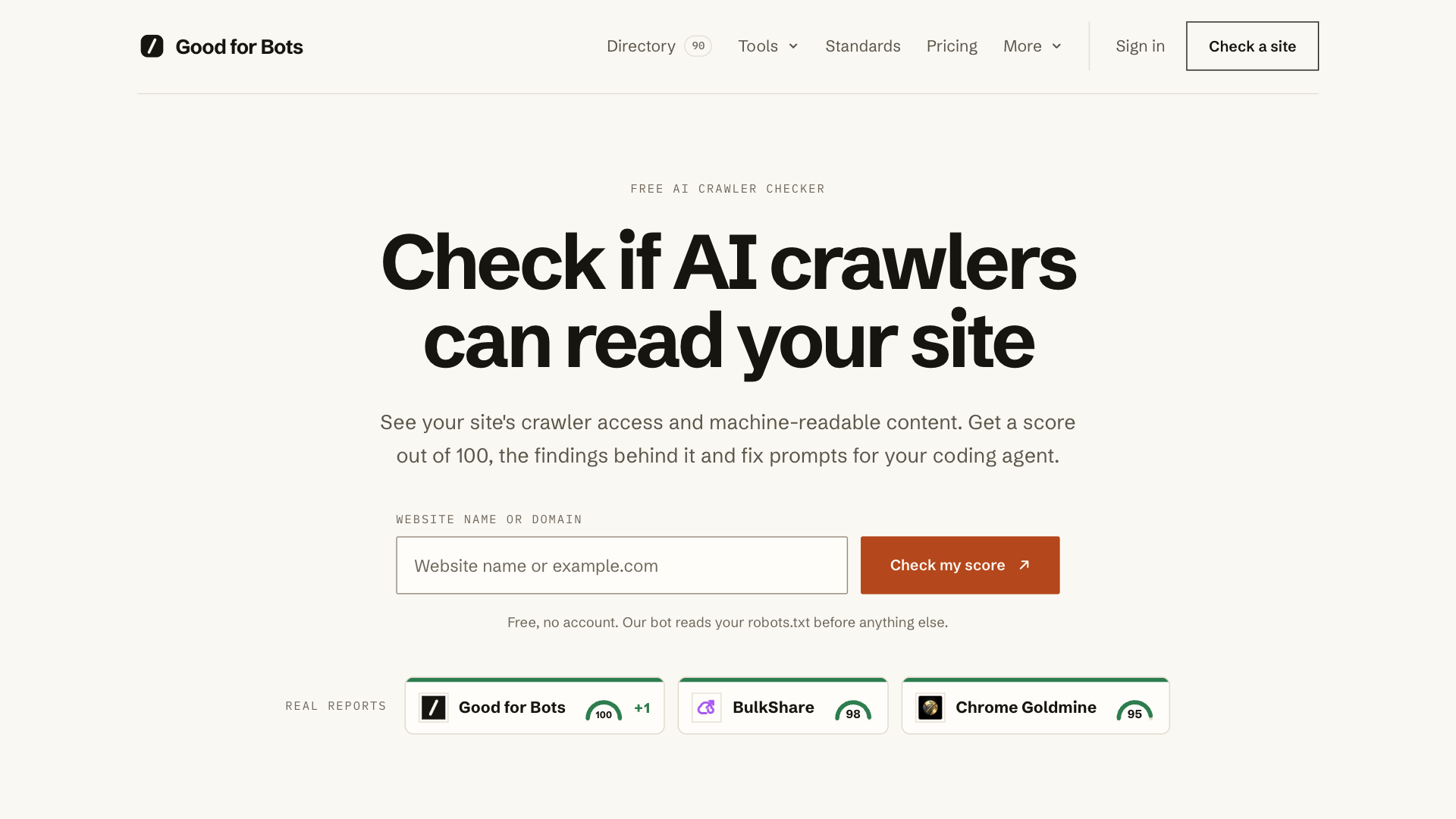
Good for Bots helps website owners check how well their sites can be read by AI crawlers and agents. Enter a domain to run a free scan and get a report with a score out of 100, the findings behind it, and prompts you can give to your coding agent.
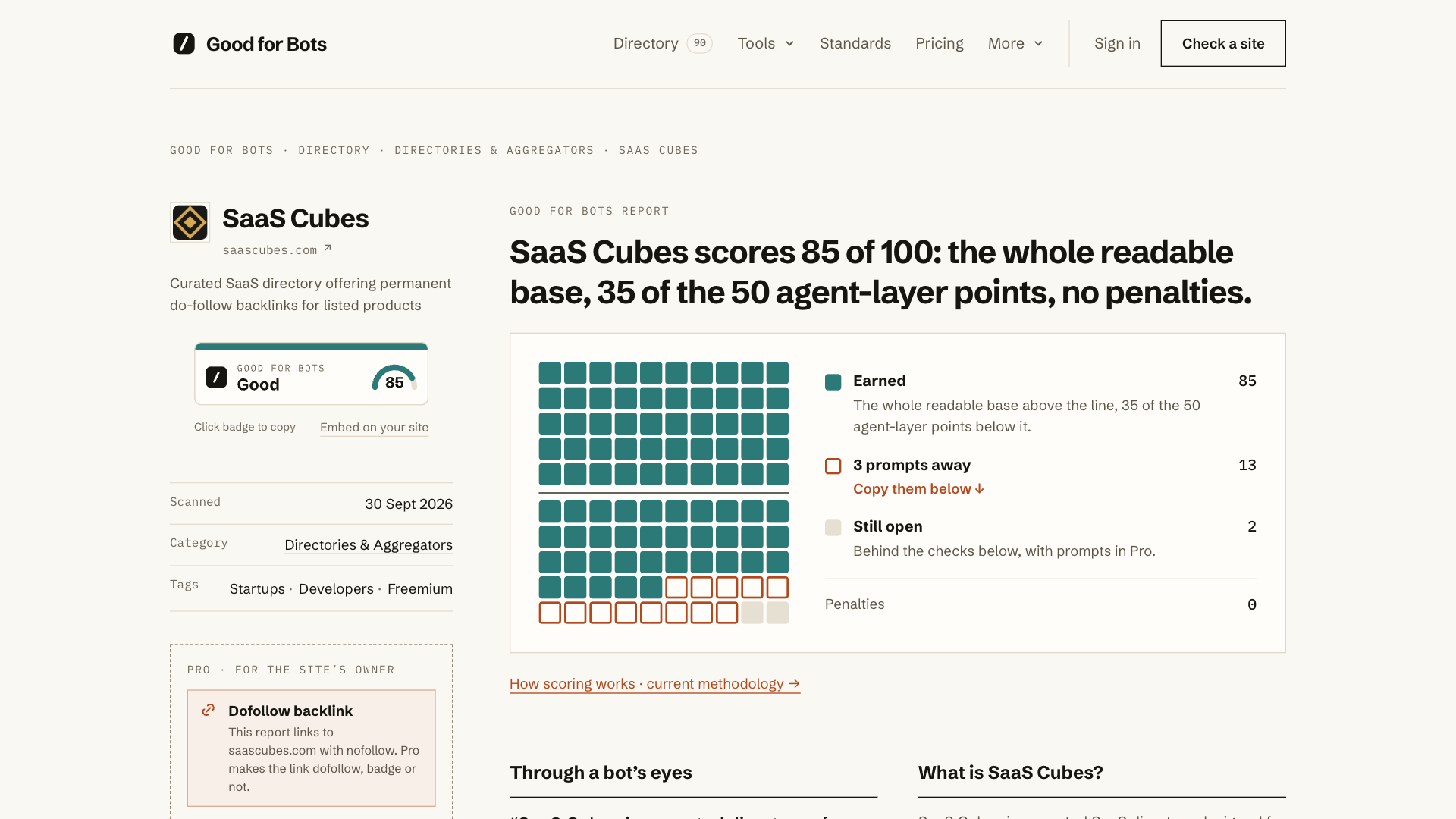
The scanner checks crawler rules, llms.txt, sitemaps, Markdown access, structured data, and the HTML it receives. Reports show where content is available, where access fails, and which fixes could recover points. A live badge lets you display your latest score on your website.
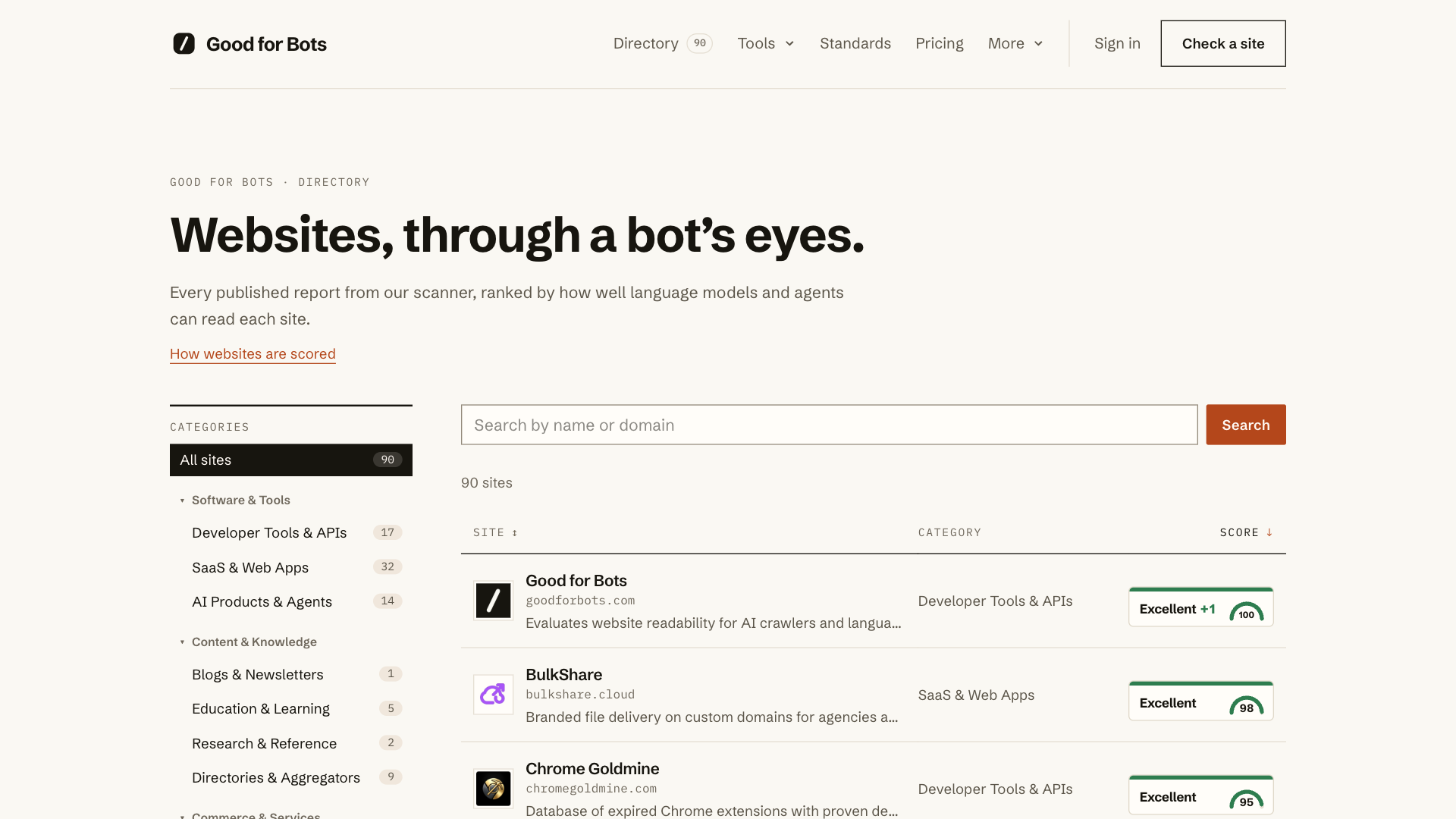
The directory brings these reports together so you can explore sites by category, platform, and detected standards. Free tools also check llms.txt and robots.txt separately.
Pro adds weekly monitoring, email alerts, score history, and prompts for every fix. Free and Pro use identical scoring rules. The scan measures technical readiness; it does not promise mentions, rankings, or citations in ChatGPT, Claude, or any other AI assistant's answers.
Features
- Checks robots.txt, llms.txt, sitemaps, Markdown access, structured data and HTML.
- Shows a score out of 100 with the findings behind it.
- Generates fix prompts for coding agents.
- Publishes a report and live embeddable score badge.
- Pro adds weekly monitoring, score history and email alerts.
Use Cases
- Check whether a website exposes readable content to AI crawlers.
- Find crawler access and content issues before a release.
- Give a coding agent fix prompts based on scan findings.
- Monitor a claimed website for score drops and bot access changes.
- Browse scored websites by category and detected standards.

Comments




I like that the report says plainly it measures technical readiness, not mentions or citations. That's the honest framing. A question on the robots.txt check: do you score AI search and user-fetch bots separately from training crawlers? Plenty of sites, especially ones using Cloudflare's AI crawler controls, deliberately allow search fetchers while blocking training, and I'd want the score not to penalize that choice.

Good call scoring crawler rules separately from the HTML the scanner actually receives. Plenty of sites allow GPTBot in robots.txt but serve an empty JS shell, so 'allowed' on its own is misleading. Do you render JavaScript during the scan, or score the raw HTML only? And for llms.txt, do you check that the linked .md pages actually resolve, or just that the file exists?

This is genuinely useful for launch week — I checked our own robots.txt by hand last week and still was not sure whether the llms.txt syntax was right. Question about the score: if a site blocks GPTBot on purpose but serves clean Markdown to PerplexityBot, does the report weight those as separate signals, or does one block drag the whole score down? Separate per-crawler scoring would make the report much easier to act on.
The free scan checks robots.txt and llms.txt alongside the HTML actually served, so it is more actionable than checking crawler permissions alone. Could each finding include the affected URL and a reproducible fetch example, so a developer can verify the issue before applying an agent-generated fix?


We run a small quiz site behind Cloudflare and hit exactly this problem: some of our endpoints returned fine to a browser but failed for tool and bot fetches, and it was invisible in normal checks. One thing I would love the report to flag explicitly is that split — 200 for a browser UA but 403/5xx for known bot UAs. The fix prompts written for a coding agent are a smart touch, that is exactly how a small team would act on the findings.
A score out of 100 with the findings behind it is exactly what makes this actionable — checking robots.txt and llms.txt alongside the HTML actually served avoids false confidence. I also like the fix prompts for coding agents and the live score badge idea. Does the free scan cover JavaScript-rendered pages, or only the initial HTML response?

Testing **pakshaheens.com** and **psychspirit.com** through the **"Good for Bots"** tool on Fazier has been an eye-opening experience for optimizing our digital platforms for the AI era. As web publishers and developers managing heavy educational content and specialized mental health resources, ensuring our platforms are fully readable, structured, and accessible to AI crawlers, agents, and modern LLMs is crucial for discoverability. Running the scans on "Good for Bots" gave us a clear breakdown of how our robots.txt files, sitemaps, structured data, and Markdown access are handled. For **pakshaheens.com**, it highlighted how cleanly our exam prep guides and student resources can be parsed, while for **psychspirit.com**, it ensured that our sensitive, empathetic articles and mental health frameworks are properly formatted for clean agent readability without running into access blocks. The actionable fix prompts generated by the tool made it super easy to feed straight into our development workflow to patch minor crawler visibility gaps. It’s an exceptional utility for any web owner wanting to stay ahead in AI-driven search and visibility.

Good point about checking crawler access separately from what the scanner actually sees. Some sites allow GPTBot in robots.txt but only serve an empty JavaScript shell. Do you render JavaScript during scans, or evaluate raw HTML only? Also, when checking llms.txt, do you verify that the linked Markdown pages are accessible, or simply check whether the file exists?

How does the scan handle multilingual sites? Does it follow hreflang alternates and check each language version, or only the URL you enter? On sites with /de and /en it's common that only one version has structured data or is listed in llms.txt, so the score can look fine while half the content is invisible to agents.


I appreciate the clear distinction between technical readiness and actually getting mentioned in AI answers. The fix prompts for coding agents sound practical, too. Can site owners distinguish intentional crawler restrictions from accidental access issues, so the recommendations respect which bots they want to allow?


Very timely — with AI search growing, checking whether crawlers can actually read a site matters as much as normal SEO. I like that it checks robots.txt, llms.txt and sitemaps against the HTML a bot actually receives, rather than just assuming the rules work, and that the score comes with findings and fix prompts you can hand to a coding agent. Does the scan handle JavaScript-heavy pages, where the readable content only appears after rendering?

The split between crawler rules and the HTML the scanner actually receives is the part I would use most — robots.txt can say one thing while a CDN or JS setup serves another. Does the free scan follow redirects before scoring the final page, and does it report the main AI crawlers (GPTBot, ClaudeBot, PerplexityBot) individually or as one combined verdict?

Useful sanity check before shipping - I have seen plenty of sites that render fine for Googlebot but block the smaller crawlers with a robots rule nobody remembered. Would be even better if the result also showed which specific bots are being tested (GPTBot, ClaudeBot, Perplexity) and a raw robots.txt snippet for the ones that fail, so you can fix it without re-running the whole check.

Useful idea. One thing we ran into on our WooCommerce shop: Rank Math generated llms.txt on every request and it took about 2 seconds, so some checkers gave up waiting. We now serve a static copy refreshed daily. Does your scanner report how fast llms.txt and robots.txt respond, or only whether they exist? A slow-but-present file would be worth flagging.




Useful idea, most site owners have no clue what GPTBot or PerplexityBot actually see on their pages. Does the score treat retrieval crawlers and training-only crawlers differently? Some people want to show up in AI answers but not be used for training, so it would help to know if blocking a training bot costs points.

Love the concept - most site owners have no idea whether GPTBot, ClaudeBot or PerplexityBot are blocked until traffic tanks. Two things that would make it more useful for me: (1) also surface whether OAI-SearchBot is allowed, since search crawlers and training crawlers are usually whitelisted separately; (2) a one-click robots.txt snippet for the recommended config, so I can diff it against mine instead of hand-editing.
Ran a scan on our own site: 76 of 100, and each of the 3 fix prompts said how many points it would add, which made it easy to decide what to do first. 2 questions. Markdown negotiation is worth 10 points. Do you have data on which crawlers send Accept: text/markdown today, or is that weight a bet on where agents are heading? And the report went public in the directory as soon as I ran it. Can an owner keep a scan private, or remove a listing that someone else triggered?

Useful idea. A lot of sites block AI crawlers by accident through their CDN or bot-protection settings and never notice until they wonder why they don't show up in AI answers. Does the check tell you which setting or file is causing the block (robots.txt vs. a firewall rule), or only that the crawler was blocked?
One thing that can skew the HTML check: Cloudflare and most bot managers verify crawlers by IP range, not by user agent, so a scanner sending GPTBot's user agent from its own servers can get a challenge page the real GPTBot never sees, or the other way round. Does the report tell a block that only hit the scanner apart from one the real crawler would hit too?

Ran my own site through this in my head and realised I have no idea what AI crawlers actually see on it. The score breakdown by fix is the useful part, a single number would not tell you what to change. Does it also check whether the readable version matches what a human sees, or only that the files exist?
Premium Products





































Sponsors
Buy
Awards
View all
Awards
View allMakers

Makers
Comments
I like that the report says plainly it measures technical readiness, not mentions or citations. That's the honest framing. A question on the robots.txt check: do you score AI search and user-fetch bots separately from training crawlers? Plenty of sites, especially ones using Cloudflare's AI crawler controls, deliberately allow search fetchers while blocking training, and I'd want the score not to penalize that choice.
Good call scoring crawler rules separately from the HTML the scanner actually receives. Plenty of sites allow GPTBot in robots.txt but serve an empty JS shell, so 'allowed' on its own is misleading. Do you render JavaScript during the scan, or score the raw HTML only? And for llms.txt, do you check that the linked .md pages actually resolve, or just that the file exists?
This is genuinely useful for launch week — I checked our own robots.txt by hand last week and still was not sure whether the llms.txt syntax was right. Question about the score: if a site blocks GPTBot on purpose but serves clean Markdown to PerplexityBot, does the report weight those as separate signals, or does one block drag the whole score down? Separate per-crawler scoring would make the report much easier to act on.
The free scan checks robots.txt and llms.txt alongside the HTML actually served, so it is more actionable than checking crawler permissions alone. Could each finding include the affected URL and a reproducible fetch example, so a developer can verify the issue before applying an agent-generated fix?
We run a small quiz site behind Cloudflare and hit exactly this problem: some of our endpoints returned fine to a browser but failed for tool and bot fetches, and it was invisible in normal checks. One thing I would love the report to flag explicitly is that split — 200 for a browser UA but 403/5xx for known bot UAs. The fix prompts written for a coding agent are a smart touch, that is exactly how a small team would act on the findings.
A score out of 100 with the findings behind it is exactly what makes this actionable — checking robots.txt and llms.txt alongside the HTML actually served avoids false confidence. I also like the fix prompts for coding agents and the live score badge idea. Does the free scan cover JavaScript-rendered pages, or only the initial HTML response?
Testing **pakshaheens.com** and **psychspirit.com** through the **"Good for Bots"** tool on Fazier has been an eye-opening experience for optimizing our digital platforms for the AI era. As web publishers and developers managing heavy educational content and specialized mental health resources, ensuring our platforms are fully readable, structured, and accessible to AI crawlers, agents, and modern LLMs is crucial for discoverability. Running the scans on "Good for Bots" gave us a clear breakdown of how our robots.txt files, sitemaps, structured data, and Markdown access are handled. For **pakshaheens.com**, it highlighted how cleanly our exam prep guides and student resources can be parsed, while for **psychspirit.com**, it ensured that our sensitive, empathetic articles and mental health frameworks are properly formatted for clean agent readability without running into access blocks. The actionable fix prompts generated by the tool made it super easy to feed straight into our development workflow to patch minor crawler visibility gaps. It’s an exceptional utility for any web owner wanting to stay ahead in AI-driven search and visibility.
Good point about checking crawler access separately from what the scanner actually sees. Some sites allow GPTBot in robots.txt but only serve an empty JavaScript shell. Do you render JavaScript during scans, or evaluate raw HTML only? Also, when checking llms.txt, do you verify that the linked Markdown pages are accessible, or simply check whether the file exists?
How does the scan handle multilingual sites? Does it follow hreflang alternates and check each language version, or only the URL you enter? On sites with /de and /en it's common that only one version has structured data or is listed in llms.txt, so the score can look fine while half the content is invisible to agents.
I appreciate the clear distinction between technical readiness and actually getting mentioned in AI answers. The fix prompts for coding agents sound practical, too. Can site owners distinguish intentional crawler restrictions from accidental access issues, so the recommendations respect which bots they want to allow?
Very timely — with AI search growing, checking whether crawlers can actually read a site matters as much as normal SEO. I like that it checks robots.txt, llms.txt and sitemaps against the HTML a bot actually receives, rather than just assuming the rules work, and that the score comes with findings and fix prompts you can hand to a coding agent. Does the scan handle JavaScript-heavy pages, where the readable content only appears after rendering?
The split between crawler rules and the HTML the scanner actually receives is the part I would use most — robots.txt can say one thing while a CDN or JS setup serves another. Does the free scan follow redirects before scoring the final page, and does it report the main AI crawlers (GPTBot, ClaudeBot, PerplexityBot) individually or as one combined verdict?
Useful sanity check before shipping - I have seen plenty of sites that render fine for Googlebot but block the smaller crawlers with a robots rule nobody remembered. Would be even better if the result also showed which specific bots are being tested (GPTBot, ClaudeBot, Perplexity) and a raw robots.txt snippet for the ones that fail, so you can fix it without re-running the whole check.
Useful idea. One thing we ran into on our WooCommerce shop: Rank Math generated llms.txt on every request and it took about 2 seconds, so some checkers gave up waiting. We now serve a static copy refreshed daily. Does your scanner report how fast llms.txt and robots.txt respond, or only whether they exist? A slow-but-present file would be worth flagging.
Useful idea, most site owners have no clue what GPTBot or PerplexityBot actually see on their pages. Does the score treat retrieval crawlers and training-only crawlers differently? Some people want to show up in AI answers but not be used for training, so it would help to know if blocking a training bot costs points.
Love the concept - most site owners have no idea whether GPTBot, ClaudeBot or PerplexityBot are blocked until traffic tanks. Two things that would make it more useful for me: (1) also surface whether OAI-SearchBot is allowed, since search crawlers and training crawlers are usually whitelisted separately; (2) a one-click robots.txt snippet for the recommended config, so I can diff it against mine instead of hand-editing.
Ran a scan on our own site: 76 of 100, and each of the 3 fix prompts said how many points it would add, which made it easy to decide what to do first. 2 questions. Markdown negotiation is worth 10 points. Do you have data on which crawlers send Accept: text/markdown today, or is that weight a bet on where agents are heading? And the report went public in the directory as soon as I ran it. Can an owner keep a scan private, or remove a listing that someone else triggered?
Useful idea. A lot of sites block AI crawlers by accident through their CDN or bot-protection settings and never notice until they wonder why they don't show up in AI answers. Does the check tell you which setting or file is causing the block (robots.txt vs. a firewall rule), or only that the crawler was blocked?
One thing that can skew the HTML check: Cloudflare and most bot managers verify crawlers by IP range, not by user agent, so a scanner sending GPTBot's user agent from its own servers can get a challenge page the real GPTBot never sees, or the other way round. Does the report tell a block that only hit the scanner apart from one the real crawler would hit too?
Ran my own site through this in my head and realised I have no idea what AI crawlers actually see on it. The score breakdown by fix is the useful part, a single number would not tell you what to change. Does it also check whether the readable version matches what a human sees, or only that the files exist?
Premium Products
New to Fazier?

Find your next favorite product or submit your own. Made by @FalakDigital.
Copyright ©2026. All Rights Reserved