Funlingo
Dual Subtitles for Netflix, Youtube & more
The best way to learn a new language while watching your favorite movies and series on Netflix, Prime Video and YouTube
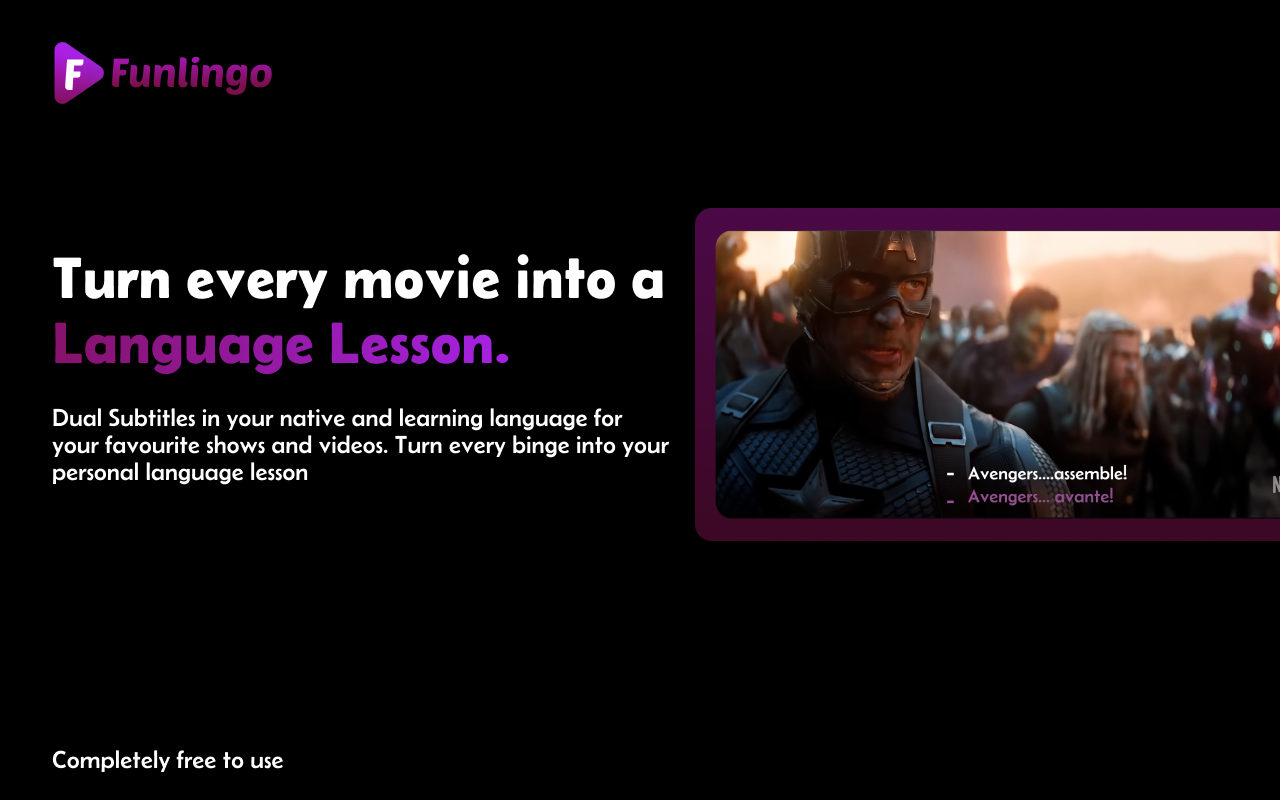
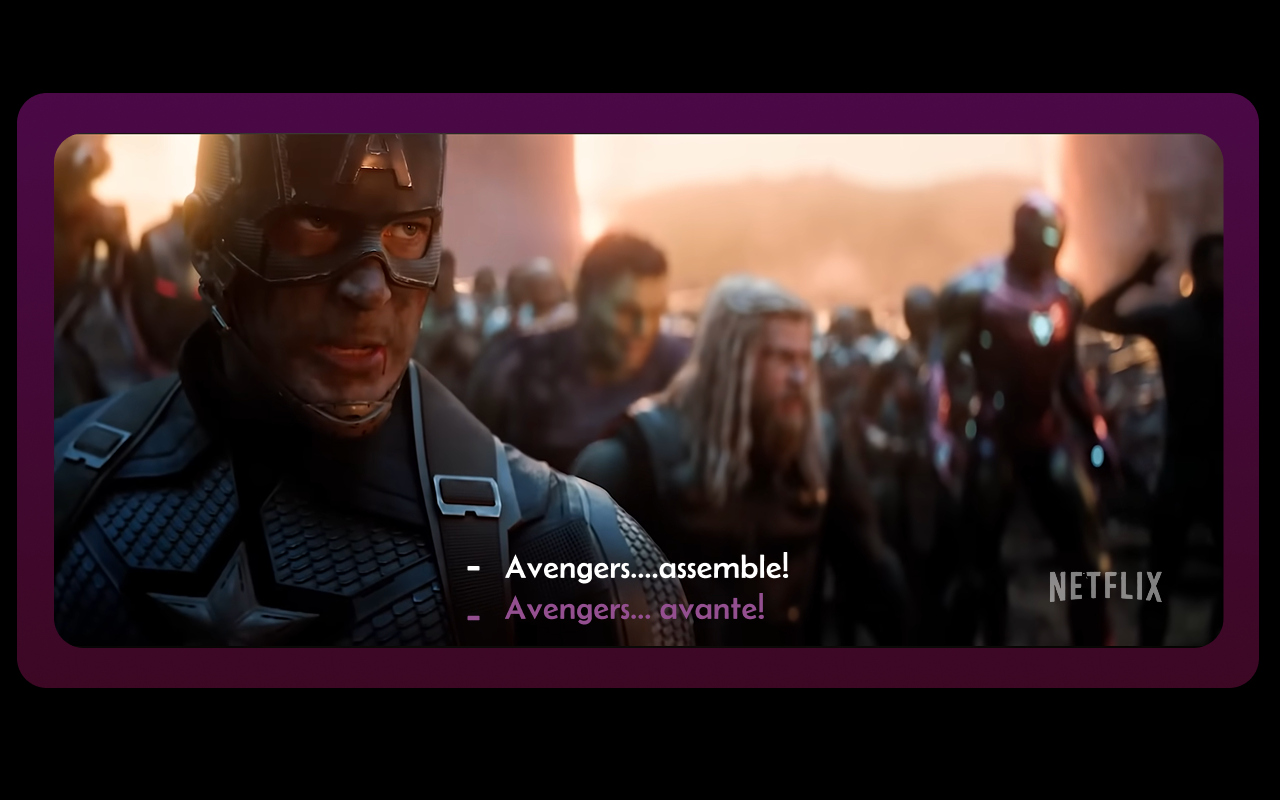
Funlingo adds dual subtitles (two languages at once) on Netflix, YouTube, Prime Video and soon on Disney+, Hulu, and more. It’s the easiest way to pick up a new language naturally — by simply watching what you love.
✨ Key Features
✅ Dual Subtitles: See both the original and translated subtitles together for instant understanding.
✅ Hover to Pause: Hover over the subtitle area to pause the video automatically.
✅ Word Highlighting: Watch subtitles highlight word-by-word as they’re spoken.
✅ Instant Word Meanings: Hover on any word to see its short meaning and translation in your native language.
✅ Seamless UI: Blends beautifully with Netflix and YouTube players — feels native.
✅ One-Click Toggle: Enable or disable subtitles easily from the video player toolbar.
✅ Completely Free: No subscriptions, no sign-ups — just install and start learning.
🌍 Learn languages the fun way!
Whether you’re learning English, Spanish, Korean, Japanese, French, or any other language — FunLingo helps you learn by watching, just like you naturally picked up your first language.
Perfect for:
English learners watching Netflix shows
K-drama or anime fans learning Korean or Japanese
Movie buffs improving pronunciation and vocabulary
Anyone who wants to turn binge-watching into learning
🔍 Why Funlingo?
Other extensions like Language Reactor, FluentU, Lingopie, and FluentAI.pro help you learn through videos — but FunLingo is:
100% free
Lighter and faster
Cleaner UI that integrates directly into Netflix & YouTube
More intuitive for everyday viewers
🚀 Coming Soon
Support for:
Disney+
Hulu
Crunchyroll
Hotstar and more!
Start learning languages naturally — just by watching what you already love.
Install FunLingo now and make every show a language lesson!
Use Cases
- Netflix
- Prime Video
- Youtube
- Much more
Comments


I analyzed 440,000 cafes and 5,200 roasters across 10 countries to answer the coffee questions Google can't. This started as a spreadsheet. I wanted to know which city actually has the best coffee - not "best coffee cities" listicles written by someone who visited one Starbucks in Rome. Real data. Consistent scoring. Every cafe rated on the same four pillars: coffee quality, atmosphere, value, service. That spreadsheet became CoffeeTrove. The dataset today: 440,449 cafes. 5,258 roasters. 10+ cities. Every entry scored. Here's what 18 months of data collection taught me: "What's the best coffee city in the world?" Depends what you mean. Melbourne has the highest median quality scores across the board. But Tokyo has more specialty cafes per square kilometer than anywhere else on Earth. Berlin is where roasters are doing the most experimental work right now. Lisbon is the fastest-growing specialty scene in Europe. There's no single answer, which is exactly why I built a scoring system instead of writing another opinion piece. "Do independent cafes actually make better coffee?" Yes. And it's not close. Across every city in the dataset, single-location cafes score 15-20% higher on coffee quality than chains. Chains win on consistency and price. That's it. I published the methodology so you can check it yourself. "Why does my espresso taste different at home?" This question comes up constantly. So I built an Espresso Dial-In Helper - you describe what's wrong (sour, bitter, watery, too intense) and it tells you exactly what to adjust. Dose, grind, time, temperature. No guessing. But the tool that gets the most traffic surprised me: the Grind Size Translator. Turns out a "medium" grind on a Comandante C40 is nothing like a "medium" on a Baratza Encore or a Timemore C2. People switch grinders and suddenly their coffee tastes terrible. The translator converts settings between 6+ grinder brands instantly. Simple problem, nobody had solved it. "How much am I actually saving brewing at home?" Built a Cost Per Cup Calculator for this. Plug in your setup - beans, equipment, how many cups per day - and it shows your real cost per cup vs your local cafe. Spoiler: a $300 grinder pays for itself in about 4 months if you were buying $5 lattes. The full tool list (14 free tools, no sign-up): - Grind Size Translator (convert between Comandante, Baratza, Fellow, Timemore, and more) - Espresso Dial-In Helper (fix your shot in 3 clicks) - Brew Timer with pour schedules (V60, AeroPress, Chemex, French Press, Cold Brew, Moka Pot) - Cost Per Cup Calculator (home vs cafe with annual savings projection) - Interactive Coffee Flavor Wheel (95 SCA tasting notes across 3 levels) - Harvest Calendar (18+ coffee-producing countries, seasonality mapped) - Brew Ratio Calculator (water-to-coffee ratios for every method) - Brew Quiz (5 questions to find your ideal brewing method) - Bean Freshness Calculator (peak windows by roast date and brew style) - Caffeine Calculator (by drink type and serving size) - Extraction Calculator (TDS, dose, yield) - Grind Size Guide (visual reference by brewing method) - Grind Size Comparator (interactive particle size slider) - Brew Strength Slider (adjust coffee-to-water live) The knowledge hub covers origin profiles for Ethiopia, Colombia, Kenya, Panama, Brazil and 13 other producing countries - terroir, altitude, processing methods, what to expect in the cup. Plus 15+ brewing method deep-dives and a reference base of 1,000+ aromatic compounds. All cross-linked so you can go from "I like fruity coffee" to "here's the exact origin, roast level, and brew method to get that" in three clicks. Why I built this Every time I Googled a coffee question I got one of three things: an affiliate blog disguised as a review, a 2,000-word article that never answers the question, or a Reddit thread from 2019 with conflicting opinions. None of them had data behind the answer. CoffeeTrove is the reference I wanted to exist. Transparent methodology. Real numbers. Tools that actually solve problems instead of selling you a grinder. 440K cafes scored. 14 tools. All free. What's the coffee question you keep searching for and never getting a real answer to? https://coffeetrove.com


The word-by-word highlighting synced to audio is a standout feature that most subtitle tools miss entirely. It bridges the gap between reading comprehension and listening comprehension simultaneously. The transliteration support for scripts like Hindi is also a thoughtful touch for learners who can speak but not read a language yet. Would love to see spaced repetition for words you hover on frequently.

Finally, something that moves away from the repetitive "flashcard" style of Duolingo. Funlingo feels much more immersive. I’ve tried a dozen language tools this year, but this one actually feels like it’s built for modern learners who want practical conversation skills rather than just memorizing grammar rules. Solid launch!

Hey everyone 👋 I built Funlingo because I realized something strange about how most of us try to learn languages. We watch a lot of content in other languages - Netflix, YouTube, dubbed shows but learning usually stops the moment it starts feeling like “study.” Dual subtitles exist, but they’re often noisy, heavy, or require constant interaction. Funlingo is an experiment in incidental learning. Instead of overwhelming you, it does something very small but intentional: Shows dual subtitles cleanly Adds just one helpful word per sentence in brackets (based on your level) Supports transliteration (e.g. English → Hindi script) for casual learners Blends into the player UI so it feels native, not like an overlay tool No quizzes. No popups. No “now practice this word”. The idea is simple: 👉 If you’re already watching something, can learning happen without effort? Funlingo is currently free and works on Netflix and YouTube, with more platforms coming soon. I’d love feedback - especially from people learning English or watching international content regularly. Happy to answer questions or hear what you think 🙌


Love the concept of passive language learning! The dual subtitle approach is brilliant - seeing both languages simultaneously helps with pattern recognition. The hover-to-pause feature sounds especially useful for catching tricky phrases. Have you considered adding a vocabulary export feature so users can review words they've learned later?




The article was fascinating to me. I found it to be quite advantageous, as did all of the other commenters. https://granny2.io



FunLingo ataca directamente la fricción del aprendizaje de idiomas mediante la gamificación interactiva, alejándose del método de repetición pasiva. Lo más valioso desde una perspectiva técnica es su capacidad para contextualizar el vocabulario en situaciones de uso real, lo que acelera la retención de memoria a largo plazo. Es una herramienta ágil para usuarios que buscan optimizar su curva de aprendizaje sin la carga cognitiva de los métodos tradicionales, priorizando la practicidad y el engagement constante.


The "incidental learning" angle is a really smart positioning choice. Most language tools try to guilt you into daily streaks and gamified exercises, you're doing the opposite by meeting people where they already spend time. That's a much easier habit to maintain because there's no new habit to build. Have you thought about creating content around "hours of passive exposure vs. active study"comparisons? There's research showing comprehensible input is more effective than drills, and that data would make a compelling case for your approach over Duolingo-style apps.
Premium Products



























Sponsors
Buy



Makers
Makers
Comments
I analyzed 440,000 cafes and 5,200 roasters across 10 countries to answer the coffee questions Google can't. This started as a spreadsheet. I wanted to know which city actually has the best coffee - not "best coffee cities" listicles written by someone who visited one Starbucks in Rome. Real data. Consistent scoring. Every cafe rated on the same four pillars: coffee quality, atmosphere, value, service. That spreadsheet became CoffeeTrove. The dataset today: 440,449 cafes. 5,258 roasters. 10+ cities. Every entry scored. Here's what 18 months of data collection taught me: "What's the best coffee city in the world?" Depends what you mean. Melbourne has the highest median quality scores across the board. But Tokyo has more specialty cafes per square kilometer than anywhere else on Earth. Berlin is where roasters are doing the most experimental work right now. Lisbon is the fastest-growing specialty scene in Europe. There's no single answer, which is exactly why I built a scoring system instead of writing another opinion piece. "Do independent cafes actually make better coffee?" Yes. And it's not close. Across every city in the dataset, single-location cafes score 15-20% higher on coffee quality than chains. Chains win on consistency and price. That's it. I published the methodology so you can check it yourself. "Why does my espresso taste different at home?" This question comes up constantly. So I built an Espresso Dial-In Helper - you describe what's wrong (sour, bitter, watery, too intense) and it tells you exactly what to adjust. Dose, grind, time, temperature. No guessing. But the tool that gets the most traffic surprised me: the Grind Size Translator. Turns out a "medium" grind on a Comandante C40 is nothing like a "medium" on a Baratza Encore or a Timemore C2. People switch grinders and suddenly their coffee tastes terrible. The translator converts settings between 6+ grinder brands instantly. Simple problem, nobody had solved it. "How much am I actually saving brewing at home?" Built a Cost Per Cup Calculator for this. Plug in your setup - beans, equipment, how many cups per day - and it shows your real cost per cup vs your local cafe. Spoiler: a $300 grinder pays for itself in about 4 months if you were buying $5 lattes. The full tool list (14 free tools, no sign-up): - Grind Size Translator (convert between Comandante, Baratza, Fellow, Timemore, and more) - Espresso Dial-In Helper (fix your shot in 3 clicks) - Brew Timer with pour schedules (V60, AeroPress, Chemex, French Press, Cold Brew, Moka Pot) - Cost Per Cup Calculator (home vs cafe with annual savings projection) - Interactive Coffee Flavor Wheel (95 SCA tasting notes across 3 levels) - Harvest Calendar (18+ coffee-producing countries, seasonality mapped) - Brew Ratio Calculator (water-to-coffee ratios for every method) - Brew Quiz (5 questions to find your ideal brewing method) - Bean Freshness Calculator (peak windows by roast date and brew style) - Caffeine Calculator (by drink type and serving size) - Extraction Calculator (TDS, dose, yield) - Grind Size Guide (visual reference by brewing method) - Grind Size Comparator (interactive particle size slider) - Brew Strength Slider (adjust coffee-to-water live) The knowledge hub covers origin profiles for Ethiopia, Colombia, Kenya, Panama, Brazil and 13 other producing countries - terroir, altitude, processing methods, what to expect in the cup. Plus 15+ brewing method deep-dives and a reference base of 1,000+ aromatic compounds. All cross-linked so you can go from "I like fruity coffee" to "here's the exact origin, roast level, and brew method to get that" in three clicks. Why I built this Every time I Googled a coffee question I got one of three things: an affiliate blog disguised as a review, a 2,000-word article that never answers the question, or a Reddit thread from 2019 with conflicting opinions. None of them had data behind the answer. CoffeeTrove is the reference I wanted to exist. Transparent methodology. Real numbers. Tools that actually solve problems instead of selling you a grinder. 440K cafes scored. 14 tools. All free. What's the coffee question you keep searching for and never getting a real answer to? https://coffeetrove.com
The word-by-word highlighting synced to audio is a standout feature that most subtitle tools miss entirely. It bridges the gap between reading comprehension and listening comprehension simultaneously. The transliteration support for scripts like Hindi is also a thoughtful touch for learners who can speak but not read a language yet. Would love to see spaced repetition for words you hover on frequently.
Finally, something that moves away from the repetitive "flashcard" style of Duolingo. Funlingo feels much more immersive. I’ve tried a dozen language tools this year, but this one actually feels like it’s built for modern learners who want practical conversation skills rather than just memorizing grammar rules. Solid launch!
Hey everyone 👋 I built Funlingo because I realized something strange about how most of us try to learn languages. We watch a lot of content in other languages - Netflix, YouTube, dubbed shows but learning usually stops the moment it starts feeling like “study.” Dual subtitles exist, but they’re often noisy, heavy, or require constant interaction. Funlingo is an experiment in incidental learning. Instead of overwhelming you, it does something very small but intentional: Shows dual subtitles cleanly Adds just one helpful word per sentence in brackets (based on your level) Supports transliteration (e.g. English → Hindi script) for casual learners Blends into the player UI so it feels native, not like an overlay tool No quizzes. No popups. No “now practice this word”. The idea is simple: 👉 If you’re already watching something, can learning happen without effort? Funlingo is currently free and works on Netflix and YouTube, with more platforms coming soon. I’d love feedback - especially from people learning English or watching international content regularly. Happy to answer questions or hear what you think 🙌
Love the concept of passive language learning! The dual subtitle approach is brilliant - seeing both languages simultaneously helps with pattern recognition. The hover-to-pause feature sounds especially useful for catching tricky phrases. Have you considered adding a vocabulary export feature so users can review words they've learned later?
The article was fascinating to me. I found it to be quite advantageous, as did all of the other commenters. https://granny2.io
FunLingo ataca directamente la fricción del aprendizaje de idiomas mediante la gamificación interactiva, alejándose del método de repetición pasiva. Lo más valioso desde una perspectiva técnica es su capacidad para contextualizar el vocabulario en situaciones de uso real, lo que acelera la retención de memoria a largo plazo. Es una herramienta ágil para usuarios que buscan optimizar su curva de aprendizaje sin la carga cognitiva de los métodos tradicionales, priorizando la practicidad y el engagement constante.
The "incidental learning" angle is a really smart positioning choice. Most language tools try to guilt you into daily streaks and gamified exercises, you're doing the opposite by meeting people where they already spend time. That's a much easier habit to maintain because there's no new habit to build. Have you thought about creating content around "hours of passive exposure vs. active study"comparisons? There's research showing comprehensible input is more effective than drills, and that data would make a compelling case for your approach over Duolingo-style apps.
Premium Products
New to Fazier?
Find your next favorite product or submit your own. Made by @FalakDigital.
Copyright ©2026. All Rights Reserved