
FeeEdge
The cheapest crypto exchange for how you actually trade
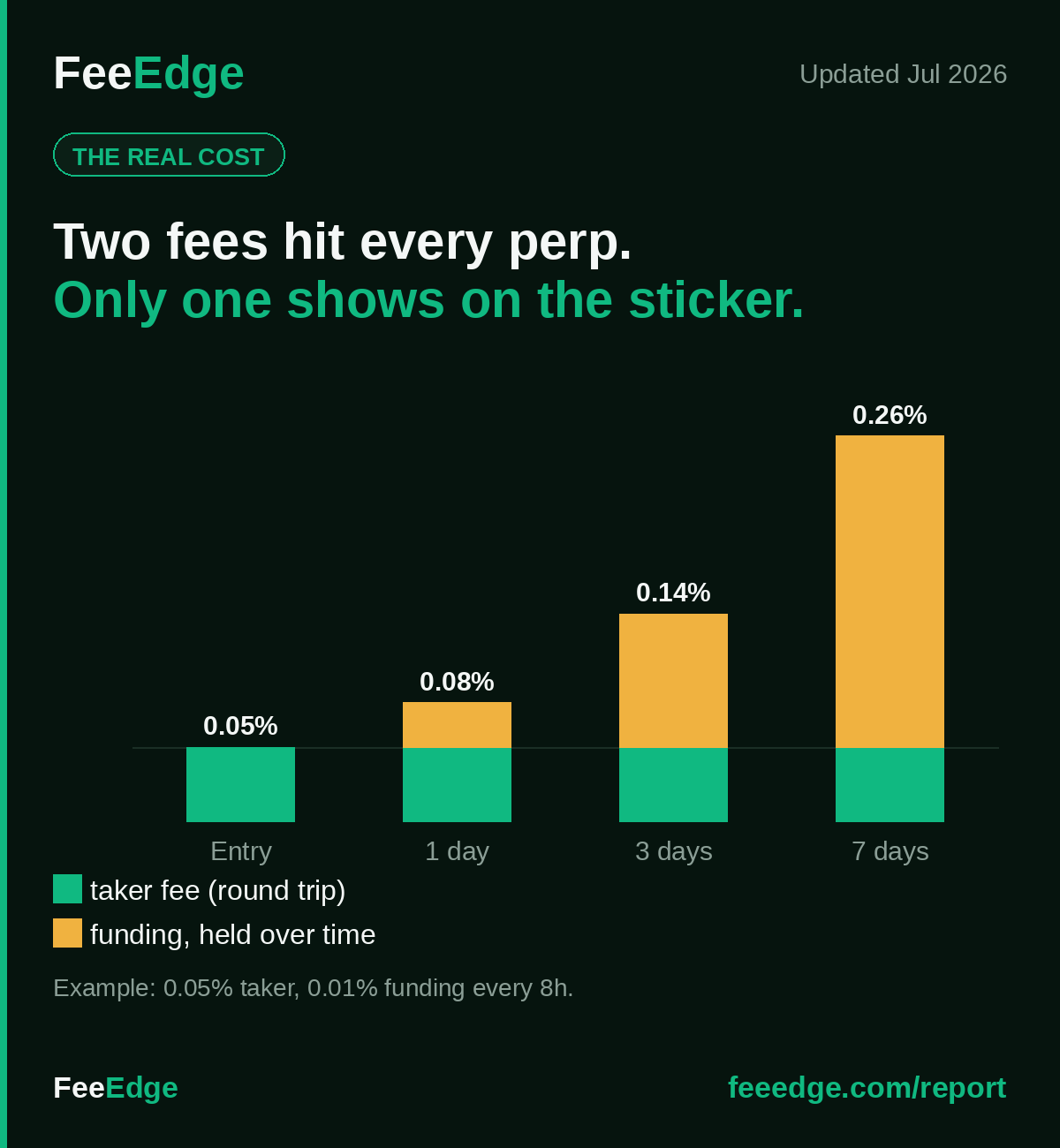
Every exchange advertises a taker fee. On perpetual futures that is only about half of what you actually pay. The other half is funding, charged on your whole position every 8 hours, and it never shows on the sticker. Hold a position for a few days and funding can quietly cost more than the fee you were comparing, which means the cheapest venue to trade is often not the cheapest venue to hold.
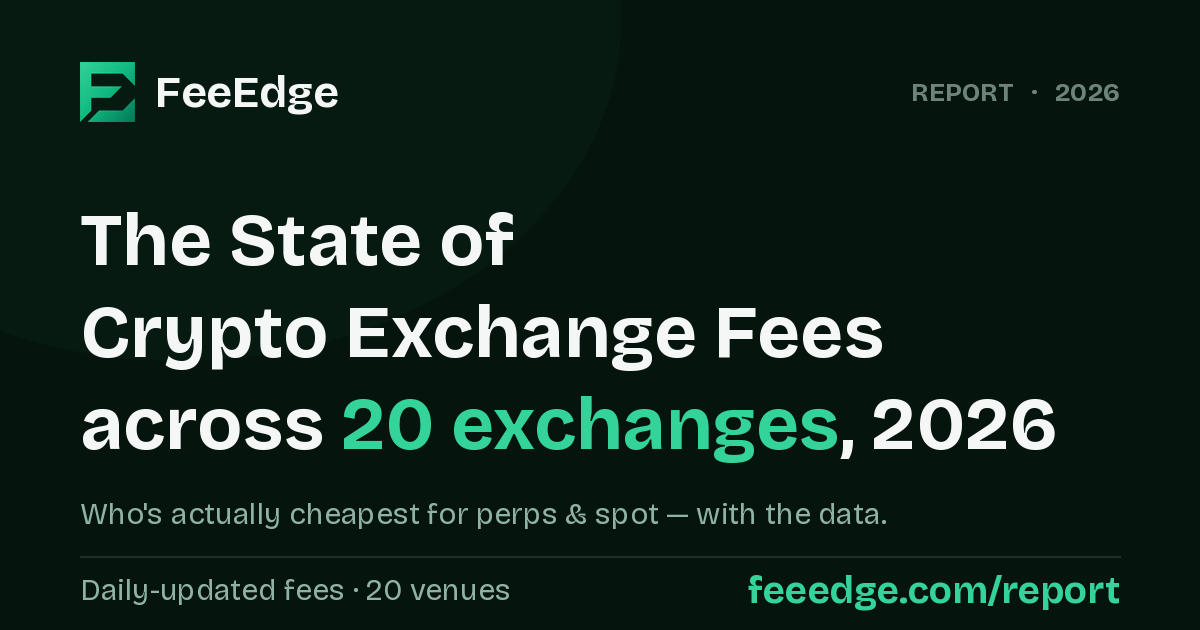
FeeEdge ranks 20 major crypto exchanges by your real estimated monthly cost, fees plus funding, tuned to how you actually trade. You set your monthly volume, your maker and taker mix, your market (perps or spot) and your assets, and it ranks every venue for your exact profile. Volume tiers and native token discounts are factored in.
There is also a free Fee Audit. Drop your exchange trade history CSV in and see exactly what you paid in fees and funding. It parses entirely in your browser, so your trade history never leaves your device and nothing is uploaded.
Free to use with no account required. Pro is a one time $29 unlock, no subscription. Rankings are estimates computed from published fee schedules and live funding data, not financial advice. FeeEdge uses affiliate links to some exchanges, but they never affect the rankings.
Features
- Ranks 20 exchanges by your real all in monthly cost, not the headline rate
- Includes perpetual funding, the cost most fee comparisons ignore
- Fee Audit: reads your trade history CSV entirely in your browser, nothing uploaded
- Funding rate optimizer: the cheapest venue to hold a long or a short
- Native token discount modelling for BNB, OKB, GT, KCS and more
- Withdrawal fee comparison by asset and network
- Volume tier savings ladder, showing where more volume unlocks a cheaper tier
- Head to head comparison of any two venues for your exact profile
- Email alerts when a cheaper venue appears for your profile
- PDF and CSV export, plus saved and shareable scenarios
- Fee data checked daily, with the last updated date shown on every venue
Use Cases
- Perps traders checking whether funding is quietly eating their edge on their current venue
- Bot and grid traders, where a high fill count multiplies every basis point of fee
- Arbitrage and delta neutral desks that need fees plus funding as one number per venue
- Traders picking a first exchange who want the real cost, not the advertised rate
- Auditing what you actually paid last month by dropping in your own trade history CSV
- Deciding whether holding a native token like BNB or OKB is worth it at your volume
- Checking if you are close to a cheaper volume tier before you change venue

Comments


I trade perps, and I got tired of the fact that every exchange advertises a taker fee that is only about half of what you actually pay. Funding is charged on your whole position every 8 hours, so hold for a few days and it can quietly cost more than the fee you were comparing. The cheapest venue to trade is often not the cheapest venue to hold. It started as a spreadsheet. Maker and taker rates in one tab, funding in another, volume tiers in a third, redone every few months and out of date the moment an exchange changed its schedule. At some point the spreadsheet became a tool, and the tool became FeeEdge. Two things I care about: The Fee Audit reads your exchange trade history CSV entirely in your browser. It never touches a server. Asking someone to upload their full trading history to a stranger's site just to see what they paid felt wrong. The fee data is a mix of live API fetches, scrapes, and hand verified published rates. Only about 7 of 40 rate rows actually auto refresh today, so instead of a vague "updated recently" badge, every venue shows the real date its rate was last updated. Expanding that live coverage is the main thing I am working on. Free to use, no account needed for the calculator, the CSV audit, or the funding board. Happy to answer anything about the cost model or the data pipeline.

FeeEdge has great potential! A few improvements could make it even better. I'd love to share my feedback and suggestions. WhatsApp: https://wa.me/447307349530 Telegram: t.me/rforrank


Most fee comparisons stop at the taker rate and ignore funding, which is exactly where perps traders actually bleed over a multi-day hold — factoring both into one real monthly cost per exchange is the right way to frame it. The client-side Fee Audit is the clincher: parsing your trade history CSV entirely in-browser means you get an honest audit of what you actually paid without having to hand your trade history to anyone.
Premium Products




































Awards
View all
Awards
View allMakers
Makers
Comments
I trade perps, and I got tired of the fact that every exchange advertises a taker fee that is only about half of what you actually pay. Funding is charged on your whole position every 8 hours, so hold for a few days and it can quietly cost more than the fee you were comparing. The cheapest venue to trade is often not the cheapest venue to hold. It started as a spreadsheet. Maker and taker rates in one tab, funding in another, volume tiers in a third, redone every few months and out of date the moment an exchange changed its schedule. At some point the spreadsheet became a tool, and the tool became FeeEdge. Two things I care about: The Fee Audit reads your exchange trade history CSV entirely in your browser. It never touches a server. Asking someone to upload their full trading history to a stranger's site just to see what they paid felt wrong. The fee data is a mix of live API fetches, scrapes, and hand verified published rates. Only about 7 of 40 rate rows actually auto refresh today, so instead of a vague "updated recently" badge, every venue shows the real date its rate was last updated. Expanding that live coverage is the main thing I am working on. Free to use, no account needed for the calculator, the CSV audit, or the funding board. Happy to answer anything about the cost model or the data pipeline.
FeeEdge has great potential! A few improvements could make it even better. I'd love to share my feedback and suggestions. WhatsApp: https://wa.me/447307349530 Telegram: t.me/rforrank
Most fee comparisons stop at the taker rate and ignore funding, which is exactly where perps traders actually bleed over a multi-day hold — factoring both into one real monthly cost per exchange is the right way to frame it. The client-side Fee Audit is the clincher: parsing your trade history CSV entirely in-browser means you get an honest audit of what you actually paid without having to hand your trade history to anyone.
Premium Products
New to Fazier?

Find your next favorite product or submit your own. Made by @FalakDigital.
Copyright ©2026. All Rights Reserved