Launch
Faculty Atlas
Visit
Example Image

Faculty Atlas

Find the academics you need to reach

Visit

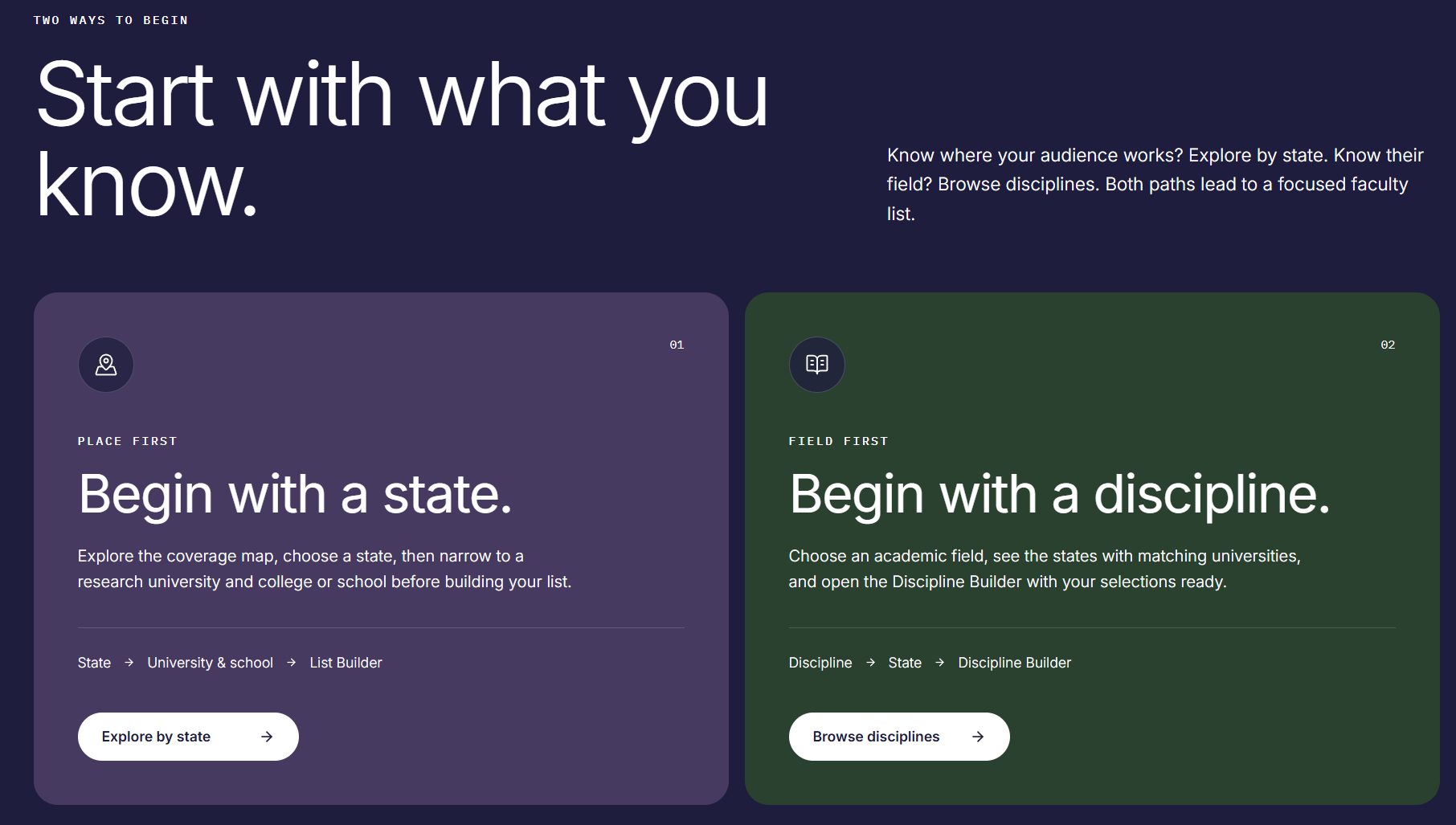
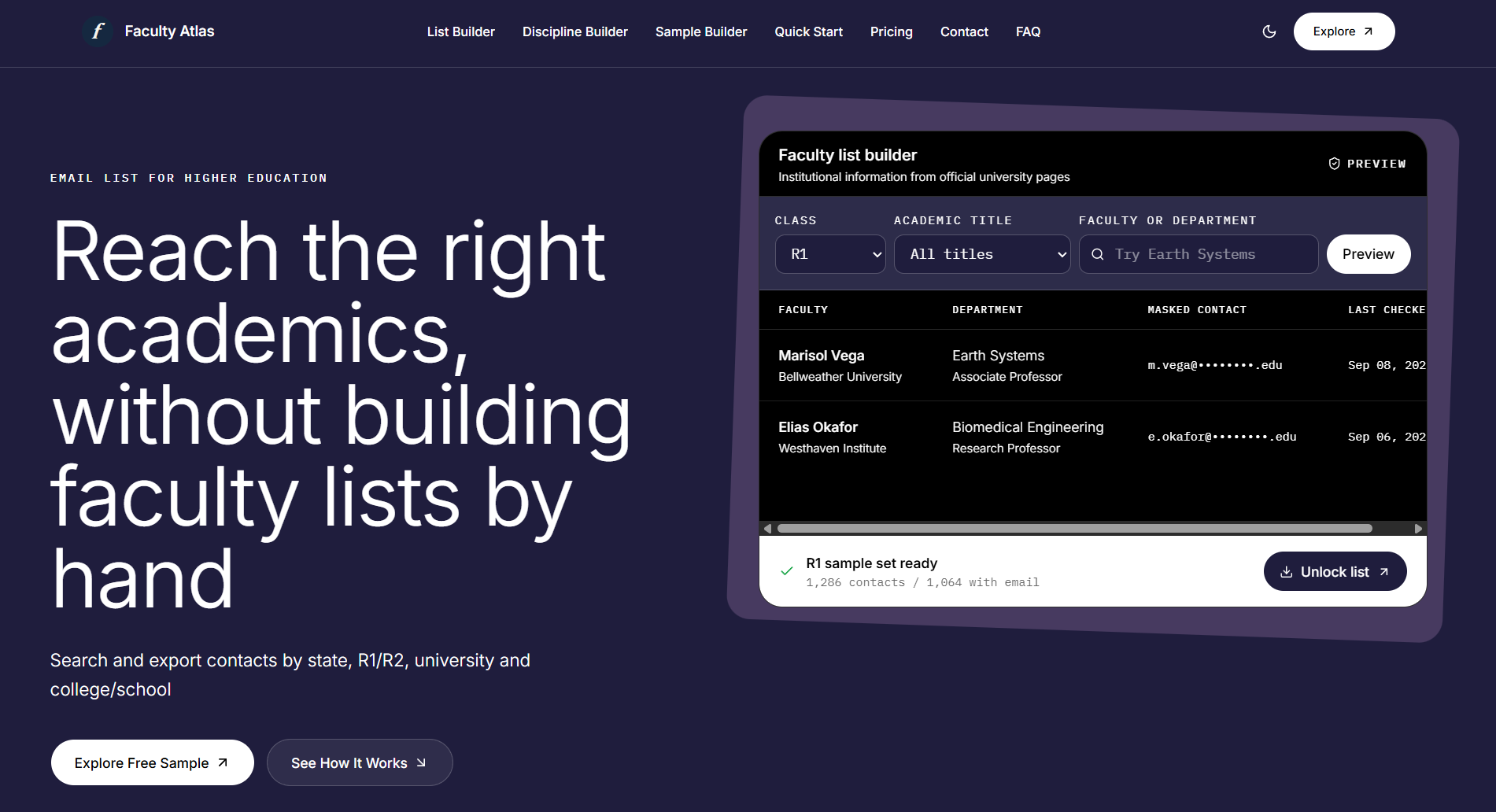
Faculty Atlas helps you build targeted faculty contact lists for higher education. You can search and export contacts by state, R1/R2 status, university, college, school, discipline, and academic title. It shows institutional context before you pay, so you can preview matches and only unlock useful rows. The data comes from public university pages and includes freshness notes, masked emails, and opt-out handling. It is built for teams in academic publishing, research software, campus technology, and professional development.
Example Image
Example Image
Example Image
Example Image

Features

  • Search faculty by state, discipline, university, and title
  • Preview institutional context before unlocking any contact rows
  • Use credits only for records that include email addresses
  • Build lists from official university pages with freshness dates
  • Choose between state-first or discipline-first workflows

Comments

custom-img
Keep going

Build targeted U.S. faculty contact lists from public university sources. Explore coverage, preview records, and choose the contacts your outreach needs.

Previewing institutional context before unlocking rows and only spending credits on records with emails feels fair to buyers. Do you show a freshness date per record before unlock, and how do you handle faculty who move universities between scrapes?

custom-img
Co-founder & CTO at Breni | AI learning ...

Nice work! The discipline-first workflow plus R1/R2 filtering is exactly what campus-focused teams need. Would love to see a research-interest filter down the line. Congrats on launching!

Filtering by R1/R2 status together with discipline and academic title is more precise than a flat university directory. Because emails stay masked until a credit is spent, can a row show just the email domain before unlock so teams can skip personal addresses?

Nice product for finding the academics

custom-img
Building bhalophone, an AI powered phone...

Really solid concept. Anyone who has tried to manually scrape faculty directories across different university websites knows how messy and inconsistent that data is. Love that you include opt-out handling and freshness notes right out of the box.

Filtering by R1/R2 status together with discipline and academic title is more precise than a flat university directory. Because emails stay masked until a credit is spent, can a row show just the email domain before unlock so teams can skip personal addresses?

custom-img
Founder of Qovia

Previewing the institution before spending credits, and only charging for rows that include an email, is a clearer model than buying a bulk dump. The R1/R2 plus title filters match how academic-publishing outreach is actually scoped. Do freshness dates update when a faculty page is re-scraped after someone changes universities, or do they stay on the first capture?

Filtering by R1/R2 status together with discipline and academic title is more precise than a flat university directory. Because emails stay masked until a credit is spent, can a row show just the email domain before unlock so teams can skip personal addresses?

custom-img
CodeDebut.com

Really useful approach, previewing institutional context before spending credits makes targeted faculty outreach much more efficient.

Congrats on the launch of Faculty Atlas! Simplifying academic networking and faculty discovery is a huge win for researchers and institutions alike. Wishing you great success in scaling the platform and bringing more visibility to academic expertise!

The masked emails and opt-out handling are a thoughtful touch for a contact database. Would it be possible to show how many records in a search have a verified email before credits are spent, so buyers can estimate cost up front?

Great Use credits only for records that include email addresses

Freshness notes and opt-out handling are smart — most academic contact lists go stale and skip compliance entirely. How do you handle shared department inboxes vs. individual faculty emails?

Very thoughtful niche directory. Connecting researchers directly based on recent publication vectors rather than static department directories solves a genuine discovery bottleneck. How are you handling cross-institutional citation matching?

custom-img
I build & lead the engineering behind AI...

The discipline-first filtering plus R1/R2 status search saves so much time. Clean data model.

Really clean approach to a notoriously messy vertical. Showing freshness dates and handling opt-outs upfront solves the two biggest headaches with academic directories—data decay and compliance. Congrats on launching Faculty Atlas!

Previewing institutional context before unlocking rows is a fair model: you only pay for contacts you will actually use. How often are records refreshed from the university pages, and does the freshness note show the date of the last check for each contact? For teams in Europe, how do you handle opt-out requests and GDPR when a contact is exported?

Spending credits only on rows that include an email is a sensible way to price contact data. When a faculty member uses the opt-out, is the record also removed from exports a team already unlocked, or only from future searches?

For outreach compliance, buyers will likely want to know where each address came from. Do exported rows include the source university page URL and capture date? Also, if two saved searches overlap, are already-unlocked contacts recognized so credits are not spent twice on the same person?

The option to only spend credits on rows that include an email is a smart way to avoid paying for empty records. A saved filter combo for state plus discipline would make repeat list building faster.

custom-img
Pantheon.ad

great product, interesting to see more about

Premium Products
View all
Example Image
Awards
View all
Example Image
Makers

Comments

custom-img
Keep going

Build targeted U.S. faculty contact lists from public university sources. Explore coverage, preview records, and choose the contacts your outreach needs.

Previewing institutional context before unlocking rows and only spending credits on records with emails feels fair to buyers. Do you show a freshness date per record before unlock, and how do you handle faculty who move universities between scrapes?

custom-img
Co-founder & CTO at Breni | AI learning ...

Nice work! The discipline-first workflow plus R1/R2 filtering is exactly what campus-focused teams need. Would love to see a research-interest filter down the line. Congrats on launching!

Filtering by R1/R2 status together with discipline and academic title is more precise than a flat university directory. Because emails stay masked until a credit is spent, can a row show just the email domain before unlock so teams can skip personal addresses?

Nice product for finding the academics

custom-img
Building bhalophone, an AI powered phone...

Really solid concept. Anyone who has tried to manually scrape faculty directories across different university websites knows how messy and inconsistent that data is. Love that you include opt-out handling and freshness notes right out of the box.

Filtering by R1/R2 status together with discipline and academic title is more precise than a flat university directory. Because emails stay masked until a credit is spent, can a row show just the email domain before unlock so teams can skip personal addresses?

custom-img
Founder of Qovia

Previewing the institution before spending credits, and only charging for rows that include an email, is a clearer model than buying a bulk dump. The R1/R2 plus title filters match how academic-publishing outreach is actually scoped. Do freshness dates update when a faculty page is re-scraped after someone changes universities, or do they stay on the first capture?

Filtering by R1/R2 status together with discipline and academic title is more precise than a flat university directory. Because emails stay masked until a credit is spent, can a row show just the email domain before unlock so teams can skip personal addresses?

custom-img
CodeDebut.com

Really useful approach, previewing institutional context before spending credits makes targeted faculty outreach much more efficient.

Congrats on the launch of Faculty Atlas! Simplifying academic networking and faculty discovery is a huge win for researchers and institutions alike. Wishing you great success in scaling the platform and bringing more visibility to academic expertise!

The masked emails and opt-out handling are a thoughtful touch for a contact database. Would it be possible to show how many records in a search have a verified email before credits are spent, so buyers can estimate cost up front?

Great Use credits only for records that include email addresses

Freshness notes and opt-out handling are smart — most academic contact lists go stale and skip compliance entirely. How do you handle shared department inboxes vs. individual faculty emails?

Very thoughtful niche directory. Connecting researchers directly based on recent publication vectors rather than static department directories solves a genuine discovery bottleneck. How are you handling cross-institutional citation matching?

custom-img
I build & lead the engineering behind AI...

The discipline-first filtering plus R1/R2 status search saves so much time. Clean data model.

Really clean approach to a notoriously messy vertical. Showing freshness dates and handling opt-outs upfront solves the two biggest headaches with academic directories—data decay and compliance. Congrats on launching Faculty Atlas!

Previewing institutional context before unlocking rows is a fair model: you only pay for contacts you will actually use. How often are records refreshed from the university pages, and does the freshness note show the date of the last check for each contact? For teams in Europe, how do you handle opt-out requests and GDPR when a contact is exported?

Spending credits only on rows that include an email is a sensible way to price contact data. When a faculty member uses the opt-out, is the record also removed from exports a team already unlocked, or only from future searches?

For outreach compliance, buyers will likely want to know where each address came from. Do exported rows include the source university page URL and capture date? Also, if two saved searches overlap, are already-unlocked contacts recognized so credits are not spent twice on the same person?


The option to only spend credits on rows that include an email is a smart way to avoid paying for empty records. A saved filter combo for state plus discipline would make repeat list building faster.

custom-img
Pantheon.ad

great product, interesting to see more about

Premium Products