Error Whisperer
Plain-English fixes for your AI-built app’s errors
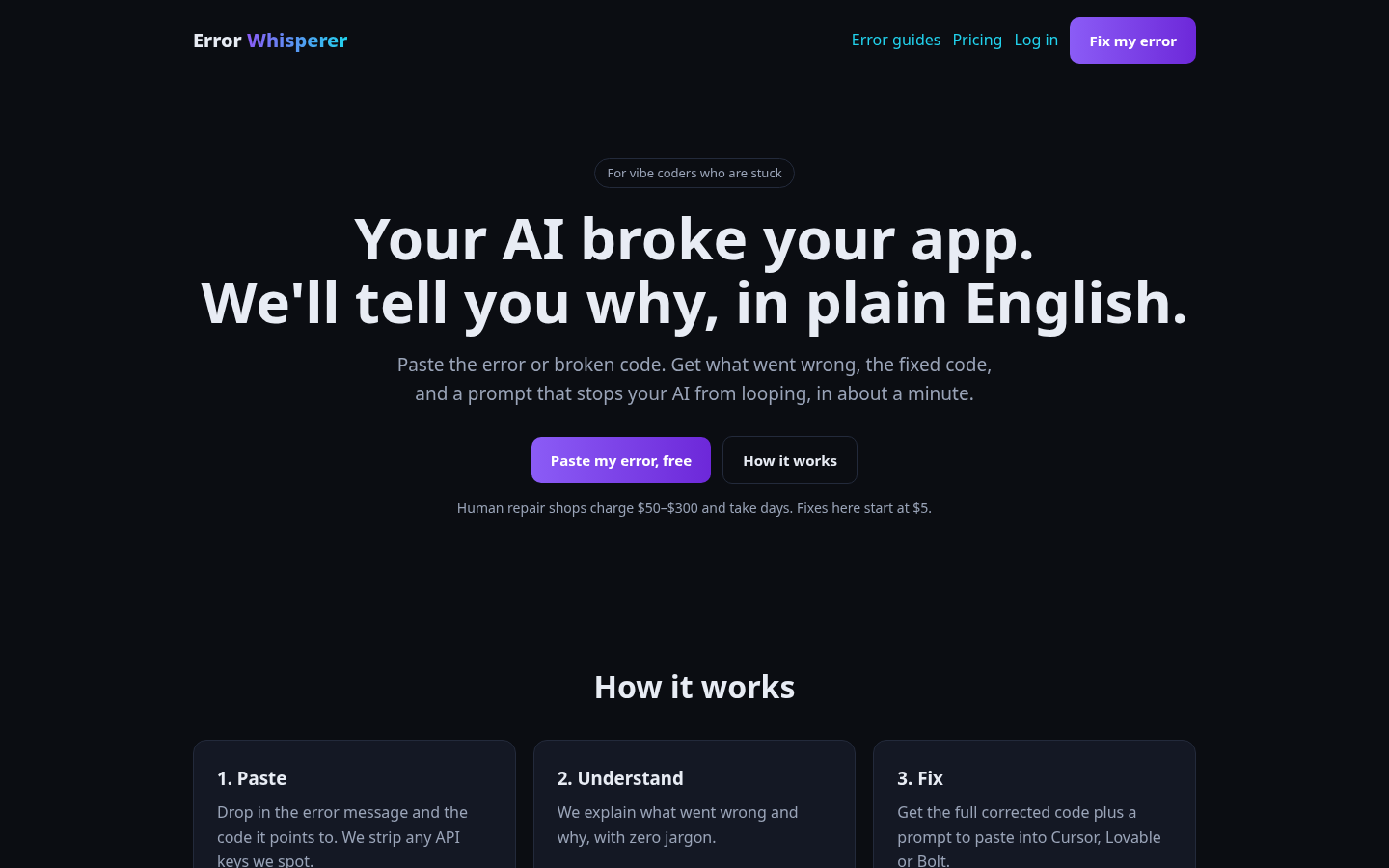
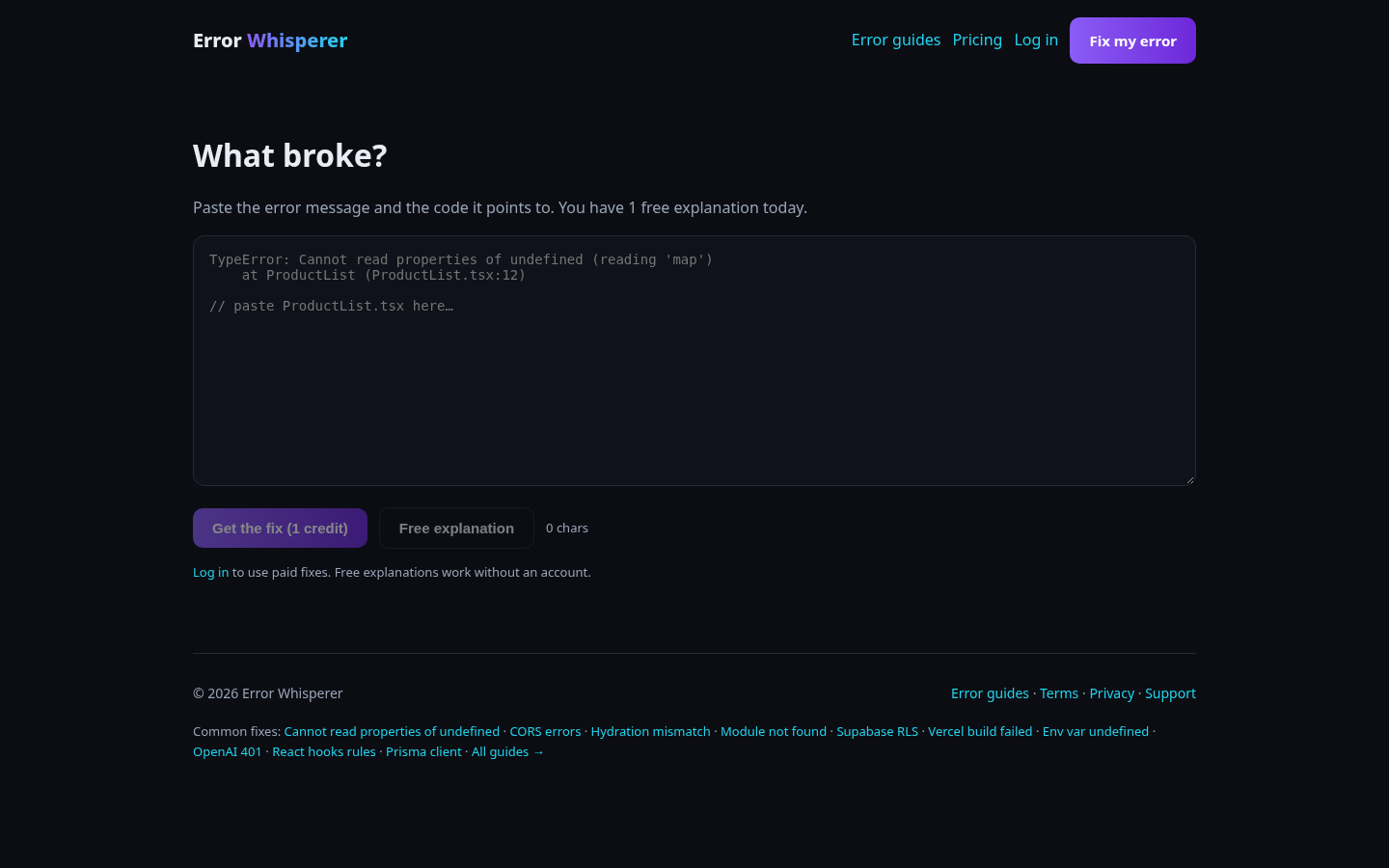
Error Whisperer is a plain-English error fixer for people building apps with AI tools such as Lovable, Bolt, Cursor, Replit and v0. Paste an error message or the broken code it points to, and get a clear explanation of what went wrong plus a working fix with corrected code you can paste in. It is tuned for everyday errors like CORS problems, React hydration mismatches, Supabase row-level security errors and failed Vercel builds. One free plain-English explanation a day, no account needed. Full fixes are paid per fix or with monthly plans, and it was built by Brian Lavallee, a self-taught builder.
Features
Plain-English explanation of any error or stack trace
Working fix with corrected code, ready to paste in
Tuned for code from Lovable, Bolt, Cursor, Replit and v0
1 free explanation a day, no account needed
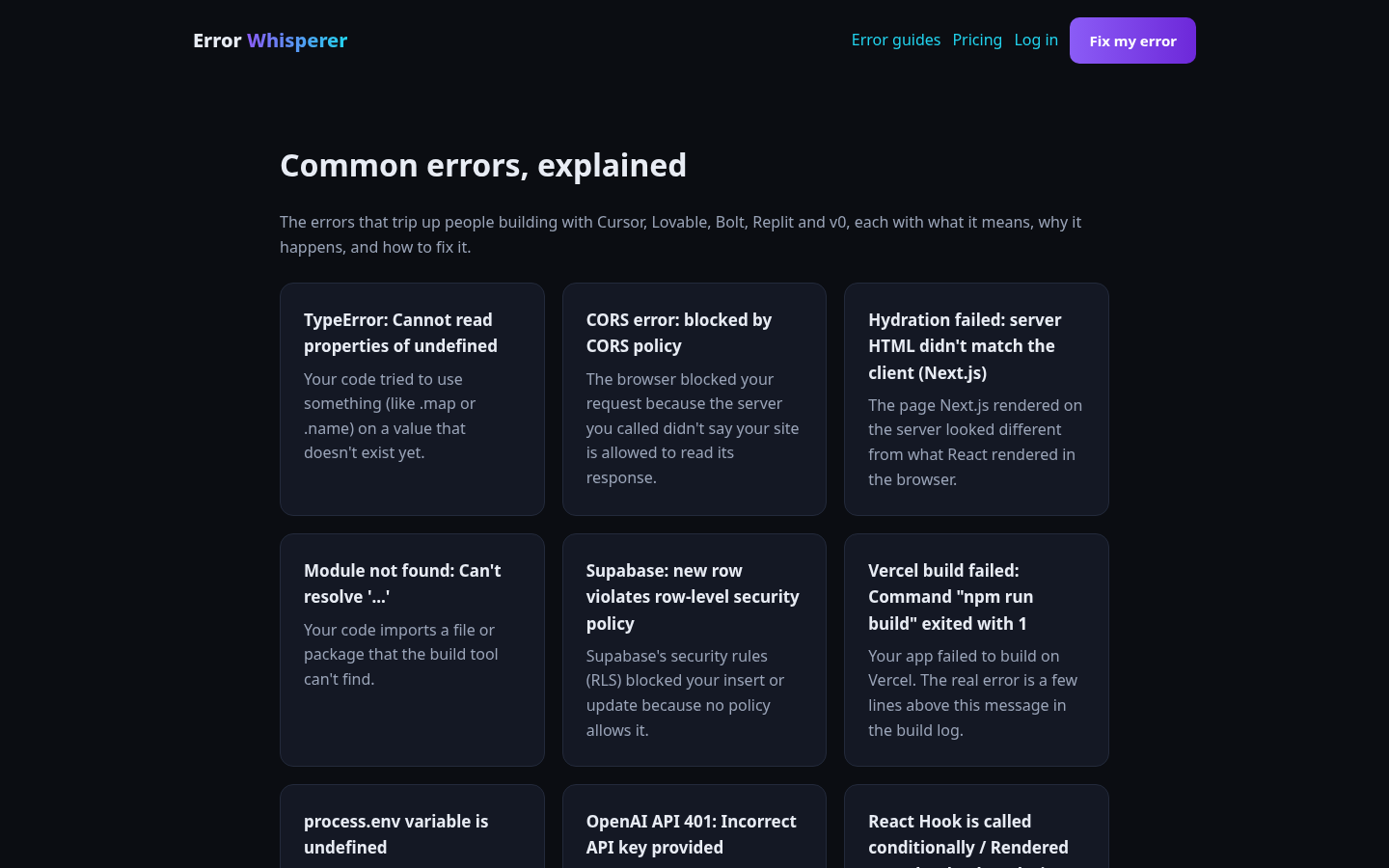
15 free guides to common vibe-coding errors (CORS, hydration, Supabase RLS, Vercel builds)
Use Cases
Non-developers and vibe coders building with AI app builders
Indie hackers and solo founders shipping MVPs fast
Students and beginners learning to code with AI
Developers who want a quick second opinion on a confusing stack trace

Comments


This targets the exact gap AI-assisted coding leaves behind: the error is in plain English but the fix still needs context. Suggestion from a fellow tool maker - if you can detect the framework (Next/Vite/CRA) from the stack trace and tailor the fix steps, that would cut the guesswork significantly.


Supabase RLS errors are a great pick to tune for, because the error message rarely tells you which policy is missing. Does the fix suggest the actual SQL policy to add, or does it mostly explain the concept? I'd also be curious how it handles hydration mismatches where the root cause is a browser extension rather than the generated code.

Read the Supabase RLS guide. Calling out that a blocked read returns an empty list instead of an error is the part that trips most people, and refusing the "just use service_role" fix is the right default for AI-built apps. One case worth adding is the reverse problem: a Postgres view runs with its owner's rights by default, so a view over an RLS table can hand every row to the anon key, and nothing errors. Agents create views freely, so it goes unnoticed. security_invoker = on, or revoking the view from anon, fixes it.
Supabase RLS errors are a great pick to tune for, since the error message rarely tells you which policy is missing. When the fix involves a new RLS policy, do you explain how to test it from the anon vs. authenticated role, or just give the SQL? A quick verification step would stop people from 'fixing' it by simply disabling RLS.
Smart niche. Vibe coders hit CORS and Supabase RLS errors constantly and the raw messages are cryptic, so plain English plus a ready-to-paste fix is exactly the right pairing. Question: does it connect to a deployed app's error logs, or is the workflow paste-the-error-in? Direct log integration would make this a daily-use tool.


The daily free explanation is a clever on-ramp, since vibe coders are usually stuck, not browsing. One question: does the free tier also include the corrected code snippet, or just the plain-English explanation? If the fix itself is paywalled, a stuck user still can't ship that day. Also, Vercel build failures usually need the full build log to diagnose properly — is there a paste limit on how much I can drop in, or should I trim it to the failing section?
Premium Products





















































Sponsors
Buy

Makers
Makers
Comments
This targets the exact gap AI-assisted coding leaves behind: the error is in plain English but the fix still needs context. Suggestion from a fellow tool maker - if you can detect the framework (Next/Vite/CRA) from the stack trace and tailor the fix steps, that would cut the guesswork significantly.
Supabase RLS errors are a great pick to tune for, because the error message rarely tells you which policy is missing. Does the fix suggest the actual SQL policy to add, or does it mostly explain the concept? I'd also be curious how it handles hydration mismatches where the root cause is a browser extension rather than the generated code.
Read the Supabase RLS guide. Calling out that a blocked read returns an empty list instead of an error is the part that trips most people, and refusing the "just use service_role" fix is the right default for AI-built apps. One case worth adding is the reverse problem: a Postgres view runs with its owner's rights by default, so a view over an RLS table can hand every row to the anon key, and nothing errors. Agents create views freely, so it goes unnoticed. security_invoker = on, or revoking the view from anon, fixes it.
Supabase RLS errors are a great pick to tune for, since the error message rarely tells you which policy is missing. When the fix involves a new RLS policy, do you explain how to test it from the anon vs. authenticated role, or just give the SQL? A quick verification step would stop people from 'fixing' it by simply disabling RLS.
Smart niche. Vibe coders hit CORS and Supabase RLS errors constantly and the raw messages are cryptic, so plain English plus a ready-to-paste fix is exactly the right pairing. Question: does it connect to a deployed app's error logs, or is the workflow paste-the-error-in? Direct log integration would make this a daily-use tool.
The daily free explanation is a clever on-ramp, since vibe coders are usually stuck, not browsing. One question: does the free tier also include the corrected code snippet, or just the plain-English explanation? If the fix itself is paywalled, a stuck user still can't ship that day. Also, Vercel build failures usually need the full build log to diagnose properly — is there a paste limit on how much I can drop in, or should I trim it to the failing section?
Premium Products
New to Fazier?

Find your next favorite product or submit your own. Made by @FalakDigital.
Copyright ©2026. All Rights Reserved