Durabl
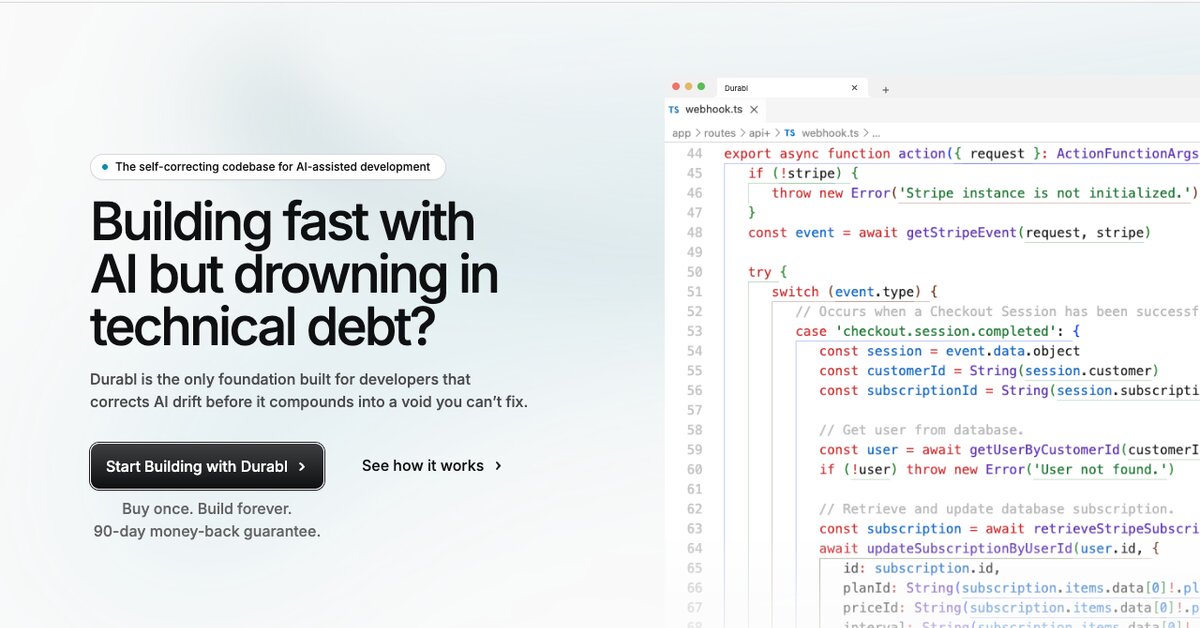
The self-correcting codebase for AI-assisted development
Durabl is the only foundation built for developers that corrects AI drift before it compounds into a void you can’t fix.
It is a founding-state codebase: UI, database, auth, payments, email, tests, and CI, with AI skills that plan, test, and self-correct. Buy once. Build forever. 90-day money-back guarantee.
Features
- UI, database, auth, payments, email, tests, CI/CD, monitoring, SEO, and analytics
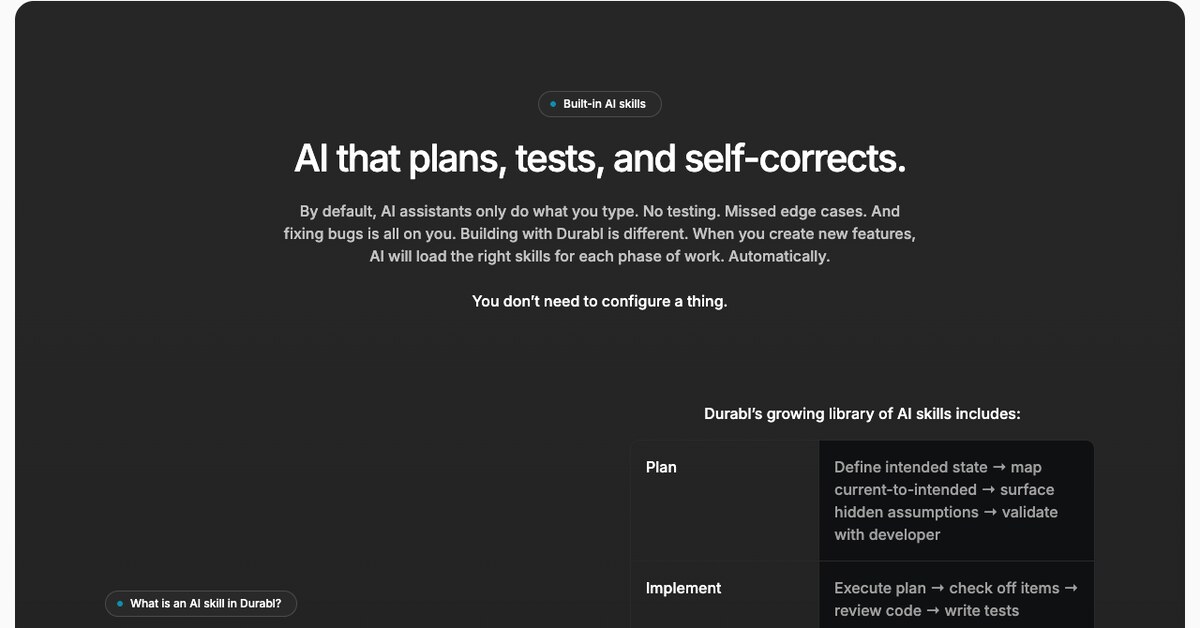
- AI skills that load for each phase of work, so the assistant plans, tests, and self-corrects
- SQLite with LiteFS: local reads, and the same database in development and production
- A documented schema with versioned migrations, so the AI is not guessing the data model
Use Cases
- Start a new app on a foundation that corrects AI drift before it compounds
- Ship with auth, payments, and email already decided, instead of rebuilding them
- Give an AI assistant skills, tests, and schema so each session keeps the codebase intact

Comments


Starting from a codebase that already has auth, payments, tests and CI wired up makes a lot of sense for AI-assisted work, since most of the drift I see happens in exactly that glue code. Curious how the versioned migrations hold up when the AI suggests schema changes. Does it always generate a migration, or can it edit the schema directly?


Giving the assistant a documented schema with versioned migrations makes a lot of sense, that's usually where it starts guessing for me. How does Durabl notice drift in practice? Is it the tests failing, or do the skills check new code against the patterns already in the repo before anything gets written?
The SQLite plus LiteFS choice is a bold default for a starter, and I like that the schema and migrations are documented so the assistant is not guessing. What happens when a developer has already diverged from the template? When a new version of the foundation ships, does the migration skill know about my own tables and customisations, or is the update path mostly manual merging?

Shipping the tests, schema and CI decisions up front so the AI works inside guardrails is a clear answer to AI drift. Is the buyer mostly solo devs starting new SaaS projects, or small agencies reusing it across clients? Search note: I googled "saas boilerplate for ai coding agents" (Google, US settings). Page 1 is a SaaSPilot repo on GitHub, a Reddit thread, a Medium guide, Lovable's template list, BoilerplateSearch's "Top AI SaaS Boilerplates (2026)", a dev.to post on how coding agents choose boilerplates, MakerKit, VibeReady and BoilerplateHub. Durabl isn't on it yet; the BoilerplateSearch and MakerKit comparison lists look like the ones to get onto. I run AI Knows Us, so this kind of search check is what I do.
Shipping the AI skills alongside the tests and a documented schema is a smart pairing, since the assistant gets both the rules and a way to check itself. From the page, the SQLite plus LiteFS setup keeps dev and prod on the same database, which should cut a whole class of "works locally" surprises. One suggestion: a short changelog or diff view per foundation release would make it easier for buyers to decide which updates to pull into a project that has already grown its own shape.
Shipping SQLite with LiteFS as the same database in dev and production is a bold choice that makes the AI skills' tests much more trustworthy. How do the phase-based skills handle a schema migration, and would they flag it if the assistant edits the documented schema without adding a versioned migration?
Premium Products







































Sponsors
Buy

Makers
Makers
Comments
Starting from a codebase that already has auth, payments, tests and CI wired up makes a lot of sense for AI-assisted work, since most of the drift I see happens in exactly that glue code. Curious how the versioned migrations hold up when the AI suggests schema changes. Does it always generate a migration, or can it edit the schema directly?
Giving the assistant a documented schema with versioned migrations makes a lot of sense, that's usually where it starts guessing for me. How does Durabl notice drift in practice? Is it the tests failing, or do the skills check new code against the patterns already in the repo before anything gets written?
The SQLite plus LiteFS choice is a bold default for a starter, and I like that the schema and migrations are documented so the assistant is not guessing. What happens when a developer has already diverged from the template? When a new version of the foundation ships, does the migration skill know about my own tables and customisations, or is the update path mostly manual merging?
Shipping the tests, schema and CI decisions up front so the AI works inside guardrails is a clear answer to AI drift. Is the buyer mostly solo devs starting new SaaS projects, or small agencies reusing it across clients? Search note: I googled "saas boilerplate for ai coding agents" (Google, US settings). Page 1 is a SaaSPilot repo on GitHub, a Reddit thread, a Medium guide, Lovable's template list, BoilerplateSearch's "Top AI SaaS Boilerplates (2026)", a dev.to post on how coding agents choose boilerplates, MakerKit, VibeReady and BoilerplateHub. Durabl isn't on it yet; the BoilerplateSearch and MakerKit comparison lists look like the ones to get onto. I run AI Knows Us, so this kind of search check is what I do.
Shipping the AI skills alongside the tests and a documented schema is a smart pairing, since the assistant gets both the rules and a way to check itself. From the page, the SQLite plus LiteFS setup keeps dev and prod on the same database, which should cut a whole class of "works locally" surprises. One suggestion: a short changelog or diff view per foundation release would make it easier for buyers to decide which updates to pull into a project that has already grown its own shape.
Shipping SQLite with LiteFS as the same database in dev and production is a bold choice that makes the AI skills' tests much more trustworthy. How do the phase-based skills handle a schema migration, and would they flag it if the assistant edits the documented schema without adding a versioned migration?
Premium Products
New to Fazier?

Find your next favorite product or submit your own. Made by @FalakDigital.
Copyright ©2026. All Rights Reserved