
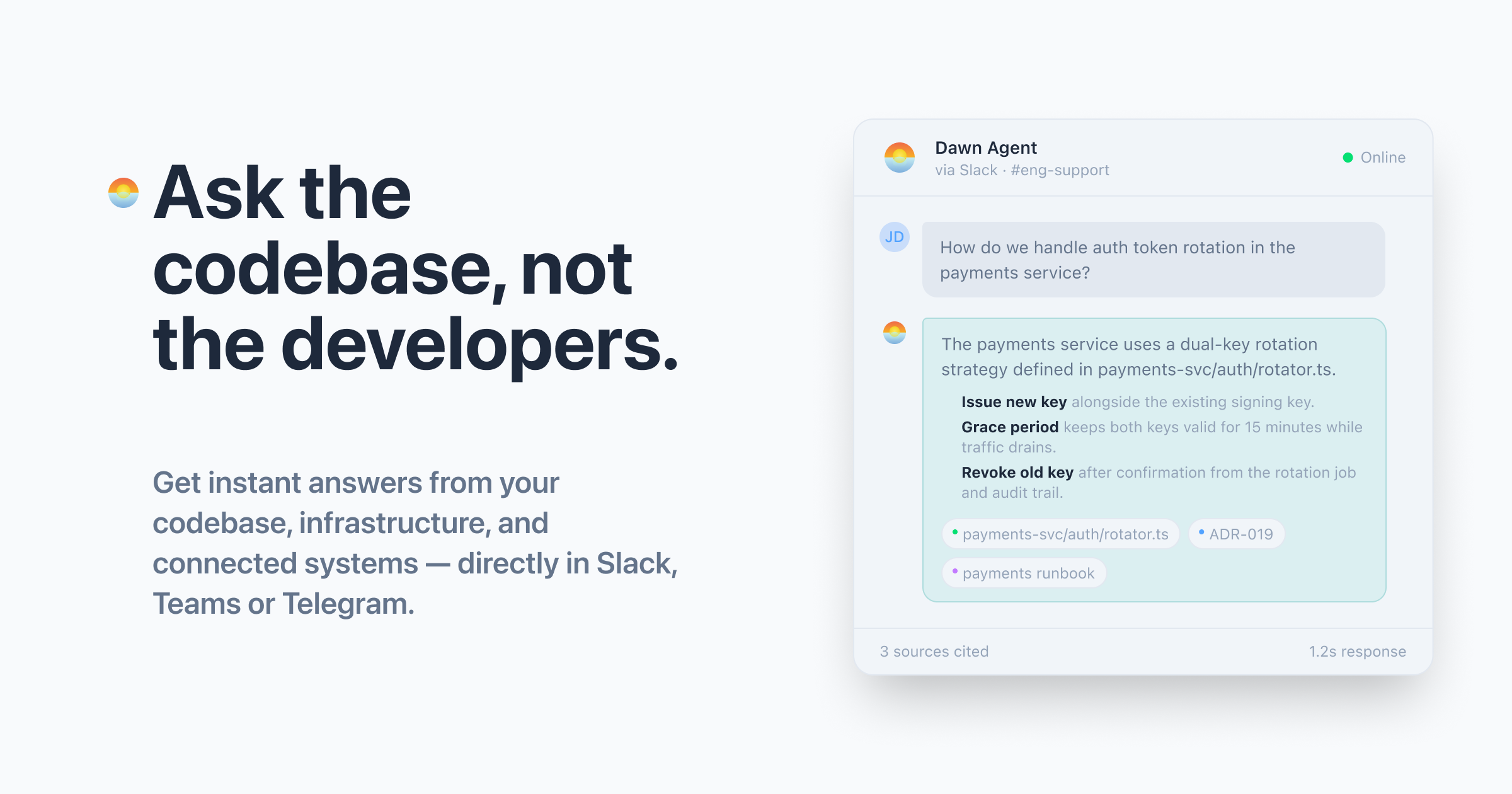
Dawn lets teams ask the codebase directly - in the chat tools they already use.
Instead of waiting on engineering, ask Dawn how something works, where it is implemented, or why it failed.
Features
- Use connected repositories, tickets, docs, and provider controls to turn a plain-language question into an answer grounded in the real system.
- Memory pages turn repeated explanations, runbooks, and architecture notes into reusable context Dawn can carry across future questions.
- When a question turns into repeatable work, Dawn can schedule it and deliver the result back into the right conversation automatically.
- Teams can ask about screenshots, reports, exports, and generated assets without leaving the conversation that already contains the question.

Comments


The memory pages for repeated questions is the feature that stands out most to me — turning one-off Slack answers into reusable runbooks is something most teams do poorly (usually someone saves it in Notion and it rots). The ability to schedule recurring question delivery is also clever for things like weekly build summaries or deployment status. The big unlock I'd be curious about: how does Dawn handle cases where the answer has changed but the memory page hasn't been updated? Does it re-index automatically or does someone need to invalidate stale context manually?





The idea of querying a codebase in plain language directly from chat tools is genuinely useful — onboarding new developers alone could justify the tool. The memory pages feature is what stands out most: turning repeated architecture explanations into reusable context solves a real pain point in growing teams. Curious how Dawn handles codebases with mixed languages or legacy systems with poor documentation — is the accuracy noticeably different?


Understanding how users actually interact with your product is one of the hardest problems in SaaS. The idea of making this discovery faster is compelling. Being able to see real usage patterns rather than relying on surveys or assumptions could fundamentally change how product teams prioritize features. How does Dawn handle privacy-sensitive user interactions?



We shipped a new feature — but it’s really about fixing a bigger problem. Integrations like #Jira ↔ #Telegram often fail when it matters most: missed alerts, delayed updates, broken sync. So we didn’t just build another integration — we focused on making it reliable. In the post: • Why integrations fail • What breaks workflows in reality • How we built a more stable solution If you’ve ever thought “why didn’t this trigger?” — this is for you. 👉 Read more: https://dawnhq.ai/blog/jira-telegram-and-integration-stability

Premium Products












































Sponsors
Buy

Awards
View all
Awards
View allMakers
Makers
Comments
The memory pages for repeated questions is the feature that stands out most to me — turning one-off Slack answers into reusable runbooks is something most teams do poorly (usually someone saves it in Notion and it rots). The ability to schedule recurring question delivery is also clever for things like weekly build summaries or deployment status. The big unlock I'd be curious about: how does Dawn handle cases where the answer has changed but the memory page hasn't been updated? Does it re-index automatically or does someone need to invalidate stale context manually?
The idea of querying a codebase in plain language directly from chat tools is genuinely useful — onboarding new developers alone could justify the tool. The memory pages feature is what stands out most: turning repeated architecture explanations into reusable context solves a real pain point in growing teams. Curious how Dawn handles codebases with mixed languages or legacy systems with poor documentation — is the accuracy noticeably different?
Understanding how users actually interact with your product is one of the hardest problems in SaaS. The idea of making this discovery faster is compelling. Being able to see real usage patterns rather than relying on surveys or assumptions could fundamentally change how product teams prioritize features. How does Dawn handle privacy-sensitive user interactions?
We shipped a new feature — but it’s really about fixing a bigger problem. Integrations like #Jira ↔ #Telegram often fail when it matters most: missed alerts, delayed updates, broken sync. So we didn’t just build another integration — we focused on making it reliable. In the post: • Why integrations fail • What breaks workflows in reality • How we built a more stable solution If you’ve ever thought “why didn’t this trigger?” — this is for you. 👉 Read more: https://dawnhq.ai/blog/jira-telegram-and-integration-stability
Premium Products
New to Fazier?

Find your next favorite product or submit your own. Made by @FalakDigital.
Copyright ©2026. All Rights Reserved