
DapDip
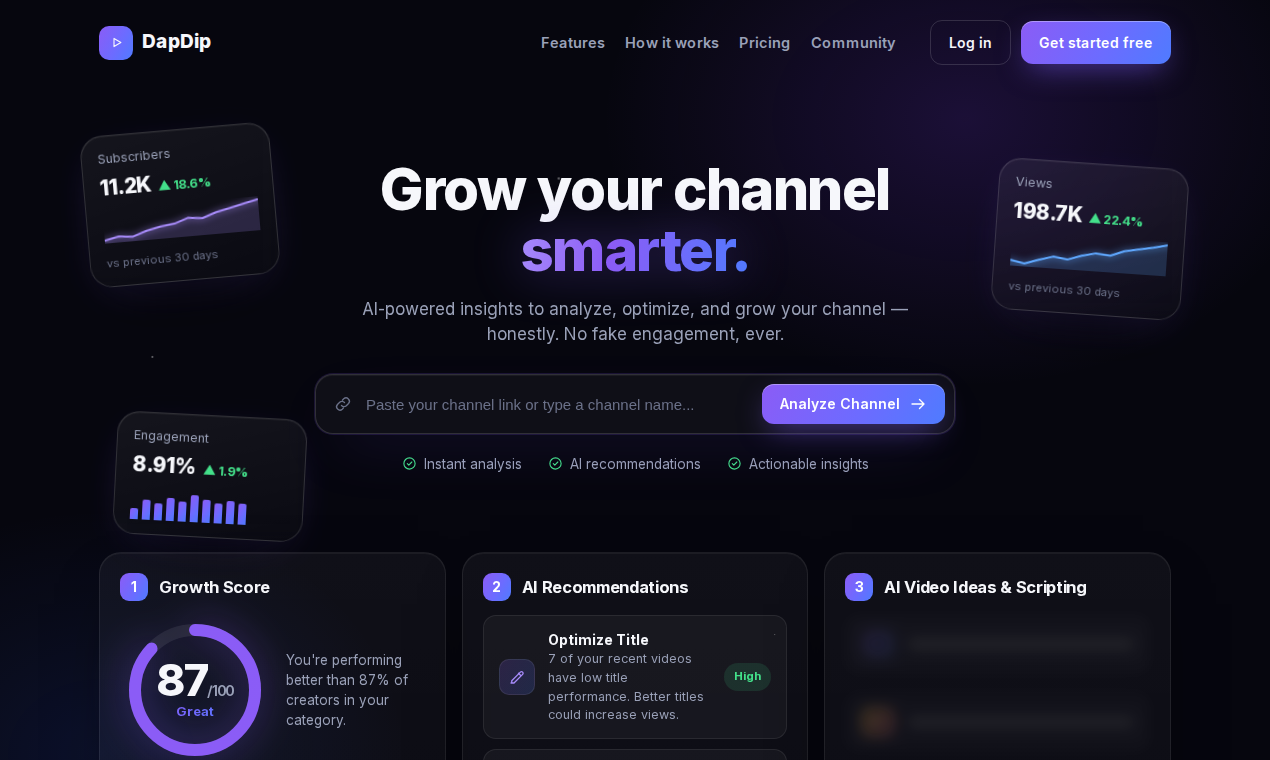
Audits your channel, and tells you when it's guessing
DapDip reads a YouTube channel's own upload history and reports what measurably works on
it — which title lengths, video lengths, posting days and formats beat that channel's own
median, and how many uploads each finding is based on. Nine videos gets labelled as nine
videos. Every figure links to the page showing the calculation.
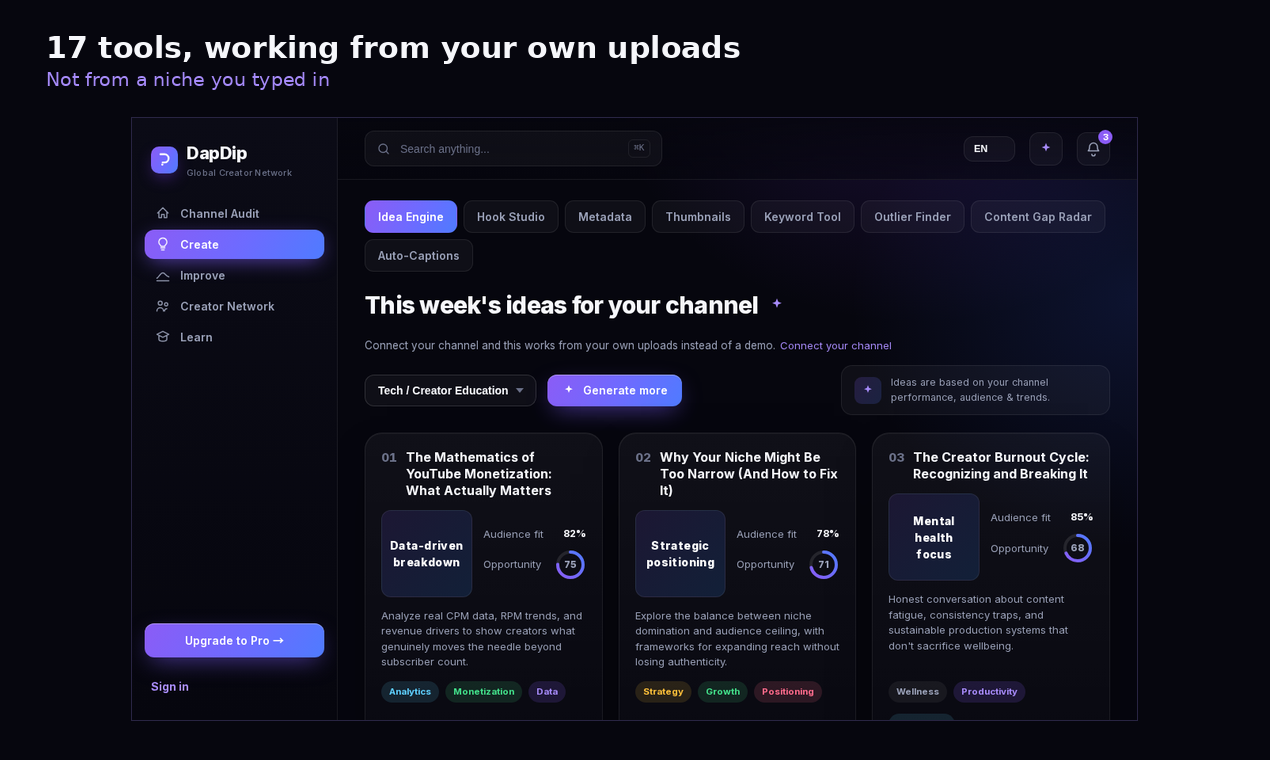
Those measurements are then the context for everything else. Seventeen tools produce the
next video's ideas, hooks, titles, keywords, thumbnails and captions from what already
performed on your channel rather than from a niche you typed into a box.
Two halves, kept apart on purpose: models write, arithmetic counts. No number in the
product is generated by a model, and when a model call fails and you get a fixed template
instead, the interface says so. That label was the hard part to build and the reason I'd
show anyone the code.
Interface in 20 languages, guides in 25, each written for its own readers rather than run
through a translator. There's an MCP server too, so an assistant can audit a real channel
and cite the numbers instead of guessing at them.
Free tier is permanent and needs no card. Pro is $15 a month.
Features
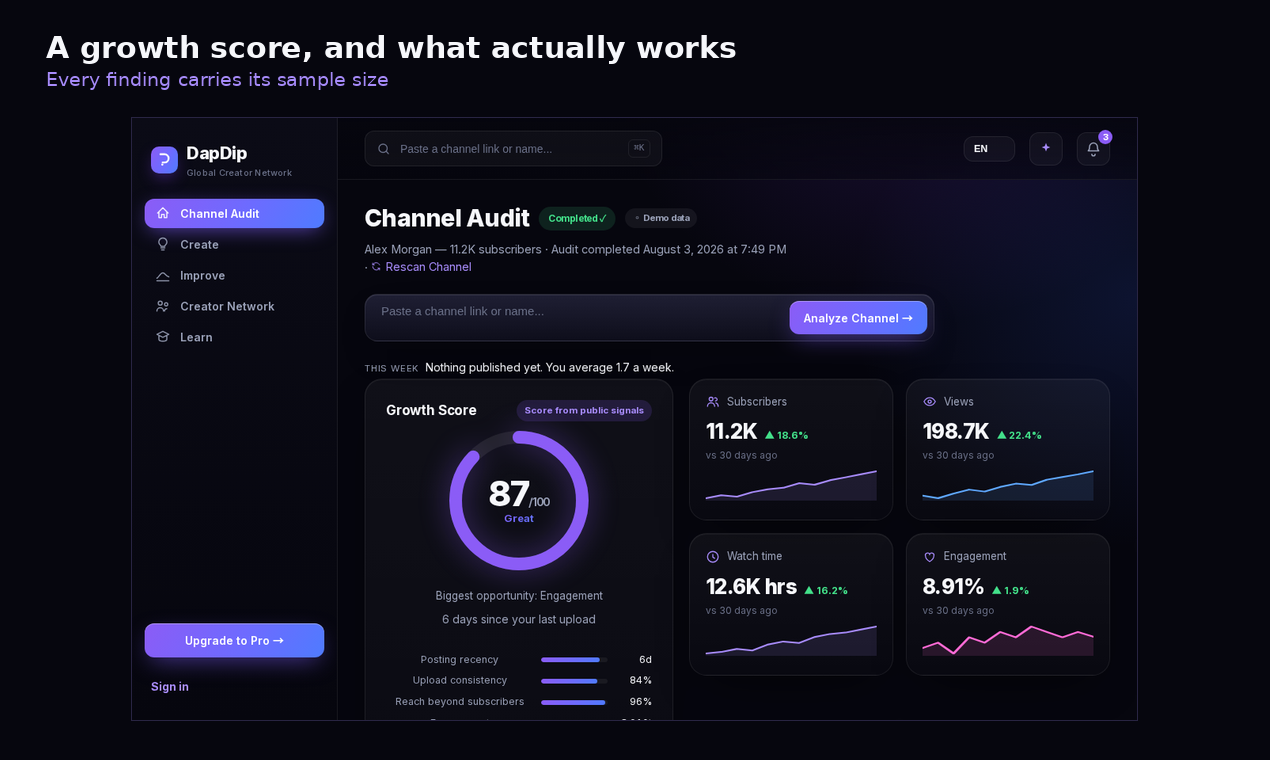
Growth score from a channel's public catalogue, with the working shown
Content patterns measured against the channel's own median, never an industry benchmark
Sample size printed on every finding
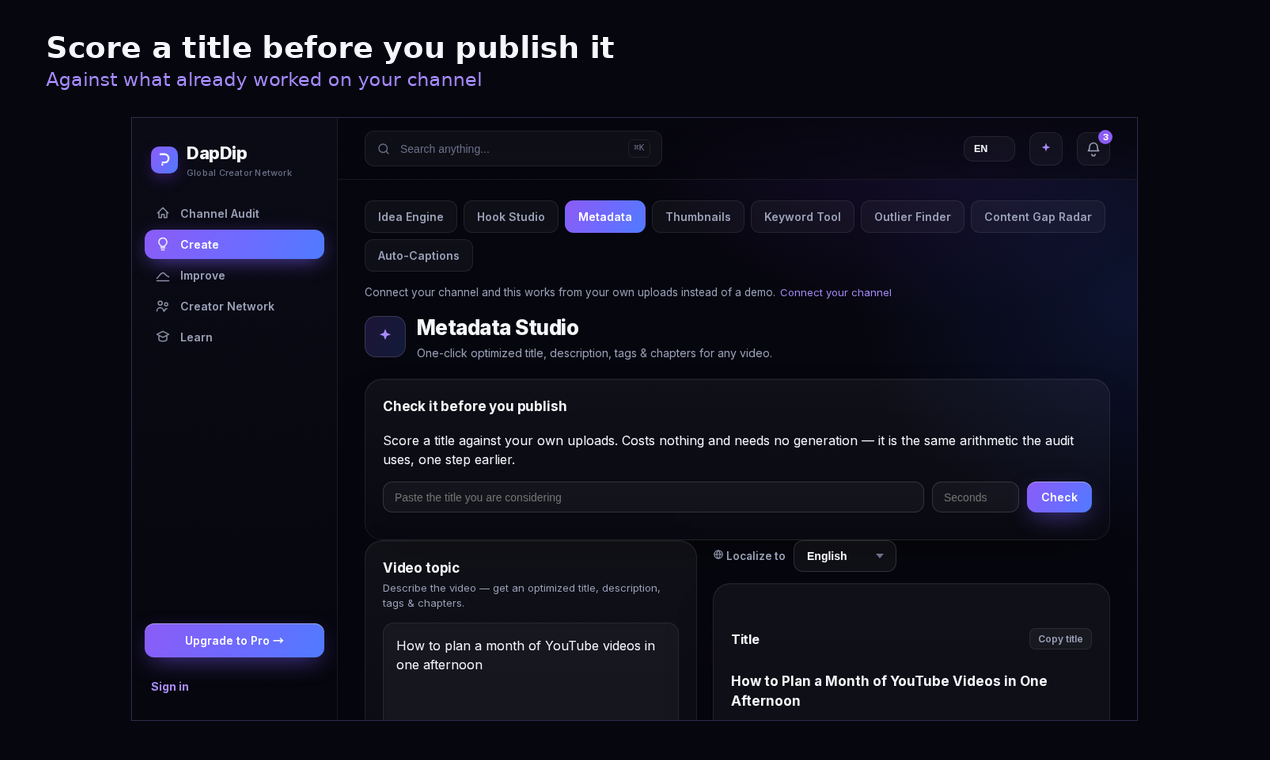
Video ideas, hooks, titles, descriptions and keywords drawn from those measurements
Thumbnail critique and automatic captions
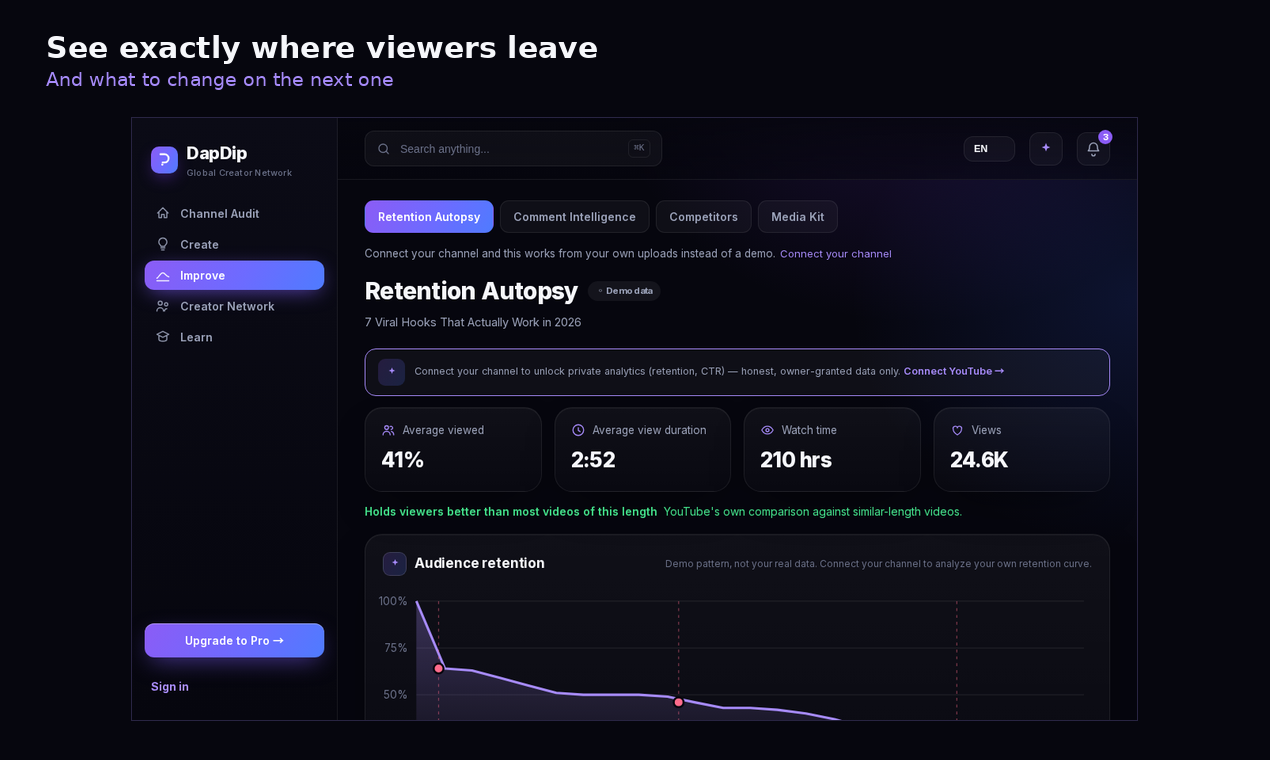
Audience retention and click-through rate once you connect Google
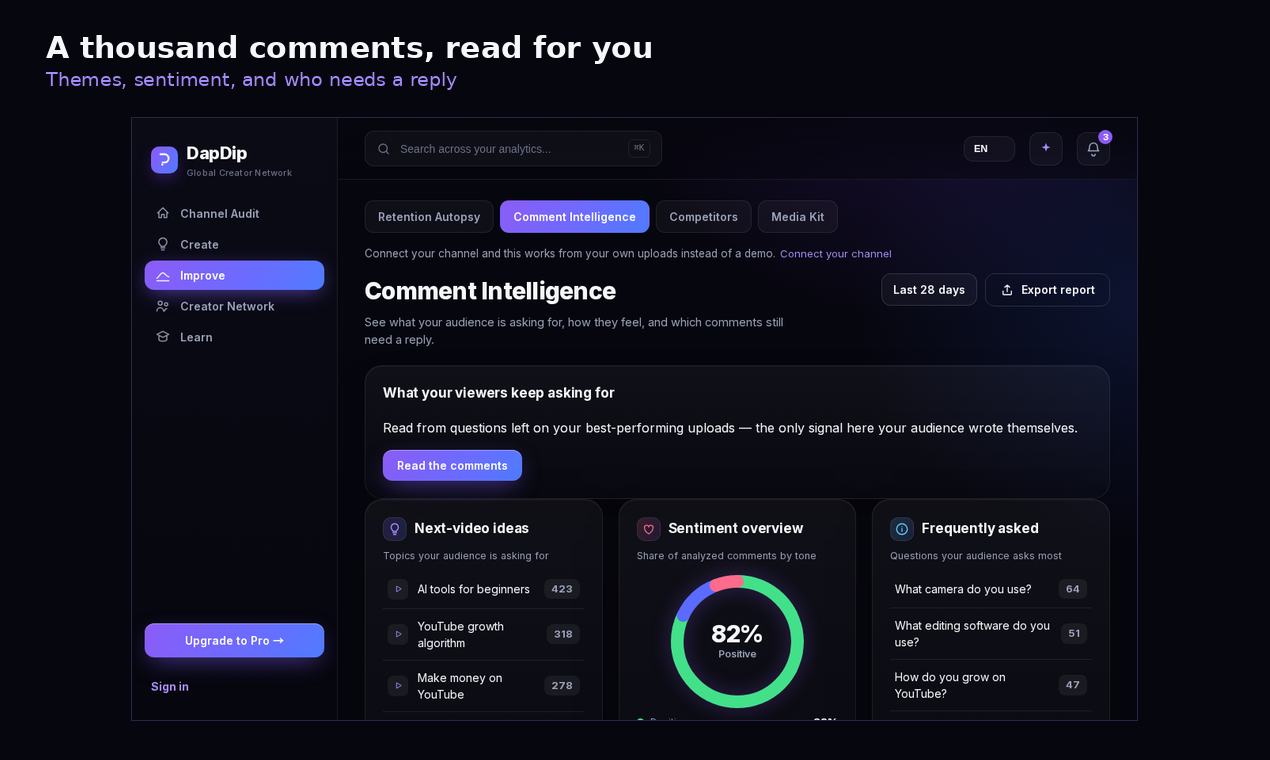
Comment analysis across a thousand comments at a time
Competitor tracking and a sponsor-ready media kit
Template fallbacks labelled in the interface, never passed off as generated
MCP server for AI assistants
20 interface languages, 25 content languages
Use Cases
You post consistently and still can't tell which videos worked and why.
You want to know whether long videos really do better on your channel, with a number.
You're about to publish and need a title, description and thumbnail that fit what already
performs on your channel.
Your retention drops and you want to know where, not just that it does.
A thousand comments arrived and you want the questions, not the noise.
You're pitching a sponsor and need a media kit today.
You don't work in English and every other tool in this category assumes you do.

Comments


I built this because every YouTube tool I tried compared my channel to other people's. "Channels your size average 4% CTR." I can't become a channel my size. I can only make more of whatever already works on mine. So DapDip measures that instead. It reads a channel's whole catalogue, groups the uploads by title length, duration, posting day and format, and tells you which groups beat that channel's own median. Then it tells you how many videos each finding rests on. If it's nine, it says nine — I wanted to be able to check my own tool rather than trust it. The part I'd point at if you only look at one thing: when a model call fails and you get a fixed template instead of generated text, the interface says so. Every AI tool I've used quietly swallows that. Building the label took longer than building the feature. It runs in 20 languages, with the written guides in 25, each one written for its readers rather than run through a translator. Under 20% of the world speaks English and every tool in this category is English-first, which felt like the actual gap. One rule it will never break: no sub-for-sub, no bought views, nothing built to dodge detection. Those get channels terminated. Free tier, no card. Happy to answer anything — including why a number is what it is.

The template-fallback labeling is the detail that'll actually earn trust here — most AI tools silently paper over a failed model call, so being upfront when you're seeing a fixed template instead of a generated one is a real differentiator, not just a nice-to-have. One question: for channels with a small catalogue (say under 20 uploads), how low does DapDip let the sample size go before it still surfaces a "which title length wins" finding vs. just saying there isn't enough data yet? That threshold seems like it'd matter a lot for newer channels using this.


Translating online courses and educational videos Dubbing YouTube videos, podcasts, and interviews Localizing enterprise training and internal communications Translating webinars, conferences, and presentations Creating multilingual documentaries and media content Producing subtitles for international audiences Localizing marketing and advertising campaigns Translating healthcare and public-information materials Converting existing content libraries into multiple languages


The 'measured against your own median, not an industry benchmark' framing is the right call. I build a YouTube monetization checker and the most common confusion I see is creators comparing themselves to channels nothing like theirs. Two questions after reading the description: do you split Shorts and long-form before computing the median? A channel that posts both has two very different duration distributions, and a single median would flag every long video as an outlier. And for the sample-size label, is there a floor below which you refuse to show a finding, or does 'nine videos' just get printed and left to the reader to judge?


Premium Products













































Sponsors
Buy

Makers
Makers
Comments
I built this because every YouTube tool I tried compared my channel to other people's. "Channels your size average 4% CTR." I can't become a channel my size. I can only make more of whatever already works on mine. So DapDip measures that instead. It reads a channel's whole catalogue, groups the uploads by title length, duration, posting day and format, and tells you which groups beat that channel's own median. Then it tells you how many videos each finding rests on. If it's nine, it says nine — I wanted to be able to check my own tool rather than trust it. The part I'd point at if you only look at one thing: when a model call fails and you get a fixed template instead of generated text, the interface says so. Every AI tool I've used quietly swallows that. Building the label took longer than building the feature. It runs in 20 languages, with the written guides in 25, each one written for its readers rather than run through a translator. Under 20% of the world speaks English and every tool in this category is English-first, which felt like the actual gap. One rule it will never break: no sub-for-sub, no bought views, nothing built to dodge detection. Those get channels terminated. Free tier, no card. Happy to answer anything — including why a number is what it is.
The template-fallback labeling is the detail that'll actually earn trust here — most AI tools silently paper over a failed model call, so being upfront when you're seeing a fixed template instead of a generated one is a real differentiator, not just a nice-to-have. One question: for channels with a small catalogue (say under 20 uploads), how low does DapDip let the sample size go before it still surfaces a "which title length wins" finding vs. just saying there isn't enough data yet? That threshold seems like it'd matter a lot for newer channels using this.
Translating online courses and educational videos Dubbing YouTube videos, podcasts, and interviews Localizing enterprise training and internal communications Translating webinars, conferences, and presentations Creating multilingual documentaries and media content Producing subtitles for international audiences Localizing marketing and advertising campaigns Translating healthcare and public-information materials Converting existing content libraries into multiple languages
The 'measured against your own median, not an industry benchmark' framing is the right call. I build a YouTube monetization checker and the most common confusion I see is creators comparing themselves to channels nothing like theirs. Two questions after reading the description: do you split Shorts and long-form before computing the median? A channel that posts both has two very different duration distributions, and a single median would flag every long video as an outlier. And for the sample-size label, is there a floor below which you refuse to show a finding, or does 'nine videos' just get printed and left to the reader to judge?
Premium Products
New to Fazier?

Find your next favorite product or submit your own. Made by @FalakDigital.
Copyright ©2026. All Rights Reserved