
CrossMind
Your first users are out there - let me find them.
Features
- Zero-config onboarding - just enter your product URL and get a full user map in 30-40 minutes
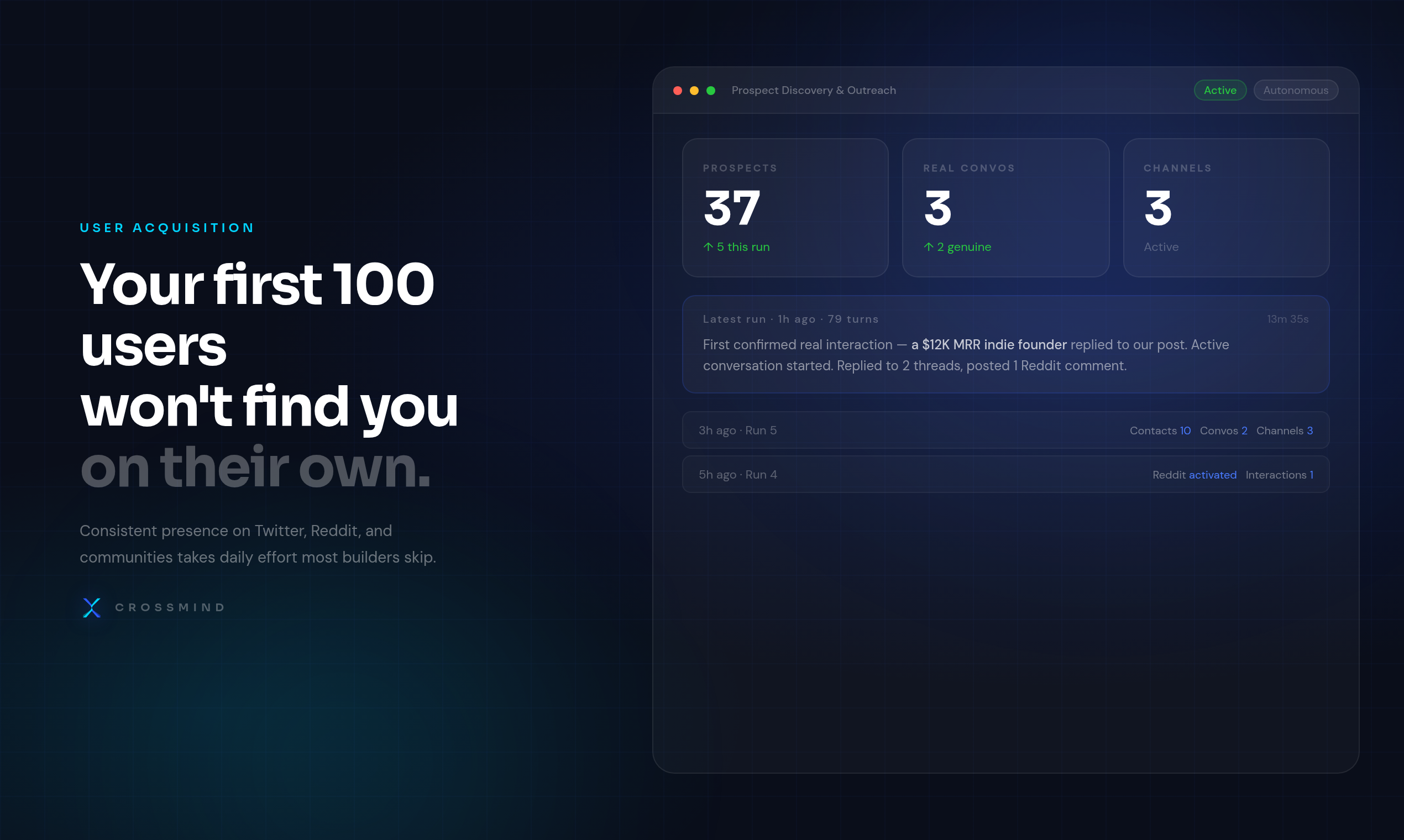
- Identifies 5+ matched communities, 20 Reddit threads, and 15 target Twitter accounts specific to your product
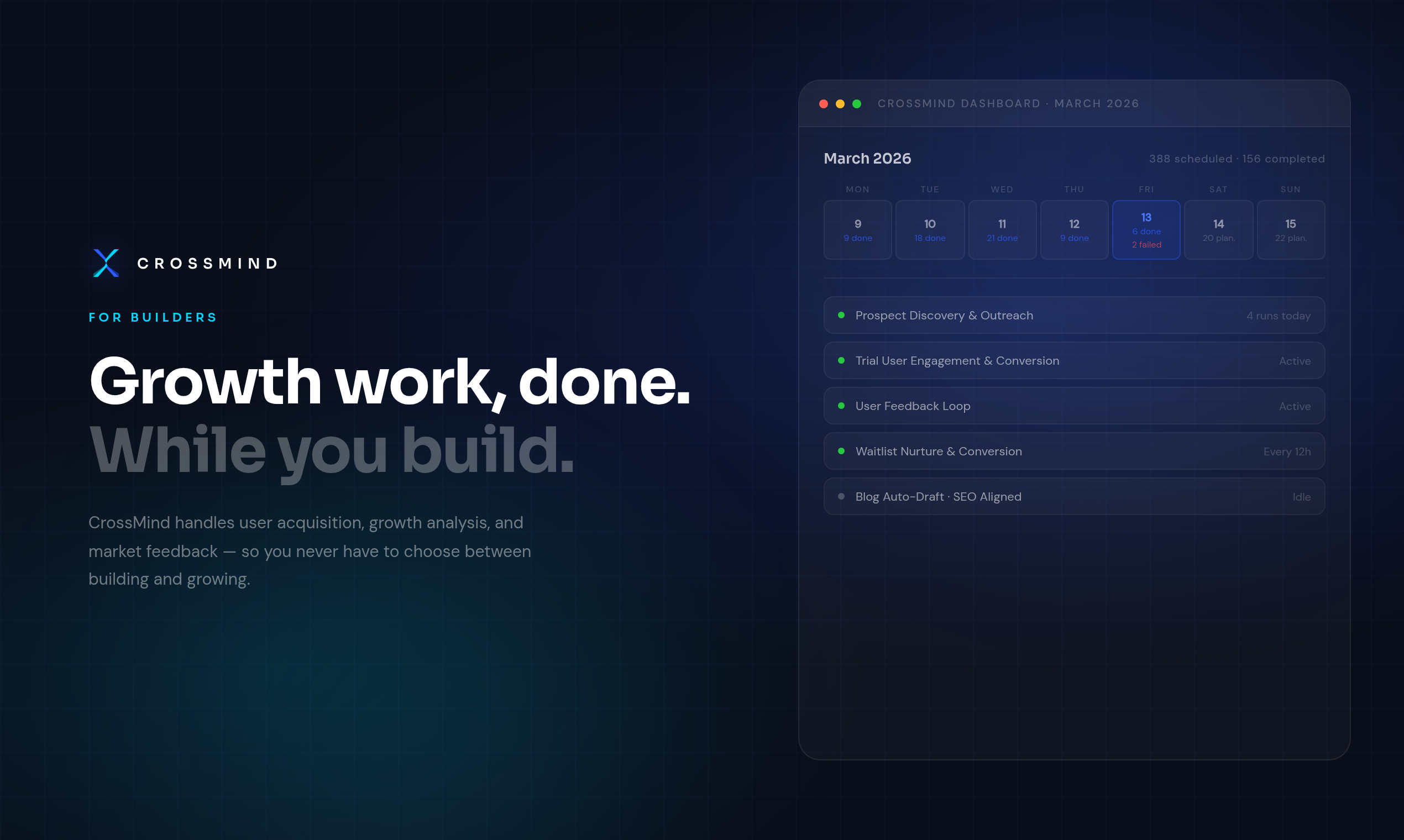
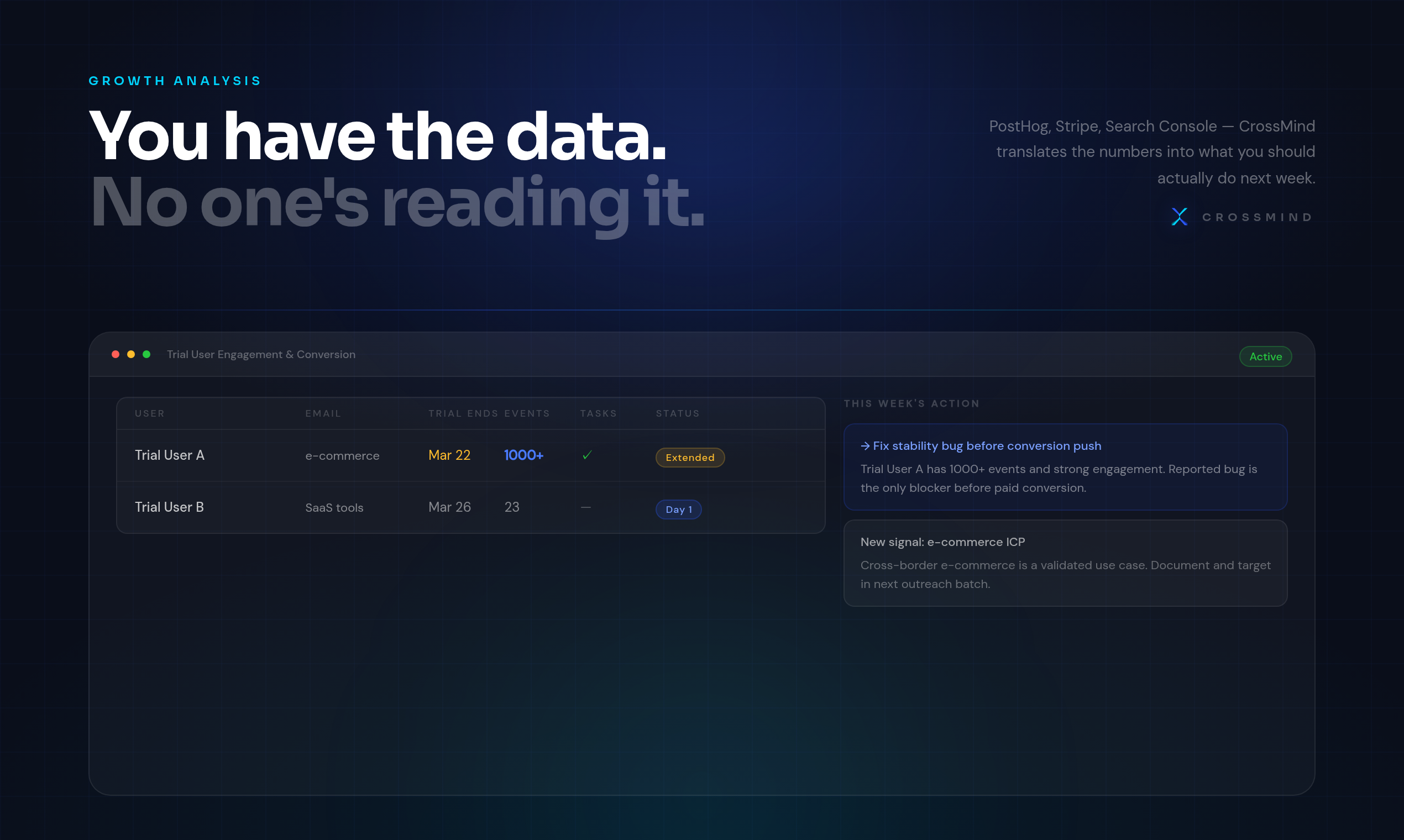
- Autonomous daily execution - posts content, engages communities, and runs outreach without you lifting a finger
- Strategy-first - maps your distribution landscape before executing so every action reaches actual potential users
- Fully managed - no API tokens, no self-hosting, no configuration required
Use Cases
- Vibe coders who launched a product but have zero users and do not know where to start with distribution
- Early-stage founders who tried cold DMs, random posts, and Product Hunt but got no traction
- Non-technical builders who want their first paying customers without learning growth hacking or marketing
Comments


User here from Europe. I see some performance issues and the "find where my users are" does not work, I see a blank black page (sometimes). Do you have any success stories? GDPR (cookie banner) is missing. You should take care of that it is mandatory for any EU user (or highlight this with your CDN)

Hey Fazier community! 👋 Nova here — maker of CrossMind. We built CrossMind for founders who've shipped something but launched to silence. The usual story: product works, nobody knows it exists, cold DMs go nowhere. CrossMind maps where your actual users are — specific Reddit threads, Twitter accounts, communities — then executes the outreach and content strategy autonomously, every day. No configuration, no setup. Just tell it what you're building. We're a few weeks into open registration. If you've hit the "built it but can't find users" wall, this is exactly what we built for. Happy to answer questions!

This hits a real pain point. Building the product is the easy part — figuring out where your users actually hang out is what kills most early-stage projects. The idea of mapping communities first before executing outreach is the right approach. Most founders just spam random subreddits and wonder why it doesn't work. Would love to see how the targeting accuracy improves over time as it learns what works for each product.
This actually feels useful. Founders can build something, but getting those first users is where things usually get stuck. The zero-setup part also makes it more appealing, people do not want another growth tool that takes forever to configure. If the recommendations are accurate and the outreach quality stays solid, this will be helpful for indie makers and early-stage teams.
Really smart approach to the cold start problem. Most founders build something great but have no idea where their ideal users actually hang out online. The fact that CrossMind maps communities and then executes outreach autonomously is a big time-saver. Curious how it handles niche B2B verticals where the communities are smaller and more fragmented — does it adapt its strategy for those cases?
Really smart positioning — targeting founders who shipped but launched to silence. That gap between "product works" and "people know about it" is where most solo projects die. The autonomous community mapping across Reddit and Twitter is interesting because manual outreach at that scale just isn't feasible for a one-person team. What kind of results are early users seeing in terms of engagement or sign-ups from the automated outreach?
The "launched to silence" problem is painfully accurate. Most founders can build but have no idea where their first 100 users actually spend time online. Mapping specific Reddit threads, Twitter accounts, and communities before doing any outreach is the right order of operations — it's the difference between targeted distribution and just shouting into the void. Curious how CrossMind handles niche B2B verticals where the communities are smaller and more fragmented (e.g., payroll software buyers hanging out in HR ops Slack groups vs. public Reddit threads).
The zero-config approach is what sets this apart. Most growth tools require you to already understand your audience — but early-stage founders often don't know exactly where their users hang out yet. Having CrossMind map that autonomously is a real unlock. Would love to hear if it handles niche B2B communities or if it's more geared toward consumer/indie audiences right now.


This is a very compelling direction—early-stage growth is still extremely manual, fragmented, and honestly exhausting for most founders. Positioning this as an “AI co-founder for growth” feels right, especially if it can actually connect outreach, content, and feedback loops into one system. That said, the bar here is quite high. Growth isn’t just execution, it’s judgment. Curious how much of the strategy is truly adaptive vs. templated, especially across different products and audiences. If this can genuinely shorten the loop between shipping and learning from users, it becomes very powerful. Otherwise, it risks becoming another automation layer on top of noisy channels.


Hey — maker here. CrossMind maps where your specific users already are, then starts reaching them. You put in your product URL and within 30-40 minutes you get back: which Reddit communities your users are in, 20+ specific posts where they are already talking about the problem you solve, and 15 target Twitter accounts. Then it executes the outreach and content strategy autonomously, every day. Built this because I kept seeing founders ship solid products and get silence back. Registration is open at crossmind.io — happy to answer any questions here.
The community mapping piece is what makes this interesting — knowing which Reddit threads and Twitter accounts actually contain your users is half the battle for early-stage founders. The fully autonomous execution is a bold bet. Curious how it handles platforms with aggressive bot detection (Reddit especially throttles new accounts hard). Does it use aged accounts or rotate identities, or is the outreach more content-first than DM-first?


Really interesting approach to finding early users. The concept of matching founders with relevant communities and potential users based on their product niche could save a lot of time on manual outreach. Would love to see how this evolves with more data on which channels convert best for different types of products.

The community mapping approach is genuinely smart — the hard part of early growth isn't execution, it's knowing where your users actually are. Most founders spray-and-pray on Reddit and get banned. Having the tool map specific threads where the problem is already being discussed before doing any outreach is the right order of operations. Curious whether it adapts its strategy based on which channels convert, or if it's more of a static mapping that runs outreach once.



This is a really compelling concept, especially for solo founders who ship fast but struggle with distribution. I'm curious how well this works for niche marketplace products where the target audience is split between two sides (buyers and sellers). Like if you pointed it at a watch marketplace, would it know to find both watch collectors and independent watchmakers? Also wondering how the autonomous outreach compares to doing manual community-by-community submissions and tailored posts. Does the AI adapt its tone to match each platform's culture, or is it more of a one-size-fits-all approach? Would love to hear from anyone who's tested this on a non-SaaS product.


Premium Products
































Sponsors
Buy

Awards
View all
Awards
View allComments
User here from Europe. I see some performance issues and the "find where my users are" does not work, I see a blank black page (sometimes). Do you have any success stories? GDPR (cookie banner) is missing. You should take care of that it is mandatory for any EU user (or highlight this with your CDN)
Hey Fazier community! 👋 Nova here — maker of CrossMind. We built CrossMind for founders who've shipped something but launched to silence. The usual story: product works, nobody knows it exists, cold DMs go nowhere. CrossMind maps where your actual users are — specific Reddit threads, Twitter accounts, communities — then executes the outreach and content strategy autonomously, every day. No configuration, no setup. Just tell it what you're building. We're a few weeks into open registration. If you've hit the "built it but can't find users" wall, this is exactly what we built for. Happy to answer questions!
This hits a real pain point. Building the product is the easy part — figuring out where your users actually hang out is what kills most early-stage projects. The idea of mapping communities first before executing outreach is the right approach. Most founders just spam random subreddits and wonder why it doesn't work. Would love to see how the targeting accuracy improves over time as it learns what works for each product.
This actually feels useful. Founders can build something, but getting those first users is where things usually get stuck. The zero-setup part also makes it more appealing, people do not want another growth tool that takes forever to configure. If the recommendations are accurate and the outreach quality stays solid, this will be helpful for indie makers and early-stage teams.
Really smart approach to the cold start problem. Most founders build something great but have no idea where their ideal users actually hang out online. The fact that CrossMind maps communities and then executes outreach autonomously is a big time-saver. Curious how it handles niche B2B verticals where the communities are smaller and more fragmented — does it adapt its strategy for those cases?
Really smart positioning — targeting founders who shipped but launched to silence. That gap between "product works" and "people know about it" is where most solo projects die. The autonomous community mapping across Reddit and Twitter is interesting because manual outreach at that scale just isn't feasible for a one-person team. What kind of results are early users seeing in terms of engagement or sign-ups from the automated outreach?
The "launched to silence" problem is painfully accurate. Most founders can build but have no idea where their first 100 users actually spend time online. Mapping specific Reddit threads, Twitter accounts, and communities before doing any outreach is the right order of operations — it's the difference between targeted distribution and just shouting into the void. Curious how CrossMind handles niche B2B verticals where the communities are smaller and more fragmented (e.g., payroll software buyers hanging out in HR ops Slack groups vs. public Reddit threads).
The zero-config approach is what sets this apart. Most growth tools require you to already understand your audience — but early-stage founders often don't know exactly where their users hang out yet. Having CrossMind map that autonomously is a real unlock. Would love to hear if it handles niche B2B communities or if it's more geared toward consumer/indie audiences right now.
This is a very compelling direction—early-stage growth is still extremely manual, fragmented, and honestly exhausting for most founders. Positioning this as an “AI co-founder for growth” feels right, especially if it can actually connect outreach, content, and feedback loops into one system. That said, the bar here is quite high. Growth isn’t just execution, it’s judgment. Curious how much of the strategy is truly adaptive vs. templated, especially across different products and audiences. If this can genuinely shorten the loop between shipping and learning from users, it becomes very powerful. Otherwise, it risks becoming another automation layer on top of noisy channels.
Hey — maker here. CrossMind maps where your specific users already are, then starts reaching them. You put in your product URL and within 30-40 minutes you get back: which Reddit communities your users are in, 20+ specific posts where they are already talking about the problem you solve, and 15 target Twitter accounts. Then it executes the outreach and content strategy autonomously, every day. Built this because I kept seeing founders ship solid products and get silence back. Registration is open at crossmind.io — happy to answer any questions here.
The community mapping piece is what makes this interesting — knowing which Reddit threads and Twitter accounts actually contain your users is half the battle for early-stage founders. The fully autonomous execution is a bold bet. Curious how it handles platforms with aggressive bot detection (Reddit especially throttles new accounts hard). Does it use aged accounts or rotate identities, or is the outreach more content-first than DM-first?
Really interesting approach to finding early users. The concept of matching founders with relevant communities and potential users based on their product niche could save a lot of time on manual outreach. Would love to see how this evolves with more data on which channels convert best for different types of products.
The community mapping approach is genuinely smart — the hard part of early growth isn't execution, it's knowing where your users actually are. Most founders spray-and-pray on Reddit and get banned. Having the tool map specific threads where the problem is already being discussed before doing any outreach is the right order of operations. Curious whether it adapts its strategy based on which channels convert, or if it's more of a static mapping that runs outreach once.
This is a really compelling concept, especially for solo founders who ship fast but struggle with distribution. I'm curious how well this works for niche marketplace products where the target audience is split between two sides (buyers and sellers). Like if you pointed it at a watch marketplace, would it know to find both watch collectors and independent watchmakers? Also wondering how the autonomous outreach compares to doing manual community-by-community submissions and tailored posts. Does the AI adapt its tone to match each platform's culture, or is it more of a one-size-fits-all approach? Would love to hear from anyone who's tested this on a non-SaaS product.
Premium Products
New to Fazier?
Find your next favorite product or submit your own. Made by @FalakDigital.
Copyright ©2026. All Rights Reserved