
Flat subscriptions and month-end invoices were designed for SaaS, not AI. When inference costs $0.10 to $0.50 per request and your margins change every time you switch a model, end-of-cycle billing leaves you exposed. You spend money to generate a response, then try to recover it from the customer days later.
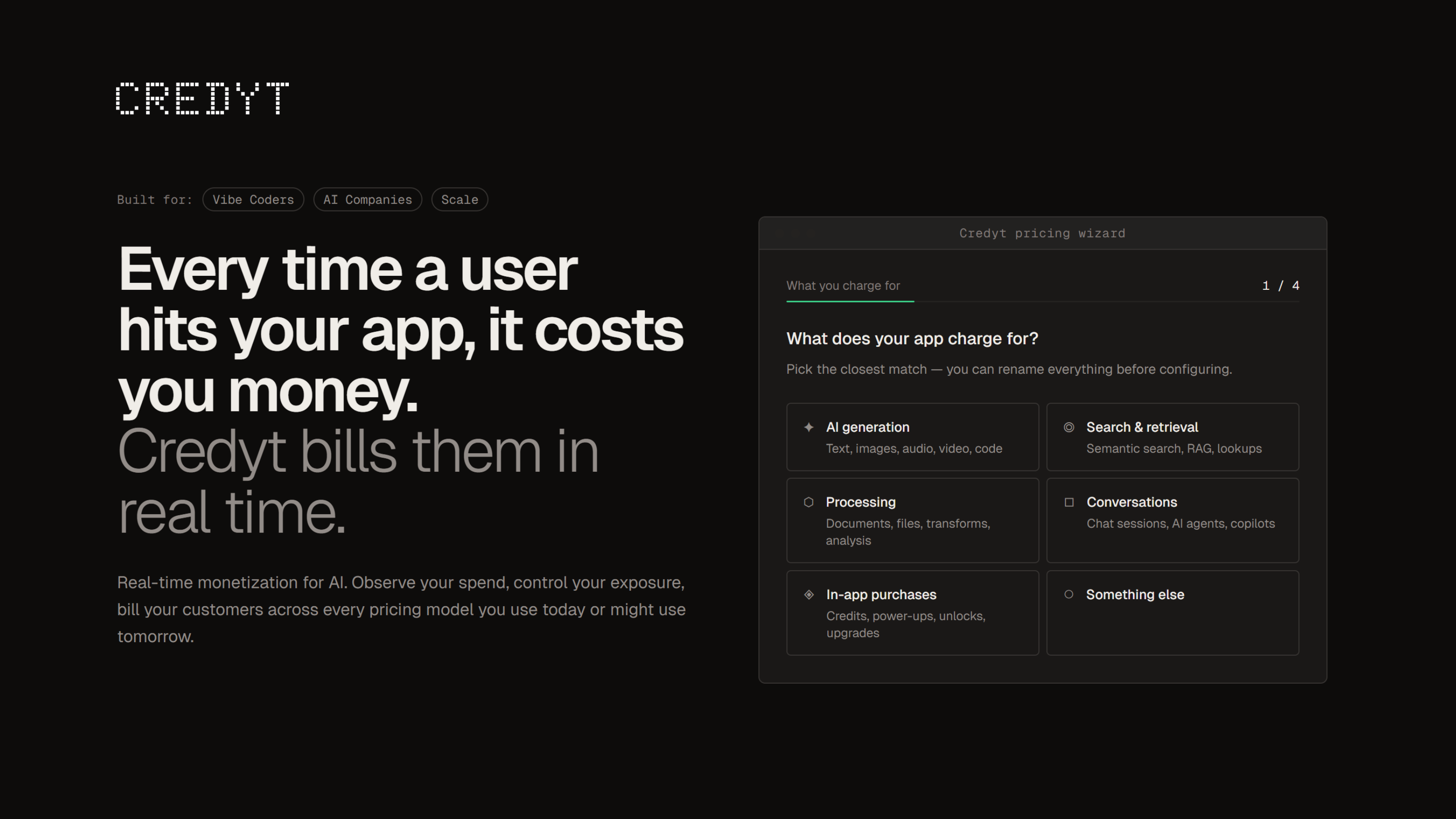
Credyt inverts that. Platforms check wallet balance before the work starts, using Credyt's Wallet APIs. Real-time authorization. Real-time visibility. Margins protected.
Sitting between product usage and downstream billing, Credyt adds the missing layer: real-time control over usage and monetization. It integrates with Stripe and your existing finance stack — it does not replace them. It replaces the 6-to-12 months of engineering teams otherwise spend building wallets, credits, and authorization logic from scratch.
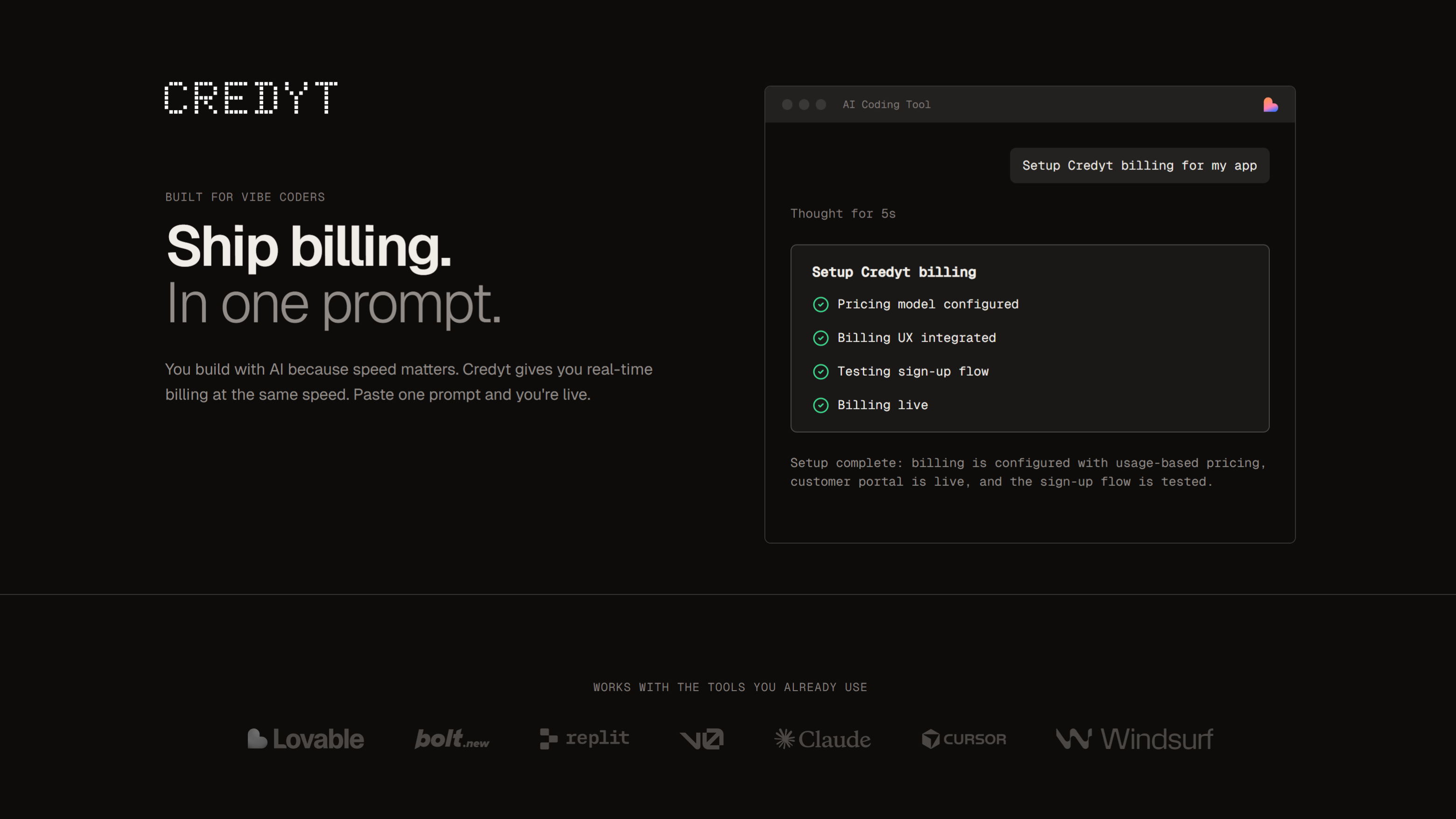
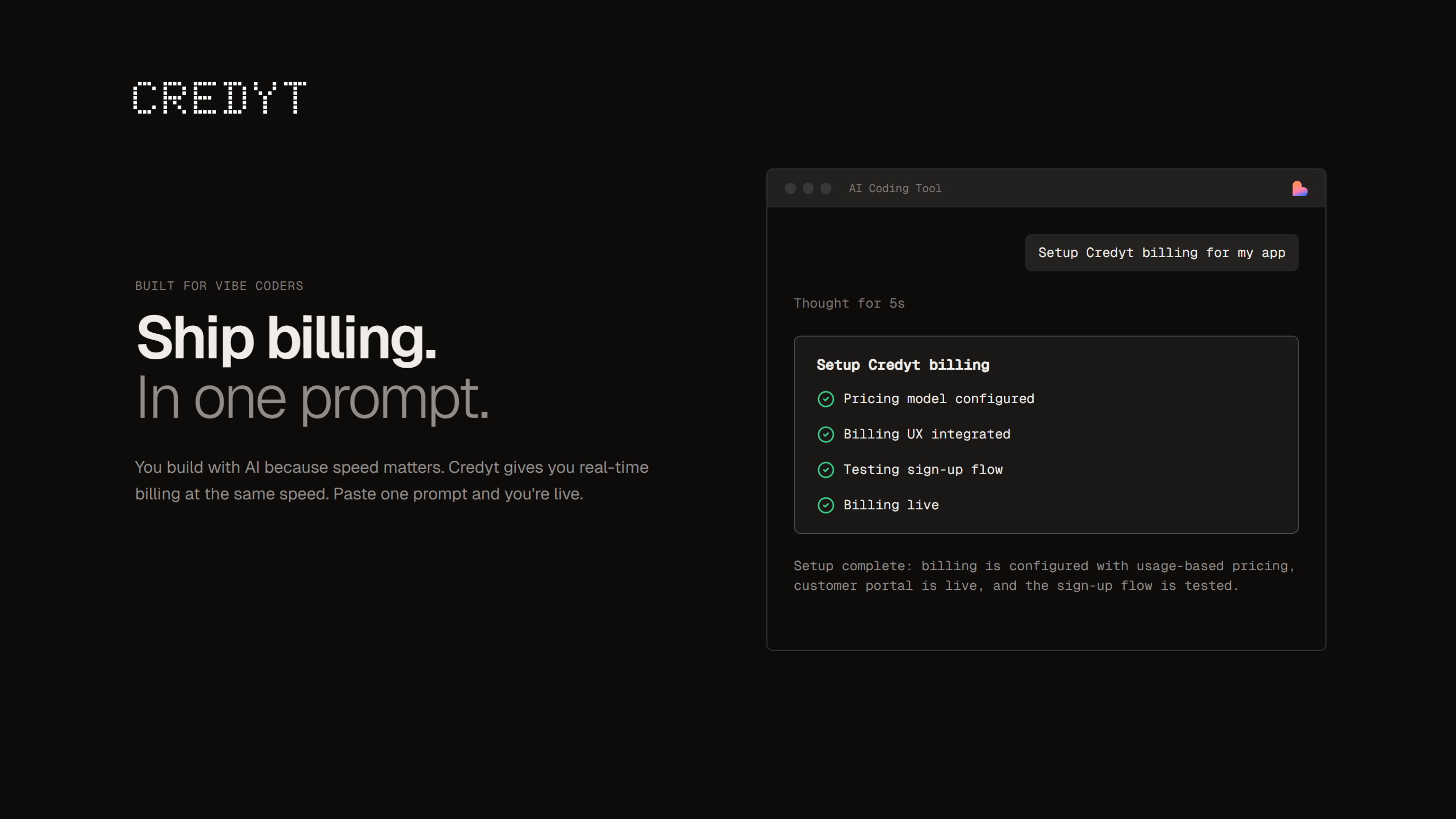
Ship usage-based billing in hours instead of months. Add billing to a Cursor, Lovable, Bolt, or Claude Code project with a single prompt through Credyt's MCP server. $0 to start. $1 per active customer in production. No percentage cut. No markup on payment fees.

Features
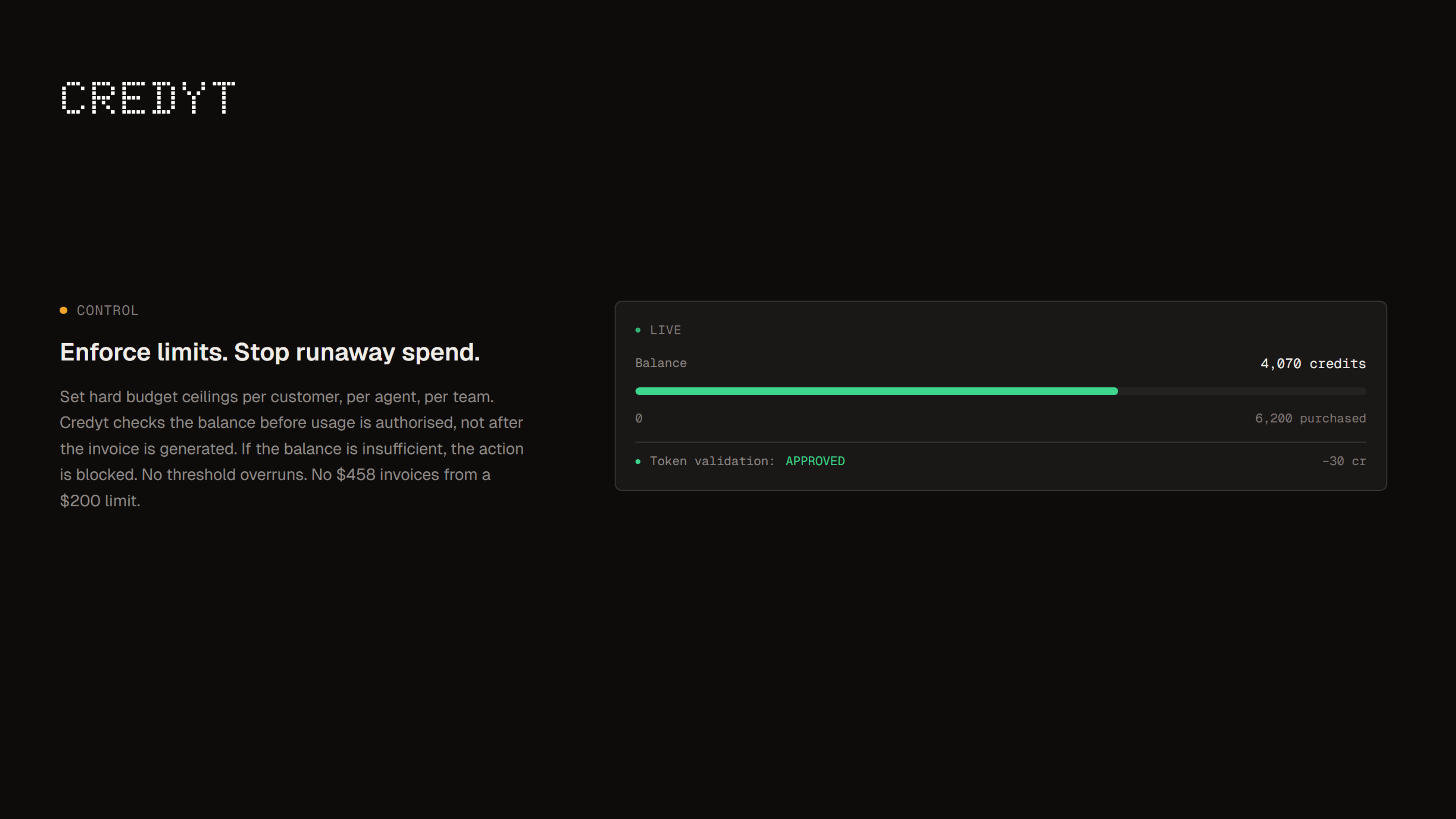
Real-time authorization — Check wallet balance before the work runs, not after. Block usage when budgets hit zero.
Multi-asset wallets — Hold USD, tokens, GPU hours, or any custom unit in a single customer wallet.
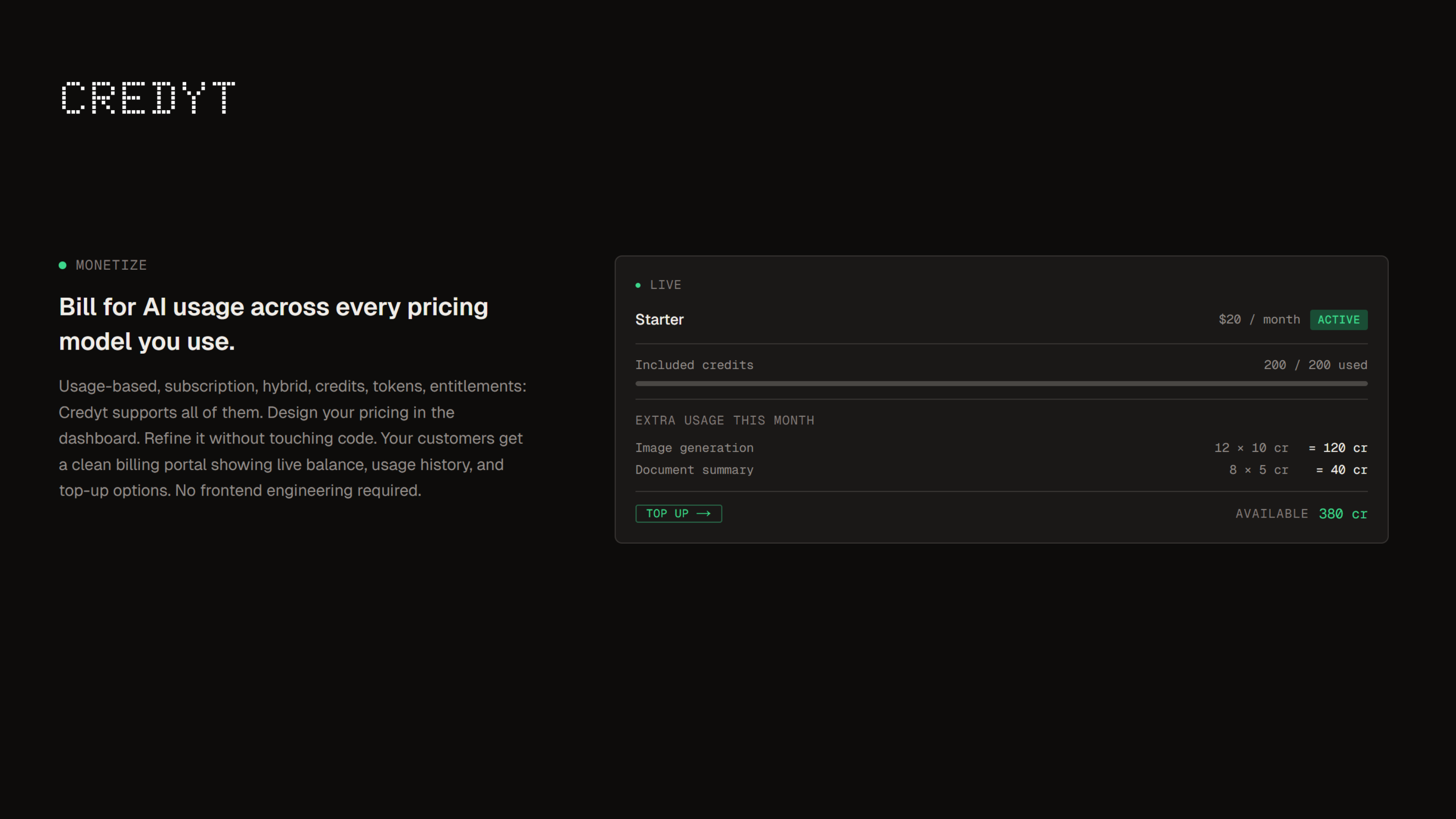
Every pricing model — Usage-based, prepaid credits, subscription, hybrid, seat-based, outcome-based, tiered, volume. Switch models without rearchitecting.
MCP server — Connect Cursor, Windsurf, Claude Code, Codex, Lovable, Bolt, Replit, or V0. Add billing through a prompt, not backend code.
Drop-in billing portal — Branded, self-service portal with live balance, usage history, top-ups, and customer-controlled auto-recharge. Zero frontend work.
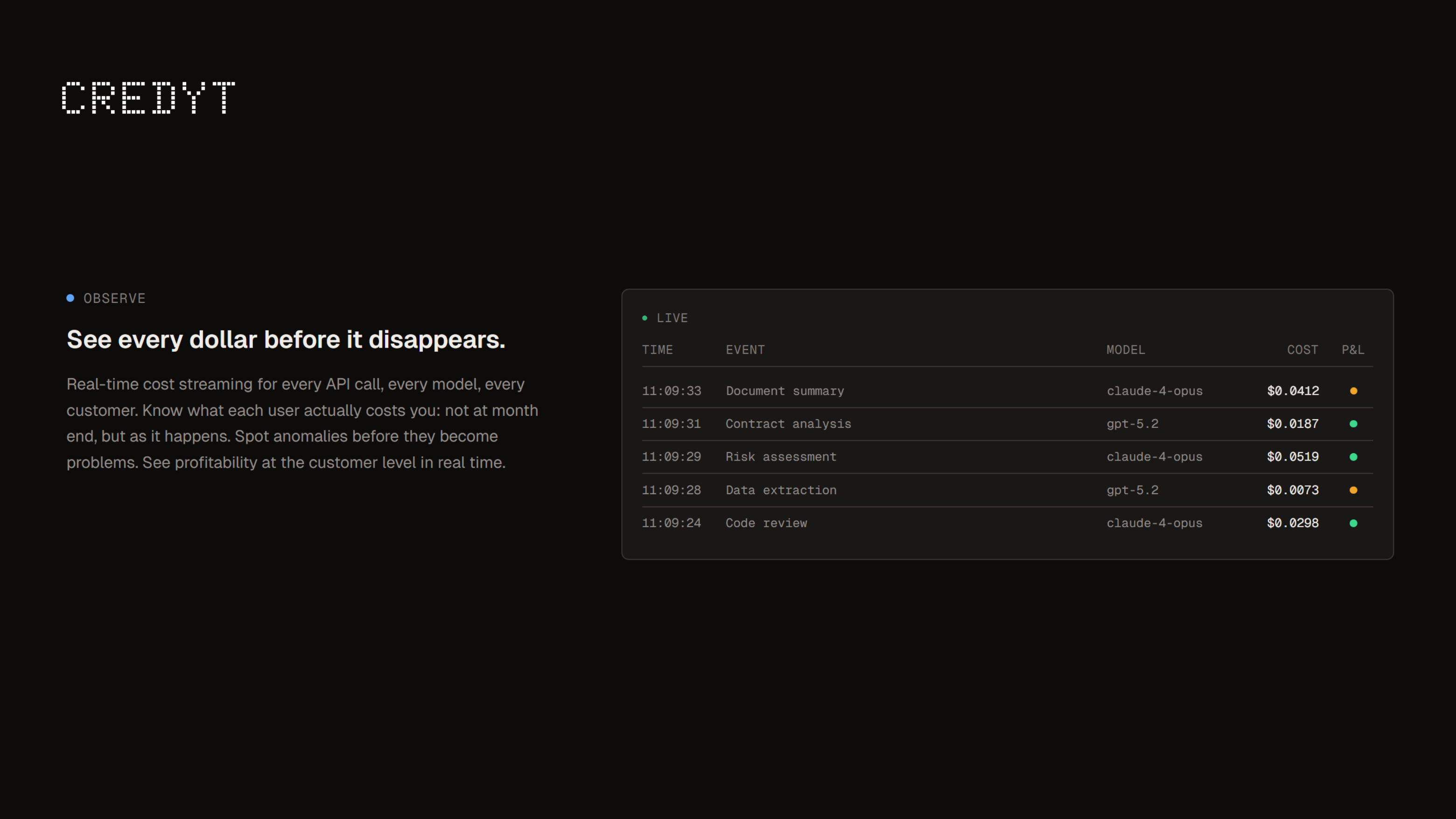
Per-customer profitability — Event-level cost attribution shows real-time gross margin per customer, per feature, per workload.
Hard budget ceilings — Set spend limits per customer or team. Enforced before usage occurs, not after.
Spend controls — Kill switches, rate limiting, tiered alerts, policy-based rules, free-tier abuse prevention.
Multi-provider cost map — Unified cost view across OpenAI, Anthropic, Google, and open-source models in one dashboard.
Hybrid billing — Subscription base fee plus included credits that refresh on schedule, with usage-based overages once exhausted.
Billing model versioning — Change pricing rules in the dashboard. Apply to new events immediately. No code changes.
Idempotent events — Duplicate events detected server-side. Safe to retry without double-billing.
Token-level audit trail — Every token, every call, fully traceable for compliance and debugging.
B2B org hierarchy — Three-level structure (Platform → Organisation → Customer) for resellers and sub-accounts.
Stripe integration — Stripe Checkout for top-ups out of the box. Bring your own PSP if you prefer.
API-first — Every capability available via REST. The dashboard runs on the same API.
Connected accounts — Fully partitioned billing per customer. Multi-tenant by design.
Webhooks, OpenAPI spec, Node and Python SDKs — Standard developer infrastructure, documented.
Transparent pricing — $0 to start with 10 free wallets forever. $1 per Monthly Active Wallet in production. First 1M events free. No revenue percentage. No PSP markup.
Live in days, not months — Replace the 6-to-12 month engineering effort of building wallets, credits, and authorization in-house.
Use Cases
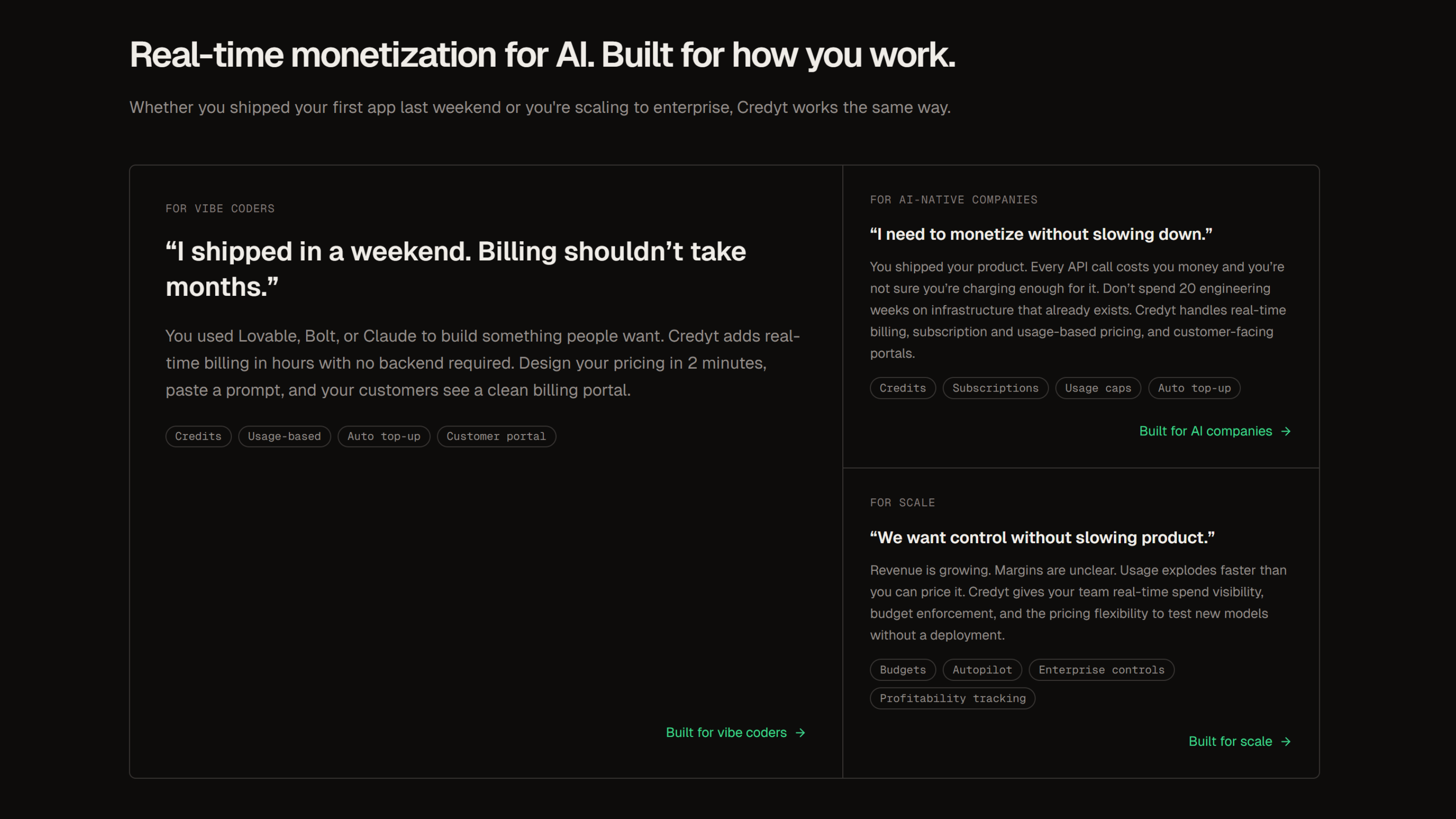
Vibe coders & indie hackers You shipped an AI app in a weekend. Add billing without spending a month on Stripe Meters wiring. Use the MCP server inside Cursor, Lovable, or Bolt and ship before your next sprint.
AI-native startups Monetize products with real-time infrastructure costs without slowing down. Run usage-based, subscription, or hybrid pricing. See per-customer margins as they happen, not at month-end when it's too late to fix.
AI companies at scale Add guardrails without slowing the product. Hard budget ceilings, per-agent spend governance, free-tier abuse prevention, and audit trails — the controls you need before a single customer can burn through your gross margin.
Platforms with prepaid credits Sell credits, tokens, or GPU hours. Customers see what they need to see; you control the underlying cost conversion. Auto top-ups keep service continuous without support tickets.

Comments


Credyt delivers a clean and engaging experience, and if you’re into creative gameplay, [Sprunki Mods->https://sprunkimods.io/] are worth exploring for their unique twists and fresh community-driven content.


The pre-authorization angle is what makes this different from just wrapping Stripe Meters. metering after the fact is fine for SaaS where a user writes a doc and you charge them later, it breaks completely when your cost is realized the moment a model call fires. catching a $0 wallet balance before the request runs versus after is the whole game.

This solves a real pain point for AI-native startups — the gap between "we need usage-based billing" and the 6+ month engineering effort to build it properly. The real-time authorization before usage runs (not after) is the detail that matters most here; post-usage billing blocks are useless when a single runaway agent can burn your margin in minutes. The per-customer profitability view at event level is something most billing tools don't offer until you're enterprise tier. MCP server integration is a smart distribution move — meeting developers inside Cursor and Lovable rather than asking them to leave their workflow. Would be curious how the B2B org hierarchy handles reseller margin splits — that's usually where billing tools get complicated fast.

Hey 👋 Honest reason we built Credyt: too many founders we talked to were burning real money on AI infrastructure before they ever collected from a customer. Stripe Billing handles the subscription. Lago and Orb handle the metering. But nothing was checking "does this user actually have the credits to run this $0.40 request?" before the request fired. That's the gap. Credyt sits in front of the work: check the wallet, authorize, then run. Multi-asset wallets (USD, tokens, GPU hours, whatever), every pricing model, a branded customer portal you don't have to build, and an MCP server that lets you add billing to your AI coding tool through a prompt. Pricing is meant to stay out of the way while you're still figuring it out: free forever for the first 10 active wallets, $1 each after that. No percentage of revenue. If you're shipping anything with real-time costs and have thoughts on what's missing, hit us in the comments. We read everything.

The authorization-before-inference model solves a real problem that anyone building AI products with variable inference costs has run into. Pay-after-the-fact billing made sense for SaaS where costs were predictable — it does not make sense when a single user session can swing your margin by 40% depending on which model handled it. The flat $1 per active customer in production with no percentage cut is a pricing model that actually aligns with how usage-based products scale. The MCP server integration is a nice touch too — adding billing to a Claude Code or Cursor project with a single prompt removes the last excuse for shipping without monetization.


Credyt looks like an interesting solution for simplifying financial tasks. I also find tools that help <a href="https://airbrush.com/ru/video-background-remover">убрать задний фон</a> useful for creating clean visuals for product presentations and online projects.
Premium Products































Sponsors
Buy

Awards
View all
Awards
View allMakers
Makers
Comments
Credyt delivers a clean and engaging experience, and if you’re into creative gameplay, [Sprunki Mods->https://sprunkimods.io/] are worth exploring for their unique twists and fresh community-driven content.
The pre-authorization angle is what makes this different from just wrapping Stripe Meters. metering after the fact is fine for SaaS where a user writes a doc and you charge them later, it breaks completely when your cost is realized the moment a model call fires. catching a $0 wallet balance before the request runs versus after is the whole game.
This solves a real pain point for AI-native startups — the gap between "we need usage-based billing" and the 6+ month engineering effort to build it properly. The real-time authorization before usage runs (not after) is the detail that matters most here; post-usage billing blocks are useless when a single runaway agent can burn your margin in minutes. The per-customer profitability view at event level is something most billing tools don't offer until you're enterprise tier. MCP server integration is a smart distribution move — meeting developers inside Cursor and Lovable rather than asking them to leave their workflow. Would be curious how the B2B org hierarchy handles reseller margin splits — that's usually where billing tools get complicated fast.
Hey 👋 Honest reason we built Credyt: too many founders we talked to were burning real money on AI infrastructure before they ever collected from a customer. Stripe Billing handles the subscription. Lago and Orb handle the metering. But nothing was checking "does this user actually have the credits to run this $0.40 request?" before the request fired. That's the gap. Credyt sits in front of the work: check the wallet, authorize, then run. Multi-asset wallets (USD, tokens, GPU hours, whatever), every pricing model, a branded customer portal you don't have to build, and an MCP server that lets you add billing to your AI coding tool through a prompt. Pricing is meant to stay out of the way while you're still figuring it out: free forever for the first 10 active wallets, $1 each after that. No percentage of revenue. If you're shipping anything with real-time costs and have thoughts on what's missing, hit us in the comments. We read everything.
The authorization-before-inference model solves a real problem that anyone building AI products with variable inference costs has run into. Pay-after-the-fact billing made sense for SaaS where costs were predictable — it does not make sense when a single user session can swing your margin by 40% depending on which model handled it. The flat $1 per active customer in production with no percentage cut is a pricing model that actually aligns with how usage-based products scale. The MCP server integration is a nice touch too — adding billing to a Claude Code or Cursor project with a single prompt removes the last excuse for shipping without monetization.
Credyt looks like an interesting solution for simplifying financial tasks. I also find tools that help <a href="https://airbrush.com/ru/video-background-remover">убрать задний фон</a> useful for creating clean visuals for product presentations and online projects.
Premium Products
New to Fazier?

Find your next favorite product or submit your own. Made by @FalakDigital.
Copyright ©2026. All Rights Reserved