
Crazyrouter
One API for all AI models
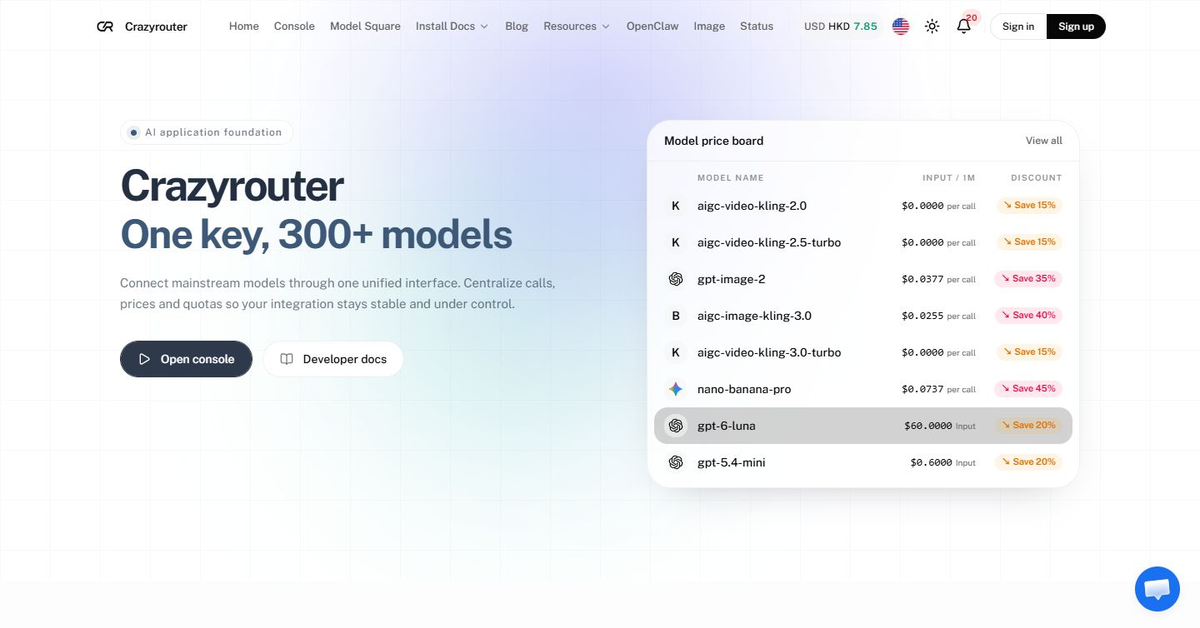
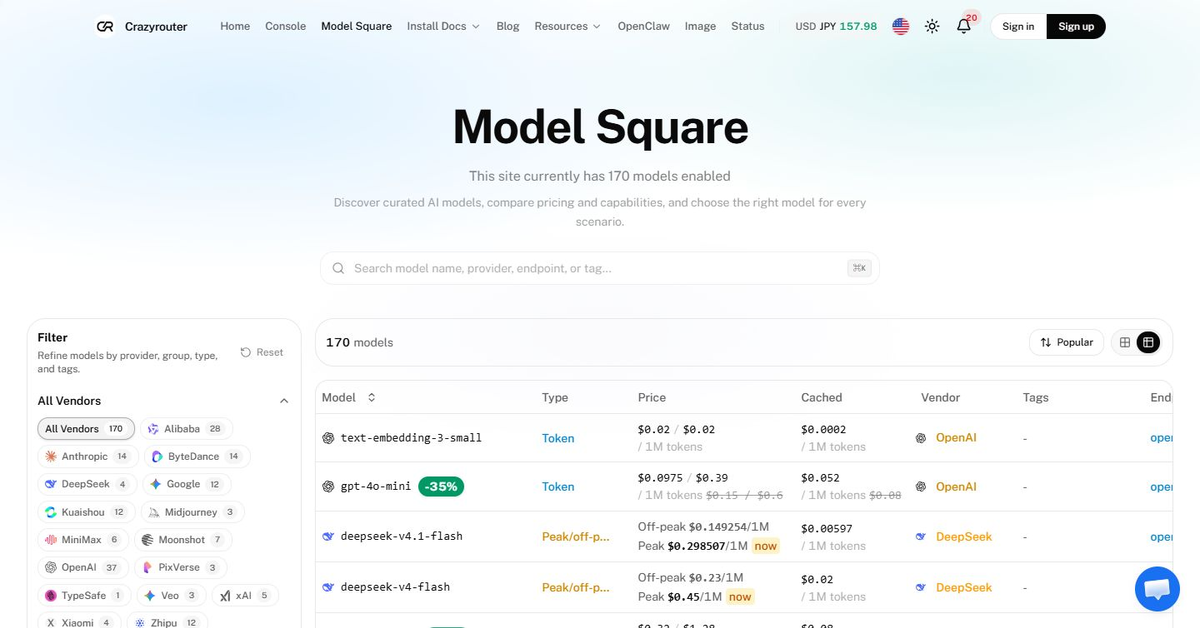
Crazyrouter is a unified API gateway for AI models. It solves the problem of integrating multiple AI providers by offering one single endpoint for all your AI needs.
Key Features:
- One API for all AI models
- Seamless routing and unified API keys
- Optimized cost and performance tracking
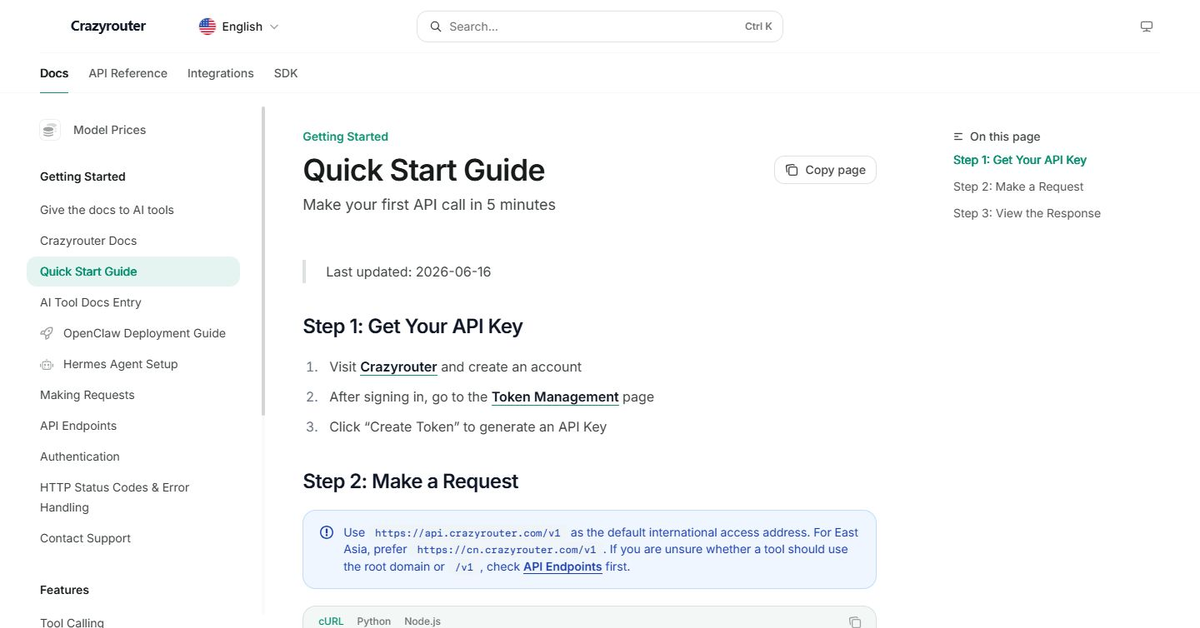
- Easy integration for developers
Features
Unified API endpoint to access multiple AI models (OpenAI, Claude, Gemini, etc.)
Seamless integration with OpenAI-compatible SDKs for easy migration
Smart routing and automatic fallback for high availability
Centralized API key management and usage tracking
Cost optimization by routing requests to the most efficient models
Use Cases
Simplifying AI integration for developers and startups
Building resilient AI applications with automatic failover
Reducing AI costs by routing traffic to the most cost-effective models
Managing multiple AI provider APIs centrally in one dashboard
Comments


Hi everyone! 👋 I'm the maker of Crazyrouter. I built this because I was tired of juggling multiple API keys, SDKs, and billing dashboards for different AI models (OpenAI, Anthropic, Gemini, etc.). Crazyrouter solves this by providing one unified API endpoint for all your AI needs. We handle the smart routing, automatic failover, and cost optimization, so you can focus on building your app instead of managing infrastructure. We are launching today on Fazier! I'd love to hear your feedback, feature requests, or any questions you might have. Let's build something great together!



A single endpoint for many models would cut a lot of integration work — especially when you want to try a new model without rewiring your app. The automatic fallback is the part I would rely on most, since an outage in the middle of a user request is hard to recover from gracefully. How transparent is the cost routing when it switches models mid-task? Clear per-request cost tracking would make this easy to trust in production.

Bringing multiple AI providers together through one API endpoint addresses a real developer pain point. The automatic fallback, centralized usage tracking, and cost optimization features are particularly interesting for teams running AI applications in production. I'm curious about the routing flexibility. Can developers define their own cost or latency limits, configure provider fallback priorities, and track which model provider handled each request?

Smart routing with automatic fallback is the right call - the hard part is usually deciding what "best" means per request: cheapest, lowest latency, or most reliable right now. Two things I'd want to know before trusting it in production: (1) when latency and error rate disagree, how do you score providers - do recent failures weigh more heavily than average latency? (2) when a request is retried on a different provider, does the conversation/context survive intact, especially for streaming (SSE) responses? A short page documenting the fallback policy would probably do more for adoption than another feature - people get burned by silent provider switches and want to know exactly what happens.
The OpenAI-compatible SDK path and unified key management could make trying another model much less disruptive, while per-model cost tracking is valuable when the router chooses a backend. When automatic fallback occurs, will the dashboard show which provider handled each request and its cost, including for streaming calls?


As an indie iOS developer, I appreciate the OpenAI-compatible SDK path because it can make testing another provider less disruptive. Could the request history expose the selected provider, fallback reason, and per-request cost, including streaming requests, so routing is easier to debug in production?
One endpoint for 300+ models with OpenAI-compatible SDKs is the part that would actually get me to switch — migration cost is usually what keeps me locked to one provider. The automatic fallback is the feature I'd test first: how do you decide when to fail over — is it per-request latency/error based, or a rule I configure? Cost routing to the cheapest capable model is a nice second win, if the usage tracking makes the savings visible.



Congratulations on the launch! A single API for all AI models is a genuinely useful idea — juggling separate keys, pricing and SDKs is a real pain for developers. The smart routing and automatic fallback sound especially valuable for keeping apps reliable, and the cost tracking could help small teams a lot. How do you handle rate limits across providers? Best of luck with the launch!


Congrats on the launch! The unified endpoint with OpenAI-compatible SDKs is the part that stands out for me — it should make switching models much less painful. I'm curious how the automatic fallback works in practice: if an upstream provider returns a 429, does the request retry on another model transparently, and does the response say which model actually answered? Cost-based routing is also a smart angle for teams running a lot of traffic.

When a request falls back to another provider, does the response say which model actually answered, in a header or the body? I would need that for billing and for debugging odd outputs. And with streaming, if the first provider fails partway through, do you retry from the start or pass the error back to the client?


One endpoint for 300+ models with OpenAI-compatible SDKs is the part that would actually get me to switch — migration cost is usually what keeps teams locked to a single provider. Smart routing plus automatic fallback also solves the real 3am problem: a provider outage taking down your whole app. Two honest questions: when a request falls back mid-stream, does the response say which model actually answered? And how do you handle a 429 rate limit mid-stream — retry on the same model or fail over immediately? Congrats on the launch!



Great concept! Managing multiple AI API keys and switching models with different SDKs is always a real headache for developers. Having a unified endpoint with cost tracking is a huge time-saver. Do you support automatic fallback routing if one provider's rate limit is hit? Upvoted and congrats on the launch!

use this tool for tools websites like tax consulting websites e.g https://digits.ie/tools/#penalty and many things can be managed by bots



Premium Products
















































Makers
Makers
Comments
Hi everyone! 👋 I'm the maker of Crazyrouter. I built this because I was tired of juggling multiple API keys, SDKs, and billing dashboards for different AI models (OpenAI, Anthropic, Gemini, etc.). Crazyrouter solves this by providing one unified API endpoint for all your AI needs. We handle the smart routing, automatic failover, and cost optimization, so you can focus on building your app instead of managing infrastructure. We are launching today on Fazier! I'd love to hear your feedback, feature requests, or any questions you might have. Let's build something great together!
A single endpoint for many models would cut a lot of integration work — especially when you want to try a new model without rewiring your app. The automatic fallback is the part I would rely on most, since an outage in the middle of a user request is hard to recover from gracefully. How transparent is the cost routing when it switches models mid-task? Clear per-request cost tracking would make this easy to trust in production.
Bringing multiple AI providers together through one API endpoint addresses a real developer pain point. The automatic fallback, centralized usage tracking, and cost optimization features are particularly interesting for teams running AI applications in production. I'm curious about the routing flexibility. Can developers define their own cost or latency limits, configure provider fallback priorities, and track which model provider handled each request?
Smart routing with automatic fallback is the right call - the hard part is usually deciding what "best" means per request: cheapest, lowest latency, or most reliable right now. Two things I'd want to know before trusting it in production: (1) when latency and error rate disagree, how do you score providers - do recent failures weigh more heavily than average latency? (2) when a request is retried on a different provider, does the conversation/context survive intact, especially for streaming (SSE) responses? A short page documenting the fallback policy would probably do more for adoption than another feature - people get burned by silent provider switches and want to know exactly what happens.
The OpenAI-compatible SDK path and unified key management could make trying another model much less disruptive, while per-model cost tracking is valuable when the router chooses a backend. When automatic fallback occurs, will the dashboard show which provider handled each request and its cost, including for streaming calls?
As an indie iOS developer, I appreciate the OpenAI-compatible SDK path because it can make testing another provider less disruptive. Could the request history expose the selected provider, fallback reason, and per-request cost, including streaming requests, so routing is easier to debug in production?
One endpoint for 300+ models with OpenAI-compatible SDKs is the part that would actually get me to switch — migration cost is usually what keeps me locked to one provider. The automatic fallback is the feature I'd test first: how do you decide when to fail over — is it per-request latency/error based, or a rule I configure? Cost routing to the cheapest capable model is a nice second win, if the usage tracking makes the savings visible.
Congratulations on the launch! A single API for all AI models is a genuinely useful idea — juggling separate keys, pricing and SDKs is a real pain for developers. The smart routing and automatic fallback sound especially valuable for keeping apps reliable, and the cost tracking could help small teams a lot. How do you handle rate limits across providers? Best of luck with the launch!
Congrats on the launch! The unified endpoint with OpenAI-compatible SDKs is the part that stands out for me — it should make switching models much less painful. I'm curious how the automatic fallback works in practice: if an upstream provider returns a 429, does the request retry on another model transparently, and does the response say which model actually answered? Cost-based routing is also a smart angle for teams running a lot of traffic.
When a request falls back to another provider, does the response say which model actually answered, in a header or the body? I would need that for billing and for debugging odd outputs. And with streaming, if the first provider fails partway through, do you retry from the start or pass the error back to the client?
One endpoint for 300+ models with OpenAI-compatible SDKs is the part that would actually get me to switch — migration cost is usually what keeps teams locked to a single provider. Smart routing plus automatic fallback also solves the real 3am problem: a provider outage taking down your whole app. Two honest questions: when a request falls back mid-stream, does the response say which model actually answered? And how do you handle a 429 rate limit mid-stream — retry on the same model or fail over immediately? Congrats on the launch!
Great concept! Managing multiple AI API keys and switching models with different SDKs is always a real headache for developers. Having a unified endpoint with cost tracking is a huge time-saver. Do you support automatic fallback routing if one provider's rate limit is hit? Upvoted and congrats on the launch!
use this tool for tools websites like tax consulting websites e.g https://digits.ie/tools/#penalty and many things can be managed by bots
Premium Products
New to Fazier?

Find your next favorite product or submit your own. Made by @FalakDigital.
Copyright ©2026. All Rights Reserved