
CrawlCheck
Audit robots.txt for 60+ AI crawlers. Free, instant.
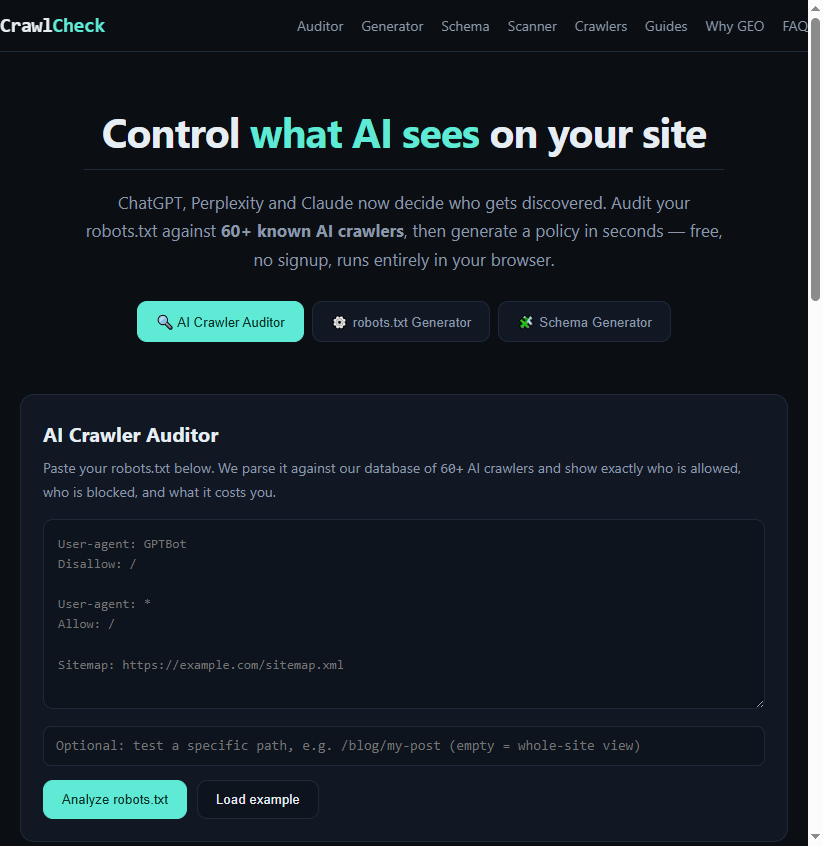
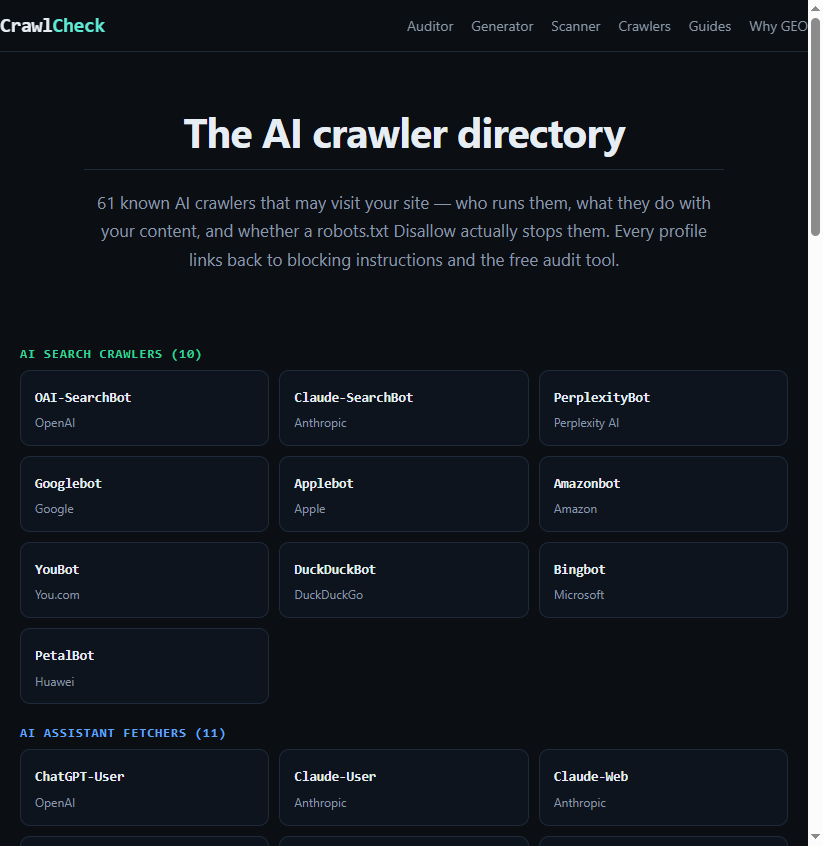
CrawlCheck is a free client-side auditor that shows exactly which AI crawlers — GPTBot, ClaudeBot, PerplexityBot, Bytespider and 60+ more — your robots.txt allows or blocks. Paste your robots.txt and get an instant verdict per bot, plus a ready-to-use policy generator that blocks or allows AI training and search crawlers with one click. It also checks broken links, audits meta tags and generates JSON-LD structured data. Everything runs 100% in your browser — no signup, no server upload, no data leaves your machine.

Comments

CrawlCheck started as an internal tool: we kept getting asked "can ChatGPT see my site?" and the honest answer required manually tracing 60+ crawler user-agents through robots.txt. So we built the auditor we wanted — paste your robots.txt, get a per-bot verdict instantly, and generate a clean policy with one click. Everything runs client-side, so nothing leaves your browser. We would love feedback on the policy generator: which AI crawlers do you block today, and did the tool miss any?




Using Load example, then testing /admin/, the auditor correctly reports that the path is blocked. The warnings also describe this as lost referral traffic and say the Googlebot block removes the site from search completely. Since /admin/ is intentionally private in this example, could those messages distinguish a path-level block from a site-wide block? An “expected private path” label would help avoid suggesting that admin pages should be opened to crawlers.
Genuinely useful - I'm working through AI-crawler policy on a few sites right now and per-bot verdicts beat manually tracing user-agents. The client-side approach is a nice trust signal too. One question: does the policy generator handle allowing search crawlers while blocking training crawlers, or is it all-or-nothing per bot?

Running everything client-side is a great choice for a robots.txt auditor, since people can test staging configs without uploading anything. Could you add a mode that fetches a live robots.txt by URL and flags bots that ignore robots.txt entirely, so users know when they need server-level blocking instead?


Since the per-bot verdict depends on matching user-agent tokens, how do you keep the list current when vendors add new crawlers like OpenAI's separate OAI-SearchBot vs GPTBot? It would help to see a 'last updated' date next to each bot so I know whether a verdict is still trustworthy. Also curious whether the policy generator distinguishes training crawlers from ones that power live search citations, since blocking the latter can cost visibility.

Ran our own robots.txt through it. We stack 13 User-agent lines over one Allow group, and it read every one correctly, which plenty of parsers get wrong. I also stacked GPTBot, CCBot and ClaudeBot over a single Disallow, and all three came back blocked as they should. One thought: blocking only training crawlers is a deliberate choice for a lot of sites, yet it still drops the score from 100 to 95. Scoring search and assistant visibility on its own, and showing training opt-outs as a neutral setting, would stop people feeling nudged to undo it.

Ran our robots.txt through it (a wildcard Allow plus a Sitemap line): 100, all 61 crawlers allowed. Grouping the results into search, assistant, agents and training is the clearest breakdown I've seen. One suggestion: the list itself notes that Bytespider and a few others are known to ignore robots.txt, yet the summary still says CLEAN. A small count of "allowed, but known to ignore robots.txt anyway" next to the score would stop people reading 100 as "protected".
Doing the robots.txt parsing fully client-side is a nice touch for privacy. One edge case worth checking: crawlers like Google-Extended and Applebot-Extended are opt-out tokens rather than real user-agents that fetch pages, so does the per-bot verdict distinguish those from bots that actually crawl? A short note on that in the results would save people a lot of confusion.

The per-bot verdict is genuinely useful — a lot of people block GPTBot and don’t realise OAI-SearchBot and ChatGPT-User are separate agents, so they lose (or keep) ChatGPT search visibility without meaning to. Suggestion: group the results into “training”, “search/answers” and “user-triggered fetch”, with one line on what blocking each group costs. Checking llms.txt next to robots.txt would also be a nice addition, since its format is easy to get wrong.

Ran this against a docs site I maintain — the client-side approach meant I could audit a staging URL behind basic auth without pasting credentials anywhere, which is exactly the right call. One feature request: an exportable GitHub Action that fails CI when a new AI crawler appears that isn't covered by the policy. The crawler landscape changes monthly; a scheduled audit would be more valuable than a one-off check.
Running the robots.txt parsing fully in the browser and distinguishing AI training crawlers from AI search crawlers is a genuinely useful split. One suggestion: let users fetch robots.txt directly by domain and also flag llms.txt or meta robots noai tags, since those often contradict what robots.txt says.

Ran our studio site's robots.txt through it: 100, 61 allowed, and the explicit Allow groups for OAI-SearchBot, Claude-SearchBot and Perplexity-User all read correctly. Two small things I noticed. First, the "Unrecognized user-agent" note lumps Slurp, Baiduspider and YandexBot (classic search engines) together with AhrefsBot, SemrushBot and MJ12bot (SEO crawlers). Splitting those into "known non-AI bot" vs "truly unknown" would stop people wondering if they have a typo. Second, the Crawl-delay note fires on "Crawl-delay: 0", which does nothing for any bot. Saying "a value of 0 has no effect, safe to remove" would be more useful there than the Googlebot reminder.
Premium Products




















































Sponsors
Buy

Makers
Makers
Comments
CrawlCheck started as an internal tool: we kept getting asked "can ChatGPT see my site?" and the honest answer required manually tracing 60+ crawler user-agents through robots.txt. So we built the auditor we wanted — paste your robots.txt, get a per-bot verdict instantly, and generate a clean policy with one click. Everything runs client-side, so nothing leaves your browser. We would love feedback on the policy generator: which AI crawlers do you block today, and did the tool miss any?
Using Load example, then testing /admin/, the auditor correctly reports that the path is blocked. The warnings also describe this as lost referral traffic and say the Googlebot block removes the site from search completely. Since /admin/ is intentionally private in this example, could those messages distinguish a path-level block from a site-wide block? An “expected private path” label would help avoid suggesting that admin pages should be opened to crawlers.
Genuinely useful - I'm working through AI-crawler policy on a few sites right now and per-bot verdicts beat manually tracing user-agents. The client-side approach is a nice trust signal too. One question: does the policy generator handle allowing search crawlers while blocking training crawlers, or is it all-or-nothing per bot?
Running everything client-side is a great choice for a robots.txt auditor, since people can test staging configs without uploading anything. Could you add a mode that fetches a live robots.txt by URL and flags bots that ignore robots.txt entirely, so users know when they need server-level blocking instead?
Since the per-bot verdict depends on matching user-agent tokens, how do you keep the list current when vendors add new crawlers like OpenAI's separate OAI-SearchBot vs GPTBot? It would help to see a 'last updated' date next to each bot so I know whether a verdict is still trustworthy. Also curious whether the policy generator distinguishes training crawlers from ones that power live search citations, since blocking the latter can cost visibility.
Ran our own robots.txt through it. We stack 13 User-agent lines over one Allow group, and it read every one correctly, which plenty of parsers get wrong. I also stacked GPTBot, CCBot and ClaudeBot over a single Disallow, and all three came back blocked as they should. One thought: blocking only training crawlers is a deliberate choice for a lot of sites, yet it still drops the score from 100 to 95. Scoring search and assistant visibility on its own, and showing training opt-outs as a neutral setting, would stop people feeling nudged to undo it.
Ran our robots.txt through it (a wildcard Allow plus a Sitemap line): 100, all 61 crawlers allowed. Grouping the results into search, assistant, agents and training is the clearest breakdown I've seen. One suggestion: the list itself notes that Bytespider and a few others are known to ignore robots.txt, yet the summary still says CLEAN. A small count of "allowed, but known to ignore robots.txt anyway" next to the score would stop people reading 100 as "protected".
Doing the robots.txt parsing fully client-side is a nice touch for privacy. One edge case worth checking: crawlers like Google-Extended and Applebot-Extended are opt-out tokens rather than real user-agents that fetch pages, so does the per-bot verdict distinguish those from bots that actually crawl? A short note on that in the results would save people a lot of confusion.
The per-bot verdict is genuinely useful — a lot of people block GPTBot and don’t realise OAI-SearchBot and ChatGPT-User are separate agents, so they lose (or keep) ChatGPT search visibility without meaning to. Suggestion: group the results into “training”, “search/answers” and “user-triggered fetch”, with one line on what blocking each group costs. Checking llms.txt next to robots.txt would also be a nice addition, since its format is easy to get wrong.
Ran this against a docs site I maintain — the client-side approach meant I could audit a staging URL behind basic auth without pasting credentials anywhere, which is exactly the right call. One feature request: an exportable GitHub Action that fails CI when a new AI crawler appears that isn't covered by the policy. The crawler landscape changes monthly; a scheduled audit would be more valuable than a one-off check.
Running the robots.txt parsing fully in the browser and distinguishing AI training crawlers from AI search crawlers is a genuinely useful split. One suggestion: let users fetch robots.txt directly by domain and also flag llms.txt or meta robots noai tags, since those often contradict what robots.txt says.
Ran our studio site's robots.txt through it: 100, 61 allowed, and the explicit Allow groups for OAI-SearchBot, Claude-SearchBot and Perplexity-User all read correctly. Two small things I noticed. First, the "Unrecognized user-agent" note lumps Slurp, Baiduspider and YandexBot (classic search engines) together with AhrefsBot, SemrushBot and MJ12bot (SEO crawlers). Splitting those into "known non-AI bot" vs "truly unknown" would stop people wondering if they have a typo. Second, the Crawl-delay note fires on "Crawl-delay: 0", which does nothing for any bot. Saying "a value of 0 has no effect, safe to remove" would be more useful there than the Googlebot reminder.
Premium Products
New to Fazier?

Find your next favorite product or submit your own. Made by @FalakDigital.
Copyright ©2026. All Rights Reserved