
Clarno
Every AI says yes. Clarno checks if the market will.
The market tells you eventually. Clarno tells you now.
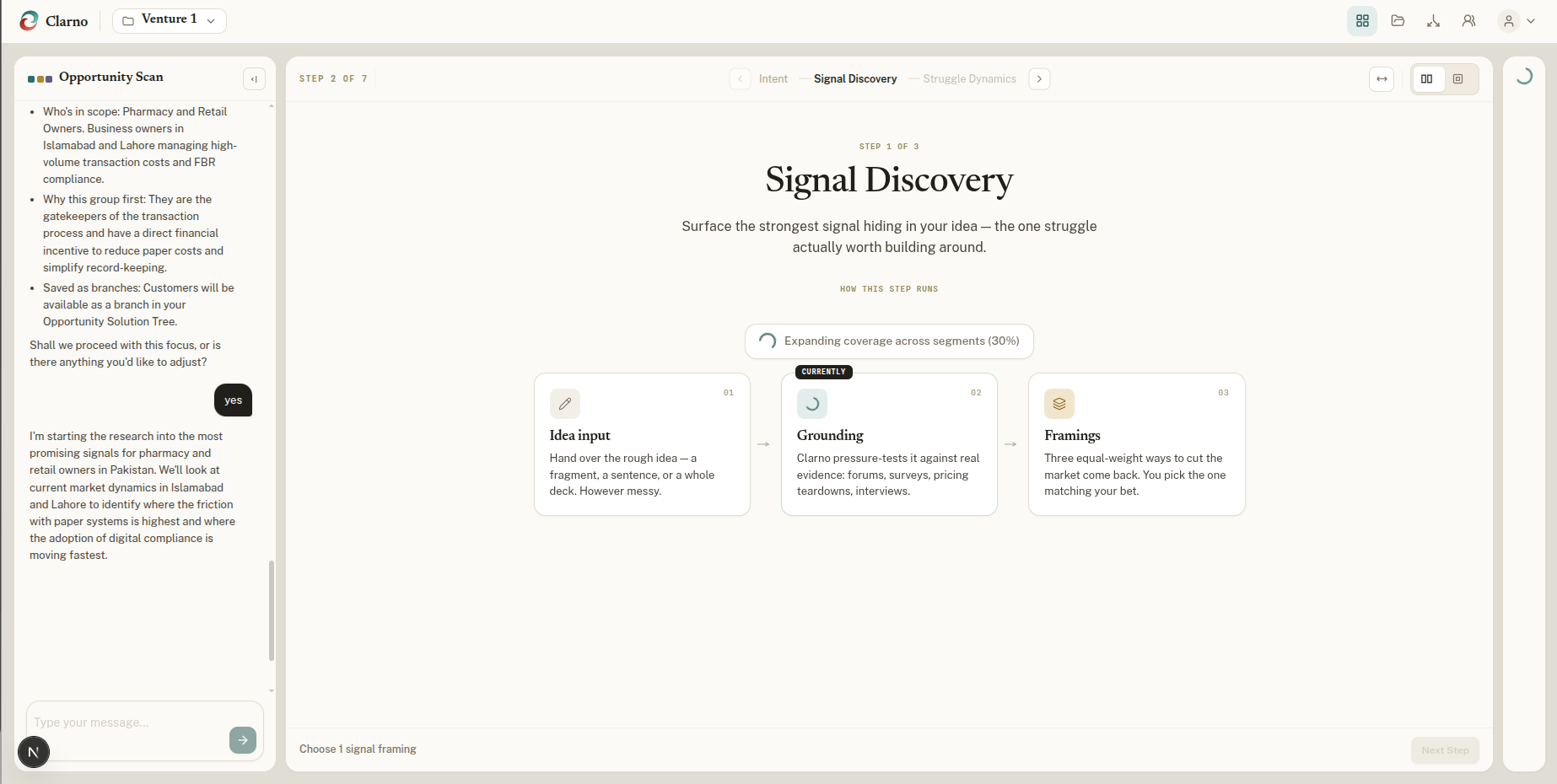
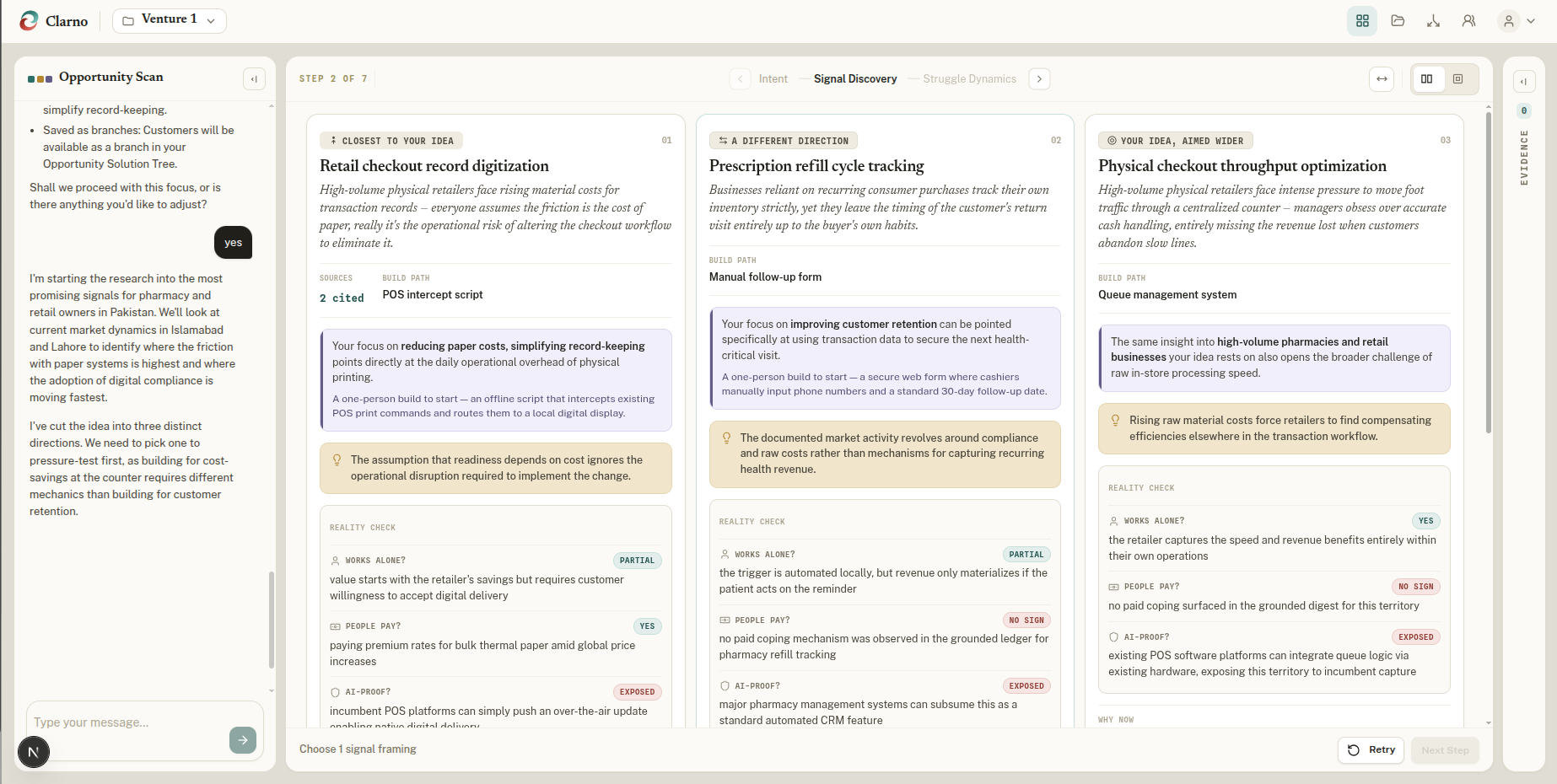
Bring an idea, or a product you have already shipped. Clarno reads the real market first: who is already struggling, and what they pay today. Then up to 50 market agents with memory and budgets take it apart. You leave with a verdict, its evidence, and three directions to choose from. When a number cannot be found, Clarno says so instead of inventing one.
Features
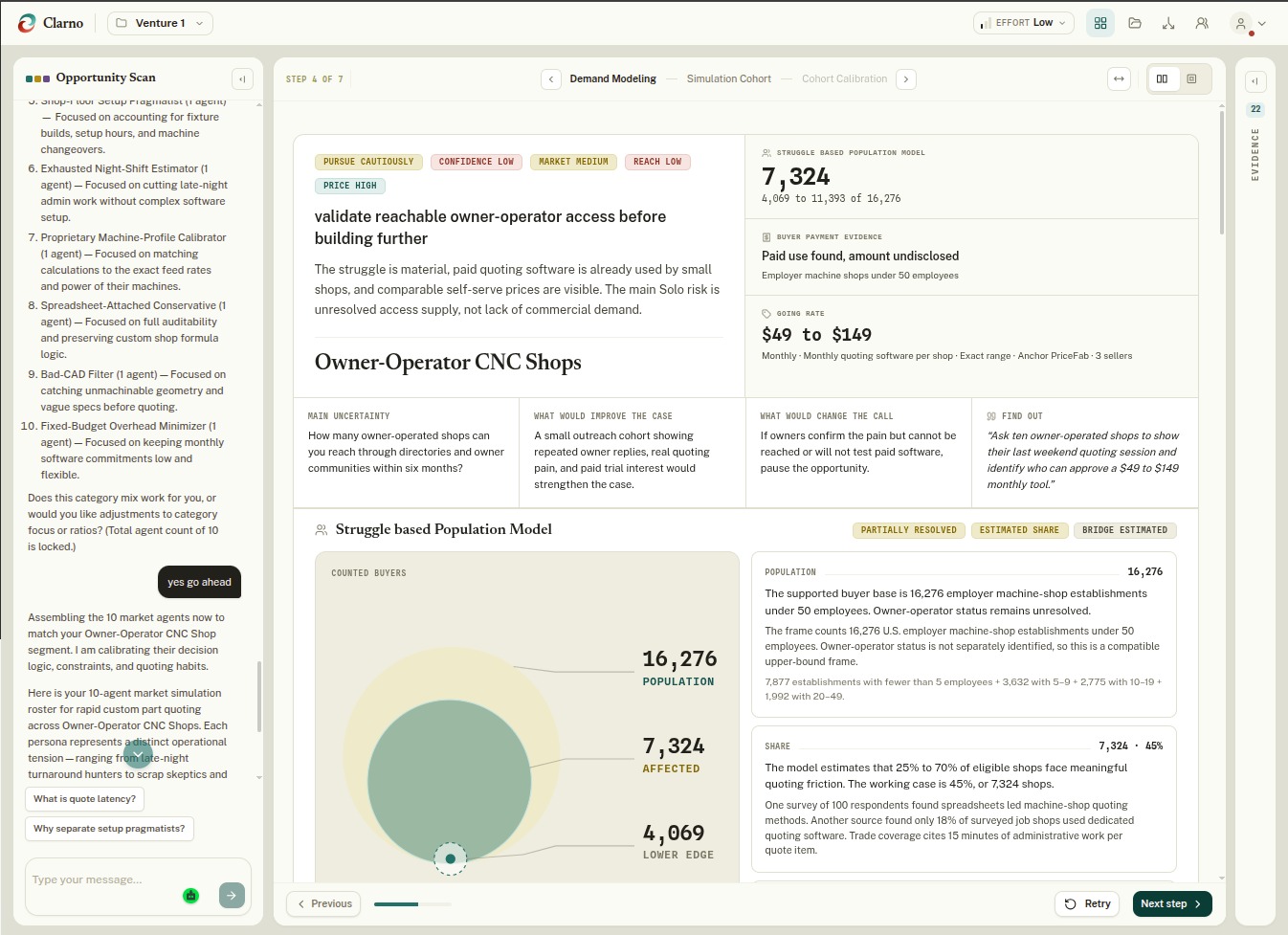
Real Market First: See who is already struggling, how badly, and what they pay today.
Market Agents: Pressure-test ideas with 10, 30, or 50 market agents with personas, episodic memory, and budgets.
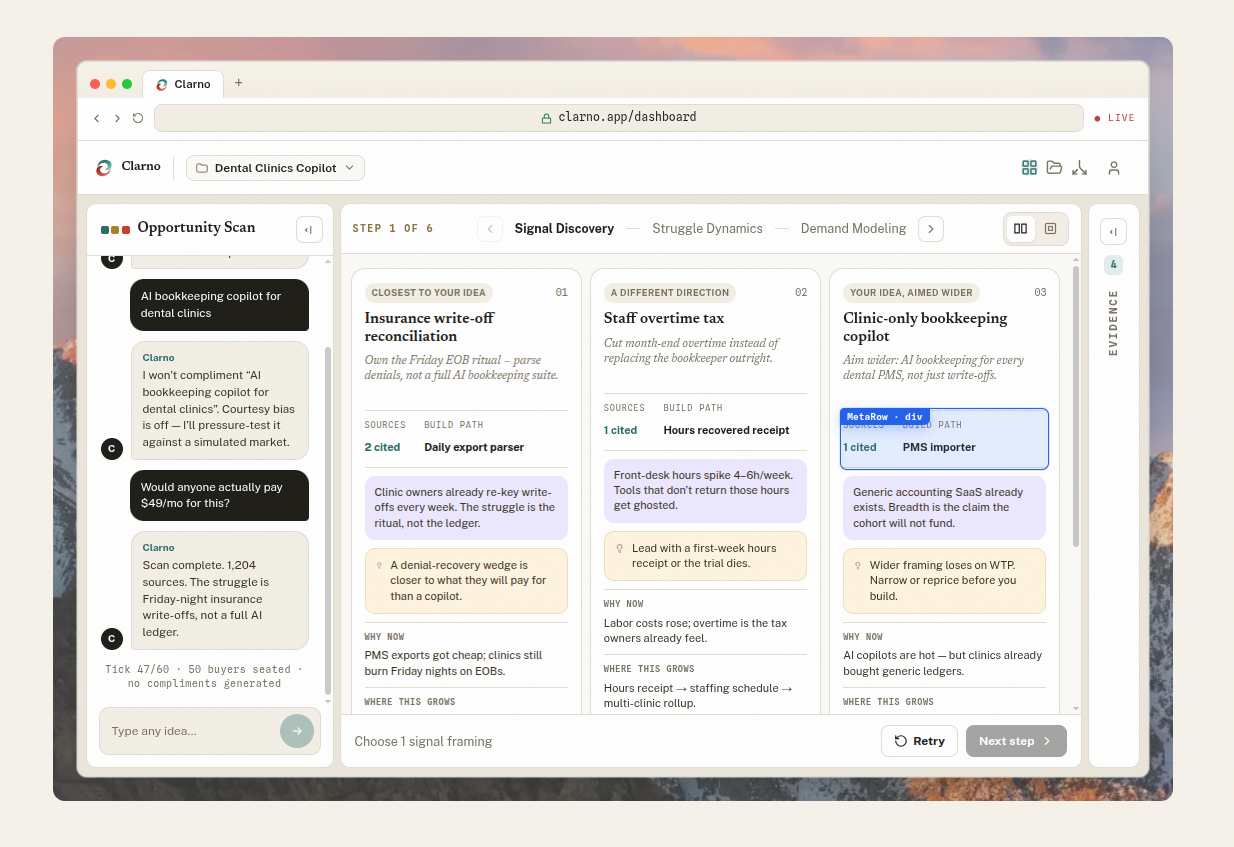
Evidence-Based Verdicts: Get PASS, FAILED, or PIVOT decisions based on gates and evidence, not arbitrary scores.
No Source, No Number: Every figure carries its source. When a number cannot be found, Clarno says “not found” instead of inventing one.
Three Directions at Every Fork: Compare three directions with their strengths and weaknesses, pick one, and have the market agents pressure-test it.
Opportunity Solution Tree: After FAILED, explore ranked pivots and test the next branch in simulation.
Standing Market Panel: The same agents carry through later stages, giving continuity to product, pricing, and switching decisions.
From Test to Build: Turn the surviving direction into features, pricing, branding, route to market, business case, and build-ready prompts.
Build Without Lock-In: Get prompts and architecture ready to build the MVP in your own tools.
Traction Tracking: After launch, track real traction against Clarno"s original verdict.
Use Cases
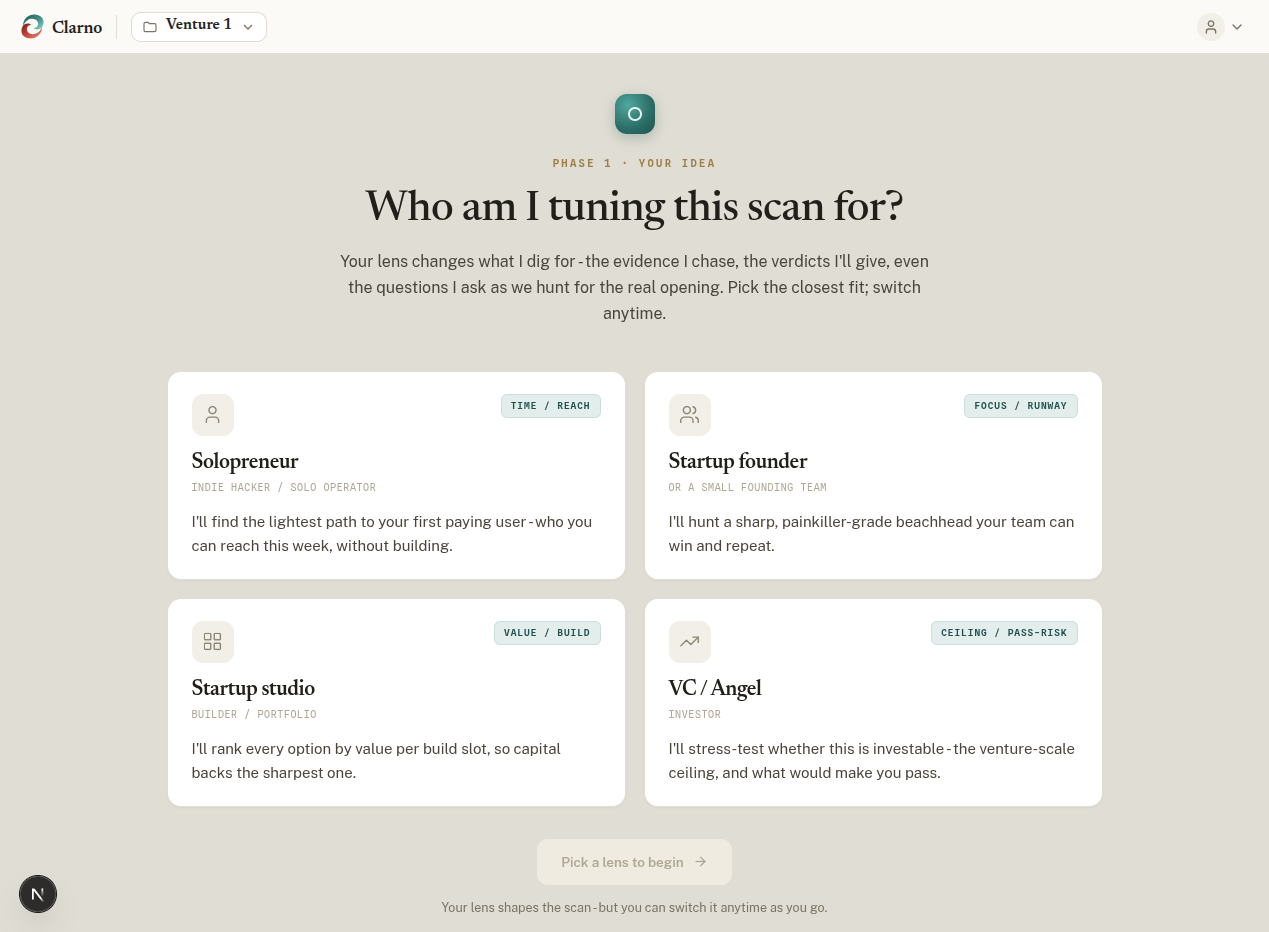
Startup Idea Screening: Pressure-test an idea before investing months or a year into building it.
Product Pressure-Testing: Run an already-shipped product through market agents to locate where traction or failure comes from.
Wedge and Pricing Decisions: Pressure-test the product direction, pricing, and positioning while they are still cheap to change.
Pivot Discovery: Use the opportunity solution tree to explore ranked alternatives when an idea does not pass as pitched.
Product Development: Choose features based on what market agents actually said they would adopt.
Business Planning: Develop pricing, branding, route to market, and a business case around the direction that survives.
MVP Planning: Turn a surviving concept into architecture and build-ready prompts for your own development tools.
Startup Studio Screening: Run multiple concepts through the same standard of evidence.
Investor Screening: Screen startup decks against a market model and up to 50 market agents before the partner meeting.

Comments


I built Clarno because I got tired of AI telling me every idea was great. The expensive part of building isn’t writing the code anymore. It’s spending months building something the market never wanted. So we built Clarno to do the uncomfortable part first: pressure-test the idea, let the market argue back, and show you where it breaks. If you have an idea you’re unusually confident about, I’d actually like to know: what would make you stop building it?


Great idea. You're not the only one tired of AI always saying yes. If you need something to relax and train your brain at the same time, I highly recommend to play block blast online https://blockblast.org



The "No Source, No Number" rule is what sold me. Most AI validation tools invent market figures when they cannot find them, so saying "not found" instead is a genuinely different design choice. Pressure-testing an idea with up to 50 market agents that have personas, episodic memory and real budgets is the kind of honest feedback founders rarely get from AI. Since investor screening is listed as a use case, does the evidence-backed verdict come with a source list I could share in a partner meeting?


The 'no source, no number' rule is what would make me trust this: most validation tools happily invent TAM figures, and a verdict built on a made-up number is worse than no verdict. Running 30-50 agents with personas, memory and budgets feels closer to a market than one LLM opinion, and showing PASS/FAILED gates instead of a score makes the result auditable. Two things I'd want to check: how do you keep a standing panel from drifting into generic personas over many sessions, and does the Opportunity Solution Tree remember which experiments already failed so I don't re-test the same branch?
his is such a relatable problem—re-explaining project stacks and personal preferences to Claude, ChatGPT, and coding agents every single day becomes exhausting. Having a portable, tool-agnostic memory layer via MCP makes total sense. Love the focus on data control and exportability too. Great launch

Premium Products























































Sponsors
Buy



Makers
Makers
Comments
I built Clarno because I got tired of AI telling me every idea was great. The expensive part of building isn’t writing the code anymore. It’s spending months building something the market never wanted. So we built Clarno to do the uncomfortable part first: pressure-test the idea, let the market argue back, and show you where it breaks. If you have an idea you’re unusually confident about, I’d actually like to know: what would make you stop building it?
Great idea. You're not the only one tired of AI always saying yes. If you need something to relax and train your brain at the same time, I highly recommend to play block blast online https://blockblast.org
The "No Source, No Number" rule is what sold me. Most AI validation tools invent market figures when they cannot find them, so saying "not found" instead is a genuinely different design choice. Pressure-testing an idea with up to 50 market agents that have personas, episodic memory and real budgets is the kind of honest feedback founders rarely get from AI. Since investor screening is listed as a use case, does the evidence-backed verdict come with a source list I could share in a partner meeting?
The 'no source, no number' rule is what would make me trust this: most validation tools happily invent TAM figures, and a verdict built on a made-up number is worse than no verdict. Running 30-50 agents with personas, memory and budgets feels closer to a market than one LLM opinion, and showing PASS/FAILED gates instead of a score makes the result auditable. Two things I'd want to check: how do you keep a standing panel from drifting into generic personas over many sessions, and does the Opportunity Solution Tree remember which experiments already failed so I don't re-test the same branch?
his is such a relatable problem—re-explaining project stacks and personal preferences to Claude, ChatGPT, and coding agents every single day becomes exhausting. Having a portable, tool-agnostic memory layer via MCP makes total sense. Love the focus on data control and exportability too. Great launch
Premium Products
New to Fazier?

Find your next favorite product or submit your own. Made by @FalakDigital.
Copyright ©2026. All Rights Reserved