
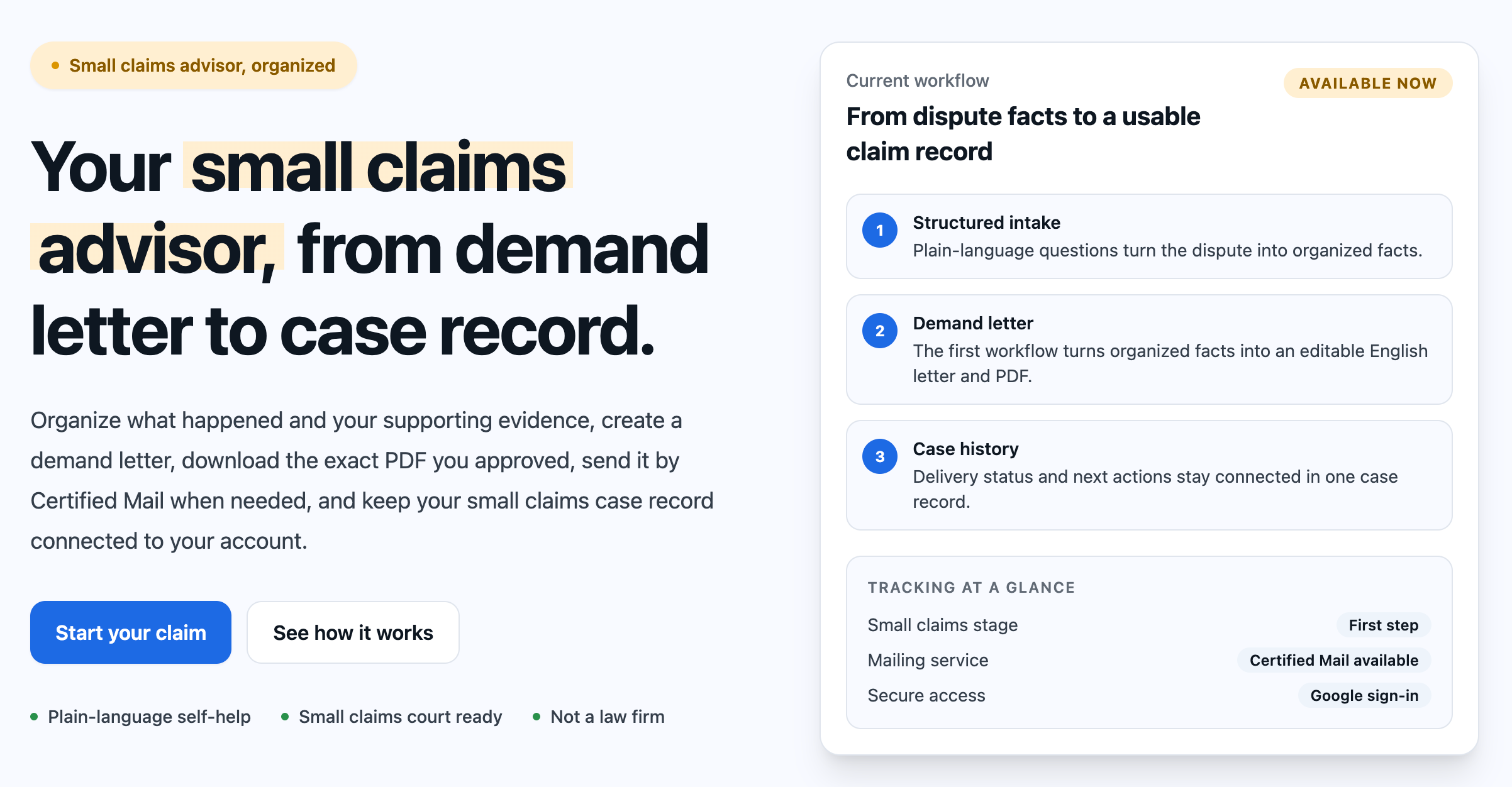
ClaimResolver is a self-help platform for people dealing with everyday disputes and small claims. It helps users organize what happened, create and review an AI-assisted demand letter, keep supporting evidence in one case workspace, and prepare for possible small claims court steps.
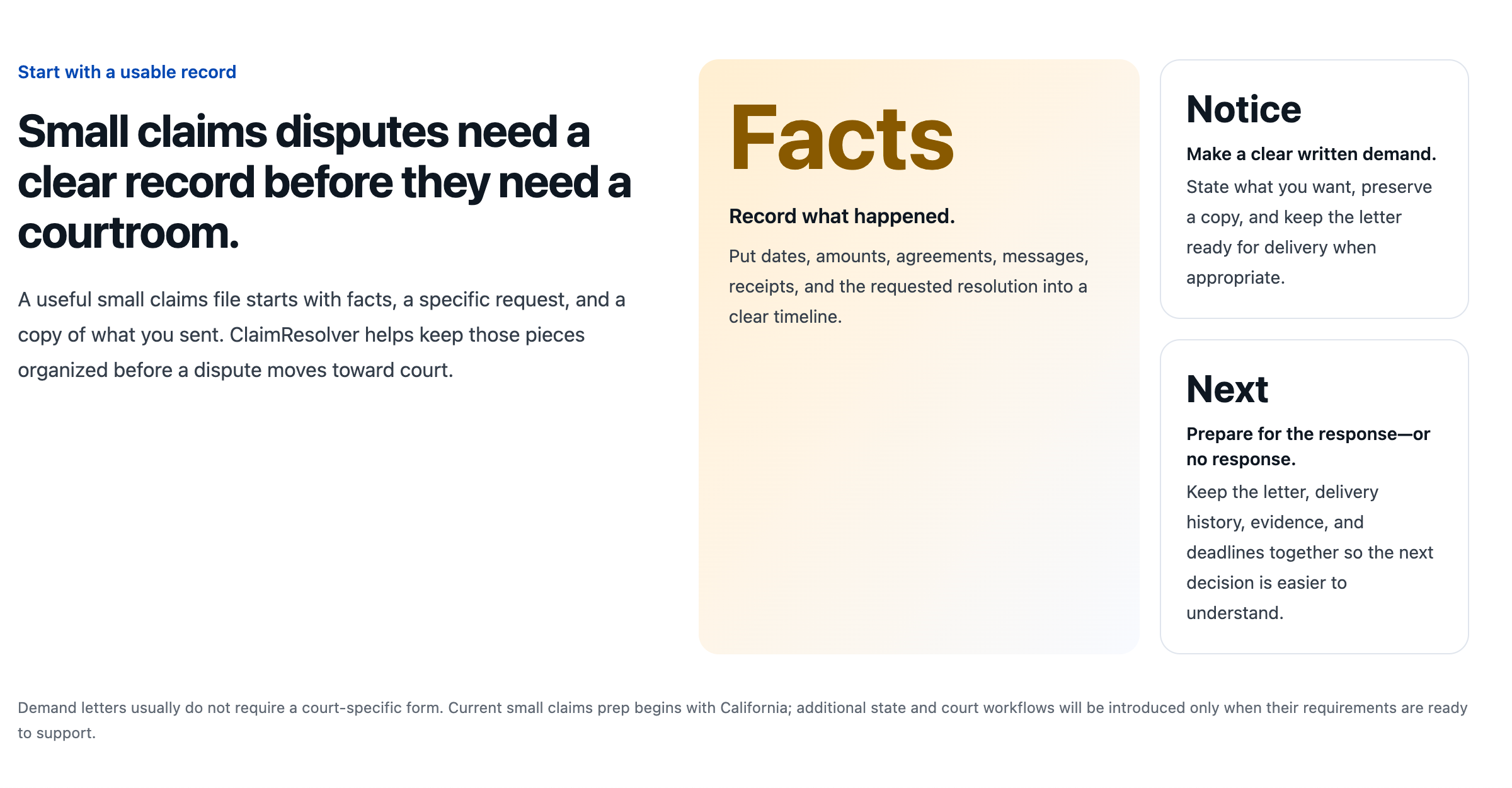
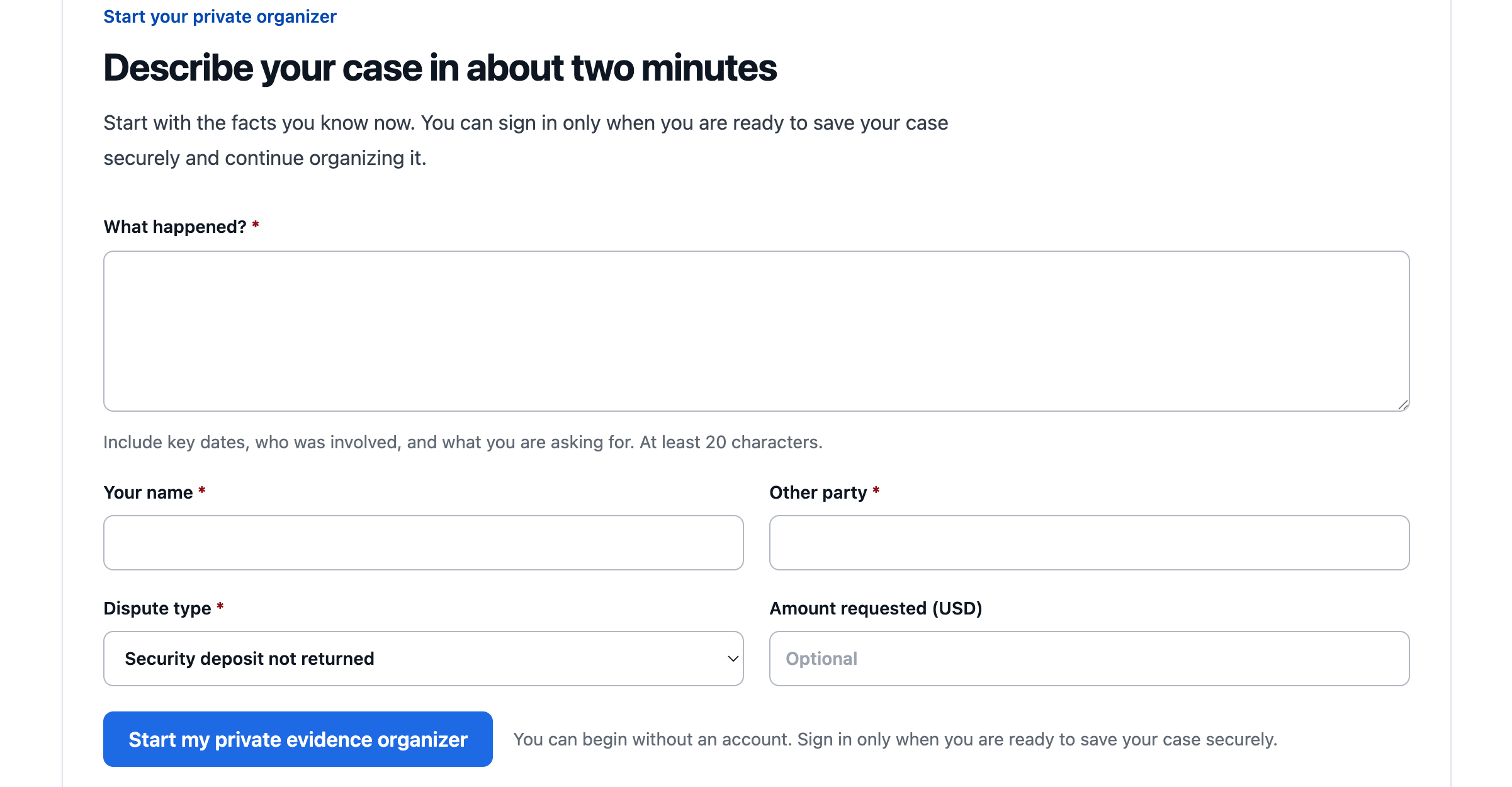
Users can record key dates, amounts, agreements, messages, receipts, photos, and other supporting information in plain language. ClaimResolver turns those details into an organized case record while keeping the user in control of the final wording and next steps.
Current workflows include editable demand letters, PDF downloads, Certified Mail tracking, evidence organization, and small claims preparation. California filing preparation is currently supported, with additional state workflows planned.
ClaimResolver is self-help technology, not a law firm, and does not provide legal advice.
Features
- Plain-language case record: dates, amounts, agreements, messages, receipts, and photos kept in one private workspace
- AI-assisted demand letter you can edit before sending. You control the final wording
- Evidence organized alongside the dispute history in a single case file
- PDF download and Certified Mail tracking when you send the letter
- Small claims preparation with draft filing materials for California cases
Use Cases
- Your landlord won't return your security deposit
- Your employer owes you wages or a client won't pay an invoice
- A business kept your deposit and never did the job
- A company won't refund a product or service you paid for
- You're heading to small claims court and need your case and evidence organized (California filing prep supported today)

Comments


I built ClaimResolver after watching a friend lose a dispute they should have won. Not because the facts were against them, but because their case was a mess: texts scattered across three apps, a missing receipt, no timeline, no idea what to do next. Most small disputes don't need a lawyer. They need a way to organize what happened, put the demand in writing, keep the evidence in one place. That's the product: you describe the dispute in plain language, ClaimResolver builds an organized case record, drafts a demand letter you can edit, and keeps everything in one private workspace. PDF download and Certified Mail tracking when you send it, draft filing materials when a California case moves toward court. One thing worth being explicit about: ClaimResolver is self-help technology, not a law firm. It doesn't give legal advice. You stay in control of the wording and every next step. I can't say the letter wins every case. Some disputes do end up in court. If you've been through a dispute where you had the facts but not the process, I'd like to hear how it ended.


Congratulations on the launch of the project. Being able to group supporting documents and text messages into a single folder while drafting correspondence is extremely convenient. If you need AI-based assistance for future projects, feel free to visit pzero.studio to take advantage of preferential rates.



The positioning is the strongest part — stating outright that it's self-help technology and not legal advice, and that you keep control of the wording, is more reassuring than any confidence claim would be. The question I'd have as a user: how jurisdiction-dependent are the letters? A demand letter that works in one country can be the wrong instrument in another, and the point where a dispute stops being a letter and starts being a procedure moves too. Do you scope it to one legal system, or adapt?

What impressed me most is that ClaimResolver focuses on the messy part of small disputes not just generating a demand letter, but organizing timelines, receipts, messages, photos, and other evidence in one place. The editable AI-assisted letter is a nice touch because users still control the final wording. I’m curious: when the other party responds to a demand letter, do you plan to add response tracking and follow-up workflows? That could make ClaimResolver even more useful throughout the entire dispute lifecycle.


The organization angle here is the real win. Most people dealing with a dispute have evidence scattered everywhere - a text thread on one phone, an email in another account, receipts in cloud storage, maybe a photo somewhere else. Consolidating all of that into one case file with a proper timeline is genuinely useful before walking into small claims court. The fact that you can download and mail the demand letter certified actually saves money compared to hiring someone to draft correspondence. The evidence organization piece is probably worth the time savings alone.


ClaimResolver Your product has strong potential, but I found a few key improvements that could make it even better. I'd love to share my feedback and suggestions—please contact me at [email protected].

One feature that could make this even more useful is a simple evidence checklist for each claim. It could show what has already been added and what is still missing, such as receipts, photos, messages, contracts, or payment records. That would make it easier to spot gaps before preparing the demand letter.

The structured intake -> demand letter -> case record flow makes sense, and keeping the receipts and texts in the same case file as the letter is the part most templates miss. Being upfront that it's self-help and not legal advice is good. Question: California filing prep is supported today which state is next, and does the case record export if someone eventually hands it to a lawyer?


Premium Products










































Sponsors
Buy

Awards
View all
Awards
View allMakers
Makers
Comments
I built ClaimResolver after watching a friend lose a dispute they should have won. Not because the facts were against them, but because their case was a mess: texts scattered across three apps, a missing receipt, no timeline, no idea what to do next. Most small disputes don't need a lawyer. They need a way to organize what happened, put the demand in writing, keep the evidence in one place. That's the product: you describe the dispute in plain language, ClaimResolver builds an organized case record, drafts a demand letter you can edit, and keeps everything in one private workspace. PDF download and Certified Mail tracking when you send it, draft filing materials when a California case moves toward court. One thing worth being explicit about: ClaimResolver is self-help technology, not a law firm. It doesn't give legal advice. You stay in control of the wording and every next step. I can't say the letter wins every case. Some disputes do end up in court. If you've been through a dispute where you had the facts but not the process, I'd like to hear how it ended.
Congratulations on the launch of the project. Being able to group supporting documents and text messages into a single folder while drafting correspondence is extremely convenient. If you need AI-based assistance for future projects, feel free to visit pzero.studio to take advantage of preferential rates.
The positioning is the strongest part — stating outright that it's self-help technology and not legal advice, and that you keep control of the wording, is more reassuring than any confidence claim would be. The question I'd have as a user: how jurisdiction-dependent are the letters? A demand letter that works in one country can be the wrong instrument in another, and the point where a dispute stops being a letter and starts being a procedure moves too. Do you scope it to one legal system, or adapt?
What impressed me most is that ClaimResolver focuses on the messy part of small disputes not just generating a demand letter, but organizing timelines, receipts, messages, photos, and other evidence in one place. The editable AI-assisted letter is a nice touch because users still control the final wording. I’m curious: when the other party responds to a demand letter, do you plan to add response tracking and follow-up workflows? That could make ClaimResolver even more useful throughout the entire dispute lifecycle.
The organization angle here is the real win. Most people dealing with a dispute have evidence scattered everywhere - a text thread on one phone, an email in another account, receipts in cloud storage, maybe a photo somewhere else. Consolidating all of that into one case file with a proper timeline is genuinely useful before walking into small claims court. The fact that you can download and mail the demand letter certified actually saves money compared to hiring someone to draft correspondence. The evidence organization piece is probably worth the time savings alone.
ClaimResolver Your product has strong potential, but I found a few key improvements that could make it even better. I'd love to share my feedback and suggestions—please contact me at [email protected].
One feature that could make this even more useful is a simple evidence checklist for each claim. It could show what has already been added and what is still missing, such as receipts, photos, messages, contracts, or payment records. That would make it easier to spot gaps before preparing the demand letter.
The structured intake -> demand letter -> case record flow makes sense, and keeping the receipts and texts in the same case file as the letter is the part most templates miss. Being upfront that it's self-help and not legal advice is good. Question: California filing prep is supported today which state is next, and does the case record export if someone eventually hands it to a lawyer?
Premium Products
New to Fazier?

Find your next favorite product or submit your own. Made by @FalakDigital.
Copyright ©2026. All Rights Reserved