
ChurnNote
Turn SaaS churn into feedback and win-backs.
ChurnNote helps SaaS founders understand what happens after customers cancel.
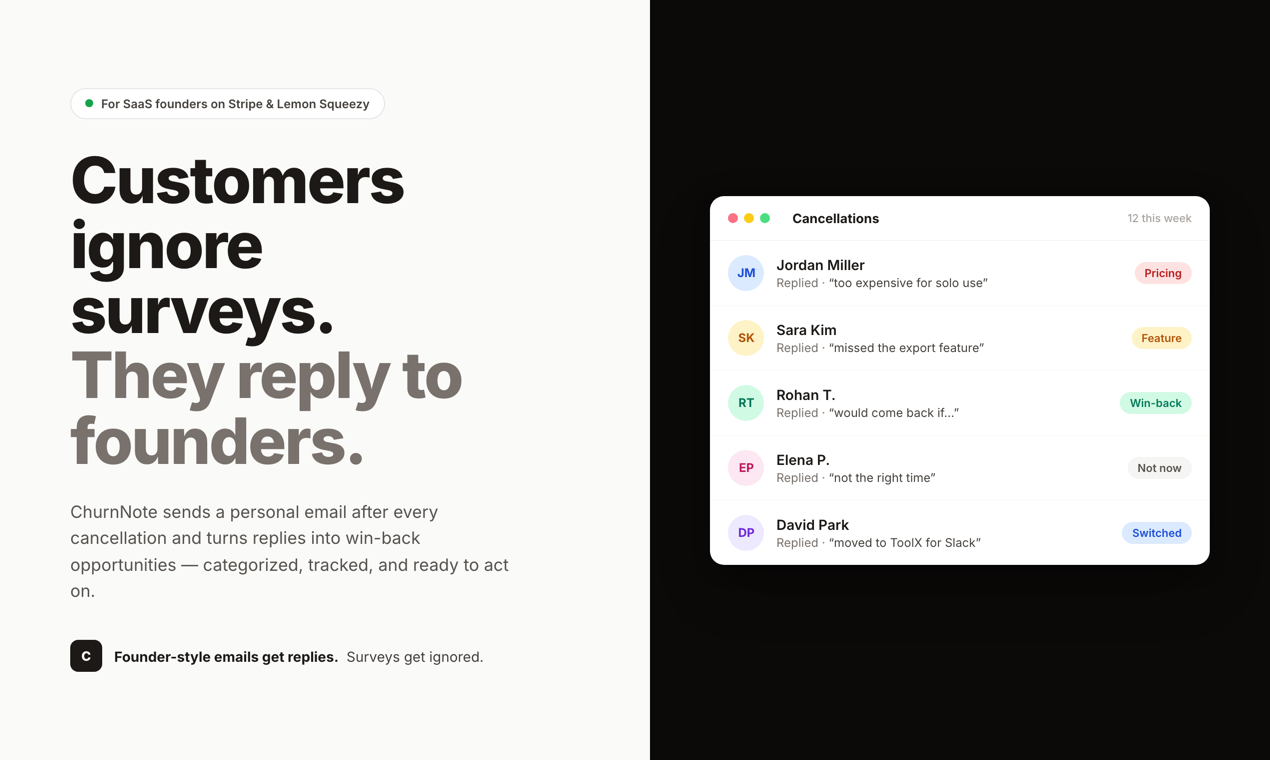
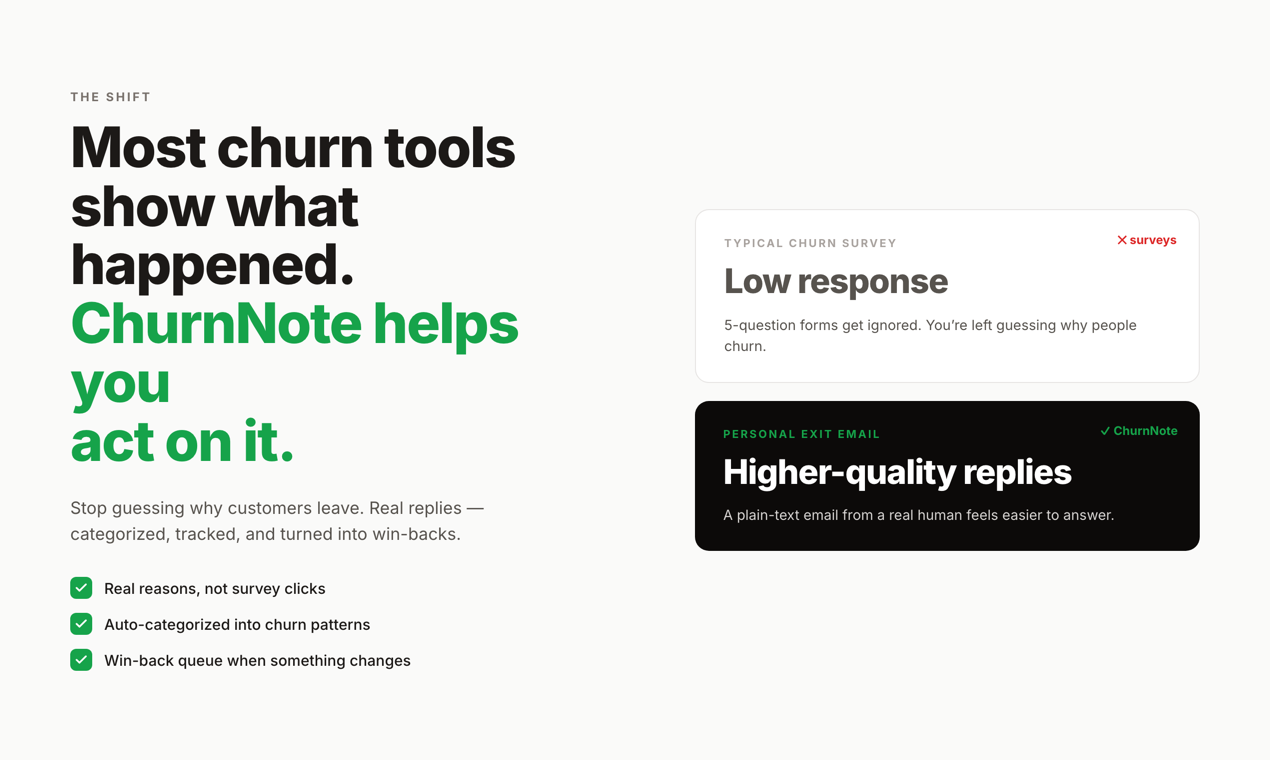
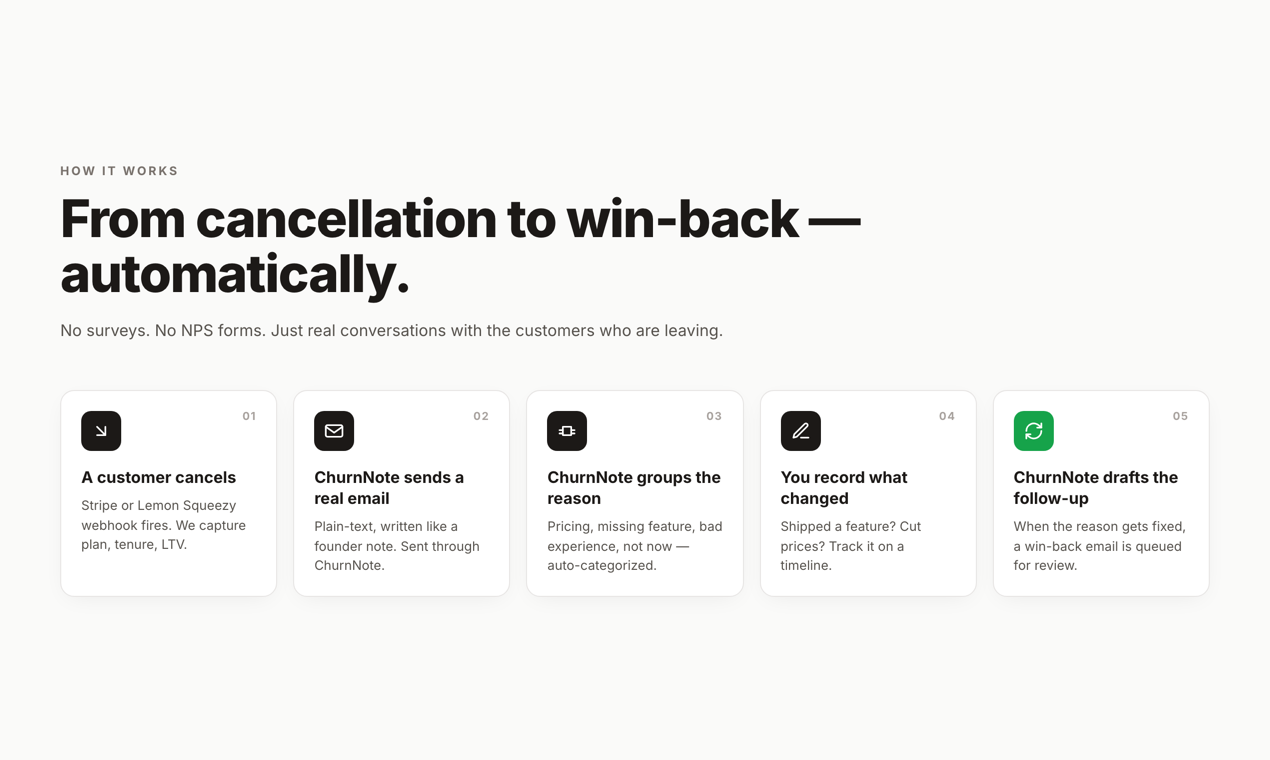
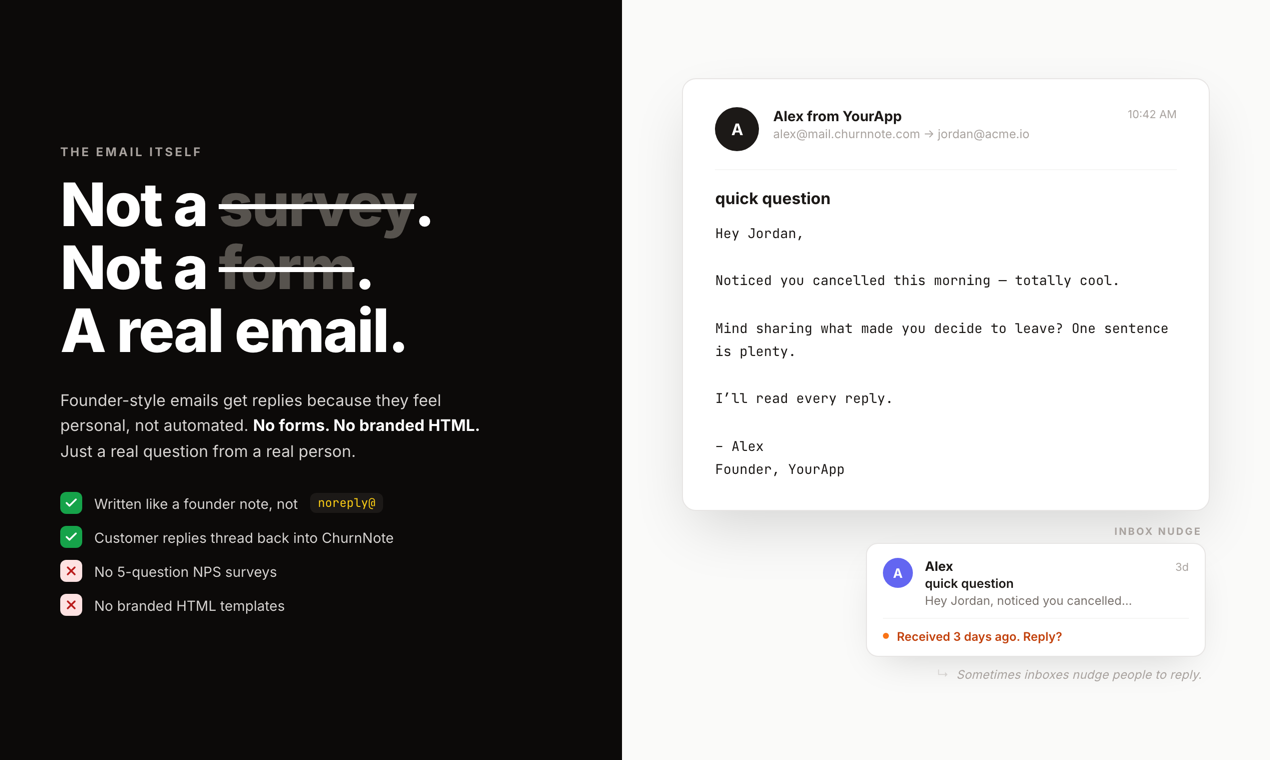
When someone cancels through Stripe or Lemon Squeezy, ChurnNote sends a short plain-text email asking why they left.
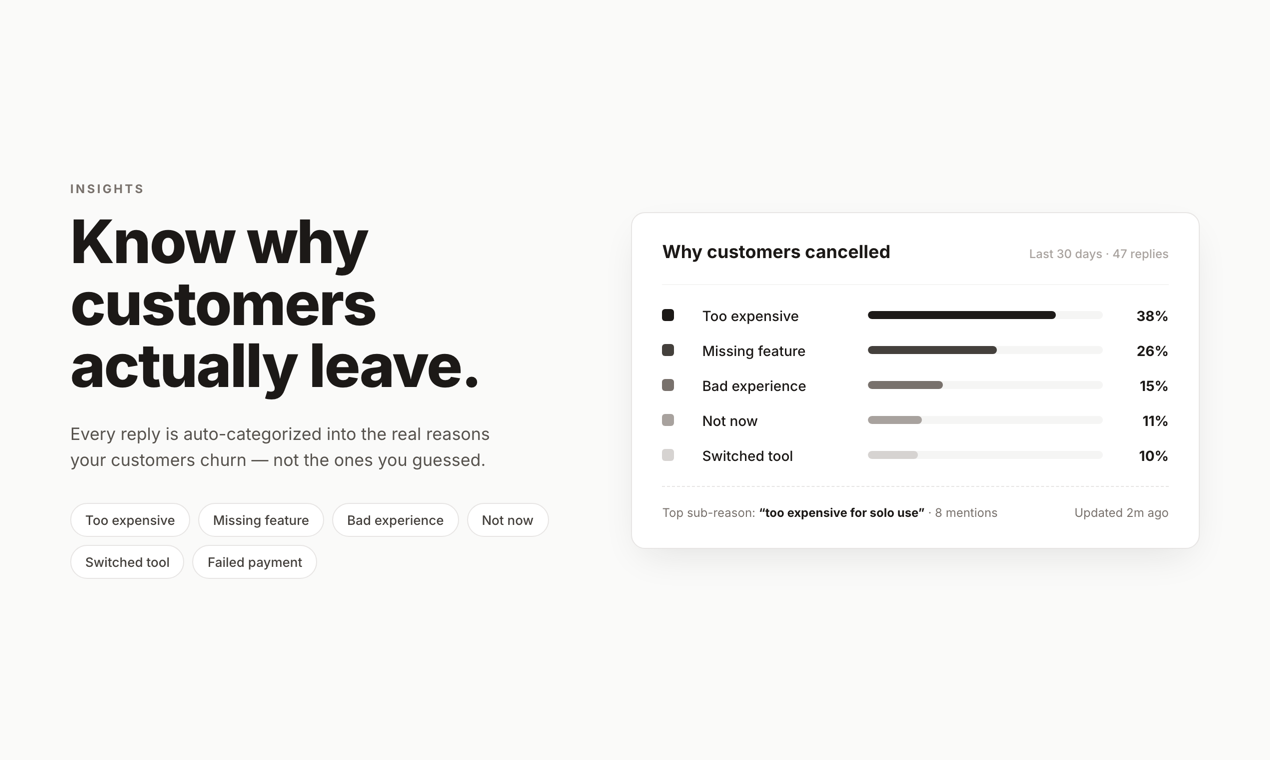
If the customer replies, ChurnNote groups the reason into patterns like pricing, missing feature, bad experience, switched tool, not using it, or failed payment.
From there, founders can decide what to do next: fix the issue, recover failed payments, or schedule a win-back follow-up when there is a real reason for the customer to come back.
ChurnNote is built for indie SaaS and small SaaS founders who want a simple way to turn cancellations into feedback, recovery, and win-back opportunities.
Features
- Stripe cancellation tracking
- Lemon Squeezy cancellation tracking
- Plain-text cancellation emails
- Reply collection
- Churn reason grouping
- Sub-reasons
- Customer timeline
- Win-back queue
- Scheduled follow-up emails
- Automatic win-back follow-ups for some churn reasons
- Failed payment recovery sequence
- Follow-up drafts for review
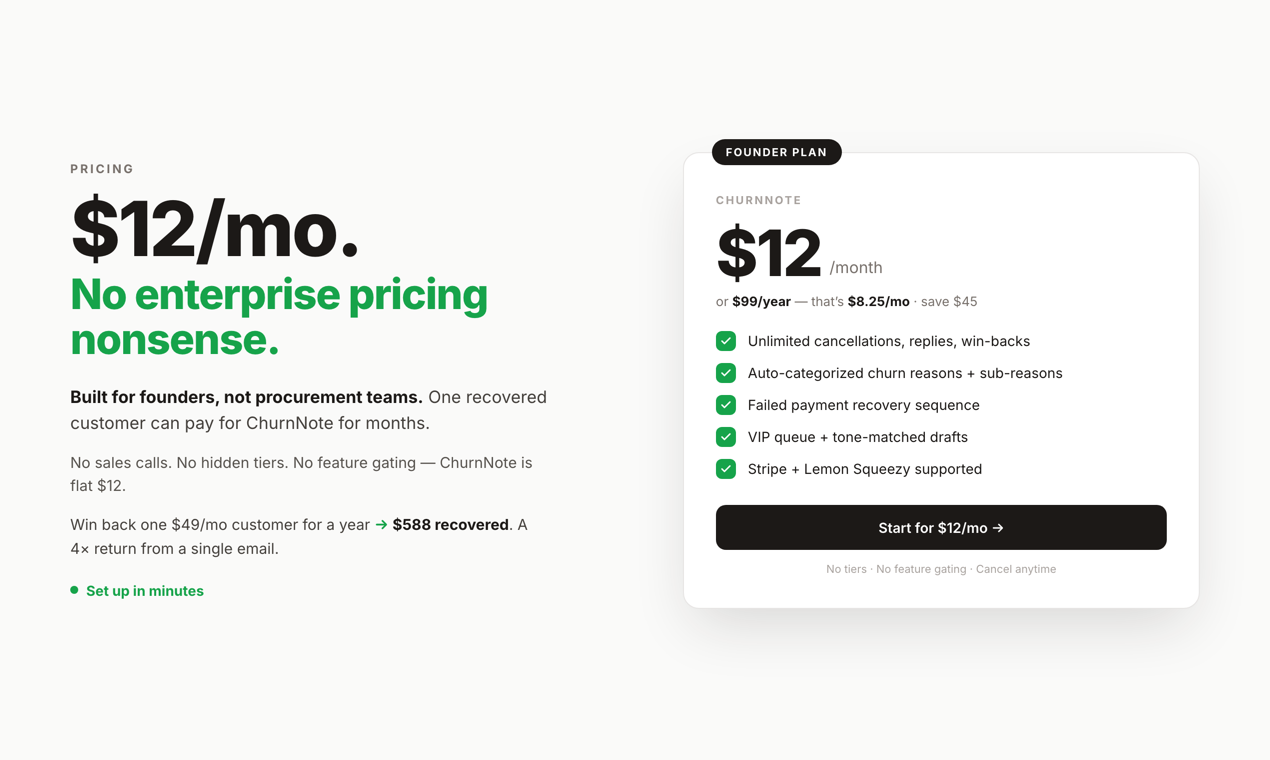
- Flat $12/mo pricing
Use Cases
- Learn why customers cancel instead of guessing from churn dashboards.
- Collect honest cancellation feedback through plain-text emails.
- Group churn reasons into patterns like pricing, missing feature, bad experience, or switched tool.
- Recover failed payments with automated recovery emails.
- Follow up with cancelled customers when a missing feature ships, pricing changes, or onboarding improves.
- Build a simple retention loop for indie SaaS or small SaaS products.

Comments


I built ChurnNote because most SaaS founders know when a customer cancels, but not what to do next. At first, I just wanted a simple way to ask cancelled customers why they left without forcing them into a survey or form. So the product is built around a simple loop: Ask why they left. Understand the real reason. Recover failed payments or schedule win-back follow-ups when there is a real reason to come back. It connects to Stripe and Lemon Squeezy, sends plain-text cancellation emails, groups replies into churn reasons, runs failed payment recovery, and helps queue follow-ups for the right customers later. I’m building it for indie SaaS and small SaaS founders who want something simple, clear, and affordable instead of a heavy enterprise retention platform. Would love feedback from other founders.


This is such a practical tool for indie SaaS teams! The combination of plain-text cancellation emails, reason grouping, and automated win-back follow-ups solves so many pain points with churn tracking. It’s great to see a flat $12/month pricing model too — super transparent and easy to budget for small businesses.

I like how this product focuses on a very clear use case instead of trying to be everything at once. The positioning feels intentional, which is something a lot of early-stage tools struggle with. One thing that stood out to me is the simplicity of the interface — it looks like something a non-technical user could pick up quickly without a learning curve. That’s a big advantage, especially if you’re targeting creators or small teams who don’t want to spend time configuring tools. I’m curious about how you’re thinking about differentiation long-term. In a crowded space, features can get copied quickly — so are you planning to compete more on workflow experience, integrations, or a specific niche audience? Also, would love to know: * What kind of users are getting the most value right now? * Are there any standout use cases that surprised you after launch? * Do you have analytics or insights built in to help users improve outcomes over time? Overall, this feels like a solid foundation. If you keep iterating based on real user feedback, I can see this becoming a very sticky product.

ChurnNote is an affordable $12/month SaaS tool that tracks Stripe and Lemon Squeezy cancellations, sends plain-text emails to ask departing users why they left, groups churn reasons automatically, enables failed payment recovery and scheduled win-back follow-ups. Praised for its simple, focused design, transparent pricing and practical value for indie SaaS founders to turn customer churn into actionable feedback and retention opportunities.

Churn reason grouping with sub-reasons is the part most tools miss. Knowing "pricing" is the reason tells you nothing. Knowing "pricing compared to X competitor after their discount expired" is actually actionable. Curious how granular the sub-reasons get and whether users define them or the tool suggests categories.
The "catch spikes before the monthly invoice" use case is the real one. Every developer has a horror story about an unexpected bill. Curious whether alerts are threshold-based (you set a limit) or anomaly-based (it learns your normal spend pattern and flags deviations). The second one is harder to build but much more useful when your spend varies naturally month to month.

Churn reason grouping with sub-reasons is the part most tools miss. Knowing "pricing" is the reason tells you nothing. Knowing "pricing compared to X competitor after their discount expired" is actually actionable. Curious how granular the sub-reasons get and whether users define them or the tool suggests categories.

just when my sack's achin from yesterday, livesexcams.work shows up in some reddit dump, clicked purely cause url sounded generic like gov paper, but damn, landing page smothers you with wall-of-Thumbnails, every flavour cam hustler from pink-ribbon teen cosplay to inked punk grandmas puffin vape while pegging sissies. no reg again, just instant xxx chats. first room i grabbed had couple: skinny alt dude chain-smoking while his domme ball-gag brunette paddles his ass plum red, every slap synced to tip-goal counter, room erupts at 1000 tokens she straps on, splits him open reverse-cowgirl while pinching his nip clamps, dude's whimperin like puppy gets stepped on. I aint even gay but edged whole 22mins cause the power dynamic's hotter than vanilla gf solo bs. https://livesex.quest/model/Bigbuttbrooklynn/ https://livesexcams.work/model/AmazingPartys/ https://sexcam.work/model/LadySecret_X/ tipped 30tokens got my username screamed mid-orgasm, felt like mini-celeb, best interactive strip sex chat I've bothered with since covid. rumor mill says weekends host fetish contests, free live couple sex everywhere, collar & leash props, dungeons lighting darker than disneyland haunted house. bookmark this before some puritan Karen petitions it gone.
Premium Products




































Awards
View all
Awards
View allMakers
Makers
Comments
I built ChurnNote because most SaaS founders know when a customer cancels, but not what to do next. At first, I just wanted a simple way to ask cancelled customers why they left without forcing them into a survey or form. So the product is built around a simple loop: Ask why they left. Understand the real reason. Recover failed payments or schedule win-back follow-ups when there is a real reason to come back. It connects to Stripe and Lemon Squeezy, sends plain-text cancellation emails, groups replies into churn reasons, runs failed payment recovery, and helps queue follow-ups for the right customers later. I’m building it for indie SaaS and small SaaS founders who want something simple, clear, and affordable instead of a heavy enterprise retention platform. Would love feedback from other founders.
This is such a practical tool for indie SaaS teams! The combination of plain-text cancellation emails, reason grouping, and automated win-back follow-ups solves so many pain points with churn tracking. It’s great to see a flat $12/month pricing model too — super transparent and easy to budget for small businesses.
I like how this product focuses on a very clear use case instead of trying to be everything at once. The positioning feels intentional, which is something a lot of early-stage tools struggle with. One thing that stood out to me is the simplicity of the interface — it looks like something a non-technical user could pick up quickly without a learning curve. That’s a big advantage, especially if you’re targeting creators or small teams who don’t want to spend time configuring tools. I’m curious about how you’re thinking about differentiation long-term. In a crowded space, features can get copied quickly — so are you planning to compete more on workflow experience, integrations, or a specific niche audience? Also, would love to know: * What kind of users are getting the most value right now? * Are there any standout use cases that surprised you after launch? * Do you have analytics or insights built in to help users improve outcomes over time? Overall, this feels like a solid foundation. If you keep iterating based on real user feedback, I can see this becoming a very sticky product.
ChurnNote is an affordable $12/month SaaS tool that tracks Stripe and Lemon Squeezy cancellations, sends plain-text emails to ask departing users why they left, groups churn reasons automatically, enables failed payment recovery and scheduled win-back follow-ups. Praised for its simple, focused design, transparent pricing and practical value for indie SaaS founders to turn customer churn into actionable feedback and retention opportunities.
Churn reason grouping with sub-reasons is the part most tools miss. Knowing "pricing" is the reason tells you nothing. Knowing "pricing compared to X competitor after their discount expired" is actually actionable. Curious how granular the sub-reasons get and whether users define them or the tool suggests categories.
The "catch spikes before the monthly invoice" use case is the real one. Every developer has a horror story about an unexpected bill. Curious whether alerts are threshold-based (you set a limit) or anomaly-based (it learns your normal spend pattern and flags deviations). The second one is harder to build but much more useful when your spend varies naturally month to month.
Churn reason grouping with sub-reasons is the part most tools miss. Knowing "pricing" is the reason tells you nothing. Knowing "pricing compared to X competitor after their discount expired" is actually actionable. Curious how granular the sub-reasons get and whether users define them or the tool suggests categories.
just when my sack's achin from yesterday, livesexcams.work shows up in some reddit dump, clicked purely cause url sounded generic like gov paper, but damn, landing page smothers you with wall-of-Thumbnails, every flavour cam hustler from pink-ribbon teen cosplay to inked punk grandmas puffin vape while pegging sissies. no reg again, just instant xxx chats. first room i grabbed had couple: skinny alt dude chain-smoking while his domme ball-gag brunette paddles his ass plum red, every slap synced to tip-goal counter, room erupts at 1000 tokens she straps on, splits him open reverse-cowgirl while pinching his nip clamps, dude's whimperin like puppy gets stepped on. I aint even gay but edged whole 22mins cause the power dynamic's hotter than vanilla gf solo bs. https://livesex.quest/model/Bigbuttbrooklynn/ https://livesexcams.work/model/AmazingPartys/ https://sexcam.work/model/LadySecret_X/ tipped 30tokens got my username screamed mid-orgasm, felt like mini-celeb, best interactive strip sex chat I've bothered with since covid. rumor mill says weekends host fetish contests, free live couple sex everywhere, collar & leash props, dungeons lighting darker than disneyland haunted house. bookmark this before some puritan Karen petitions it gone.
Premium Products
New to Fazier?

Find your next favorite product or submit your own. Made by @FalakDigital.
Copyright ©2026. All Rights Reserved