
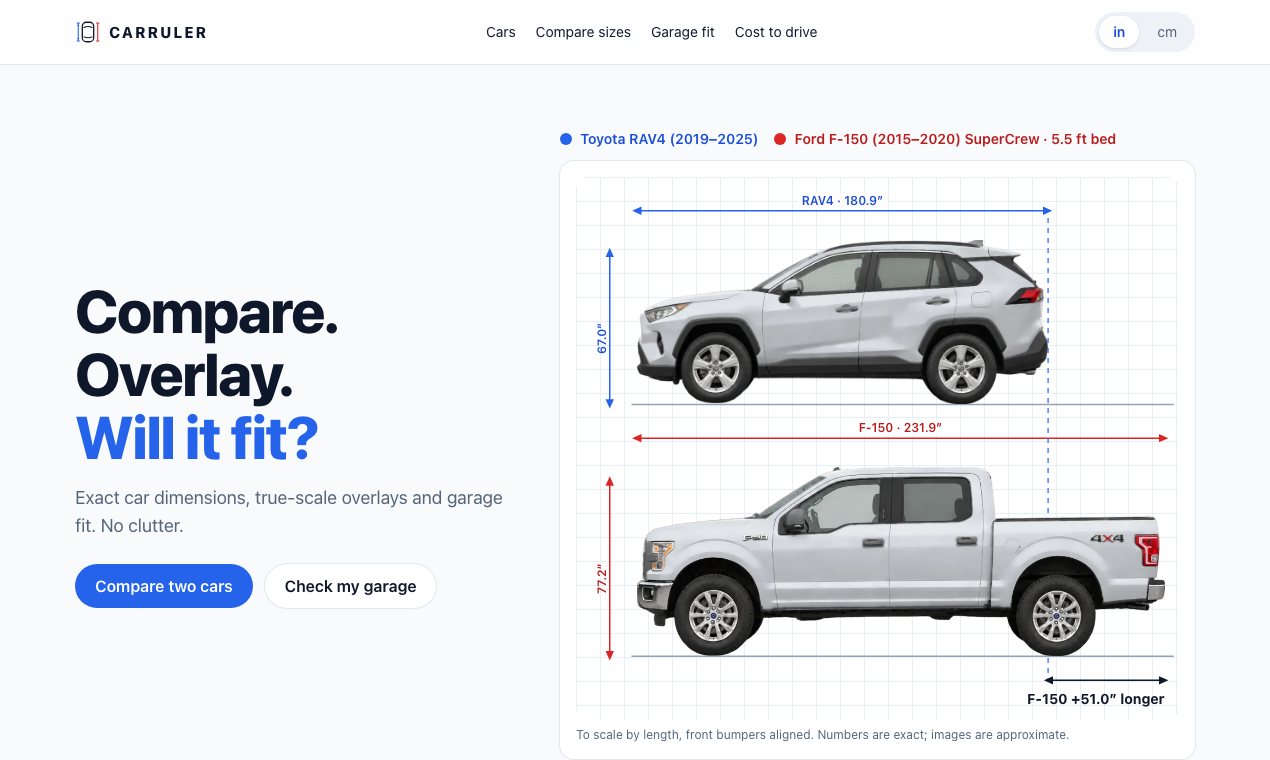
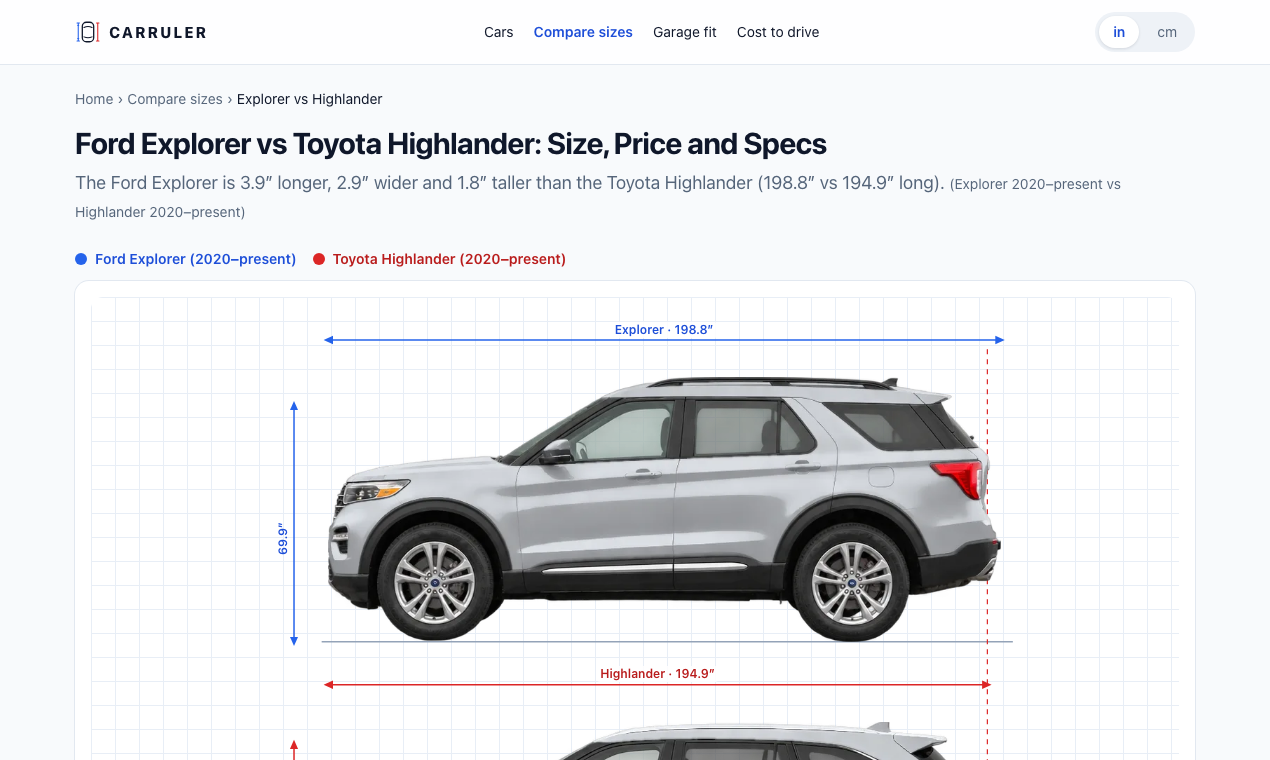
Exact dimensions for 301 current US models: side-by-side size overlays at true scale, garage and parking fit, and what each car costs to drive in your state.

Comments

True scale is the right call - 'will it fit my garage' is the actual question, and most comparison sites answer a different one. One ask: let me save my garage dimensions once and check every car against them, rather than re-entering height and length each time. Would also love a note on whether the dimensions are with mirrors folded.

Comparing cars at true scale is more useful than reading length and width in a spec sheet, especially when two models look similar in photos but differ by a few inches. The garage-fit check is the main reason I would open this. It would help to know whether the 301 US models include common trims that change overall length, since those extra inches are what usually catch people off guard.

True-scale overlays for 301 current US models solve a better problem than a spec sheet: two similar-looking crossovers can differ by a few inches, and that is what decides whether the car clears the garage door. I also like that you show what each car costs to drive in a given state, not just the physical fit. Do those driving-cost figures use a stated MPG source and a published state fuel-price average, and how often are they updated? Separately, does the height check include roof rails on trims that ship with them? Those extra inches usually show up only after someone has already bought the car.

True scale is the right call — 'will it fit in my garage' is the actual question, and most comparison sites only give you numbers to squint at. The cost-to-drive in your state is a smart extra. One thing I'd love: the ability to save a garage profile with my own dimensions so I don't have to re-enter them every time I compare a new model — is that on the roadmap?
The true-scale overlay approach is what sets this apart — most size-comparison tools just print two numbers side by side and leave you squinting at a spec sheet. The state-by-state cost-to-drive figure is a nice touch too, since total ownership cost is usually the part buyers regret skipping. One suggestion: a saved garage profile (depth, door width, ceiling height) you can re-check against any new model as the 301-car list updates would make this a recurring visit instead of a one-off lookup.

Premium Products











































Sponsors
Buy
Makers

Makers
Comments
True scale is the right call - 'will it fit my garage' is the actual question, and most comparison sites answer a different one. One ask: let me save my garage dimensions once and check every car against them, rather than re-entering height and length each time. Would also love a note on whether the dimensions are with mirrors folded.
Comparing cars at true scale is more useful than reading length and width in a spec sheet, especially when two models look similar in photos but differ by a few inches. The garage-fit check is the main reason I would open this. It would help to know whether the 301 US models include common trims that change overall length, since those extra inches are what usually catch people off guard.
True-scale overlays for 301 current US models solve a better problem than a spec sheet: two similar-looking crossovers can differ by a few inches, and that is what decides whether the car clears the garage door. I also like that you show what each car costs to drive in a given state, not just the physical fit. Do those driving-cost figures use a stated MPG source and a published state fuel-price average, and how often are they updated? Separately, does the height check include roof rails on trims that ship with them? Those extra inches usually show up only after someone has already bought the car.
True scale is the right call — 'will it fit in my garage' is the actual question, and most comparison sites only give you numbers to squint at. The cost-to-drive in your state is a smart extra. One thing I'd love: the ability to save a garage profile with my own dimensions so I don't have to re-enter them every time I compare a new model — is that on the roadmap?
The true-scale overlay approach is what sets this apart — most size-comparison tools just print two numbers side by side and leave you squinting at a spec sheet. The state-by-state cost-to-drive figure is a nice touch too, since total ownership cost is usually the part buyers regret skipping. One suggestion: a saved garage profile (depth, door width, ceiling height) you can re-check against any new model as the 301-car list updates would make this a recurring visit instead of a one-off lookup.
Premium Products
New to Fazier?

Find your next favorite product or submit your own. Made by @FalakDigital.
Copyright ©2026. All Rights Reserved