
Bypassify
Humanize. Rewrite. Be You.
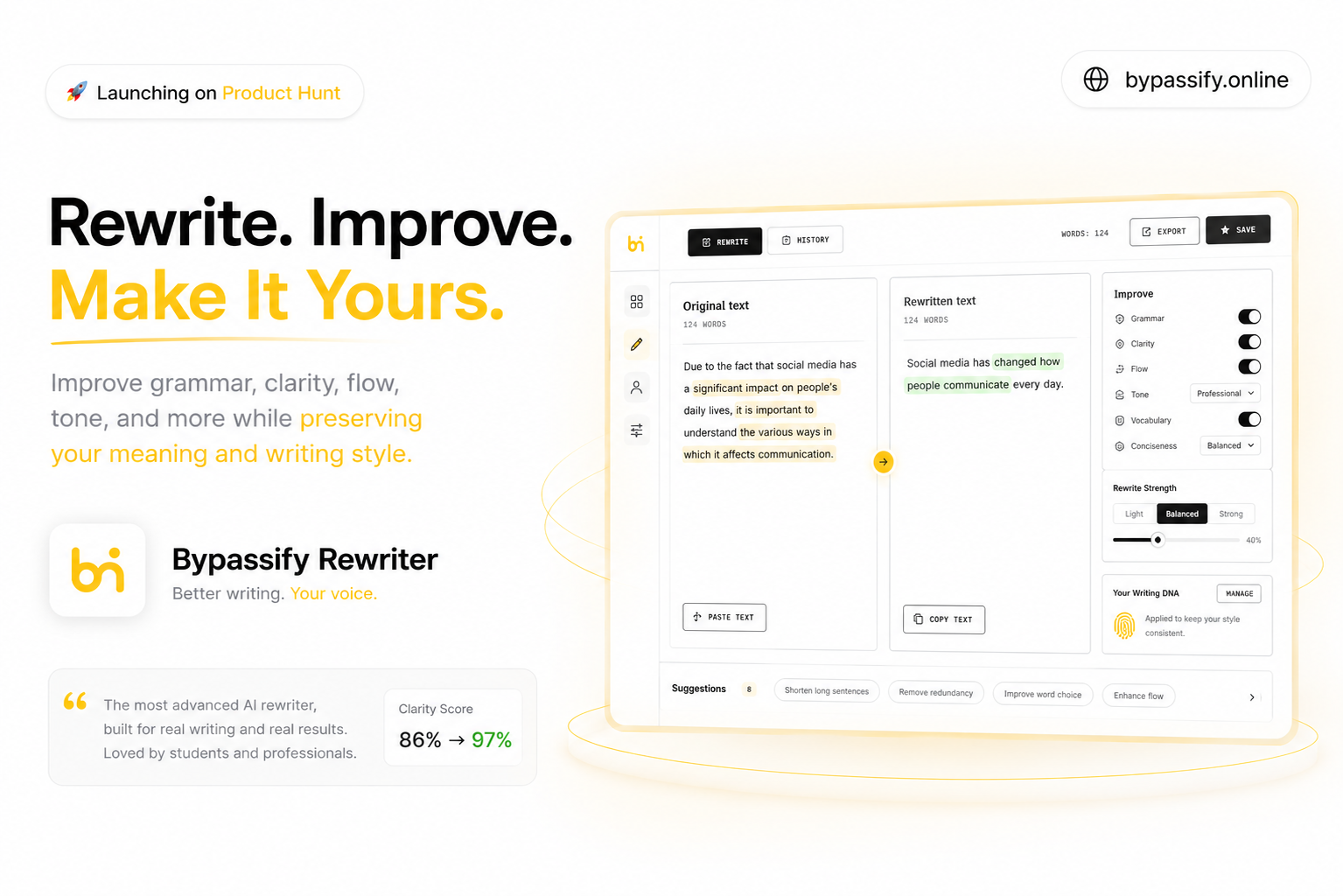
Bypassify the AI humanizer and rewriter that transforms your text into natural, authentic writing while keeping your ideas yours.

Features
✍️ Bypassify Humanizer
- 🧠 Advanced AI humanization
- ✨ Natural, human-like phrasing
- 🔀 Sentence structure & cadence variation
- 🎯 Tone & style control
- 📝 Preserves your original meaning
- 📚 Citation & quote protection
- 🚫 Reduces repetitive AI patterns
- 🌍 Supports multiple writing styles
🔄 Bypassify Rewriter
- ✍️ Rewrite without changing your ideas
- 🧠 Context-aware rewriting
- 🎯 Tone & style customization
- 💡 Improves clarity & flow
- 🔀 Restructures sentences naturally
- 📖 Preserves citations & formatting
- ⚡ Fast rewriting
- 📝 Handles long-form content
Use Cases
- 📚 Essays & coursework
- 📝 Academic writing
- 🎓 University assignments
- 💼 Professional emails
- 📄 Reports & documents
- 📱 Social media content
- 🌐 Blog posts & articles
- 💡 Improving AI-generated drafts
- ✍️ Polishing rough writing
- 🔄 Rewriting repetitive or awkward text

Comments


Hey Fazier users! 👋 I'm the founder of Bypassify. Like a lot of people, I noticed that AI generated writing often gets the job done but it doesn't always sound natural. I kept trying different tools, but I wanted something that was faster, simpler, and focused on producing writing that actually reads well. So I decided to build Bypassify. Over the past few months I've spent countless hours designing, testing, and refining the platform from the rewriting engine to the overall user experience. There's still plenty I want to improve, and that's exactly why I'm launching here. I'd genuinely love your honest feedback. What works well? What doesn't? Is there a feature you'd like to see? Every comment helps shape where Bypassify goes next. Thanks for checking it out I really appreciate it. 🚀
Premium Products

























Sponsors
Buy

Makers
Makers
Comments
Hey Fazier users! 👋 I'm the founder of Bypassify. Like a lot of people, I noticed that AI generated writing often gets the job done but it doesn't always sound natural. I kept trying different tools, but I wanted something that was faster, simpler, and focused on producing writing that actually reads well. So I decided to build Bypassify. Over the past few months I've spent countless hours designing, testing, and refining the platform from the rewriting engine to the overall user experience. There's still plenty I want to improve, and that's exactly why I'm launching here. I'd genuinely love your honest feedback. What works well? What doesn't? Is there a feature you'd like to see? Every comment helps shape where Bypassify goes next. Thanks for checking it out I really appreciate it. 🚀
Premium Products
New to Fazier?

Find your next favorite product or submit your own. Made by @FalakDigital.
Copyright ©2025. All Rights Reserved