
BoomAU
Identify next boom suburbs in Australia with high accuracy
Most Australian property investors pick suburbs based on gut feel, word of mouth, or outdated annual reports. BoomAU replaces guesswork with a fortnightly scoring engine that monitors roughly 15,000 suburbs and surfaces the ones actually showing boom signals right now.
How it works
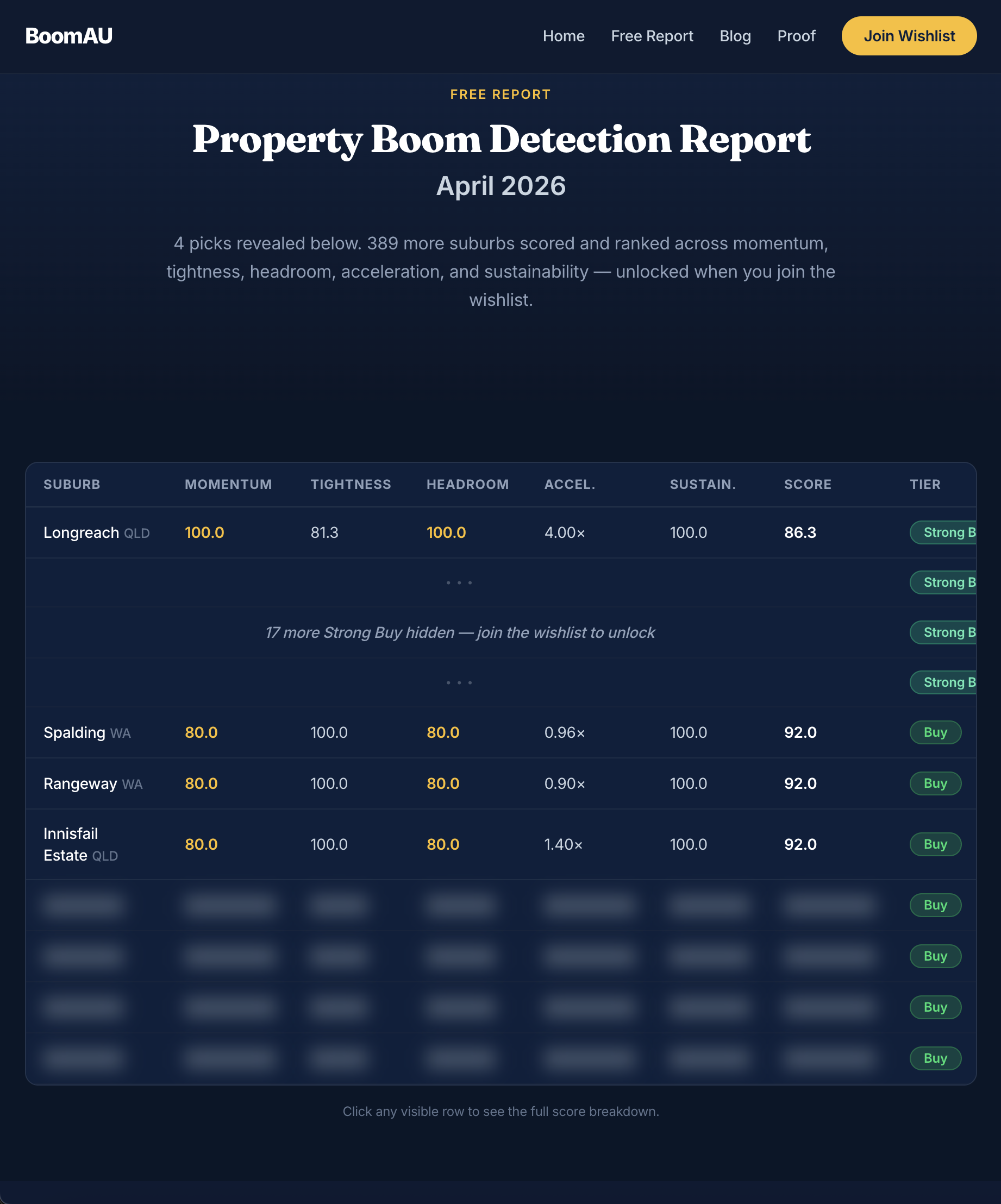
BoomAU runs a three-layer funnel. First, every suburb in Australia is screened against hard filters: price growth momentum, days on market, vacancy rates, and a price cap of $800K. The roughly 300-500 suburbs that survive get precision-scored using a five-signal formula covering momentum, growth strength, market tightness, sustainability, and headroom. Top scorers then go through deep validation before being published.
Each suburb receives one of four recommendation tiers:
- Strong Buy -- Currently booming, early in the cycle, and priced below the capital city median. In backtesting, Strong Buy suburbs delivered a median excess return of +7.5 percentage points, with 71% beating the broader market.
- Buy -- Warming or booming, still affordable. +2.5pp median excess return, 58% beat the market.
- Watch -- Active signals but above median pricing. Worth monitoring, not yet actionable.
- Pass -- Expensive relative to the capital city. These historically underperform by -6.4pp.
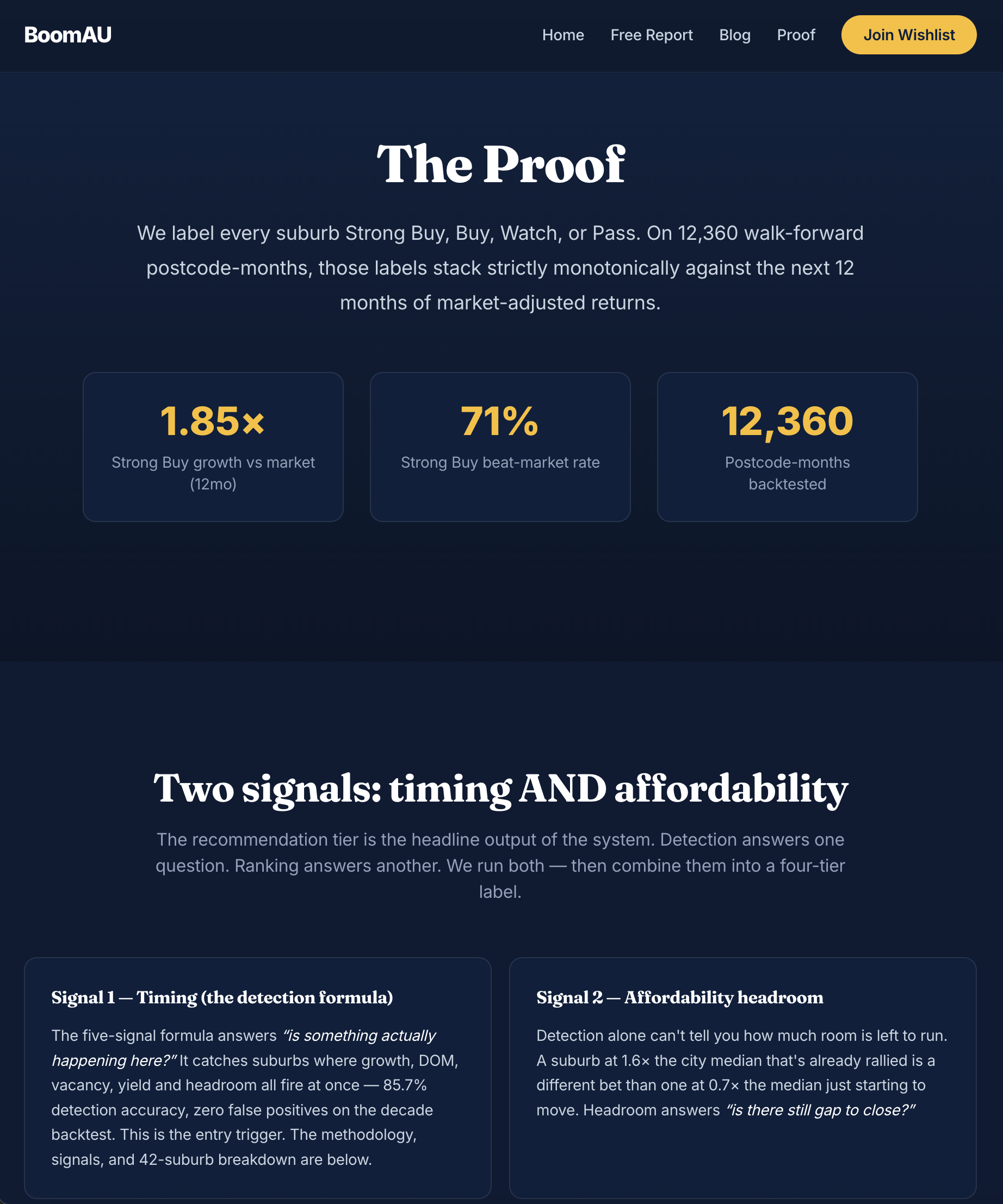
Tier performance is perfectly monotonic: Strong Buy beats Buy beats Watch beats Pass on every metric. That's not cherry-picked -- it's the result of a 78-suburb walk-forward backtest covering 12,360 postcode-months of data.
The proof
No competitor in the Australian property data space publicly quantifies their prediction accuracy. BoomAU does. The methodology and full backtest results are published transparently at boomau.com/proof, showing 85.7% detection accuracy with zero false positives and a 20.2-point score separation gap between booming and non-booming suburbs.
Who it's for
Australian property investors looking for affordable growth suburbs -- the person asking, "Where do I find the next sub-$800K house that'll grow over the next 5-10 years?" Whether you're buying your first investment property or adding to a portfolio, BoomAU gives you a shortlist grounded in data, not speculation.

Features
- Fortnightly automated scoring of ~15,000 Australian suburbs
- Four-tier recommendation system: Strong Buy / Buy / Watch / Pass
- Backtested formula with 85.7% detection accuracy and zero false positives
- Focused on affordable growth suburbs under $800K
- Transparent methodology and proof page with full backtest results
- Free monthly report -- no credit card required
- Built on public data sources, not paywalled or proprietary datasets

Comments


The transparency angle here is what sets BoomAU apart. Most property data tools in Australia hide their methodology behind paywalls or vague proprietary scoring — publishing a full walk-forward backtest with 85.7% accuracy and zero false positives is a genuinely bold move that builds real trust with serious investors. The four-tier system (Strong Buy / Buy / Watch / Pass) is clean and actionable. The +7.5pp median excess return for Strong Buy suburbs is a specific, verifiable claim — much more useful than the generic "growth suburb" lists most tools produce. One thing I'd love to see: a filter by state or region for investors who are only looking in specific markets like Queensland or Victoria. Would make the shortlist even more immediately actionable.

Hey everyone -- I'm the maker of BoomAU. I built this because I was frustrated with how Australian property investors pick suburbs. It's mostly gut feel, word of mouth, or generic "hotspot lists" that never show their working. So I asked a simple question: can you build a formula that actually detects suburb booms, backtest it rigorously, and publish the accuracy? Turns out you can -- 85.7% detection accuracy with zero false positives across a 78-suburb walk-forward backtest. BoomAU scores every Australian suburb fortnightly and labels each one Strong Buy, Buy, Watch, or Pass. Strong Buy suburbs outperformed the market by +7.5 percentage points in backtesting. The full methodology and backtest results are published transparently at boomau.com/proof -- no black boxes. What surprised me most building this: no competitor in the Australian property data space publicly quantifies their prediction accuracy. That felt like a gap worth filling. Would love feedback from anyone who invests in Australian property. What would make this more useful for you?

As a developer who works with data pipelines, I absolutely love the transparency of publishing your walk-forward backtest results. It's rare to see that level of quantitative rigor in the property space. Quick question: with the fortnightly updates, how do you handle data anomalies or lagging indicators from regional reporting sources? Really impressive analytical approach!


Premium Products





































Sponsors
Buy
Awards
View all
Awards
View allMakers
Makers
Comments
The transparency angle here is what sets BoomAU apart. Most property data tools in Australia hide their methodology behind paywalls or vague proprietary scoring — publishing a full walk-forward backtest with 85.7% accuracy and zero false positives is a genuinely bold move that builds real trust with serious investors. The four-tier system (Strong Buy / Buy / Watch / Pass) is clean and actionable. The +7.5pp median excess return for Strong Buy suburbs is a specific, verifiable claim — much more useful than the generic "growth suburb" lists most tools produce. One thing I'd love to see: a filter by state or region for investors who are only looking in specific markets like Queensland or Victoria. Would make the shortlist even more immediately actionable.
Hey everyone -- I'm the maker of BoomAU. I built this because I was frustrated with how Australian property investors pick suburbs. It's mostly gut feel, word of mouth, or generic "hotspot lists" that never show their working. So I asked a simple question: can you build a formula that actually detects suburb booms, backtest it rigorously, and publish the accuracy? Turns out you can -- 85.7% detection accuracy with zero false positives across a 78-suburb walk-forward backtest. BoomAU scores every Australian suburb fortnightly and labels each one Strong Buy, Buy, Watch, or Pass. Strong Buy suburbs outperformed the market by +7.5 percentage points in backtesting. The full methodology and backtest results are published transparently at boomau.com/proof -- no black boxes. What surprised me most building this: no competitor in the Australian property data space publicly quantifies their prediction accuracy. That felt like a gap worth filling. Would love feedback from anyone who invests in Australian property. What would make this more useful for you?
As a developer who works with data pipelines, I absolutely love the transparency of publishing your walk-forward backtest results. It's rare to see that level of quantitative rigor in the property space. Quick question: with the fortnightly updates, how do you handle data anomalies or lagging indicators from regional reporting sources? Really impressive analytical approach!
Premium Products
New to Fazier?

Find your next favorite product or submit your own. Made by @FalakDigital.
Copyright ©2026. All Rights Reserved