BillingHub is invoicing software you pay for by the invoice, not by the month.
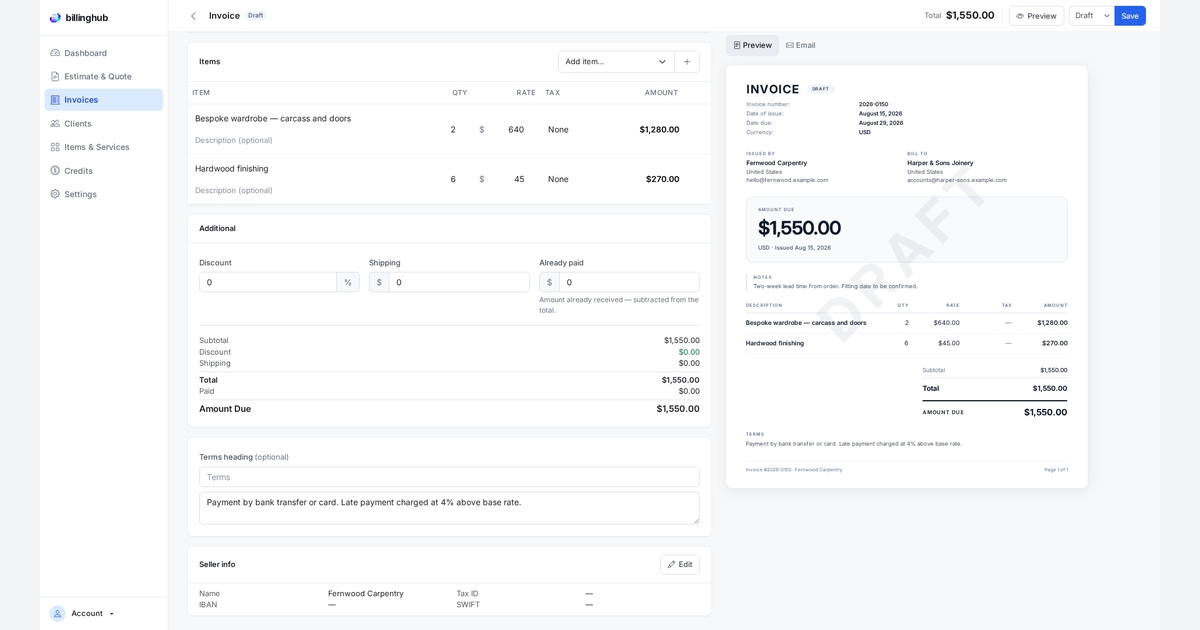
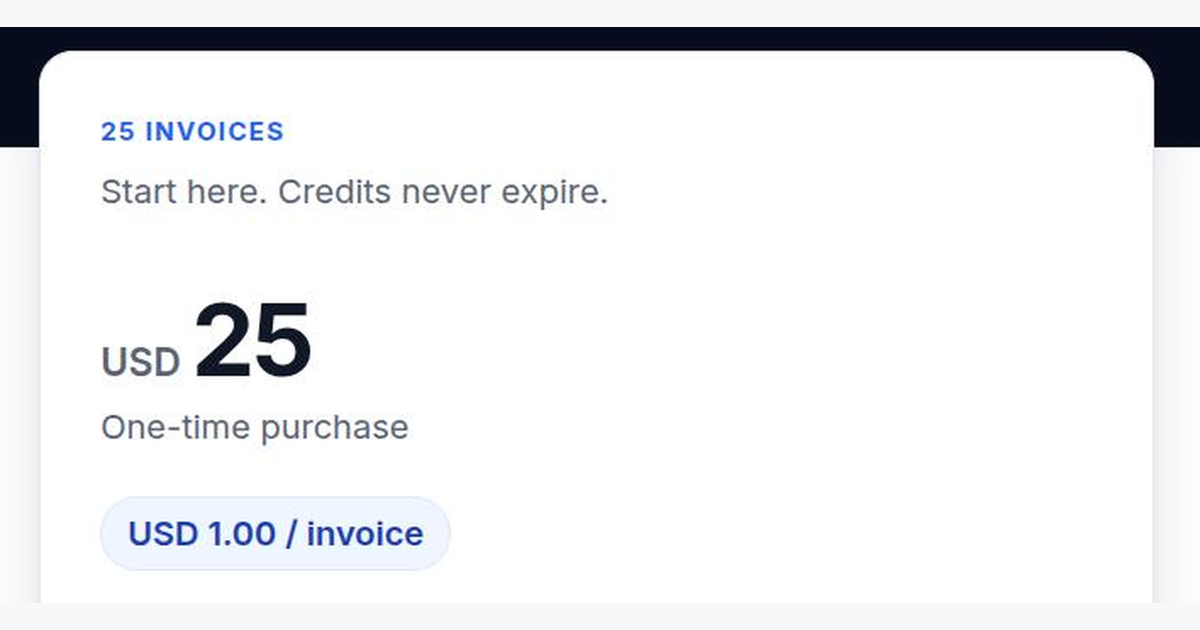
Buy a pack of credits (25 invoices for $25 to start) and one credit is spent at a single moment: when you issue an invoice. Drafts, clients, sending, PDF downloads and payments received cost nothing. Estimates and quotes are free on any balance, forever. Credits never expire, so a month with no invoices costs you nothing.
It's built for people whose billing comes in bursts: freelancers with three clients one month and none the next, consultants who quote for weeks before any work is billed. A monthly plan charges them for January whether or not they invoiced in January.
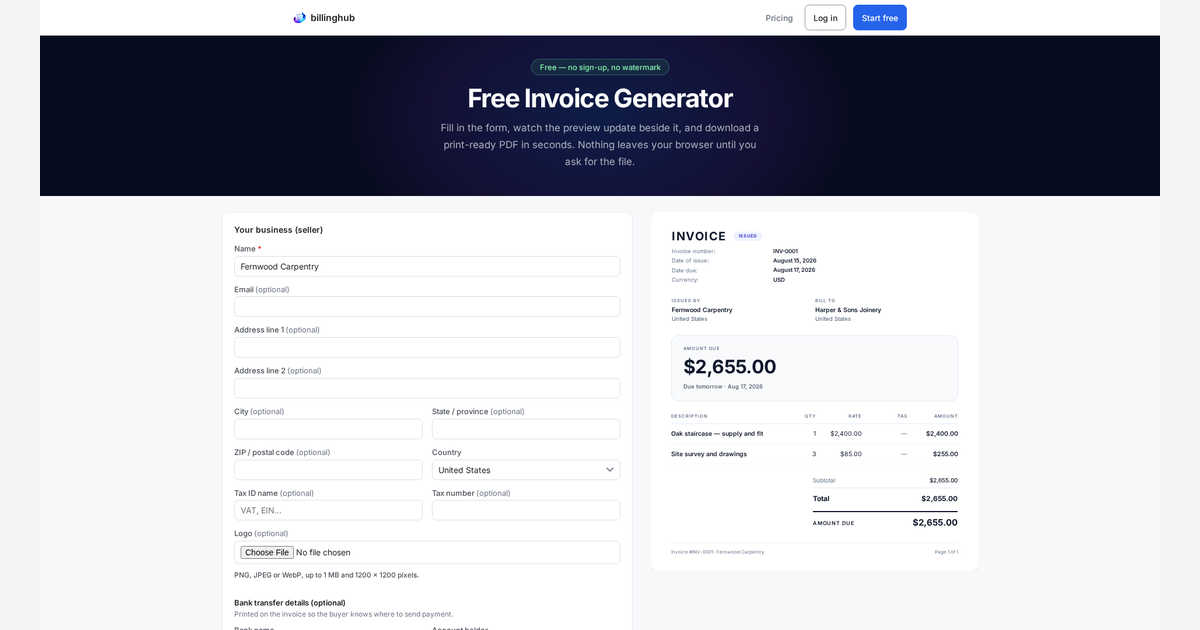
Not ready to sign up? The free invoice generator on the homepage makes a PDF with no account, no email and no watermark.
If you send hundreds of invoices every month, a flat monthly plan will likely cost you less. We'd rather say that up front.
Features
- Invoices, estimates and quotes. Estimates and quotes never use a credit
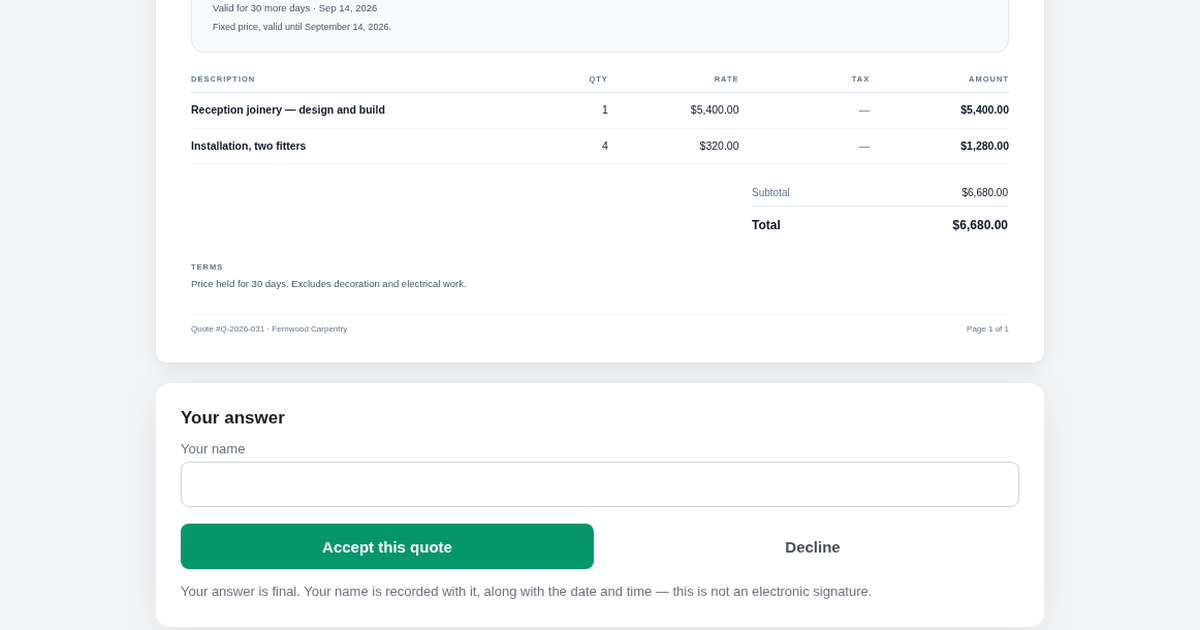
- Clients accept or decline a quote online
- Clients pay by card straight from the invoice (Stripe), and it marks itself paid
- 156 currencies and unlimited clients
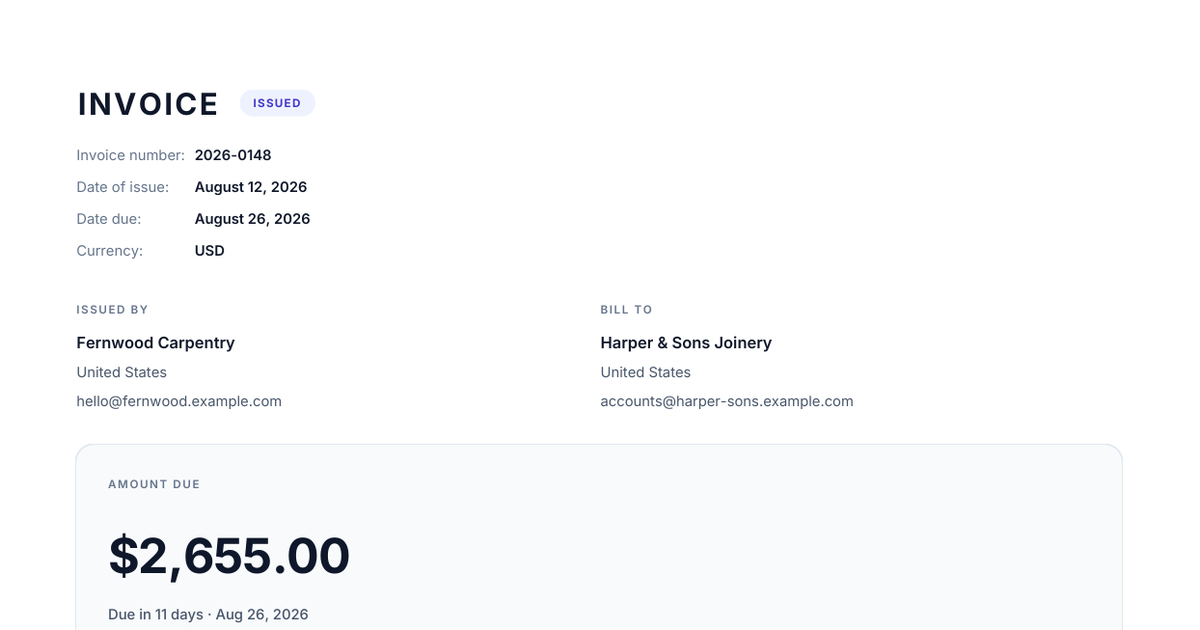
- Several taxes per line item, each printed as its own total
- Your logo, your email subject and wording. Our brand is not on your PDF
- Invoice tracking from the 100-invoice pack
- Recurring invoices and API access on the yearly plan (300 invoices, $150 a year)
- One-time packs never renew
Use Cases
- Freelancers who bill a few clients a month, and some months none
- Consultants and agencies quoting before the work starts, at no cost
- Contractors who send many estimates and invoice when the job is done
- Billing international clients in their own currency
- One invoice needed today: the free generator, no sign-up

Comments



Switched from a subscription invoicing tool to BillingHub mostly to escape paying monthly for something I use maybe ten times a month, and the pay-per-invoice credits actually work the way they describe, no surprise fees, no expiring balance hanging over me. Billed a client in a different currency for the first time last week and the multi-currency and tax handling just worked, no manual conversion math. Only wish is the free estimate generator nudges you toward creating an account pretty quickly, but for a one-person shop the pricing model alone was worth the switch.

The pay-per-invoice model is genuinely customer-friendly compared to typical SaaS subscription pricing. For businesses with sporadic invoicing, being charged monthly when you're not even using the system doesn't make sense. Having credits that never expire removes the artificial pressure to use-it-or-lose-it and lets teams adopt it at their own pace without bleeding budget.

Charging at the moment the invoice is issued, rather than for drafts or sending, is a really clean rule. It means nobody gets billed for a quote that never turns into work. We run prepaid credits for our own product too, and the question people ask most is "what happens to my balance if I stop for a few months?", so leading with "credits never expire" is smart. One question: if an issued invoice gets voided because of a typo, does that credit come back?

New since launch: every new BillingHub account starts with 3 free invoices. Not a trial with a watermark. Three real invoices you issue to real clients, and once you connect Stripe your clients can pay them by card. No credit card needed to sign up. Why: you can't tell whether an invoicing tool works until a client has actually paid through it, and until now finding that out meant buying a pack first. After the three it's $25 for 25, credits never expire, and estimates and quotes stay free.

Charging at the moment of issue lines up nicely with how invoice numbering works in a lot of countries: many EU tax rules require numbers to be sequential with no gaps, and a draft shouldn't take a number. Is the number assigned only when the invoice is issued, and if an issued invoice has to be cancelled, do you issue a credit note against it rather than deleting it? That would make the tool safe for VAT-registered freelancers, not just US ones.
Hi Fazier, I'm Alex and I build BillingHub. It started with one annoyance: invoicing apps charge by the month, but plenty of people don't invoice every month. A freelancer with a quiet August still pays for August. So BillingHub sells invoices in packs. $25 buys 25, a credit is used only when you issue an invoice, and unused credits never expire. Estimates and quotes are free, and so is the invoice generator on the homepage, no account needed. One thing I'd rather say here than have you find later: the yearly plan is a real subscription. The one-time packs never renew. New lately: clients can accept or decline a quote online, and setup now asks four things and lets you skip the rest. A question for you: do you send invoices every week, every month, or in bursts? That answer tells me whether per-invoice pricing fits people like you.

Charging when an invoice is issued makes the cost easier to judge for businesses with irregular billing. Keeping quotes and drafts free also avoids charging for work that may never become a sale. The distinction between non-renewing credit packs and the yearly subscription is especially useful to spell out.

Premium Products













































Sponsors
Buy

Makers
Makers
Comments
Switched from a subscription invoicing tool to BillingHub mostly to escape paying monthly for something I use maybe ten times a month, and the pay-per-invoice credits actually work the way they describe, no surprise fees, no expiring balance hanging over me. Billed a client in a different currency for the first time last week and the multi-currency and tax handling just worked, no manual conversion math. Only wish is the free estimate generator nudges you toward creating an account pretty quickly, but for a one-person shop the pricing model alone was worth the switch.
The pay-per-invoice model is genuinely customer-friendly compared to typical SaaS subscription pricing. For businesses with sporadic invoicing, being charged monthly when you're not even using the system doesn't make sense. Having credits that never expire removes the artificial pressure to use-it-or-lose-it and lets teams adopt it at their own pace without bleeding budget.
Charging at the moment the invoice is issued, rather than for drafts or sending, is a really clean rule. It means nobody gets billed for a quote that never turns into work. We run prepaid credits for our own product too, and the question people ask most is "what happens to my balance if I stop for a few months?", so leading with "credits never expire" is smart. One question: if an issued invoice gets voided because of a typo, does that credit come back?
New since launch: every new BillingHub account starts with 3 free invoices. Not a trial with a watermark. Three real invoices you issue to real clients, and once you connect Stripe your clients can pay them by card. No credit card needed to sign up. Why: you can't tell whether an invoicing tool works until a client has actually paid through it, and until now finding that out meant buying a pack first. After the three it's $25 for 25, credits never expire, and estimates and quotes stay free.
Charging at the moment of issue lines up nicely with how invoice numbering works in a lot of countries: many EU tax rules require numbers to be sequential with no gaps, and a draft shouldn't take a number. Is the number assigned only when the invoice is issued, and if an issued invoice has to be cancelled, do you issue a credit note against it rather than deleting it? That would make the tool safe for VAT-registered freelancers, not just US ones.
Hi Fazier, I'm Alex and I build BillingHub. It started with one annoyance: invoicing apps charge by the month, but plenty of people don't invoice every month. A freelancer with a quiet August still pays for August. So BillingHub sells invoices in packs. $25 buys 25, a credit is used only when you issue an invoice, and unused credits never expire. Estimates and quotes are free, and so is the invoice generator on the homepage, no account needed. One thing I'd rather say here than have you find later: the yearly plan is a real subscription. The one-time packs never renew. New lately: clients can accept or decline a quote online, and setup now asks four things and lets you skip the rest. A question for you: do you send invoices every week, every month, or in bursts? That answer tells me whether per-invoice pricing fits people like you.
Charging when an invoice is issued makes the cost easier to judge for businesses with irregular billing. Keeping quotes and drafts free also avoids charging for work that may never become a sale. The distinction between non-renewing credit packs and the yearly subscription is especially useful to spell out.
Premium Products
New to Fazier?

Find your next favorite product or submit your own. Made by @FalakDigital.
Copyright ©2026. All Rights Reserved