
BaZi Atlas
Free Four Pillars of Destiny chart calculator - open source, bilingual, private by design
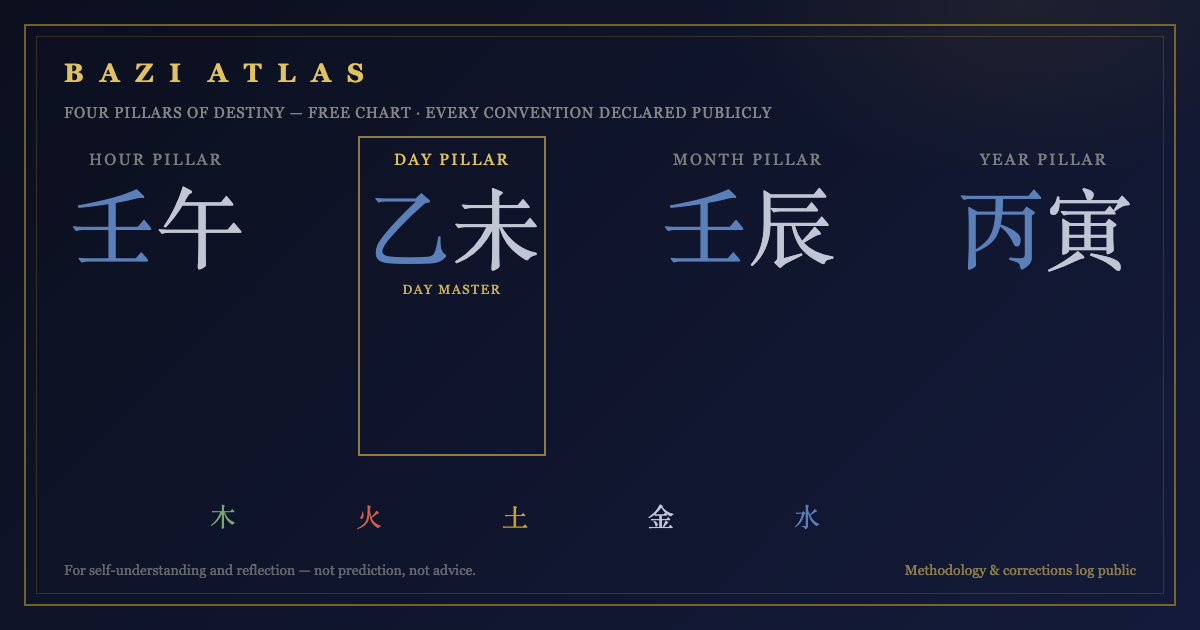
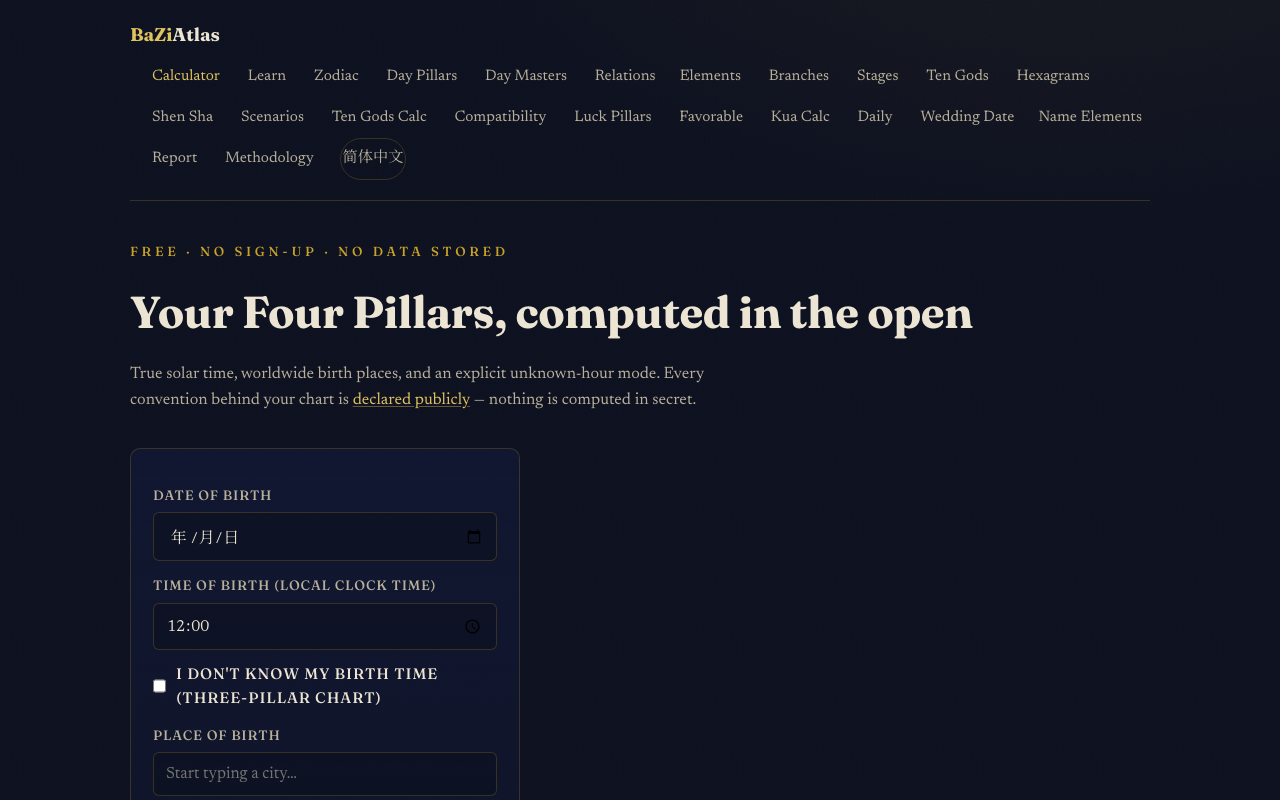
BaZi Atlas is a free, open-source Four Pillars of Destiny (BaZi) chart calculator that runs entirely in your browser. Enter a birth date, time, and place and get an instant, accurate chart: four pillars, hidden stems, twelve stages, ten gods, shen sha, and luck pillars - all computed client-side with the lunar-javascript library, so birth data never leaves the device.
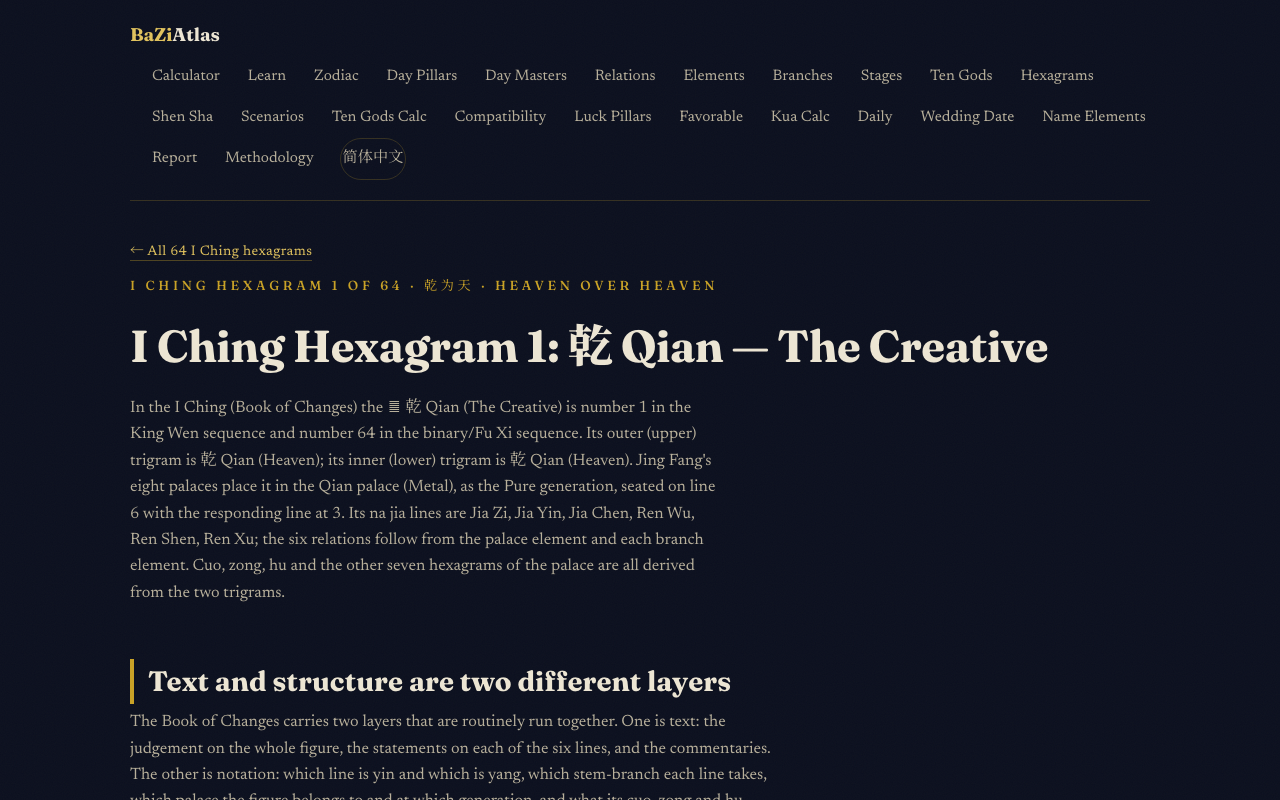
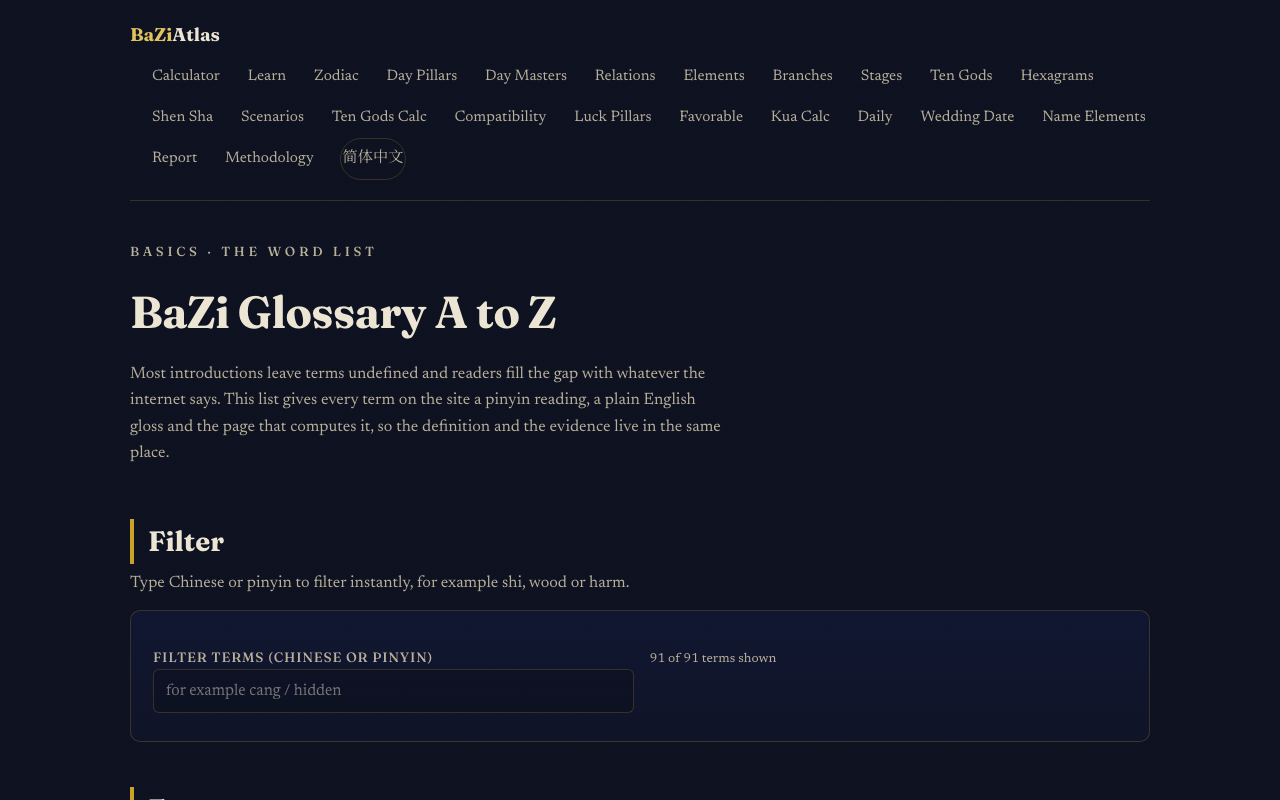
The engine is fully open source on GitHub (MIT), and the methodology page documents every rule with a public corrections log. An English edition and a simplified Chinese edition (bazi-atlas.com/zh/) share the same engine. Beyond the calculator, the site ships a growing library of free tools and reference pages: compatibility calculator, ten gods calculator, favorable element calculator, Kua number, daily pillar, wedding date picker, name analysis, a 64-hexagrams index, and 30 scenario pages.
BaZi Atlas was built for people who want serious, rule-transparent Chinese astrology tools instead of black-box apps. No account required, no paywall on charts, no ads. If you are learning BaZi, comparing software, or need a reliable reference for research, start with the main calculator and explore the index pages from there.
Features
- 100% client-side chart calculation - birth data never leaves your browser
- Full BaZi output: four pillars, hidden stems, ten gods, twelve stages, shen sha, luck pillars
- Open source engine (MIT) with a documented methodology and public corrections log
- Bilingual: complete English and simplified Chinese editions
- Free companion tools: compatibility, ten gods, favorable elements, Kua number, daily pillar, wedding date picker, name analysis
- Reference library: 64 hexagrams index, twelve branches, ten day masters, 36 shen sha, 30 scenario pages
Use Cases
- Generate an accurate BaZi chart instantly without signing up or installing anything
- Cross-check charts produced by other apps against a transparent, rule-documented engine
- Look up quick answers with the ten gods, favorable element, and compatibility calculators
- Study systematically using the hexagram, shen sha, and day master reference indexes

Comments

As someone building in the astrology space myself, the 'private by design' choice really stands out - birth data is about as personal as it gets, and computing everything client-side with lunar-javascript means there is genuinely nothing to breach. I also respect the methodology page with a public corrections log: BaZi has so many competing conventions (true solar time vs standard time, early/late zi hour handling) that documenting every rule is the only way to be credible. One question: does the calculator show which convention choices were applied for a given chart, e.g. which zi-hour rule or time correction was used? For a research tool, exposing that per-chart would be genuinely valuable.

Nice to see lunar-javascript doing everything client-side. We use the same library for a Four Pillars page, and solar-term boundaries were the part we had to test hardest. Since you ask for the birth place: do you also apply historical daylight saving time? China used DST in 1986-1991 and Japan in 1948-1951, so a summer 1988 birth at 1:30 on the clock lands in a different hour pillar unless it is shifted back an hour. A short note on each chart saying which corrections were applied (DST, true solar time from longitude) would make cross-checking against other apps much easier.
I built BaZi Atlas because every BaZi calculator I tried was either a black box, paywalled, or sloppy with the rules. As a developer, I wanted an engine where every computation is documented and correctable - so I open-sourced it (MIT) and keep a public corrections log on the methodology page. Everything runs client-side: your birth data never leaves your browser. The English and Chinese editions share the same engine, and the tool library (ten gods, compatibility, luck pillars, hexagrams index, etc.) grew out of questions learners kept asking. Happy to answer anything about the engine, the rules, or the roadmap. If you spot a calculation issue, the corrections page is the fastest way to get it fixed.
Premium Products

















































Sponsors
Buy
Makers
Makers
Comments
As someone building in the astrology space myself, the 'private by design' choice really stands out - birth data is about as personal as it gets, and computing everything client-side with lunar-javascript means there is genuinely nothing to breach. I also respect the methodology page with a public corrections log: BaZi has so many competing conventions (true solar time vs standard time, early/late zi hour handling) that documenting every rule is the only way to be credible. One question: does the calculator show which convention choices were applied for a given chart, e.g. which zi-hour rule or time correction was used? For a research tool, exposing that per-chart would be genuinely valuable.
Nice to see lunar-javascript doing everything client-side. We use the same library for a Four Pillars page, and solar-term boundaries were the part we had to test hardest. Since you ask for the birth place: do you also apply historical daylight saving time? China used DST in 1986-1991 and Japan in 1948-1951, so a summer 1988 birth at 1:30 on the clock lands in a different hour pillar unless it is shifted back an hour. A short note on each chart saying which corrections were applied (DST, true solar time from longitude) would make cross-checking against other apps much easier.
I built BaZi Atlas because every BaZi calculator I tried was either a black box, paywalled, or sloppy with the rules. As a developer, I wanted an engine where every computation is documented and correctable - so I open-sourced it (MIT) and keep a public corrections log on the methodology page. Everything runs client-side: your birth data never leaves your browser. The English and Chinese editions share the same engine, and the tool library (ten gods, compatibility, luck pillars, hexagrams index, etc.) grew out of questions learners kept asking. Happy to answer anything about the engine, the rules, or the roadmap. If you spot a calculation issue, the corrections page is the fastest way to get it fixed.
Premium Products
New to Fazier?

Find your next favorite product or submit your own. Made by @FalakDigital.
Copyright ©2026. All Rights Reserved