
Most companies wire Claude or ChatGPT into Slack, email, calls, tickets, and their CRM over one singular MCP. That's raw pipes into scattered systems. The model reads a slice and guesses at the rest.
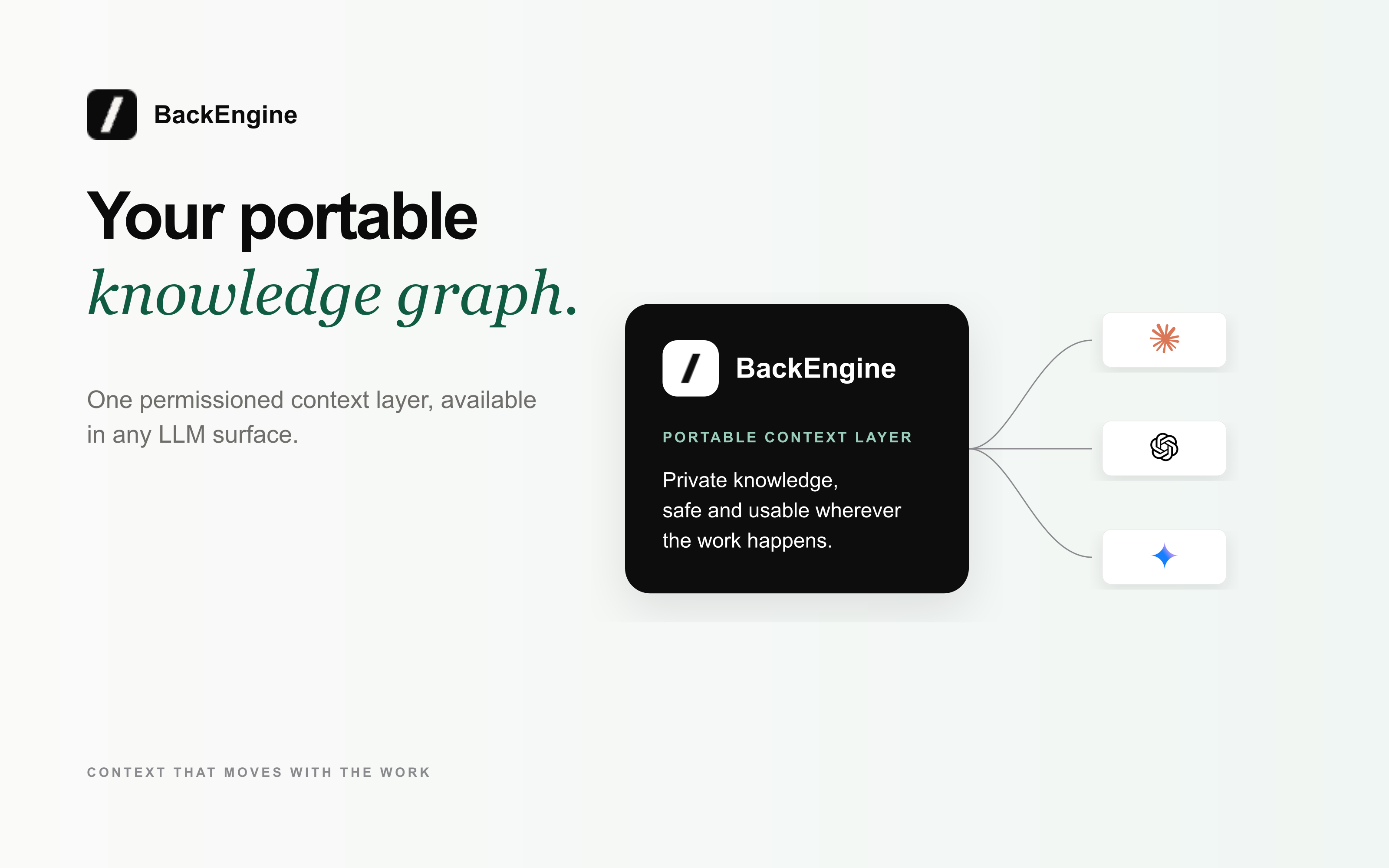
BackEngine MCP connects to the same tools, but reads everything first, joins all of it into one permissioned record per account, kept current, so Claude and ChatGPT always work from the whole picture.
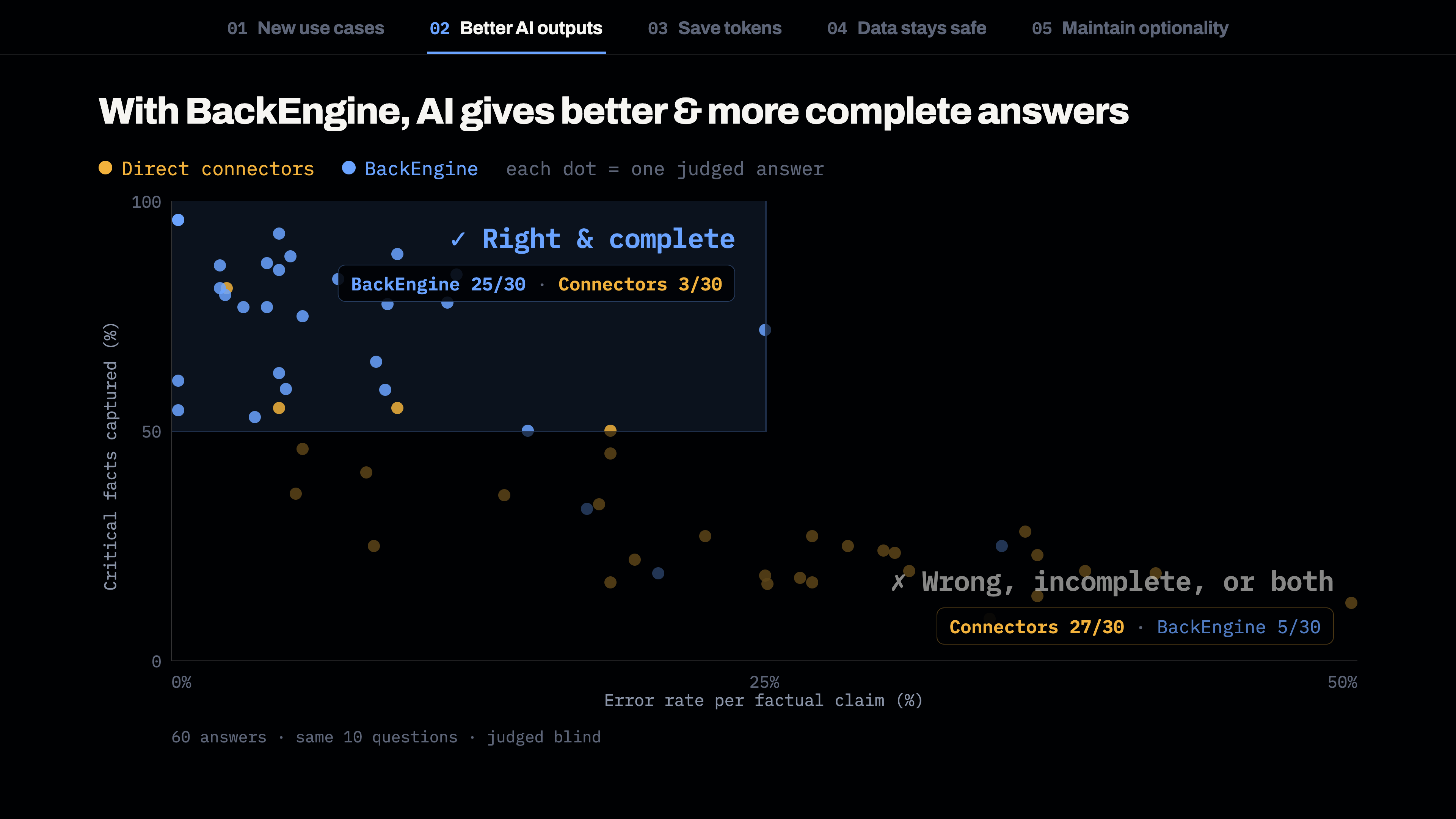
Head-to-head: 67% fewer errors, 2.4x more key facts, 65% fewer tokens vs. direct connectors.
Features
- A knowledge graph, not a pile of connectors | Most tools bolt AI onto your existing systems and hope it finds the right answer. BackEngine pre-processes your calls, emails, Slack messages, tickets, and support history into a structured knowledge graph before anyone asks a question. The AI pulls from an organized record, not a live search across a dozen tabs.
- 65-89% fewer tokens per answer | Because the data is pre-joined and organized, the AI pulls only what it needs instead of stuffing an entire account's history into every query. Fewer tokens than running the same questions through direct connectors multiples savings across the team quickly.
- Accuracy you can act on | Direct connectors produced factual errors 23.2% of the time in a benchmark study, roughly 1 in 4 answers. BackEngine brought that down to 1-7.6%, or as good as 1 in 13. That's the difference between an answer you check twice and one you take to a customer.
- Own your knowledge layer, not your vendor's | Your customer context lives in a layer you control, not locked inside one model's memory. Switch from Claude to ChatGPT to a custom agent, and the same permissioned knowledge comes with you.
- Built-in account intelligence | Every account and prospect gets a computed health score, sentiment tracking, and a pre-built overview covering the last 12 weeks of activity. No manual grading, no digging through call transcripts to find out what changed. Customers can opt to extend the data window further back as well.
- Broad connectivity out of the box | Salesforce, HubSpot, Zoom, Gmail, Slack, and Teams all feed into the same graph, so fragmented conversations and product data live in one place instead of dozens.
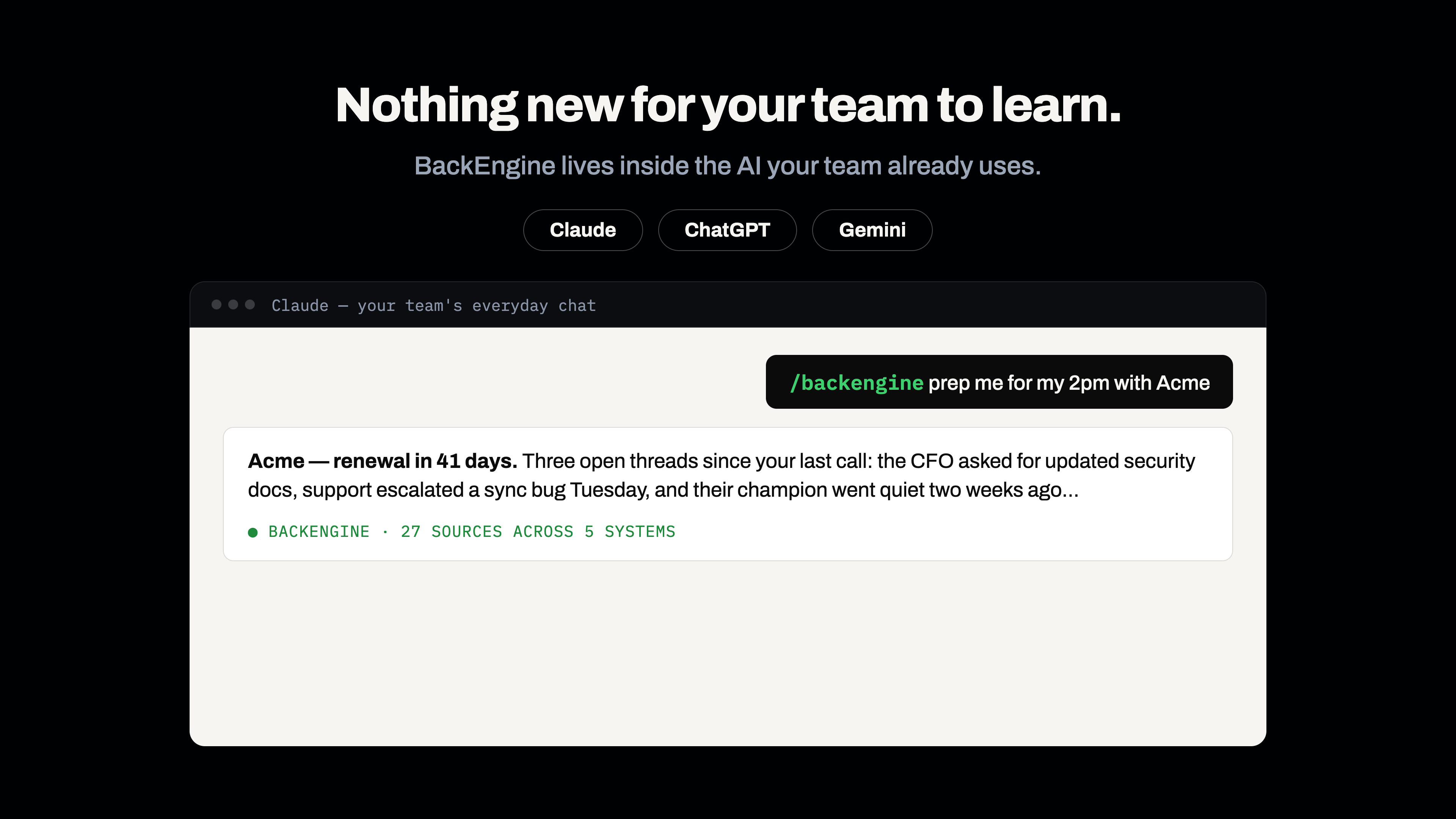
- Live where your team already works | Access BackEngine through Slack, Claude, or any other AI interface your team uses. No new app to learn.
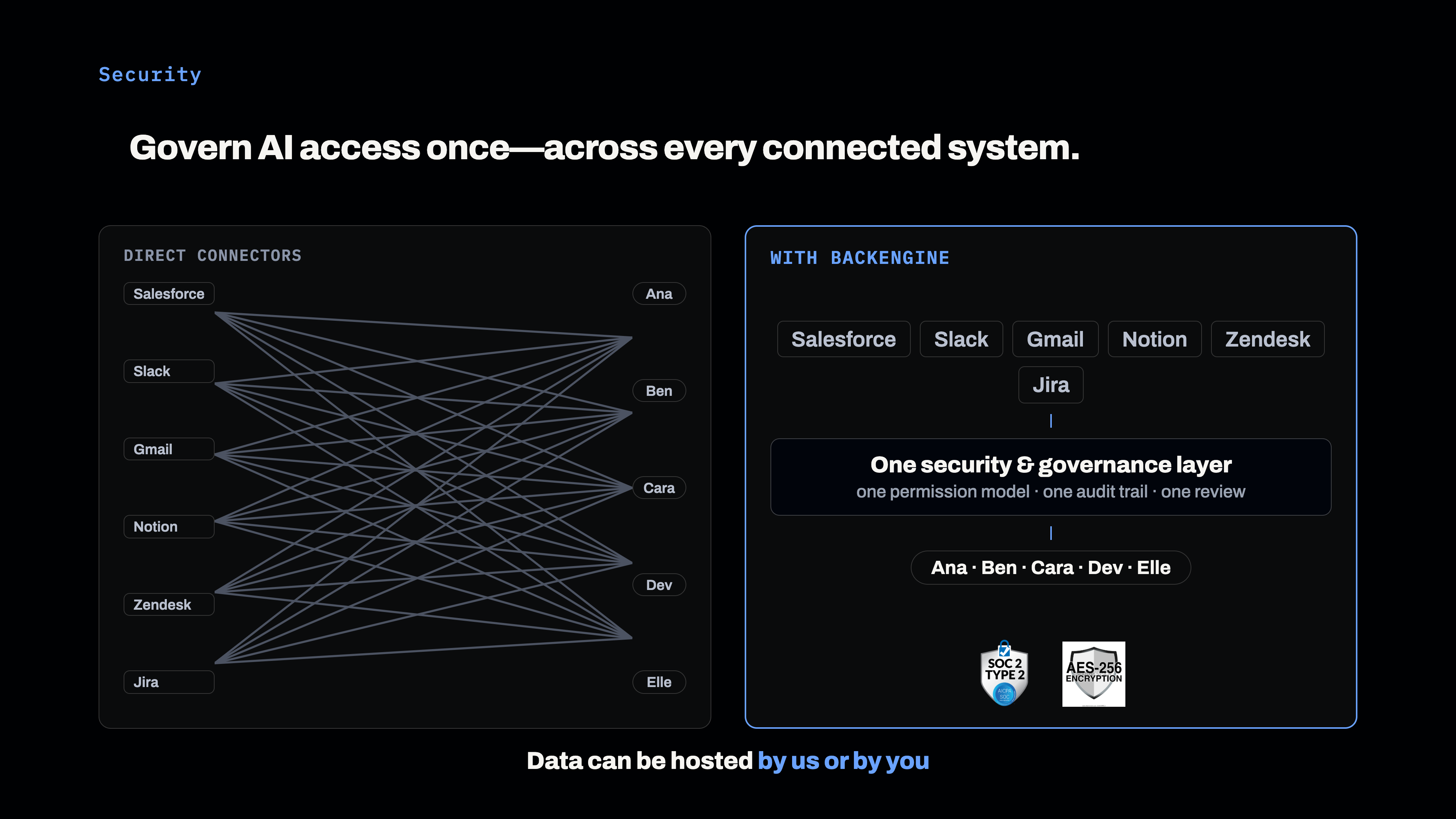
- Enterprise-grade security | SOC 2 and HIPAA compliant, with data encrypted throughout.
- Fast to stand up | Setup takes about fifteen minutes, with your data ready to use in two days. No months-long pipeline build before your first use case goes live.
- MCP-first | BackEngine connects directly into the Model Context Protocol, the emerging standard for how AI models access outside data. That means one connection point works across Claude, ChatGPT, or whatever model your team uses next. No rebuilding your data layer every time you switch tools.
Use Cases
- Prep for any call in minutes. Pull a full account or prospect overview before a meeting: sentiment, health score, open concerns, wins, and who's said what over the last 12 weeks. No digging through Slack, email, and call recordings before a 9am call.
- Catch renewal risk before it becomes a surprise. Every account carries a computed health score and sentiment trend. See which accounts are drifting weeks before the renewal conversation, instead of finding out from a cancellation email.
- Know exactly who to re-engage and why. Ask which dormant prospects or existing accounts are worth a call right now, and get a ranked list backed by real signals, not a rep's gut feeling about who "seemed interested."
- Turn scattered feedback into a roadmap you can defend. Which features are customers actually asking for, and which ones are gating the most revenue? BackEngine pulls the answer from tickets, calls, and emails across the whole customer base, then helps you build the business case to prioritize it.
- Spot patterns no single person could see. Ask "who's mentioned a competitor this month" or "which accounts raised the same complaint" and get a real, cited answer, instead of relying on whichever rep happens to remember.
- Coach reps and qualify deals on what was actually said. Score a discovery call against your qualification framework, or review how a call ended, grounded in the transcript, not a rep's self-report after the fact.
- Build a forecast grounded in real signals. Roll deal health and account activity into a forecast based on what customers have actually said and done, not just what's sitting in a CRM stage field.
- Write outreach that sounds like you were actually paying attention. Draft a follow-up, re-engagement email, or renewal pitch that references the real last conversation with that account, not a generic template with their name dropped in.

Comments


Hey guys! I’m Eli, founder of BackEngine. Claude is becoming the next work OS. Not a great LLM. Not a chatbot. The place where work happens. Microsoft Office owned the workday for 30 years (with Google Workspace making progress). But work is moving to Claude, fast. Email is already there (Gmail, Superhuman MCPs). Research is there (Deep Research). Dashboards are there (Live Artifacts). Scheduled automations are there (Co-Work Scheduled). Your data is there. Most of mine already is. This was my morning. I got to the office. Opened up Claude. Inside was a TLDR on all the emails and slacks I had missed with drafted responses to any that required it. I sent 8 of them. A few minutes later I got a list of all the people that had visited BackEngine that matched our ICP, with their email address pulled up and a draft ready to go. I sent them. I then opened up a Live Artifact in Claude that showed me what we had shipped in the past week, what tickets were being worked on, and what was not being worked on. I then got a summary of everything we had spent money on the past 7 days. One item looked like a billing mistake. I slacked the team to find out if it was real or not. I then had a case study interview with a customer. As soon as it was done, I asked Claude to find our other case studies and to write a similar one based on the transcript. And then I asked Claude to summarize the morning and write this post. A couple of takeaways. 1) Building a horizontal productivity tool in 2026 is a fool's errand. No one is going to leave Claude to use your standalone dashboard, your standalone inbox, your standalone CRM UI. 2) What's worth building: things Claude won't, that live inside Claude. And now you can access that intelligence directly inside Claude (or any LLM) via BackEngine MCP. BackEngine pre-process a company’s unstructured customer data - calls, emails, slack, tickets, support history - before anyone asks a question. We do three things no connector or customer pipeline does on its own: Three things we do that no set of connectors can: 1️⃣ Improve token efficiency In July 2026 benchmark study, BackEngine used 65-89% fewer tokens to run the same 10 cross-functional business questions when compared to using direct connectors into all of the same data systems independently Example: Which product features have customers asked for that are gating the most revenue? Prioritize our roadmap based on impact to deals and renewals and build a PRD for the top 3 features. 291.7K tokens using direct connectors vs. 33.1K tokens using BackEngine 2️⃣ Produce consistently correct answers In the same benchmark study, direct connectors resulted in factual errors 23.2% of the time. That means nearly 1 in 4 questions you ask an LLM, even when connected to your data sources, will still hallucinate an answer. When using BackEngine, only 1-7.6% of the time did the LLM produce an answer that was not fully factually accurate. Example: What 5 prospects who have gone dormant are the highest priority to re-engage with a personalized product update? 66.2% accuracy using direct connectors vs. 99% using BackEngine 3️⃣ Portability across systems If your customer data, calls, and support history live inside one model's memory, you're locked in. Two years ago every company built its AI stack around ChatGPT. Now Claude leads for a lot of teams, Gemini has fans, and new models show up every month. BackEngine keeps that context in a knowledge layer you own, so you can point any model at it. Switch models, keep your knowledge ❓Why this matters Deterministic, code-built context pipelines work for some use cases, but they get expensive fast, and they don't scale to multi-agent architectures. BackEngine's raw material is conversation — unstructured, messy, and everywhere — and it needs no mapping to start. BackEngine isn't a tool to bolt onto one project. It's the piece of the stack that lets any client engagement scale past a single well-scoped use case into a repeatable, multi-agent system without every new agent requiring its own custom data store. BackEngine is helping teams: • Prepare for calls faster • Catch risk signals earlier • Track product feedback • Run better renewals • And give leadership real visibility into account health All without adding more reporting or manual updates. If you’re curious what it looks like in practice: You can read the benchmark study cited above here: https://backengine.com/benchmark We happy to answer questions and would love your feedback!


BackEngine has great potential and offers some useful features, but I encountered a few issues that could be improved. Please contact me so I can share detailed feedback and suggest the changes I'd like to see. Email: [email protected]

Premium Products


































Sponsors
Buy
Makers
Makers
Comments
Hey guys! I’m Eli, founder of BackEngine. Claude is becoming the next work OS. Not a great LLM. Not a chatbot. The place where work happens. Microsoft Office owned the workday for 30 years (with Google Workspace making progress). But work is moving to Claude, fast. Email is already there (Gmail, Superhuman MCPs). Research is there (Deep Research). Dashboards are there (Live Artifacts). Scheduled automations are there (Co-Work Scheduled). Your data is there. Most of mine already is. This was my morning. I got to the office. Opened up Claude. Inside was a TLDR on all the emails and slacks I had missed with drafted responses to any that required it. I sent 8 of them. A few minutes later I got a list of all the people that had visited BackEngine that matched our ICP, with their email address pulled up and a draft ready to go. I sent them. I then opened up a Live Artifact in Claude that showed me what we had shipped in the past week, what tickets were being worked on, and what was not being worked on. I then got a summary of everything we had spent money on the past 7 days. One item looked like a billing mistake. I slacked the team to find out if it was real or not. I then had a case study interview with a customer. As soon as it was done, I asked Claude to find our other case studies and to write a similar one based on the transcript. And then I asked Claude to summarize the morning and write this post. A couple of takeaways. 1) Building a horizontal productivity tool in 2026 is a fool's errand. No one is going to leave Claude to use your standalone dashboard, your standalone inbox, your standalone CRM UI. 2) What's worth building: things Claude won't, that live inside Claude. And now you can access that intelligence directly inside Claude (or any LLM) via BackEngine MCP. BackEngine pre-process a company’s unstructured customer data - calls, emails, slack, tickets, support history - before anyone asks a question. We do three things no connector or customer pipeline does on its own: Three things we do that no set of connectors can: 1️⃣ Improve token efficiency In July 2026 benchmark study, BackEngine used 65-89% fewer tokens to run the same 10 cross-functional business questions when compared to using direct connectors into all of the same data systems independently Example: Which product features have customers asked for that are gating the most revenue? Prioritize our roadmap based on impact to deals and renewals and build a PRD for the top 3 features. 291.7K tokens using direct connectors vs. 33.1K tokens using BackEngine 2️⃣ Produce consistently correct answers In the same benchmark study, direct connectors resulted in factual errors 23.2% of the time. That means nearly 1 in 4 questions you ask an LLM, even when connected to your data sources, will still hallucinate an answer. When using BackEngine, only 1-7.6% of the time did the LLM produce an answer that was not fully factually accurate. Example: What 5 prospects who have gone dormant are the highest priority to re-engage with a personalized product update? 66.2% accuracy using direct connectors vs. 99% using BackEngine 3️⃣ Portability across systems If your customer data, calls, and support history live inside one model's memory, you're locked in. Two years ago every company built its AI stack around ChatGPT. Now Claude leads for a lot of teams, Gemini has fans, and new models show up every month. BackEngine keeps that context in a knowledge layer you own, so you can point any model at it. Switch models, keep your knowledge ❓Why this matters Deterministic, code-built context pipelines work for some use cases, but they get expensive fast, and they don't scale to multi-agent architectures. BackEngine's raw material is conversation — unstructured, messy, and everywhere — and it needs no mapping to start. BackEngine isn't a tool to bolt onto one project. It's the piece of the stack that lets any client engagement scale past a single well-scoped use case into a repeatable, multi-agent system without every new agent requiring its own custom data store. BackEngine is helping teams: • Prepare for calls faster • Catch risk signals earlier • Track product feedback • Run better renewals • And give leadership real visibility into account health All without adding more reporting or manual updates. If you’re curious what it looks like in practice: You can read the benchmark study cited above here: https://backengine.com/benchmark We happy to answer questions and would love your feedback!
BackEngine has great potential and offers some useful features, but I encountered a few issues that could be improved. Please contact me so I can share detailed feedback and suggest the changes I'd like to see. Email: [email protected]
Premium Products
New to Fazier?
Find your next favorite product or submit your own. Made by @FalakDigital.
Copyright ©2026. All Rights Reserved