
AudioUtils
Convert audio in your browser, 77 tools, nothing uploads
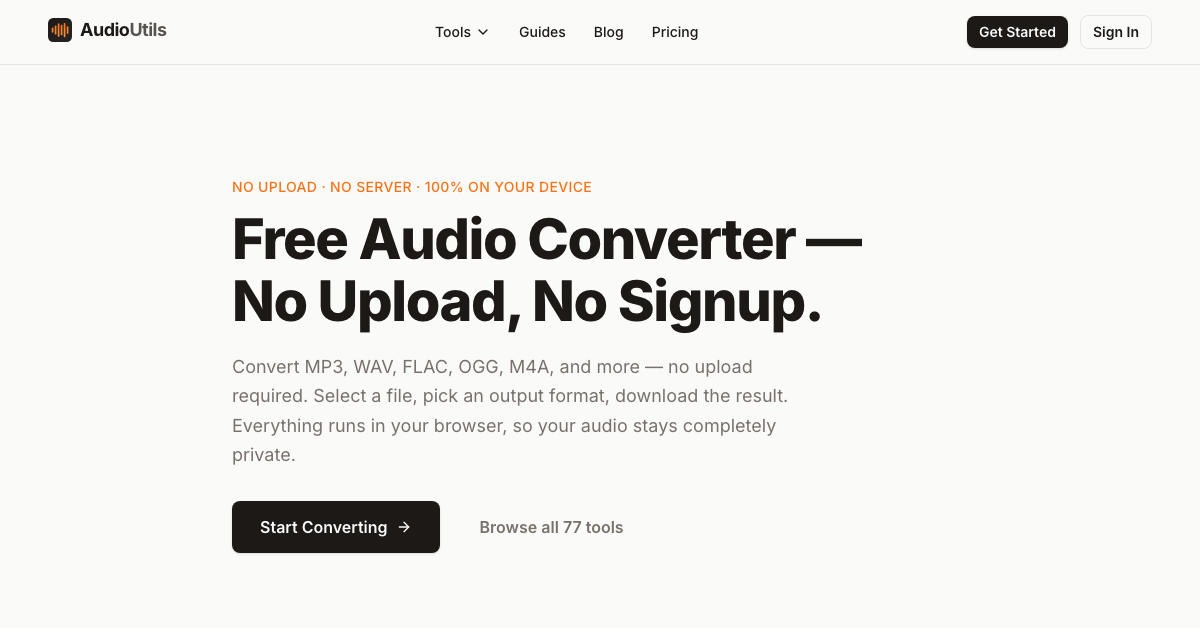
AudioUtils converts audio formats entirely inside your browser. Pick a file, choose an output format, download the result. The file is never uploaded, because the conversion runs on your own machine rather than on a server.
Under the hood it is FFmpeg compiled to WebAssembly, so there is nothing to install and no plugin to enable.
Features
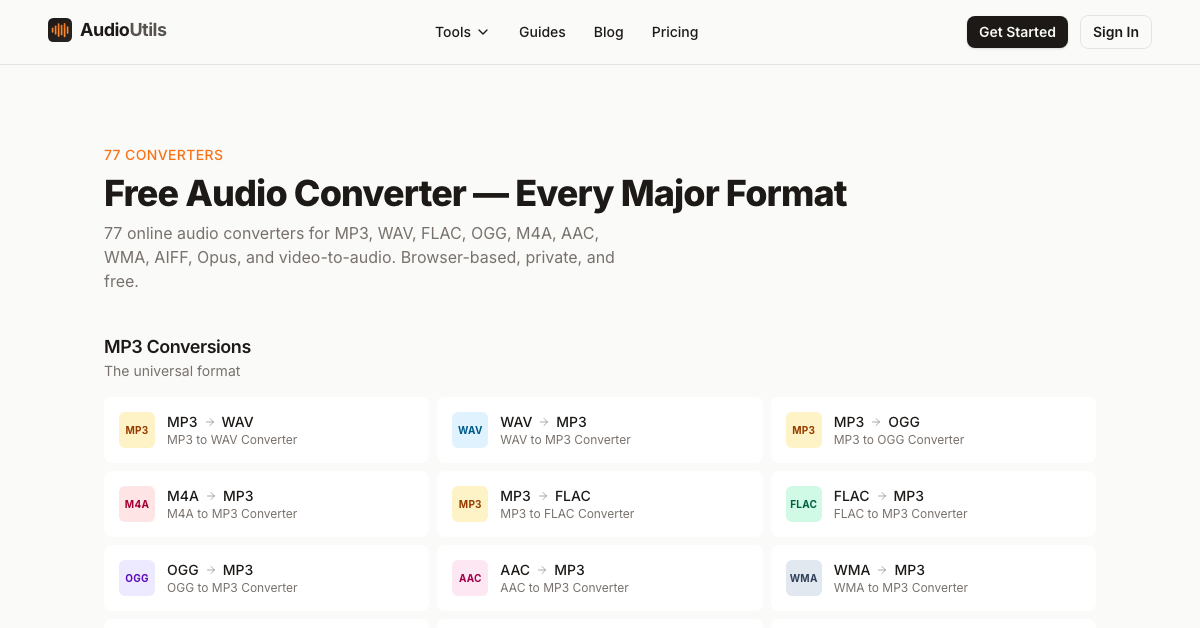
Seventy-seven converters across MP3, WAV, FLAC, OGG, M4A, AAC, WMA, AIFF and Opus
A second group extracts audio out of video: MP4, MOV, MKV, AVI, WebM and more into MP3, WAV, M4A or FLAC
A dedicated MP3 to M4R converter for iPhone ringtones
Nothing uploads: files stay on your own device
No email gate and no signup wall at any point
Works on Mac, Windows, iPhone, Android and Linux in any modern browser
Use Cases
Turning a voice memo or interview into MP3 before sending it on
Pulling the audio track out of a video file
Getting a lossless WAV to FLAC conversion without installing anything
Making an iPhone ringtone from an MP3
Converting audio on a work machine where you cannot install software

Comments


This started because every online audio converter I tried wanted an upload, and a lot of the files people convert are things they would rather not hand to a server: voice memos, interview recordings, unreleased tracks. FFmpeg compiled to WebAssembly means the conversion runs on your own machine, so there is no upload and no queue. The seventy-seven pairs came from watching which conversions people actually search for rather than trying to be exhaustive. Curious which format pair you would add next.


The "nothing uploads" part is the whole reason I'd use this. I'm building a small on-device iPhone tool for the same reason: people don't want to hand a server their voice memos or screenshots just to do one conversion. One question: how do you handle large files with the WASM build? Memory limits in mobile Safari bit me on a similar project, curious if you hit the same wall.


The FFmpeg-to-WASM approach is the right call here for anything with voice memos or interview audio - nobody wants to babysit an upload progress bar for a file they're about to delete anyway. Curious how you're handling really large files (an hour+ podcast recording, say) in the browser without the tab choking on memory. Also surprised the MP3-to-M4R iPhone ringtone converter isn't more common; that's a genuinely annoying gap most converters miss.

The MP4-to-MP3 page explains the bitrate tradeoffs clearly. If a video contains multiple audio tracks, such as different languages or separate microphone and system audio, can the user choose which track to extract? A track selector or a note about the default selection would make the meeting and lecture use cases easier to assess.

Premium Products



































Sponsors
Buy

Makers
Makers
Comments
This started because every online audio converter I tried wanted an upload, and a lot of the files people convert are things they would rather not hand to a server: voice memos, interview recordings, unreleased tracks. FFmpeg compiled to WebAssembly means the conversion runs on your own machine, so there is no upload and no queue. The seventy-seven pairs came from watching which conversions people actually search for rather than trying to be exhaustive. Curious which format pair you would add next.
The "nothing uploads" part is the whole reason I'd use this. I'm building a small on-device iPhone tool for the same reason: people don't want to hand a server their voice memos or screenshots just to do one conversion. One question: how do you handle large files with the WASM build? Memory limits in mobile Safari bit me on a similar project, curious if you hit the same wall.
The FFmpeg-to-WASM approach is the right call here for anything with voice memos or interview audio - nobody wants to babysit an upload progress bar for a file they're about to delete anyway. Curious how you're handling really large files (an hour+ podcast recording, say) in the browser without the tab choking on memory. Also surprised the MP3-to-M4R iPhone ringtone converter isn't more common; that's a genuinely annoying gap most converters miss.
The MP4-to-MP3 page explains the bitrate tradeoffs clearly. If a video contains multiple audio tracks, such as different languages or separate microphone and system audio, can the user choose which track to extract? A track selector or a note about the default selection would make the meeting and lecture use cases easier to assess.
Premium Products
New to Fazier?

Find your next favorite product or submit your own. Made by @FalakDigital.
Copyright ©2026. All Rights Reserved