
AudienceCue
Turn YouTube comments into cited audience reports
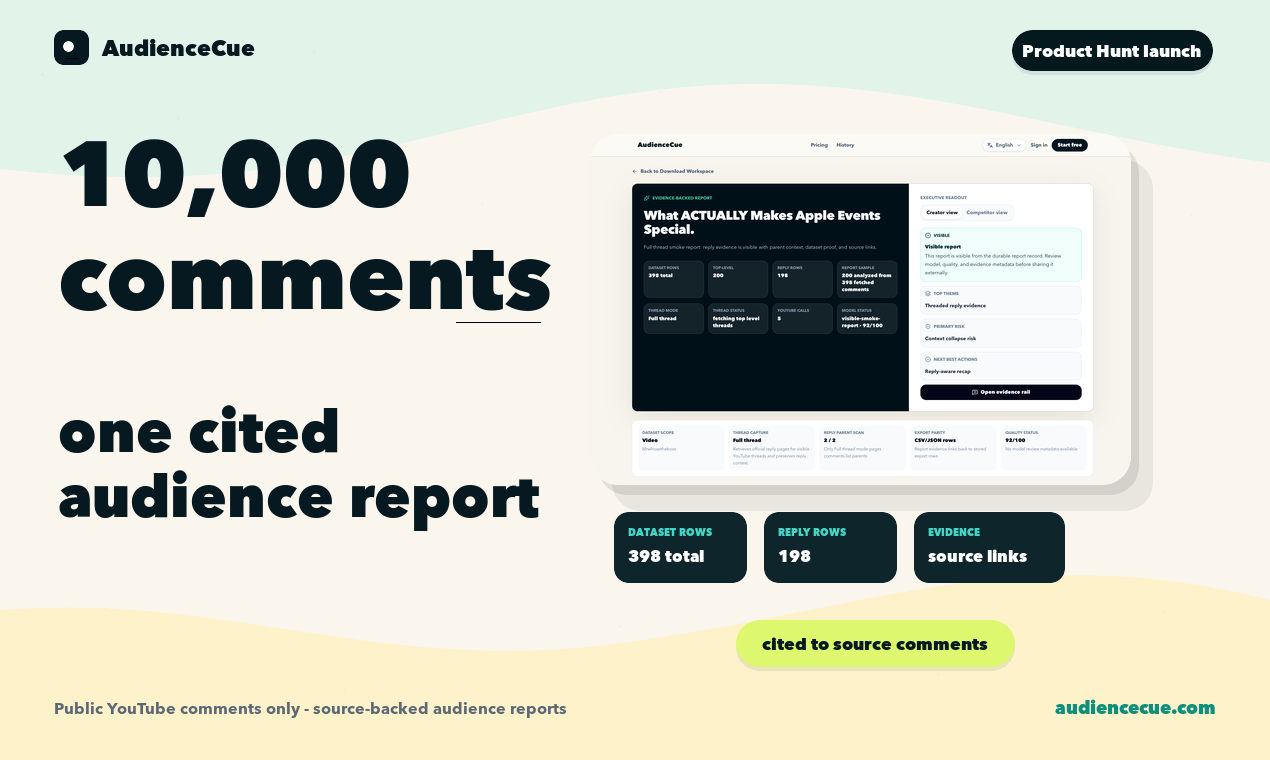
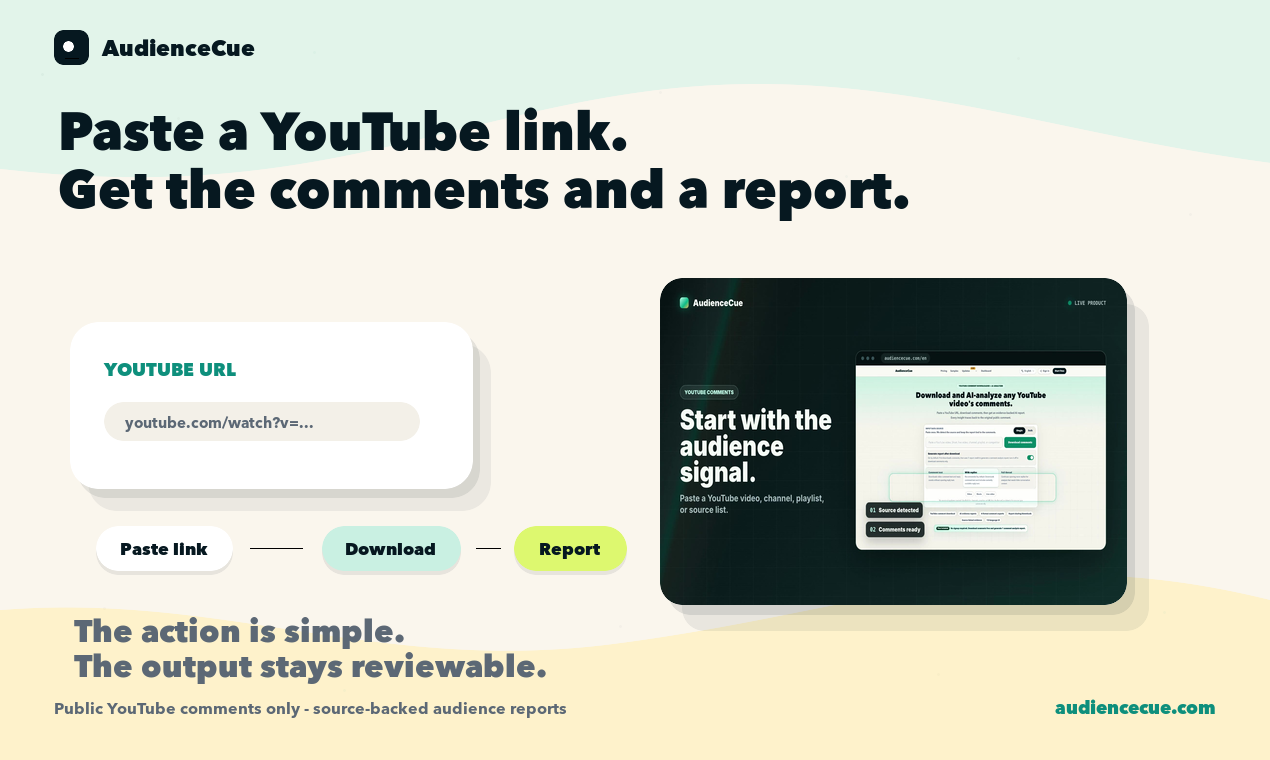
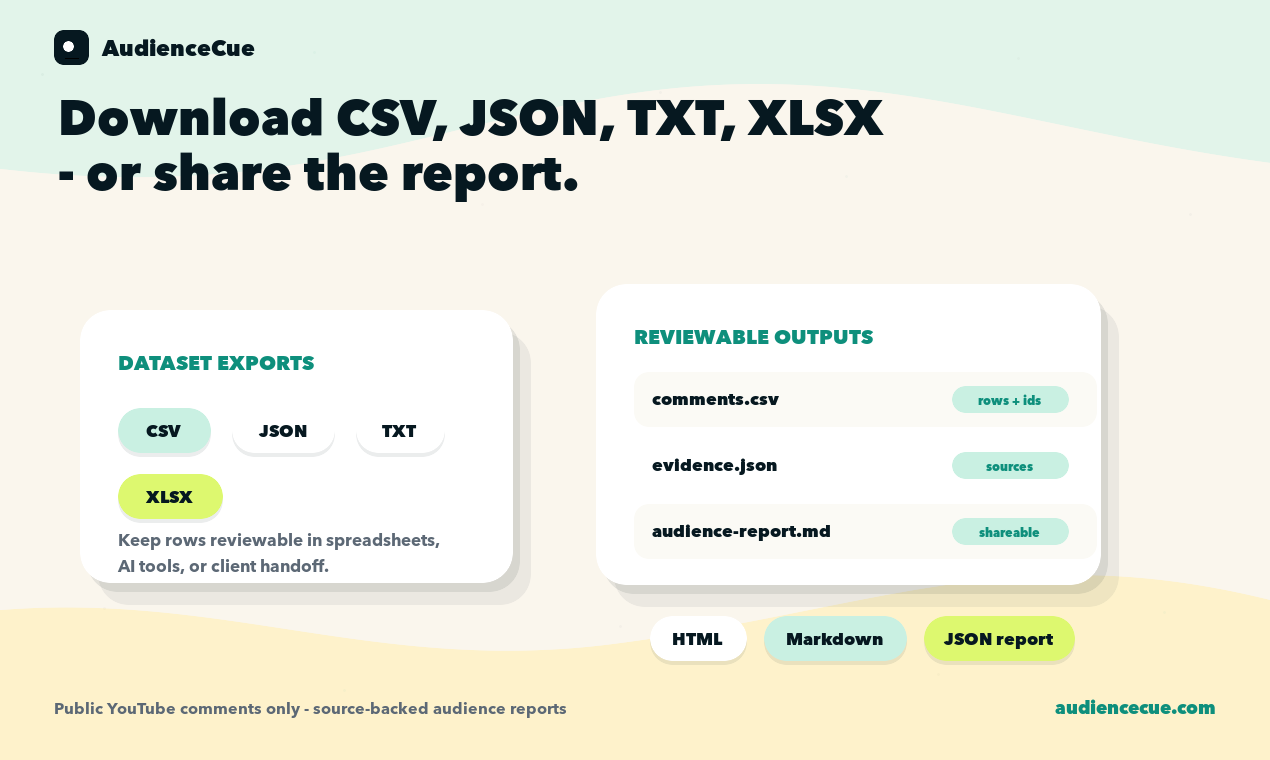
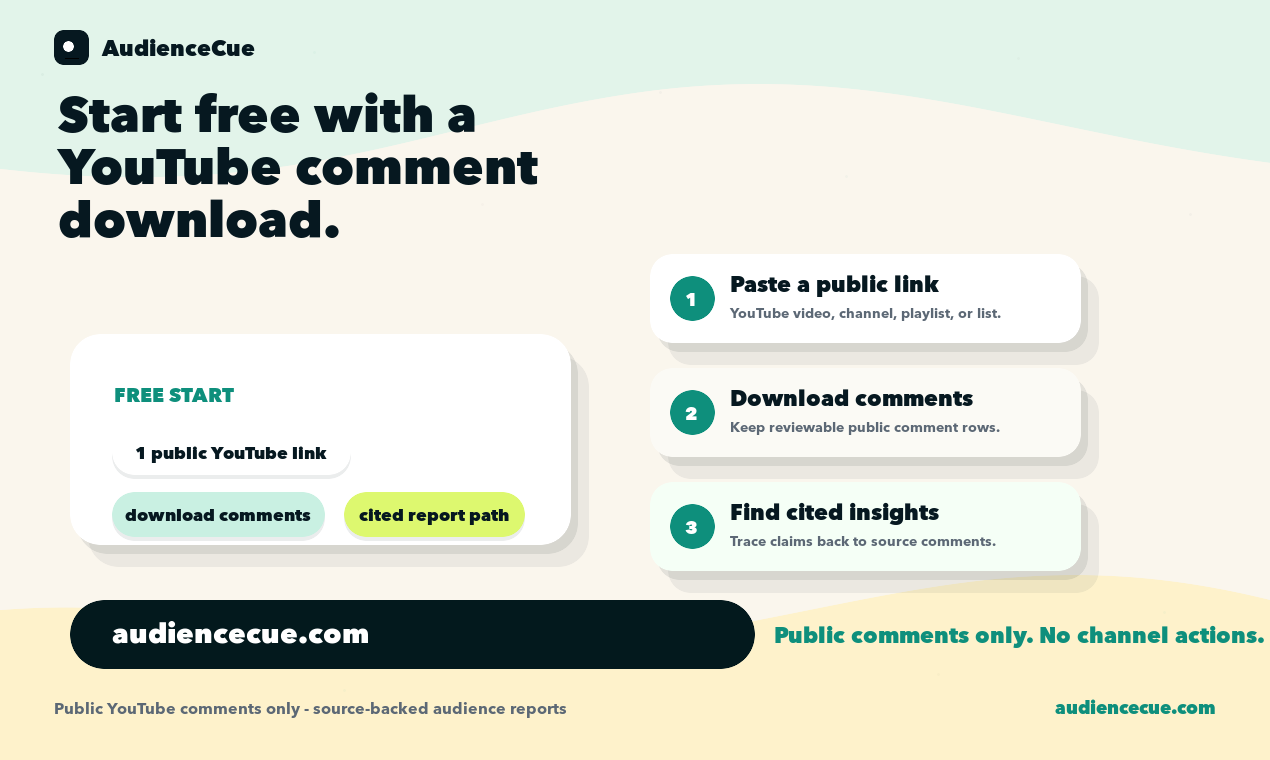
AudienceCue helps creators, marketers, researchers, and agencies download public YouTube comments and turn them into cited AI reports. Paste a supported video, Short, live-video page, channel, playlist, or list of URLs. Keep the returned comments and available public replies in CSV, JSON, TXT, or XLSX, then generate a report whose findings stay tied to source evidence. Share a read-only report or export it as HTML, Markdown, or JSON. AudienceCue does not post replies, moderate comments, or take actions on a YouTube channel.
Features
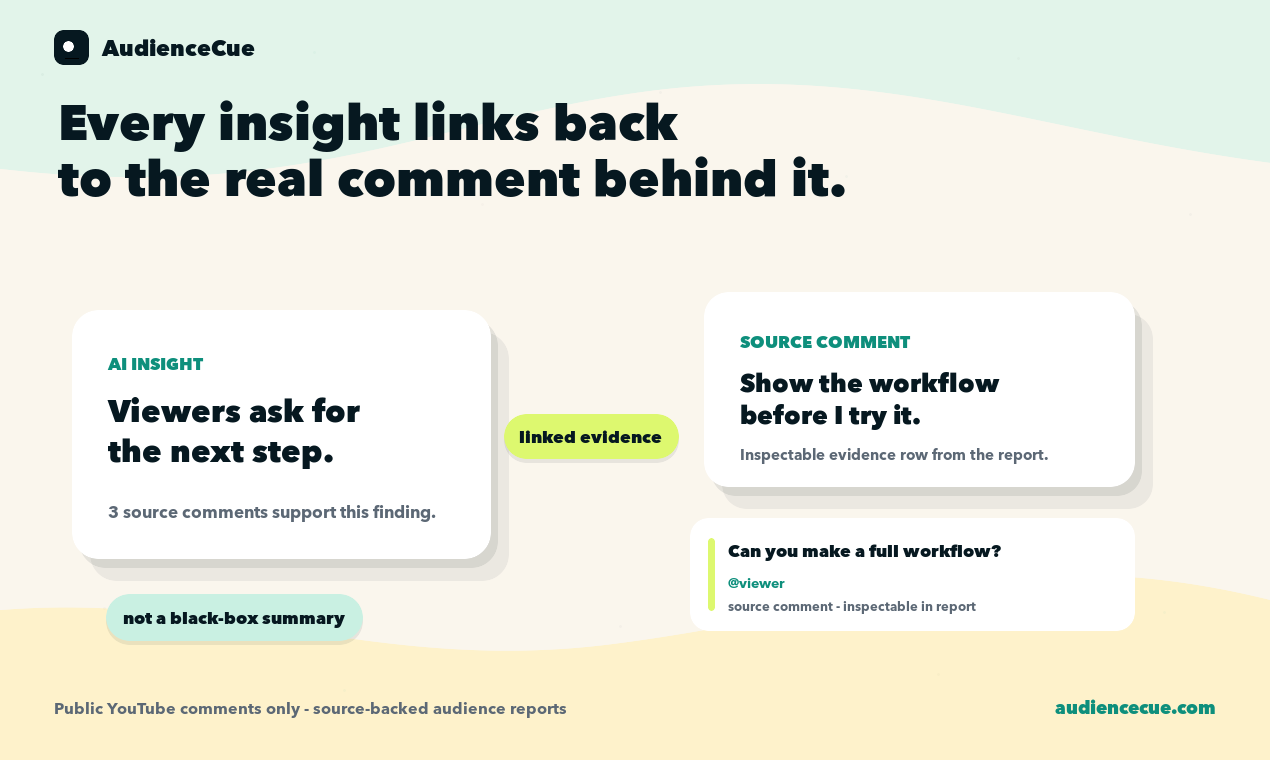
Download public YouTube comments from a video, Short, live-video page, channel, playlist, or list of URLs. Export comments and available public replies as CSV, JSON, TXT, or XLSX. Generate AI reports whose findings stay tied to source comments. Share reports through read-only links and export them as HTML, Markdown, or JSON. Free no-signup downloader returns up to 100 rows for one video.
Use Cases
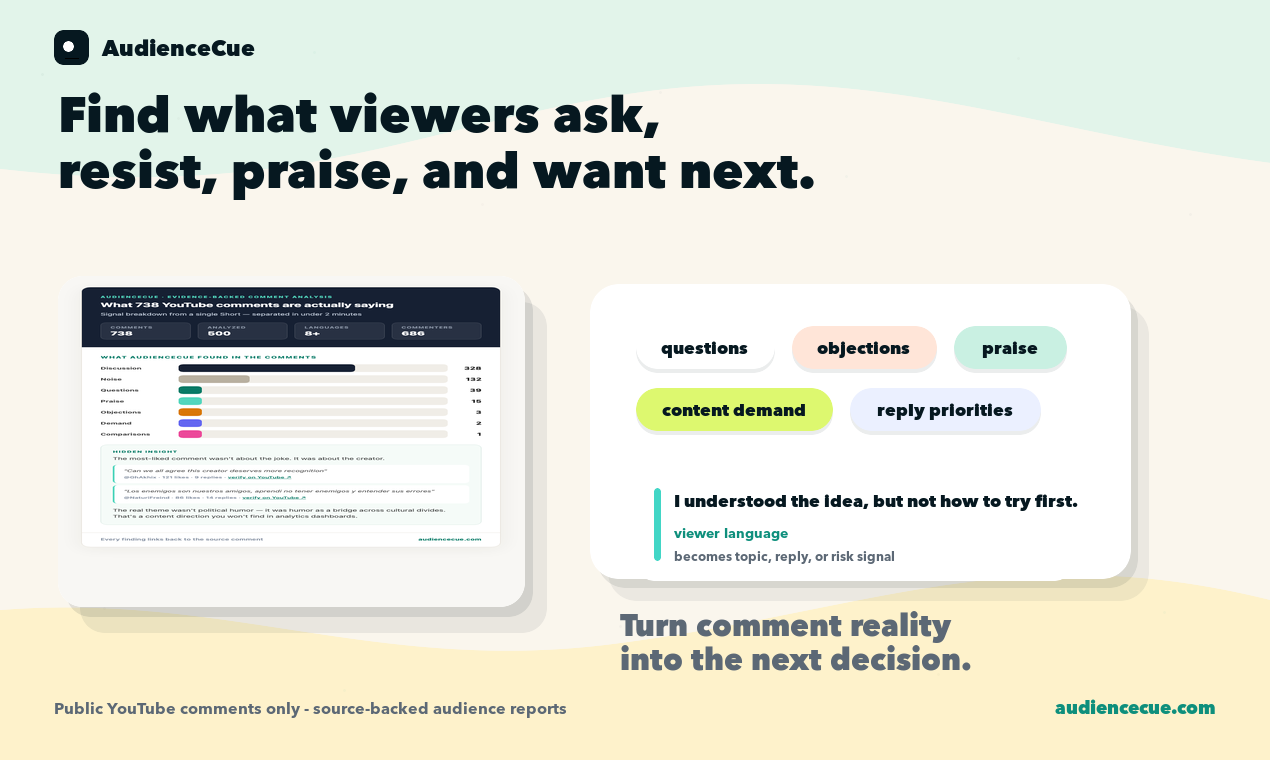
Creators mining audience feedback for content ideas. Marketers and agencies researching audience sentiment and competitor videos. Researchers collecting citable public comment datasets. Product teams validating pain points before building.

Comments

Shorts comments are notoriously low-signal — emoji spam and inside jokes drown out real feedback. Does the report separate substantive feedback from noise, or weight comments by engagement when building the citations? For research use cases, filtering noise matters more than comment volume, so I'd love to know how you handle that.

This sounds good. I will give it a try. I have made a game names wordable can any one let me knoe how is it. https://wordable.live/

Hi! I built AudienceCue after watching creators read thousands of YouTube comments by hand. Paste a public video, Short, channel, or playlist link and AudienceCue saves the comments YouTube returns, exports them as CSV/JSON/TXT/XLSX, and turns them into a cited AI report. It never posts, moderates, or takes actions on your channel. Feedback very welcome!


Keeping every finding tied to source comments is the part that makes this useful rather than another summary that invents a vibe. Exporting the raw comments as CSV or JSON alongside the report also means a researcher can check the sample, not just the narrative. One thing I would look for is how the report marks comments YouTube truncated or failed to return,



This tool is incredibly useful for content creators and marketers! It allows you to download public YouTube comments and turn them into highly detailed, AI-driven reports. I love that it supports multiple export formats like CSV, JSON, and XLSX, and that every finding in the report links back to the original source evidence. It saves a massive amount of time and is perfect for audience analysis. Highly recommended!"

Tying every finding to the source comment is what makes this usable for real decisions. One thing that would help video creators a lot: comments often mention timestamps like "at 2:14 you said...". If the report grouped feedback by those timestamps, you'd see exactly which moments of a video people reacted to, not just the overall sentiment. Is that on the roadmap?



Cited audience reports from public YouTube comments could save creators and researchers a lot of manual sorting, especially with exports to CSV, JSON, TXT, or XLSX. I like the read-only design and the fact that it keeps findings tied to source evidence rather than posting or moderating on a channel. Can you combine multiple videos or playlists into one comparative report?


The cited-findings approach is the right call - most AI sentiment reports are unverifiable black boxes, so tying every finding back to its source comment solves the trust problem outright. The free no-signup downloader is also a smart funnel. Two questions: how do the AI reports handle non-English comments, and in channel-level reports can you separate comments by video so feedback across a series can be compared? Also curious whether creator replies are threaded into the analysis or counted as separate rows.
Keeping every finding tied to source comments is the part that makes this useful rather than another summary that invents a vibe. Exporting the raw comments as CSV or JSON alongside the report also means a researcher can check the sample, not just the narrative. One thing I would look for is how the report marks comments YouTube truncated or failed to return, so a cited claim is not mistaken for a complete census of the thread.
AudienceCue looks like a useful tool for anyone trying to better understand and reach their target audience. I like the focus on making audience research more practical and actionable for creators and businesses. https://wordlehint.tips/
Premium Products








































Sponsors
Buy

Awards
View all
Awards
View allComments
Shorts comments are notoriously low-signal — emoji spam and inside jokes drown out real feedback. Does the report separate substantive feedback from noise, or weight comments by engagement when building the citations? For research use cases, filtering noise matters more than comment volume, so I'd love to know how you handle that.
This sounds good. I will give it a try. I have made a game names wordable can any one let me knoe how is it. https://wordable.live/
Hi! I built AudienceCue after watching creators read thousands of YouTube comments by hand. Paste a public video, Short, channel, or playlist link and AudienceCue saves the comments YouTube returns, exports them as CSV/JSON/TXT/XLSX, and turns them into a cited AI report. It never posts, moderates, or takes actions on your channel. Feedback very welcome!
Keeping every finding tied to source comments is the part that makes this useful rather than another summary that invents a vibe. Exporting the raw comments as CSV or JSON alongside the report also means a researcher can check the sample, not just the narrative. One thing I would look for is how the report marks comments YouTube truncated or failed to return,
This tool is incredibly useful for content creators and marketers! It allows you to download public YouTube comments and turn them into highly detailed, AI-driven reports. I love that it supports multiple export formats like CSV, JSON, and XLSX, and that every finding in the report links back to the original source evidence. It saves a massive amount of time and is perfect for audience analysis. Highly recommended!"
Tying every finding to the source comment is what makes this usable for real decisions. One thing that would help video creators a lot: comments often mention timestamps like "at 2:14 you said...". If the report grouped feedback by those timestamps, you'd see exactly which moments of a video people reacted to, not just the overall sentiment. Is that on the roadmap?
Cited audience reports from public YouTube comments could save creators and researchers a lot of manual sorting, especially with exports to CSV, JSON, TXT, or XLSX. I like the read-only design and the fact that it keeps findings tied to source evidence rather than posting or moderating on a channel. Can you combine multiple videos or playlists into one comparative report?
The cited-findings approach is the right call - most AI sentiment reports are unverifiable black boxes, so tying every finding back to its source comment solves the trust problem outright. The free no-signup downloader is also a smart funnel. Two questions: how do the AI reports handle non-English comments, and in channel-level reports can you separate comments by video so feedback across a series can be compared? Also curious whether creator replies are threaded into the analysis or counted as separate rows.
Keeping every finding tied to source comments is the part that makes this useful rather than another summary that invents a vibe. Exporting the raw comments as CSV or JSON alongside the report also means a researcher can check the sample, not just the narrative. One thing I would look for is how the report marks comments YouTube truncated or failed to return, so a cited claim is not mistaken for a complete census of the thread.
AudienceCue looks like a useful tool for anyone trying to better understand and reach their target audience. I like the focus on making audience research more practical and actionable for creators and businesses. https://wordlehint.tips/
Premium Products
New to Fazier?

Find your next favorite product or submit your own. Made by @FalakDigital.
Copyright ©2026. All Rights Reserved