
Answer Insight
Tracks how your brand appears in AI-generated answers
Answer Insight helps you understand how your brand shows up in AI-generated answers across platforms like ChatGPT, Perplexity, Gemini, and Claude.
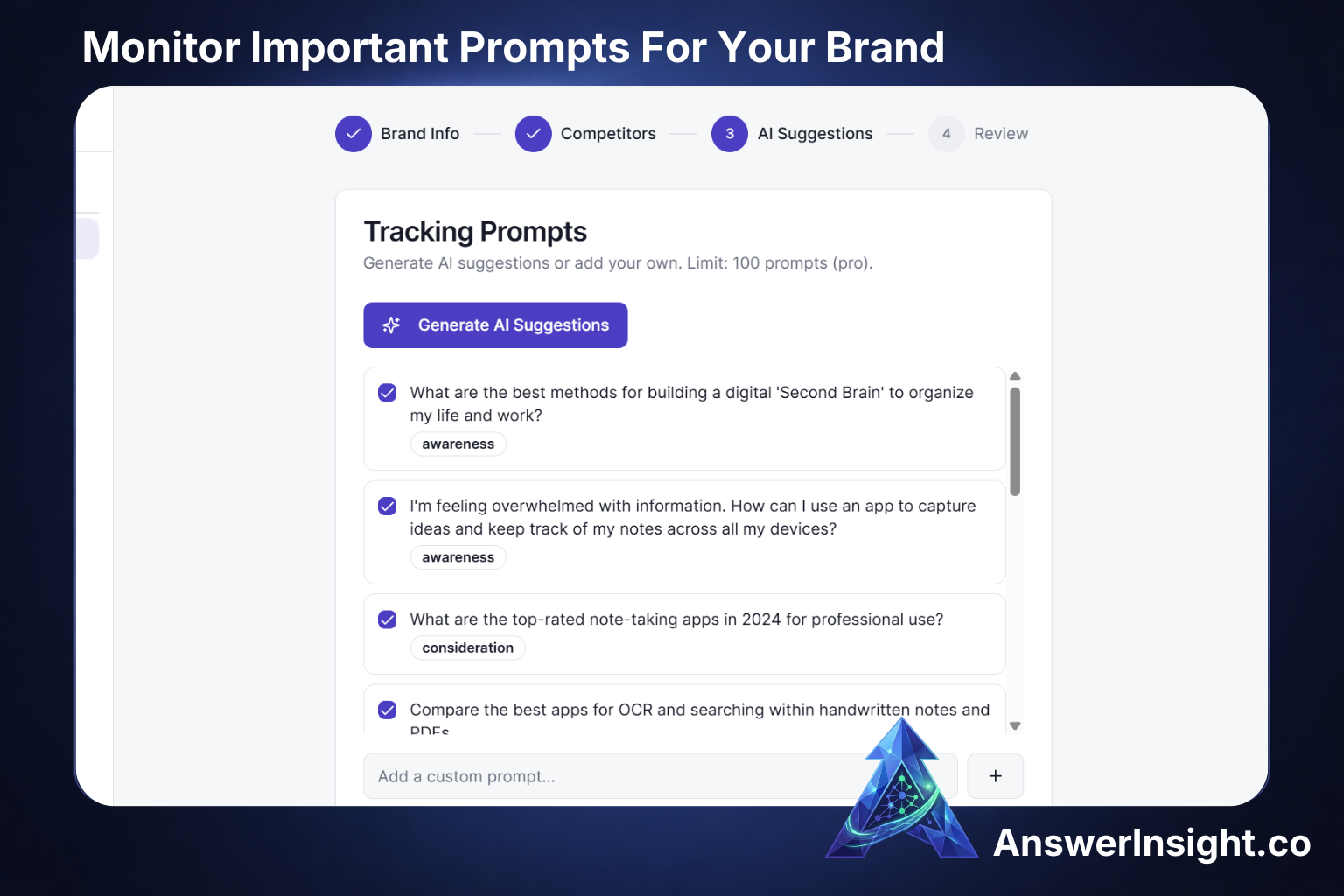
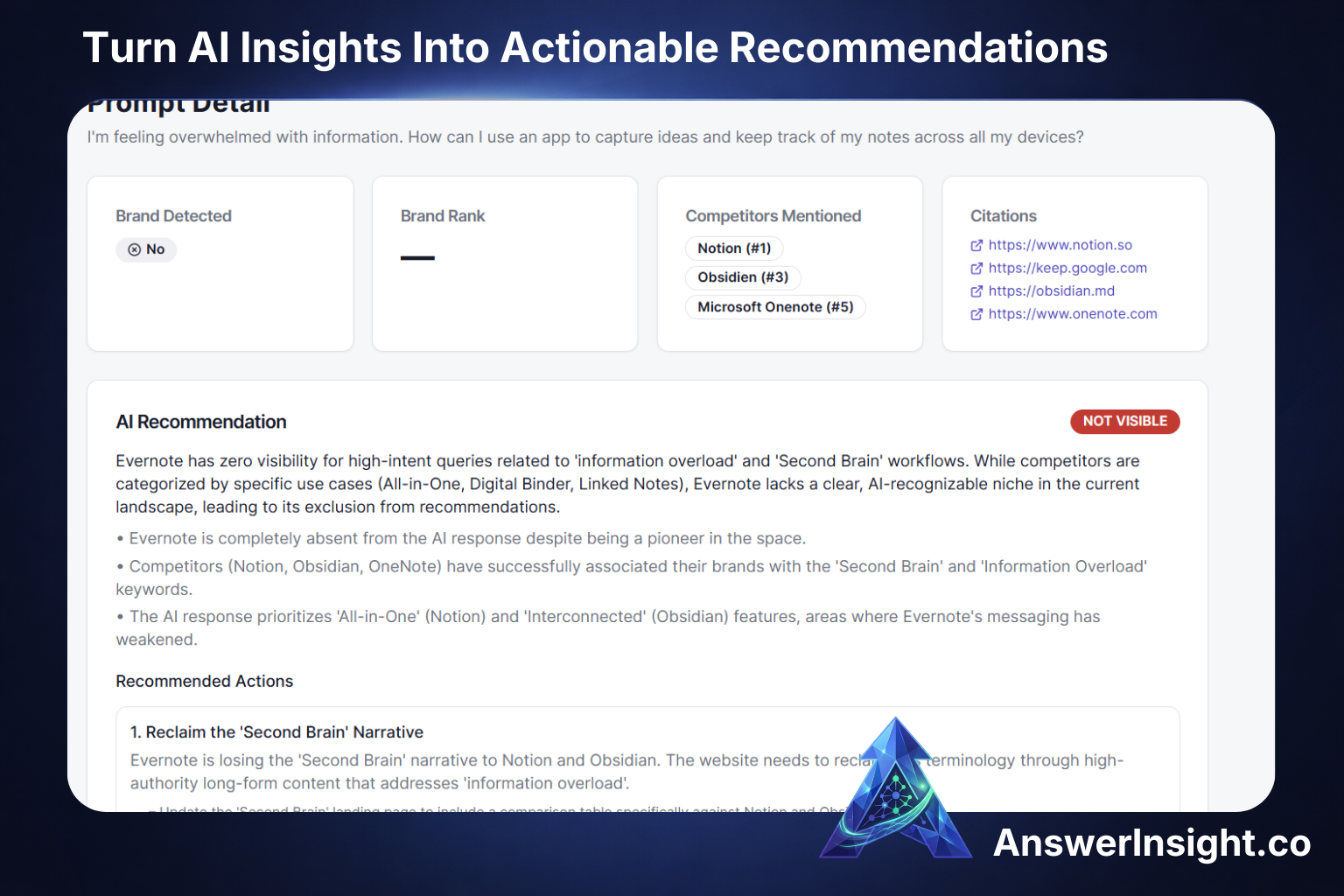
Instead of guessing, you can track visibility, measure sentiment, and benchmark against competitors using structured prompts that run across several models.
See exactly when your brand is recommended, when it’s missing, and where competitors are winning.
As AI becomes a key decision-making layer for customers, Answer Insight gives you the clarity and insights needed to improve your “AI share of voice” and stay visible where it matters most.
Features
- AI Answer Monitoring - Track how your brand appears across AI tools like ChatGPT, Perplexity, Gemini, and Claude.
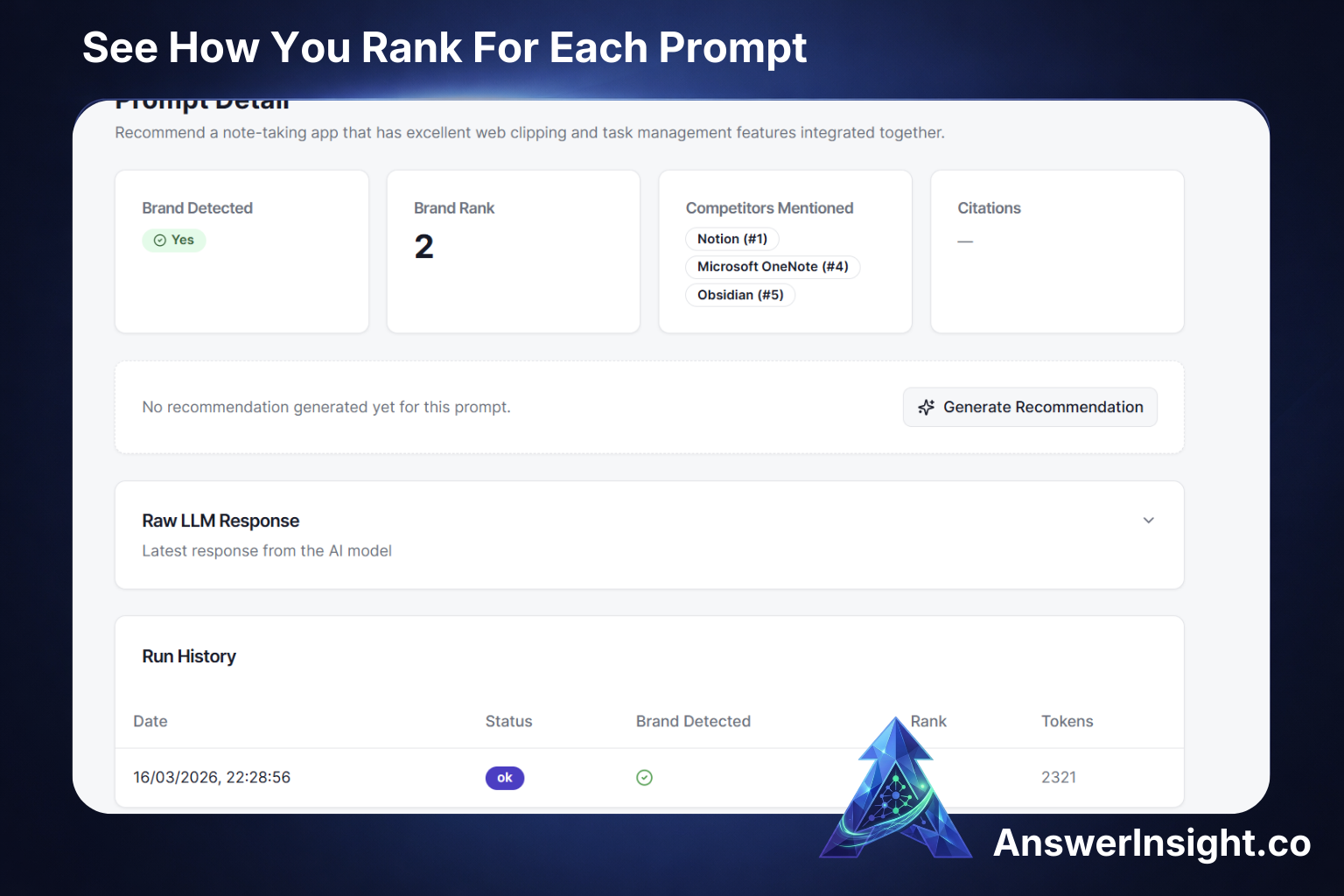
- Brand Mention Detection - Instantly see whether your brand is included—or missing—from AI-generated answers.
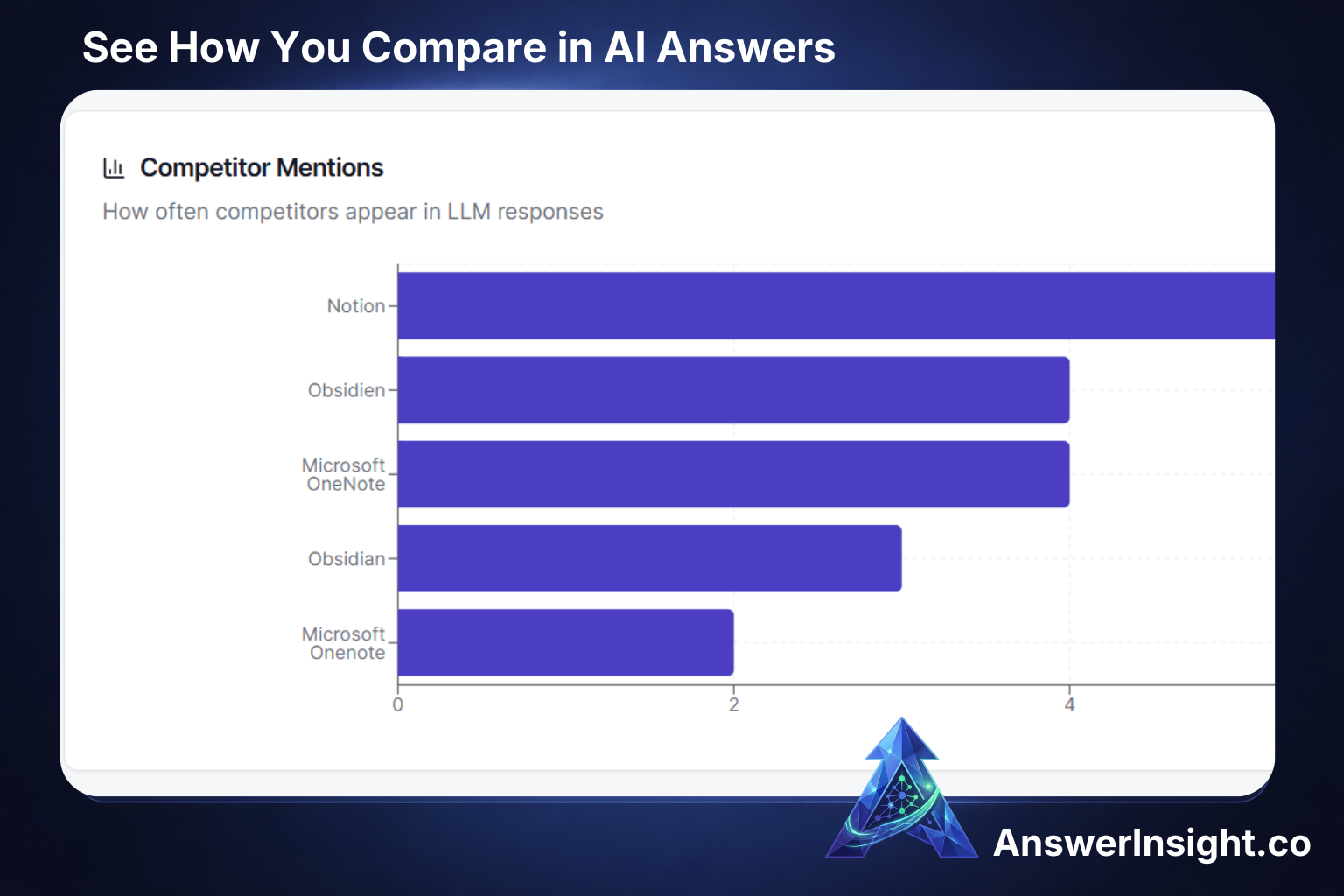
- Competitor Benchmarking - Compare your AI visibility against key competitors to identify gaps and opportunities.
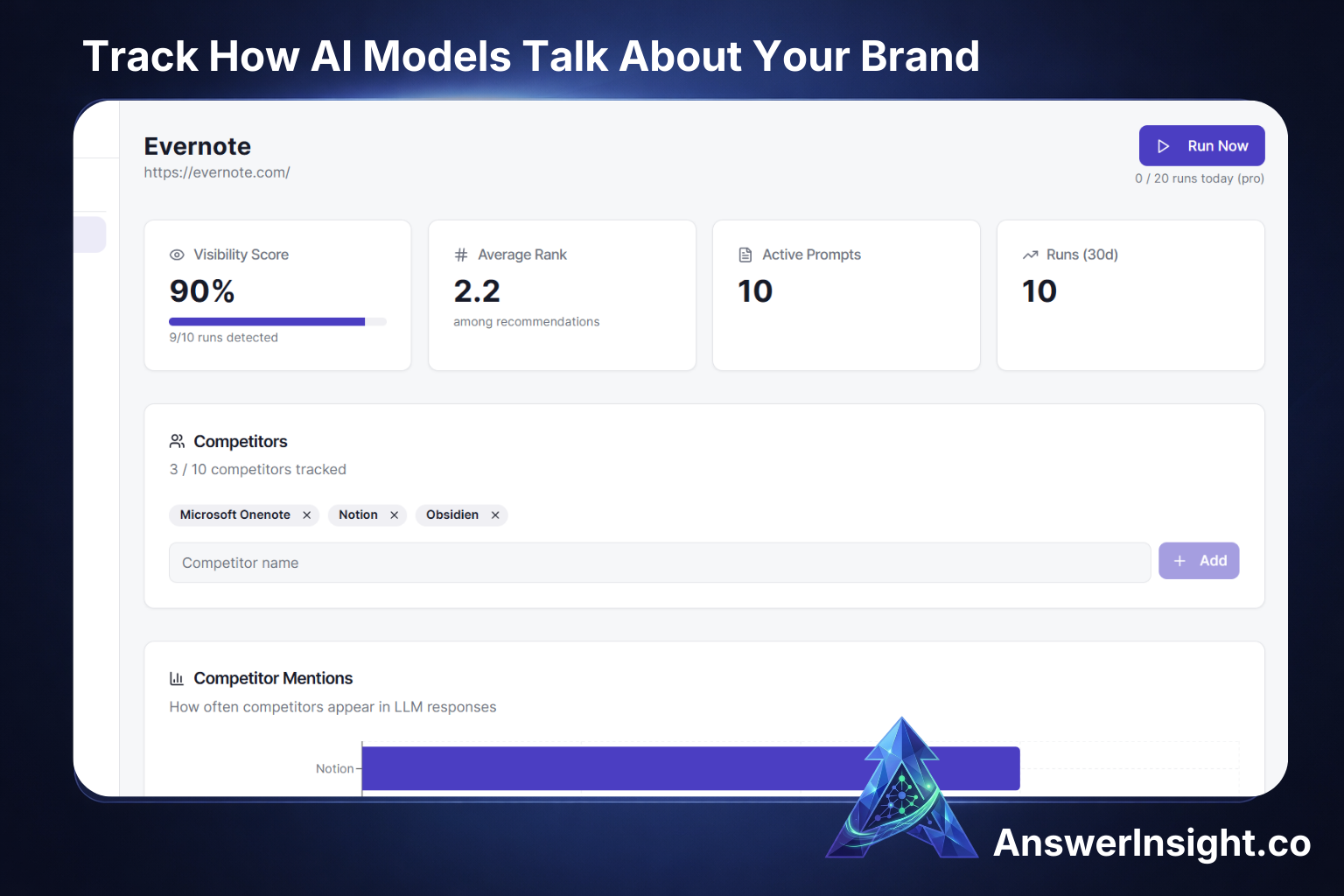
- AI Share of Voice - Measure your overall presence across AI platforms with a clear, trackable metric.
- Trend & Performance Tracking- Monitor how your visibility changes over time to evaluate progress and impact.
- Actionable Recommendations - Receive insights on how to improve your chances of being recommended by AI systems
Use Cases
- AI Answer Monitoring - Track how your brand appears across AI tools like ChatGPT, Perplexity, Gemini, and Claude.
- Brand Mention Detection - Instantly see whether your brand is included—or missing—from AI-generated answers.
- Competitor Benchmarking - Compare your AI visibility against key competitors to identify gaps and opportunities.
- AI Share of Voice - Measure your overall presence across AI platforms with a clear, trackable metric.
- Trend & Performance Tracking- Monitor how your visibility changes over time to evaluate progress and impact.
- Actionable Recommendations - Receive insights on how to improve your chances of being recommended by AI systems

Comments


Search is changing—faster than most businesses realise. For years, companies have invested heavily in SEO to rank on Google. But today, more decisions are being shaped inside AI tools like ChatGPT, Perplexity, and Gemini. Instead of browsing links, users are getting direct answers—and recommendations. The problem is, this shift is happening in a black box. Brands have no visibility into how they’re being represented, when they’re being recommended, or why competitors are showing up instead. I built Answer Insight to solve that. It’s designed to give businesses the same clarity for AI that SEO tools brought to search—showing how your brand appears in AI answers, how you compare to competitors, and where you need to improve. We’re entering the next phase of discovery. Those who understand it early will have a significant advantage. Answer Insight exists to make sure you’re one of them.





This solves a real blind spot. Most founders I know obsess over Google rankings but have zero visibility into how AI assistants talk about their brand. The fact that you can benchmark against competitors across multiple models is the real differentiator here — knowing you're invisible in ChatGPT but recommended in Perplexity would completely change your content strategy. Curious: how often do the AI models update their "knowledge" of brands, and does Answer Insight track that drift over time?


This addresses a genuinely underserved problem. Most brands are still optimizing purely for traditional search while AI-generated answers are increasingly shaping purchase decisions. The "AI share of voice" metric is particularly compelling — it's the equivalent of brand tracking but for the LLM era. Curious whether you've seen patterns in what makes certain brands get recommended more consistently across models (e.g., structured data, citation-friendly content, or domain authority). This kind of visibility data could become essential for any serious marketing analytics stack.
Premium Products



































Sponsors
Buy
Awards
View all
Awards
View allMakers
Makers
Comments
Search is changing—faster than most businesses realise. For years, companies have invested heavily in SEO to rank on Google. But today, more decisions are being shaped inside AI tools like ChatGPT, Perplexity, and Gemini. Instead of browsing links, users are getting direct answers—and recommendations. The problem is, this shift is happening in a black box. Brands have no visibility into how they’re being represented, when they’re being recommended, or why competitors are showing up instead. I built Answer Insight to solve that. It’s designed to give businesses the same clarity for AI that SEO tools brought to search—showing how your brand appears in AI answers, how you compare to competitors, and where you need to improve. We’re entering the next phase of discovery. Those who understand it early will have a significant advantage. Answer Insight exists to make sure you’re one of them.
This solves a real blind spot. Most founders I know obsess over Google rankings but have zero visibility into how AI assistants talk about their brand. The fact that you can benchmark against competitors across multiple models is the real differentiator here — knowing you're invisible in ChatGPT but recommended in Perplexity would completely change your content strategy. Curious: how often do the AI models update their "knowledge" of brands, and does Answer Insight track that drift over time?
This addresses a genuinely underserved problem. Most brands are still optimizing purely for traditional search while AI-generated answers are increasingly shaping purchase decisions. The "AI share of voice" metric is particularly compelling — it's the equivalent of brand tracking but for the LLM era. Curious whether you've seen patterns in what makes certain brands get recommended more consistently across models (e.g., structured data, citation-friendly content, or domain authority). This kind of visibility data could become essential for any serious marketing analytics stack.
Premium Products
New to Fazier?
Find your next favorite product or submit your own. Made by @FalakDigital.
Copyright ©2026. All Rights Reserved