AllergyCard
Bilingual food allergy cards for travel in 14 languages
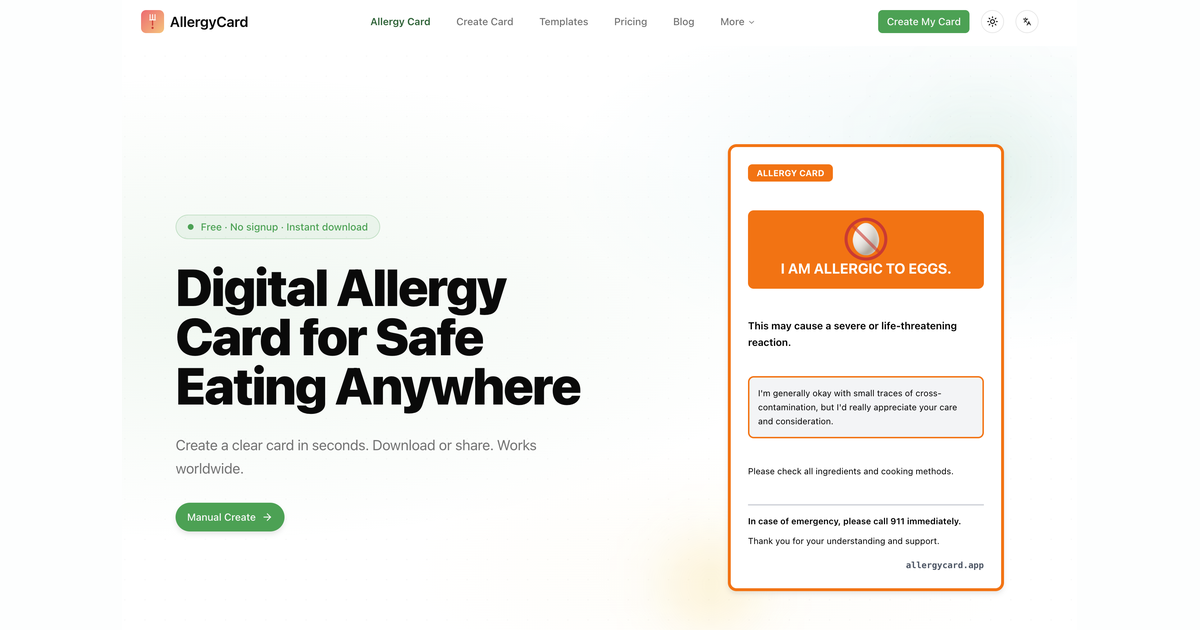
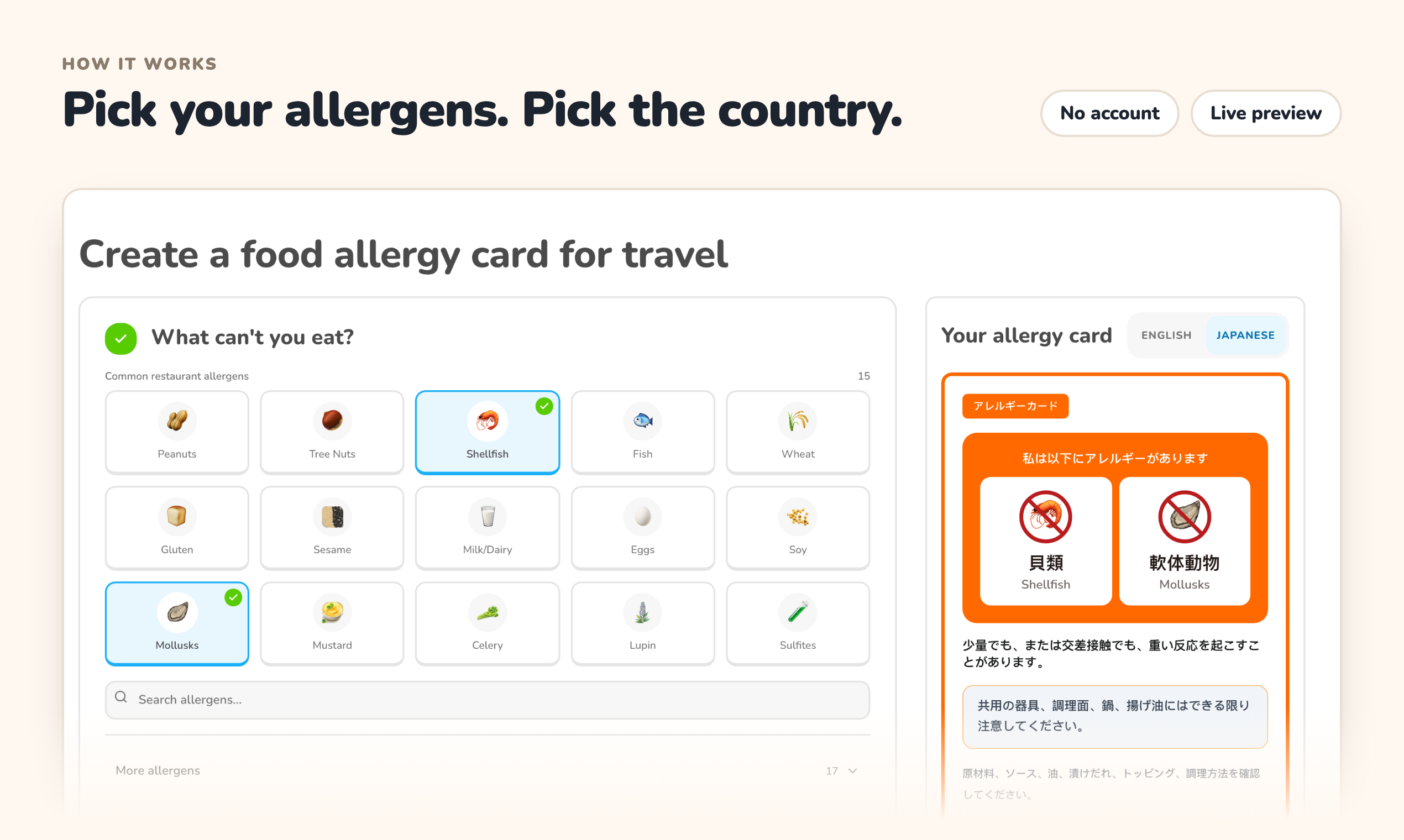
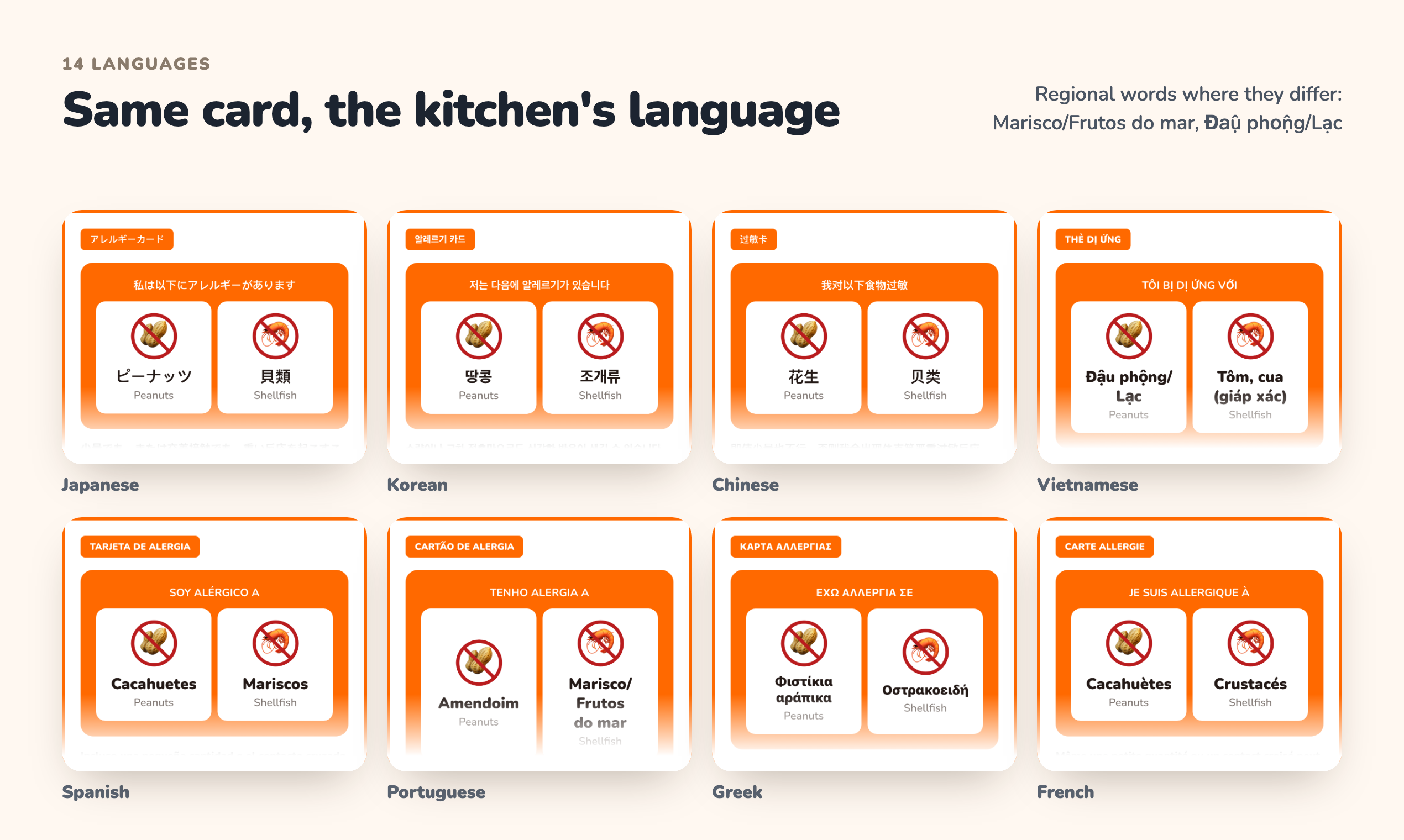
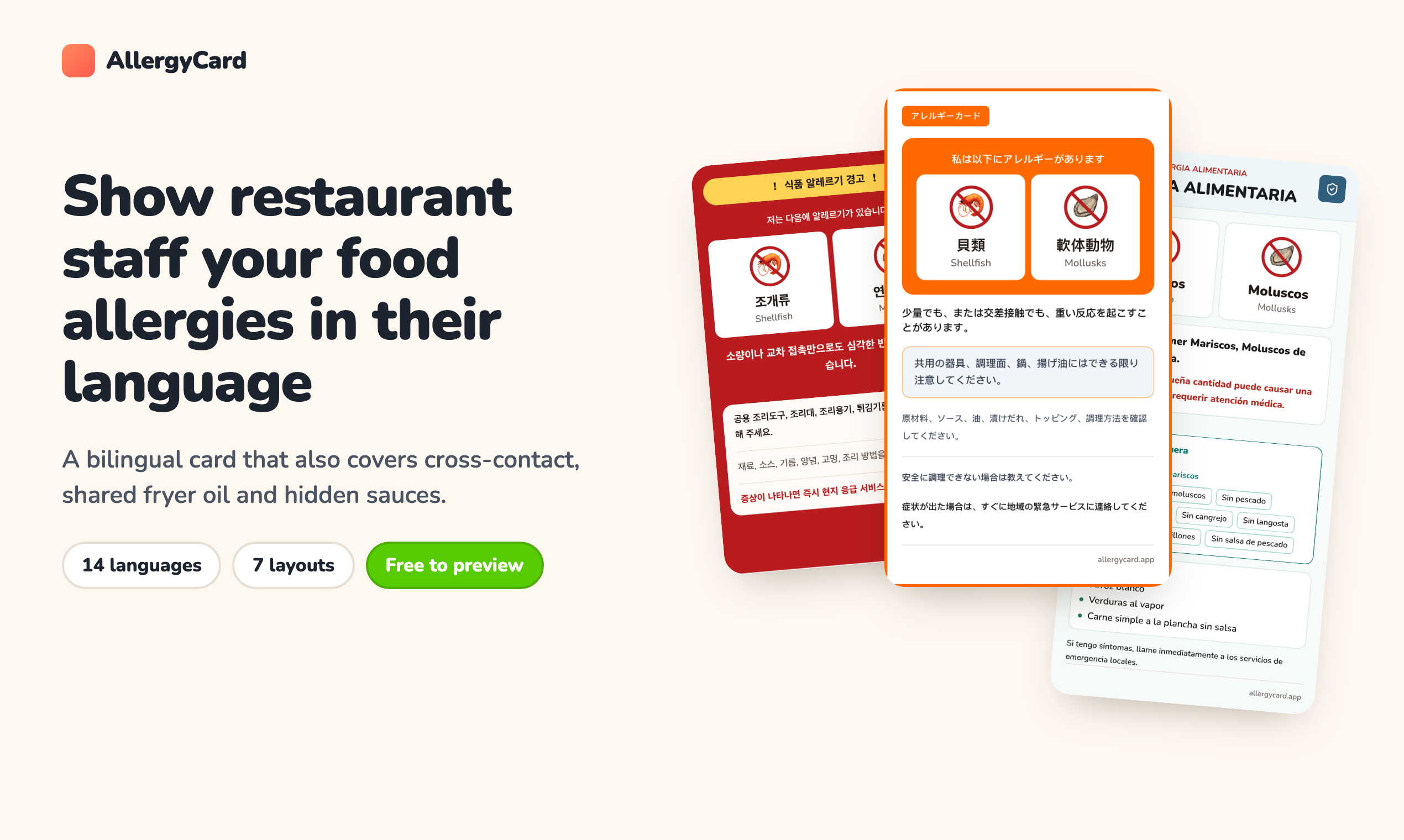
AllergyCard is a food allergy card generator for travelers. Pick from 30 allergens and it builds a bilingual restaurant card in 14 languages (Japanese, Korean, Chinese, Thai, Spanish, French and more), or a plain English card for eating out at home. Unlike a translation app, it uses established allergen terms kitchen staff recognise and includes a cross-contact warning. Free to create and preview with no account; pay once ($8.99) to download a printable PNG and PDF.
Features
- Bilingual cards in 14 languages, or English-only for home
- Choose from 30 allergens, or type your own
- Each allergen shown as a picture plus its local name
- Cross-contact warning: utensils, fryer oil, sauces
- Free preview, no account; one-time $8.99 PNG + PDF download
Use Cases
- Showing restaurant staff your allergies when traveling in Japan, Korea or Thailand
- Printing a wallet card to carry for a child with food allergies
- Giving kitchens a clear English allergy card when eating out at home

Comments


Hi Fazier! I built AllergyCard because explaining a food allergy in a language you don't speak is stressful, and translation apps often turn allergen names into something a kitchen doesn't recognise. AllergyCard puts each allergen as a picture plus its local name, adds a cross-contact warning, and keeps your own language underneath so you can check what the card says. It covers 14 languages and you can preview your card free without an account. I'd love feedback on which languages or allergens I should add next.


Keeping the card in the user's own language so they can check it themselves is a thoughtful answer to the translation-app problem. The one-time $8.99 for downloads is refreshingly simple too. Have you thought about adding a severity line, like anaphylaxis versus intolerance? Kitchens react differently to each.
Using the terms kitchen staff actually recognise, rather than a literal translation, is the right call. We hit the same problem translating official notices, where the literal word is often not the one people use. Who checks the allergen terms in each language, native speakers or a professional source? A line on the card saying how the terms were checked would reassure parents of children with severe allergies.
The cross-contact warning is the detail that sets this apart from a plain translation app. Translating "I am allergic to peanuts" misses how kitchens actually work, so including shared fryer oil and utensils is smart. Letting people type their own allergen is a good call for the less common ones. Does a custom allergen get translated into the 14 languages too, or does it stay in English?

The cross-contact line about fryer oil and shared utensils is a great touch, that's the part people forget to explain. For languages with regional differences, like Spanish in Spain vs Mexico or Portuguese in Portugal vs Brazil, do you pick one variant or can the traveller choose the country? A small wallet-size print layout would also be handy for kids' lunch boxes.


The 'terms kitchen staff actually recognise' angle is what makes this useful — translation accuracy is not the same as kitchen comprehension. Two things I would want as a buyer: (1) who verifies the 14 translations — native speakers, or machine translation, and is that noted on the card itself? (2) a short emergency line on the card ('If I eat this, I need urgent medical help — please call an ambulance'), since that is the sentence that matters most during a severe reaction. Is that in the plan?

Really useful idea, and the cross-contact wording is clearer than anything a translation app would give. I looked at the Spanish card: it says "Soy alérgico", so an option for "alérgica" would help women using it. "Cacahuetes" is the Spain term too; travellers in Latin America will mostly see "maní" or "cacahuate", so a Spain / Latin America choice could make it safer. Also "mariscos" covers molluscs as well, while the Japanese card names crustaceans specifically, so those might be worth aligning.
I build multilingual pages myself, and right-to-left languages are where things quietly break. Is Arabic among the 14 languages? It would be a strong addition for travel to the Gulf, Egypt or Morocco. If you add it, check that the bilingual layout flips direction properly so the Arabic allergen names don't get jumbled with the English line underneath. A phone-friendly version (saved to Apple or Google Wallet) would also help travellers who never carry a printed card.
Premium Products





























Sponsors
Buy

Comments
Hi Fazier! I built AllergyCard because explaining a food allergy in a language you don't speak is stressful, and translation apps often turn allergen names into something a kitchen doesn't recognise. AllergyCard puts each allergen as a picture plus its local name, adds a cross-contact warning, and keeps your own language underneath so you can check what the card says. It covers 14 languages and you can preview your card free without an account. I'd love feedback on which languages or allergens I should add next.
Keeping the card in the user's own language so they can check it themselves is a thoughtful answer to the translation-app problem. The one-time $8.99 for downloads is refreshingly simple too. Have you thought about adding a severity line, like anaphylaxis versus intolerance? Kitchens react differently to each.
Using the terms kitchen staff actually recognise, rather than a literal translation, is the right call. We hit the same problem translating official notices, where the literal word is often not the one people use. Who checks the allergen terms in each language, native speakers or a professional source? A line on the card saying how the terms were checked would reassure parents of children with severe allergies.
The cross-contact warning is the detail that sets this apart from a plain translation app. Translating "I am allergic to peanuts" misses how kitchens actually work, so including shared fryer oil and utensils is smart. Letting people type their own allergen is a good call for the less common ones. Does a custom allergen get translated into the 14 languages too, or does it stay in English?
The cross-contact line about fryer oil and shared utensils is a great touch, that's the part people forget to explain. For languages with regional differences, like Spanish in Spain vs Mexico or Portuguese in Portugal vs Brazil, do you pick one variant or can the traveller choose the country? A small wallet-size print layout would also be handy for kids' lunch boxes.
The 'terms kitchen staff actually recognise' angle is what makes this useful — translation accuracy is not the same as kitchen comprehension. Two things I would want as a buyer: (1) who verifies the 14 translations — native speakers, or machine translation, and is that noted on the card itself? (2) a short emergency line on the card ('If I eat this, I need urgent medical help — please call an ambulance'), since that is the sentence that matters most during a severe reaction. Is that in the plan?
Really useful idea, and the cross-contact wording is clearer than anything a translation app would give. I looked at the Spanish card: it says "Soy alérgico", so an option for "alérgica" would help women using it. "Cacahuetes" is the Spain term too; travellers in Latin America will mostly see "maní" or "cacahuate", so a Spain / Latin America choice could make it safer. Also "mariscos" covers molluscs as well, while the Japanese card names crustaceans specifically, so those might be worth aligning.
I build multilingual pages myself, and right-to-left languages are where things quietly break. Is Arabic among the 14 languages? It would be a strong addition for travel to the Gulf, Egypt or Morocco. If you add it, check that the bilingual layout flips direction properly so the Arabic allergen names don't get jumbled with the English line underneath. A phone-friendly version (saved to Apple or Google Wallet) would also help travellers who never carry a printed card.
Premium Products
New to Fazier?

Find your next favorite product or submit your own. Made by @FalakDigital.
Copyright ©2026. All Rights Reserved