AI Search Checker
Check if AI engines can find and cite your website
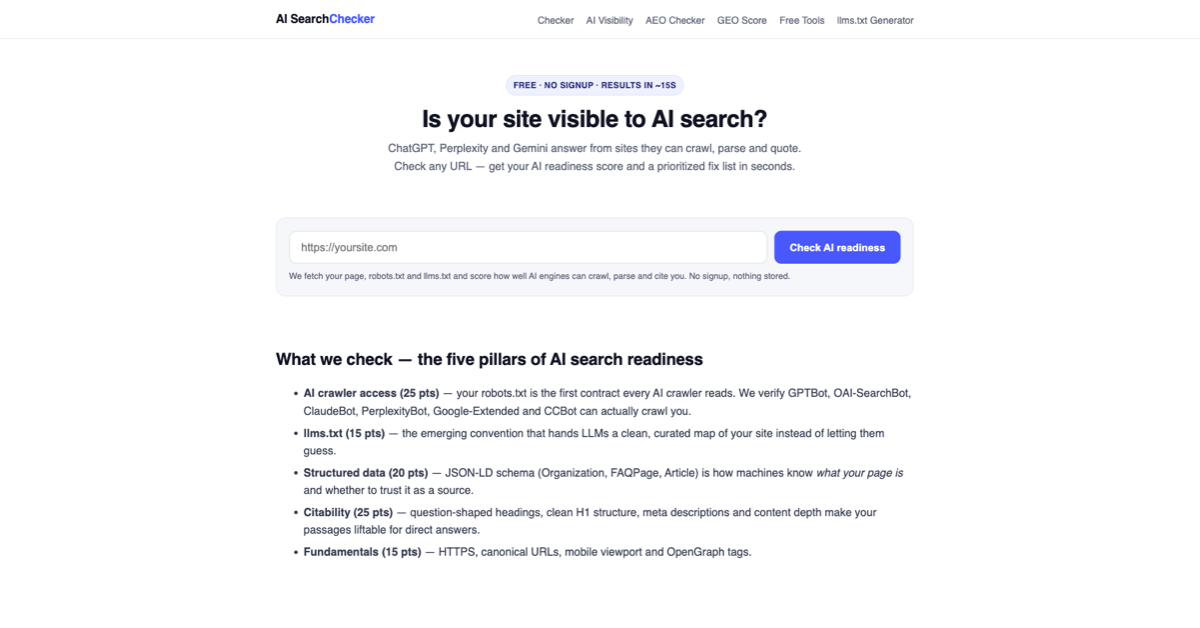
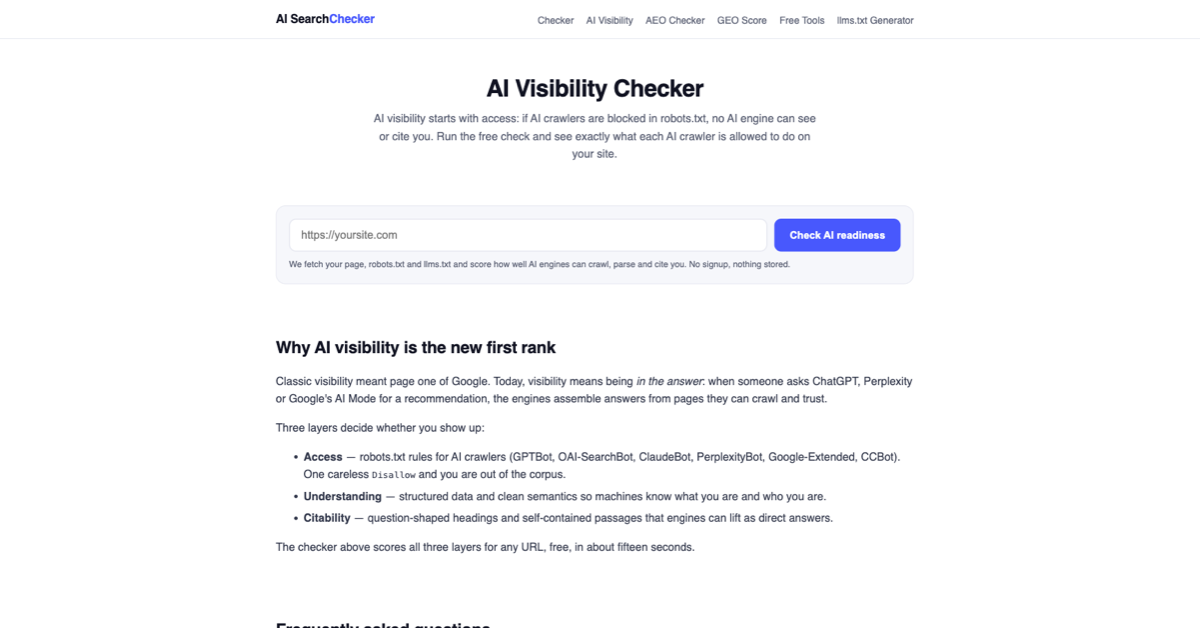
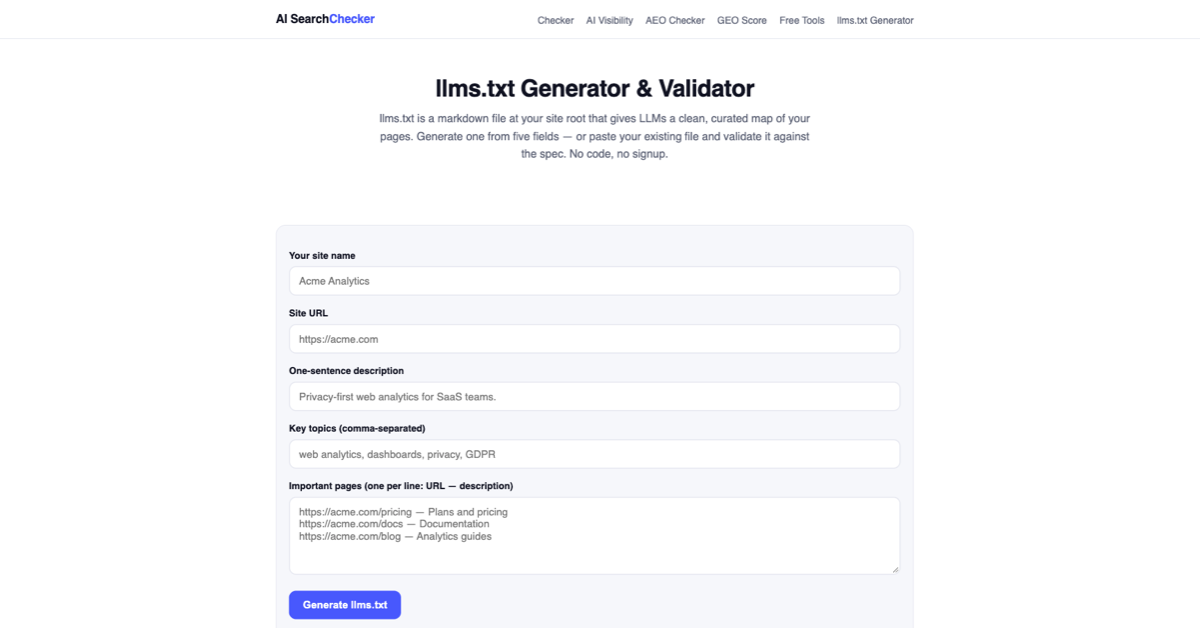
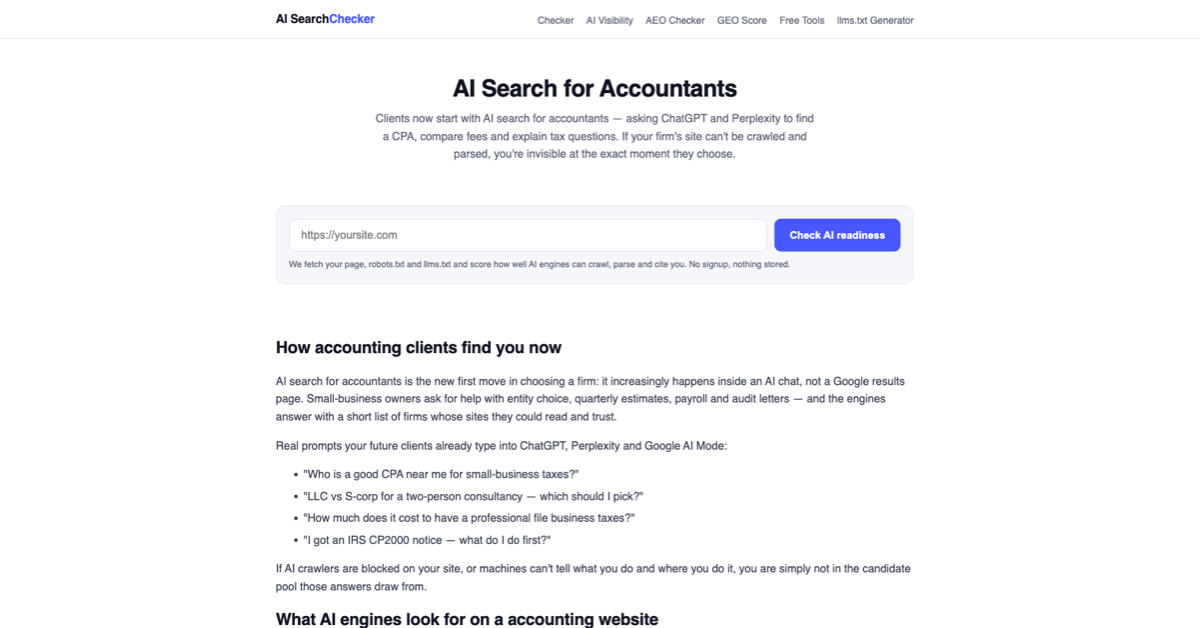
AI Search Checker is a free auditing tool that shows whether AI search engines can actually find, crawl and cite a website. Enter any URL to get a 0-100 readiness score built from five pillars: per-bot crawler access (GPTBot, ClaudeBot, PerplexityBot, Google-Extended, CCBot), llms.txt, structured data, content citability and technical fundamentals. Every scan returns a per-bot access table plus a prioritized fix list - no signup, results in about fifteen seconds. A free llms.txt generator and vertical guides for accountants, lawyers, dentists, SaaS and ecommerce are included.

Comments



A useful tool for understanding how visible your website is across AI-powered search platforms. It’s especially relevant as more people use tools like ChatGPT, Gemini, and Perplexity to find information. Checking whether your website gets discovered and cited can help identify opportunities to improve your content and AI search visibility. A practical resource for anyone working on SEO, AEO, or GEO.

We kept seeing the same question in SEO communities: why does a competitor show up in ChatGPT and Perplexity answers while your site never does? The technical side - which AI crawlers can reach you, whether llms.txt exists, how citable your content is - was scattered across five different tools, so we built one checker that scores it all in about fifteen seconds. The five-pillar scoring and the per-bot access table came from auditing our own sites. It is free because we wanted the fastest possible feedback loop between fixing something and seeing the score move.
Really useful framing — most AI visibility checkers hand you a vague score, but a per-bot access table (GPTBot vs ClaudeBot vs PerplexityBot) is exactly what you need to debug why one engine cites you and another doesn't. Genuine question: does the scan also catch the case where llms.txt exists but gets ignored, e.g. contradictory robots.txt rules for a specific bot? That's the failure mode I run into most often. The vertical guides for accountants, lawyers and dentists are a smart touch too — citation patterns differ a lot by niche.

Really useful angle: most SEO tools still ignore AI crawlers, and the per-bot access table (GPTBot, ClaudeBot, PerplexityBot…) is exactly what I didn't know how to check. I'm building a small SaaS for content creators and just added guide pages + structured data, so this is timely. Question: does the score take into account sites in other languages (mine is in French), or is the "content citability" part mostly tuned for English content?
Useful for anyone doing GEO work. Two things that would make it more actionable for niche sites: a per-engine breakdown (Perplexity vs Google AI Overviews vs ChatGPT browsing) rather than a single score, and a way to track music or audio keywords specifically, since those queries behave very differently from SaaS ones. Does the checker re-crawl on a schedule or is it one-shot?

Does the content-citability check assess the initial HTML response or also render client-side JavaScript? For SaaS sites, a page can look complete in a browser while returning only an empty app shell to a crawler. Showing which content was actually visible to the checker would make the prioritized fixes easier to interpret.


The per-bot access table is the useful part for me. Rules for GPTBot, ClaudeBot and PerplexityBot are easy to get wrong, especially when a CDN adds its own bot blocking on top of robots.txt. Does the scan also detect blocks at the CDN level (for example a 403 returned to the bot user agent), or does it only read robots.txt and meta tags?

Interesting tool. AI search visibility is becoming increasingly important, especially for startups trying to get discovered beyond traditional Google search. Checking crawler access, structured data, and content citability in one place sounds useful. Curious to see how the scores translate into actual citations across AI search engines.


The per-bot breakdown is the part I like most — knowing whether GPTBot and ClaudeBot can actually crawl your site is very different from a generic SEO score. We recently added an llms.txt file to our own site for exactly this reason. Does the fix list also prioritise structured data issues, or is it mainly about crawler access?


The per-bot access table is the clearest way I've seen to explain to a team why one AI engine cites them and another doesn't. One case I'm curious about: sites with a cookie-consent banner for EU visitors. Can the checker tell when the consent layer hides the main content from a crawler, or does it read the page as if consent was already given?


Really useful tool AI visibility is becoming as important as Google ranking and most founders have no idea where they stand. Quick question: does it check across all major LLMs (ChatGPT, Claude, Perplexity, Gemini) or focus on specific ones? Would love to see a score breakdown by engine so you know where to prioritize.

The per-bot access table for GPTBot and ClaudeBot is the part I'd check first, since a stray robots.txt rule blocking those crawlers is easy to miss. <a href="https://ai-anime-generator.io/" target="_blank">AI Anime Generator</a>
<a href="https://fkelectricalestimatings.com/services/"> FK Electrical Estimating</a> provides accurate and professional electrical estimating services for contractors across the USA. We offer detailed material takeoffs, labor cost calculations, and bid-ready estimates for residential, commercial, and industrial projects. Our experienced estimators help reduce costly errors and save valuable time. Get reliable estimates to bid confidently and improve your chances of winning more projects.

We kept seeing the same question in SEO communities: why does a competitor show up in ChatGPT and Perplexity answers while your site never does? The technical side - which AI crawlers can reach you, whether llms.txt exists, how citable your content is - was scattered across five different tools, so we built one checker that scores it all in about fifteen seconds. The five-pillar scoring and the per-bot access table came from auditing our own sites. It is free because we wanted the fastest possible feedback loop between fixing something and seeing the score move.

Love the per-bot access table! Most website owners are focusing on traditional SEO, but understanding whether AI crawlers can actually access and cite their content is becoming just as important. The prioritized fix list is especially useful because it turns a technical audit into actionable steps. Curious to see how the readiness score correlates with actual citations in AI search results!
The five-pillar split is the useful part: crawler access, llms.txt, structured data, citability, and technical basics in one 0-100. Before I'd trust the number, I want to know whether a blocked GPTBot tanks the score even when PerplexityBot and Google-Extended are allowed, or whether those bots are averaged. That split matters if a site blocks one training crawler on purpose but still wants citations.


The per-bot access table is a great touch. Accidentally blocking GPTBot or ClaudeBot in robots.txt is such an easy miss. One question: does the citability score look at anything off-site? When we ran 12 buying questions through an AI assistant with web search, only about half of the citations went to company websites; the rest came from blogs and review sites. So a perfectly crawlable site can still be missing from the answer. Showing which third-party pages the engines lean on for a query would be a strong next step.

The five-pillar breakdown is a smart way to make AI visibility concrete — especially the per-bot crawler access table, since one stray robots.txt rule can silently block GPTBot or ClaudeBot without anyone noticing. Two questions: does the content citability check look at how pages are structured (clear headings, direct answers, lists), and does the prioritized fix list rank issues by expected impact? Also curious how the llms.txt generator handles larger sites with many sections.

Really thoughtful approach — checking per-bot crawler access (GPTBot, ClaudeBot, PerplexityBot) rather than one vague score makes this genuinely actionable for a site owner. The llms.txt angle is timely too. Question: does the scan also detect whether a site serves different content to AI crawlers versus browsers? That would help catch accidental cloaking issues. Also curious whether it verifies JSON-LD schema validity or just its presence. Congrats on the launch!


I just ran my own site through it: 67/100 in about fifteen seconds, and the per-bot table plus the prioritized fix list made it obvious what to do next. As a solo founder, that’s exactly the level of guidance I need. One question: does the checker render JavaScript? My site is a React app, so I’d love to know if the low “content depth” score comes from content that’s invisible without JS.

The five-pillar scoring is a smart way to break this down - most tools just say you're not cited without explaining which crawler or content issue is blocking it. The per-bot access table is what I'd check first: a blocked GPTBot or a missing llms.txt explains a lot of 'invisible in ChatGPT' cases. Curious how often the score changes for the same site - do you re-crawl on demand or cache the results?

Splitting the score into crawler access, llms.txt, structured data, citability and technical basics is more useful than one AI-visibility number. The per-bot table (GPTBot, ClaudeBot, PerplexityBot, Google-Extended, CCBot) is what I would actually act on, because blocking one bot and allowing another is a common robots.txt mistake. Does the fix list treat a bot blocked on purpose differently from one blocked by accident, or does it always recommend opening every crawler?

The prioritized fix list is what makes this actionable — a readiness score alone doesn't tell you whether to fix robots.txt first, add llms.txt, or sort out structured data, so ordering the fixes by pillar is the right design choice. One question on the vertical guides (accountants, lawyers, dentists, SaaS, ecommerce): do those weight the five pillars differently per industry, or is it the same scoring with industry-specific fix advice on top?


Premium Products






































Sponsors
Buy

Awards
View all
Awards
View allComments
A useful tool for understanding how visible your website is across AI-powered search platforms. It’s especially relevant as more people use tools like ChatGPT, Gemini, and Perplexity to find information. Checking whether your website gets discovered and cited can help identify opportunities to improve your content and AI search visibility. A practical resource for anyone working on SEO, AEO, or GEO.
We kept seeing the same question in SEO communities: why does a competitor show up in ChatGPT and Perplexity answers while your site never does? The technical side - which AI crawlers can reach you, whether llms.txt exists, how citable your content is - was scattered across five different tools, so we built one checker that scores it all in about fifteen seconds. The five-pillar scoring and the per-bot access table came from auditing our own sites. It is free because we wanted the fastest possible feedback loop between fixing something and seeing the score move.
Really useful framing — most AI visibility checkers hand you a vague score, but a per-bot access table (GPTBot vs ClaudeBot vs PerplexityBot) is exactly what you need to debug why one engine cites you and another doesn't. Genuine question: does the scan also catch the case where llms.txt exists but gets ignored, e.g. contradictory robots.txt rules for a specific bot? That's the failure mode I run into most often. The vertical guides for accountants, lawyers and dentists are a smart touch too — citation patterns differ a lot by niche.
Really useful angle: most SEO tools still ignore AI crawlers, and the per-bot access table (GPTBot, ClaudeBot, PerplexityBot…) is exactly what I didn't know how to check. I'm building a small SaaS for content creators and just added guide pages + structured data, so this is timely. Question: does the score take into account sites in other languages (mine is in French), or is the "content citability" part mostly tuned for English content?
Useful for anyone doing GEO work. Two things that would make it more actionable for niche sites: a per-engine breakdown (Perplexity vs Google AI Overviews vs ChatGPT browsing) rather than a single score, and a way to track music or audio keywords specifically, since those queries behave very differently from SaaS ones. Does the checker re-crawl on a schedule or is it one-shot?
Does the content-citability check assess the initial HTML response or also render client-side JavaScript? For SaaS sites, a page can look complete in a browser while returning only an empty app shell to a crawler. Showing which content was actually visible to the checker would make the prioritized fixes easier to interpret.
The per-bot access table is the useful part for me. Rules for GPTBot, ClaudeBot and PerplexityBot are easy to get wrong, especially when a CDN adds its own bot blocking on top of robots.txt. Does the scan also detect blocks at the CDN level (for example a 403 returned to the bot user agent), or does it only read robots.txt and meta tags?
Interesting tool. AI search visibility is becoming increasingly important, especially for startups trying to get discovered beyond traditional Google search. Checking crawler access, structured data, and content citability in one place sounds useful. Curious to see how the scores translate into actual citations across AI search engines.
The per-bot breakdown is the part I like most — knowing whether GPTBot and ClaudeBot can actually crawl your site is very different from a generic SEO score. We recently added an llms.txt file to our own site for exactly this reason. Does the fix list also prioritise structured data issues, or is it mainly about crawler access?
The per-bot access table is the clearest way I've seen to explain to a team why one AI engine cites them and another doesn't. One case I'm curious about: sites with a cookie-consent banner for EU visitors. Can the checker tell when the consent layer hides the main content from a crawler, or does it read the page as if consent was already given?
Really useful tool AI visibility is becoming as important as Google ranking and most founders have no idea where they stand. Quick question: does it check across all major LLMs (ChatGPT, Claude, Perplexity, Gemini) or focus on specific ones? Would love to see a score breakdown by engine so you know where to prioritize.
The per-bot access table for GPTBot and ClaudeBot is the part I'd check first, since a stray robots.txt rule blocking those crawlers is easy to miss. <a href="https://ai-anime-generator.io/" target="_blank">AI Anime Generator</a>
<a href="https://fkelectricalestimatings.com/services/"> FK Electrical Estimating</a> provides accurate and professional electrical estimating services for contractors across the USA. We offer detailed material takeoffs, labor cost calculations, and bid-ready estimates for residential, commercial, and industrial projects. Our experienced estimators help reduce costly errors and save valuable time. Get reliable estimates to bid confidently and improve your chances of winning more projects.
We kept seeing the same question in SEO communities: why does a competitor show up in ChatGPT and Perplexity answers while your site never does? The technical side - which AI crawlers can reach you, whether llms.txt exists, how citable your content is - was scattered across five different tools, so we built one checker that scores it all in about fifteen seconds. The five-pillar scoring and the per-bot access table came from auditing our own sites. It is free because we wanted the fastest possible feedback loop between fixing something and seeing the score move.
Love the per-bot access table! Most website owners are focusing on traditional SEO, but understanding whether AI crawlers can actually access and cite their content is becoming just as important. The prioritized fix list is especially useful because it turns a technical audit into actionable steps. Curious to see how the readiness score correlates with actual citations in AI search results!
The five-pillar split is the useful part: crawler access, llms.txt, structured data, citability, and technical basics in one 0-100. Before I'd trust the number, I want to know whether a blocked GPTBot tanks the score even when PerplexityBot and Google-Extended are allowed, or whether those bots are averaged. That split matters if a site blocks one training crawler on purpose but still wants citations.
The per-bot access table is a great touch. Accidentally blocking GPTBot or ClaudeBot in robots.txt is such an easy miss. One question: does the citability score look at anything off-site? When we ran 12 buying questions through an AI assistant with web search, only about half of the citations went to company websites; the rest came from blogs and review sites. So a perfectly crawlable site can still be missing from the answer. Showing which third-party pages the engines lean on for a query would be a strong next step.
The five-pillar breakdown is a smart way to make AI visibility concrete — especially the per-bot crawler access table, since one stray robots.txt rule can silently block GPTBot or ClaudeBot without anyone noticing. Two questions: does the content citability check look at how pages are structured (clear headings, direct answers, lists), and does the prioritized fix list rank issues by expected impact? Also curious how the llms.txt generator handles larger sites with many sections.
Really thoughtful approach — checking per-bot crawler access (GPTBot, ClaudeBot, PerplexityBot) rather than one vague score makes this genuinely actionable for a site owner. The llms.txt angle is timely too. Question: does the scan also detect whether a site serves different content to AI crawlers versus browsers? That would help catch accidental cloaking issues. Also curious whether it verifies JSON-LD schema validity or just its presence. Congrats on the launch!
I just ran my own site through it: 67/100 in about fifteen seconds, and the per-bot table plus the prioritized fix list made it obvious what to do next. As a solo founder, that’s exactly the level of guidance I need. One question: does the checker render JavaScript? My site is a React app, so I’d love to know if the low “content depth” score comes from content that’s invisible without JS.
The five-pillar scoring is a smart way to break this down - most tools just say you're not cited without explaining which crawler or content issue is blocking it. The per-bot access table is what I'd check first: a blocked GPTBot or a missing llms.txt explains a lot of 'invisible in ChatGPT' cases. Curious how often the score changes for the same site - do you re-crawl on demand or cache the results?
Splitting the score into crawler access, llms.txt, structured data, citability and technical basics is more useful than one AI-visibility number. The per-bot table (GPTBot, ClaudeBot, PerplexityBot, Google-Extended, CCBot) is what I would actually act on, because blocking one bot and allowing another is a common robots.txt mistake. Does the fix list treat a bot blocked on purpose differently from one blocked by accident, or does it always recommend opening every crawler?
The prioritized fix list is what makes this actionable — a readiness score alone doesn't tell you whether to fix robots.txt first, add llms.txt, or sort out structured data, so ordering the fixes by pillar is the right design choice. One question on the vertical guides (accountants, lawyers, dentists, SaaS, ecommerce): do those weight the five pillars differently per industry, or is it the same scoring with industry-specific fix advice on top?
Premium Products
New to Fazier?

Find your next favorite product or submit your own. Made by @FalakDigital.
Copyright ©2026. All Rights Reserved