
AEO Copilot
AI visibility tools without the fat costs
When someone asks ChatGPT for the best tool in your category, are you in the answer? AEO Copilot tells you.
I built it because every tool that tracks AI visibility costs $500 a mont and is made for companies with procurement teams.
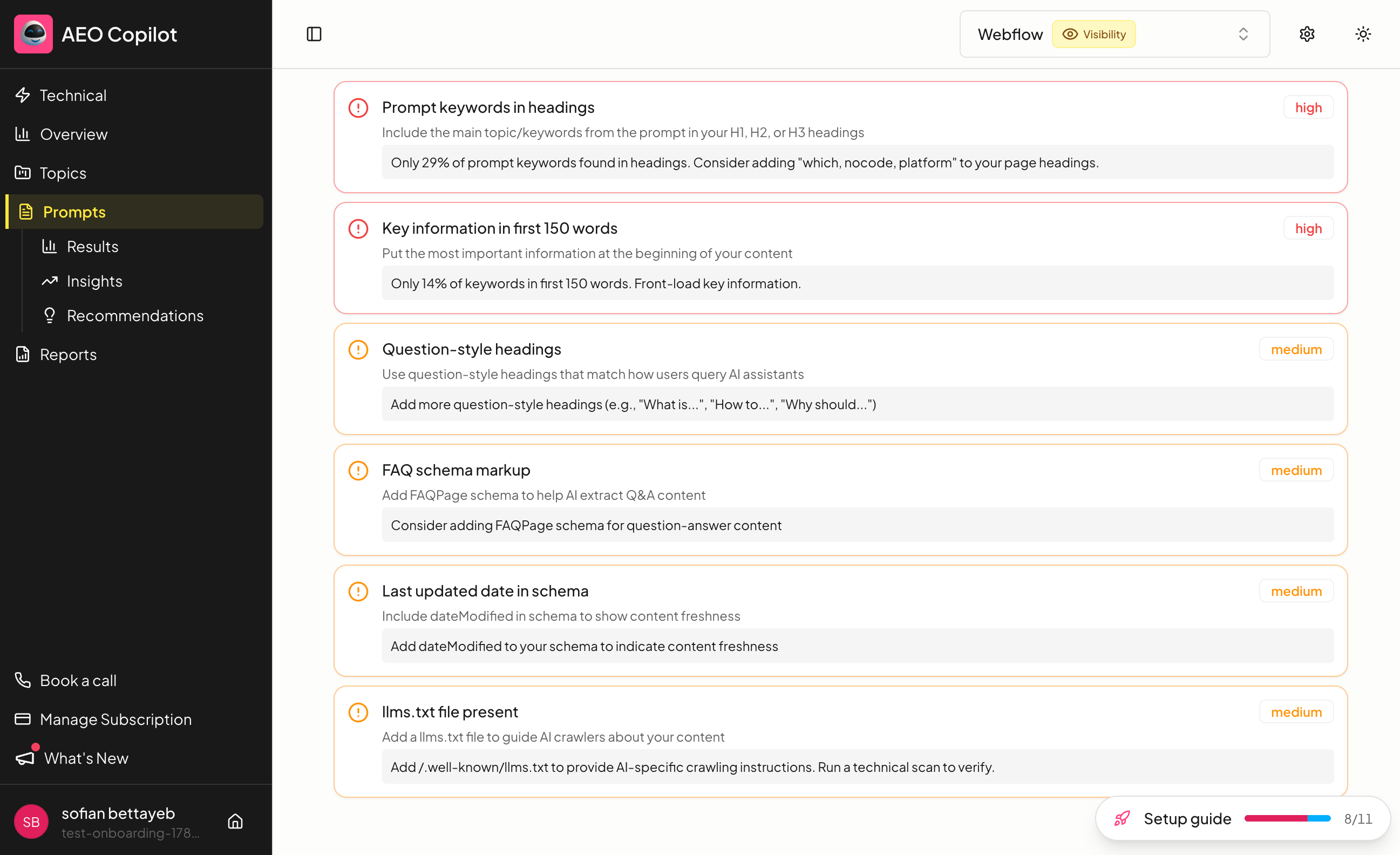
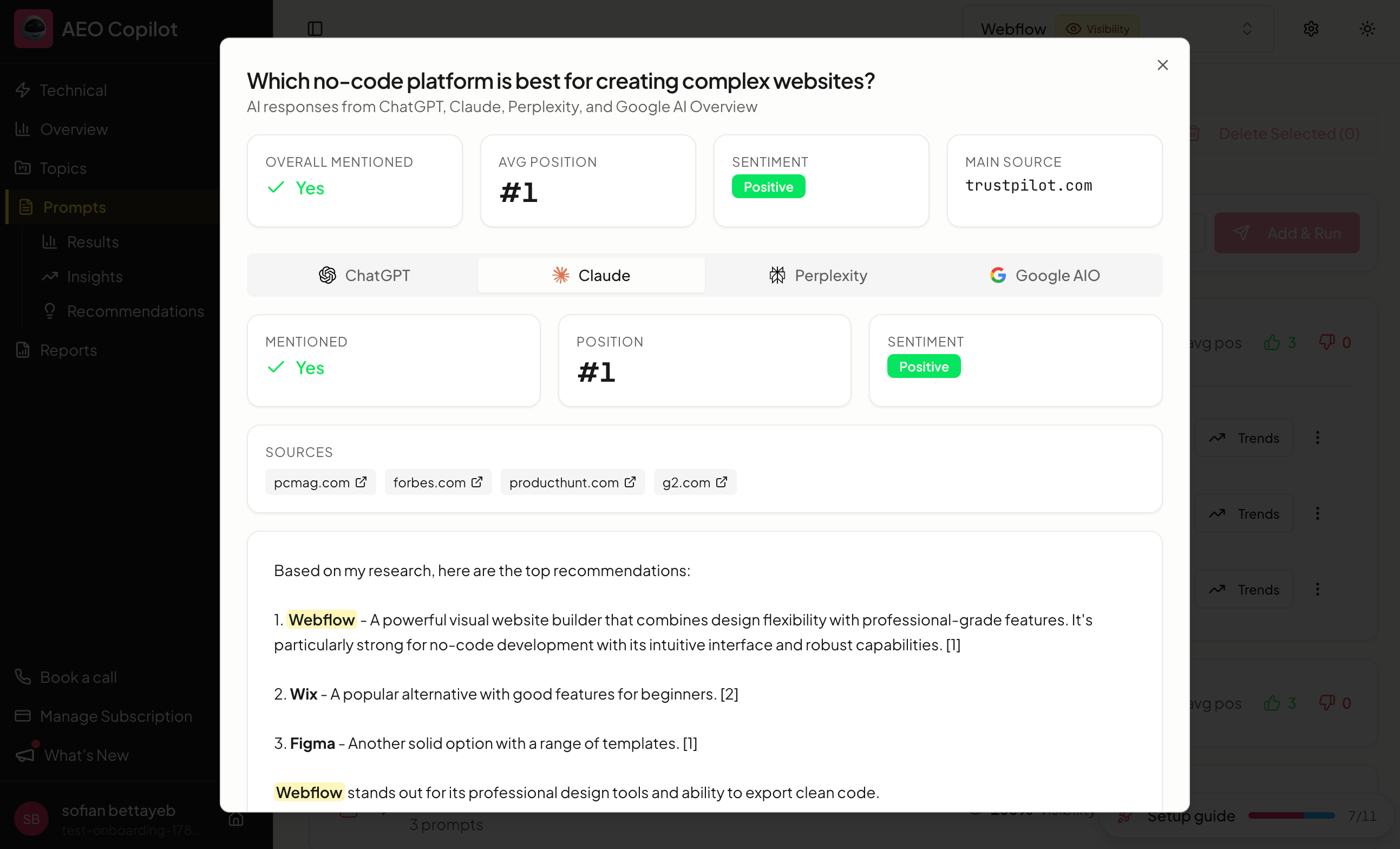
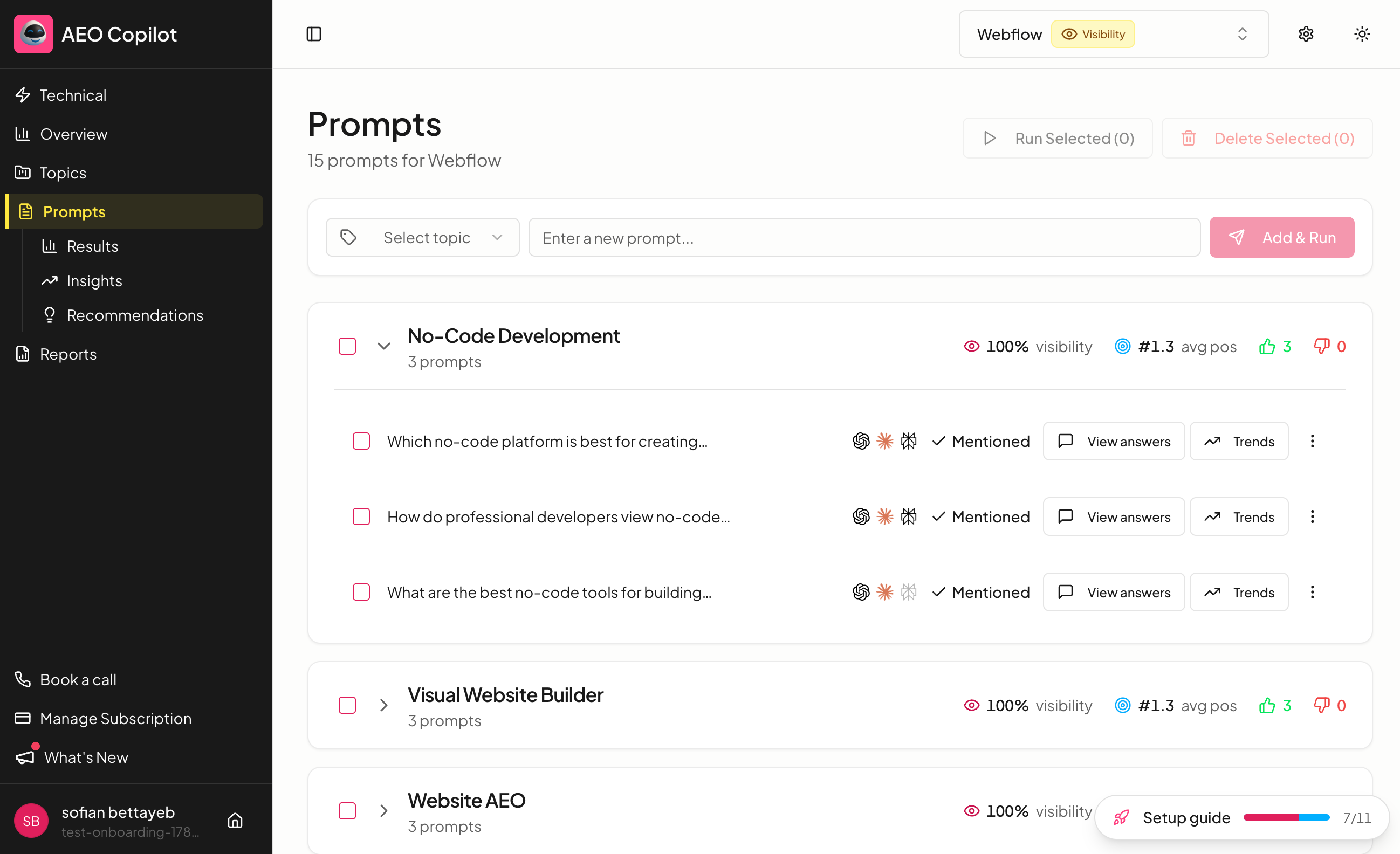
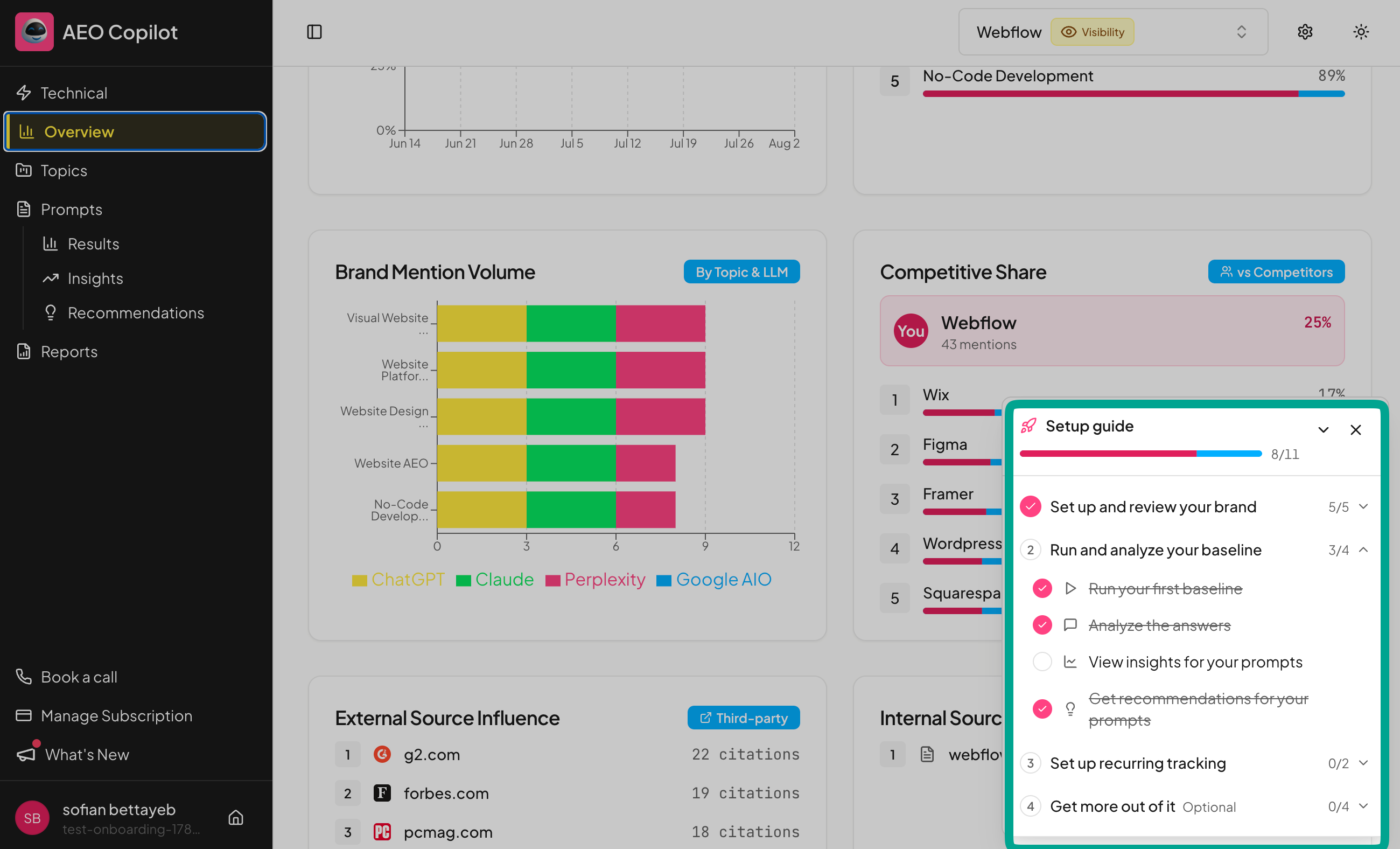
AEO Copilot runs your prompts across ChatGPT, Claude, Perplexity and Google AI Overview. For each answer it records whether your brand was named, where it ranked, which sources were cited and what the sentiment was. Then it ranks what to fix, by impact.
It's built for people who work with an AI agent. Paid plans include an API and an MCP server, so Claude Code or your own agent can pull the data and do the work for you.
There's a free plan with no card and no expiry.
Paid plans are $9, $34 and $99.
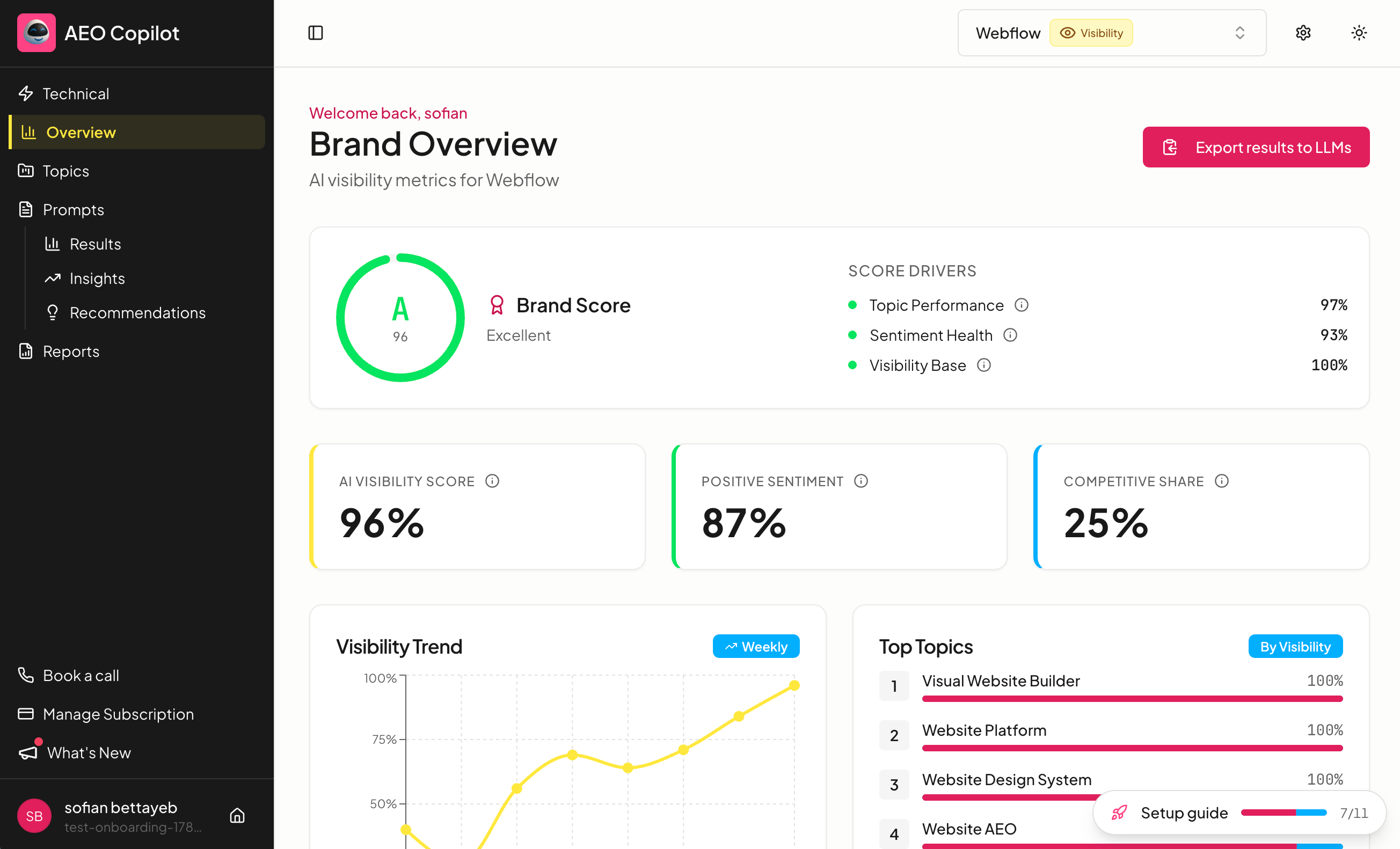
Features
- Tracks 4 engines: ChatGPT, Claude, Perplexity and Google AI Overview
- Records for every answer whether you were named, your position, cited sources and sentiment
- Ranks recommendations by impact and links each one to the prompt behind it
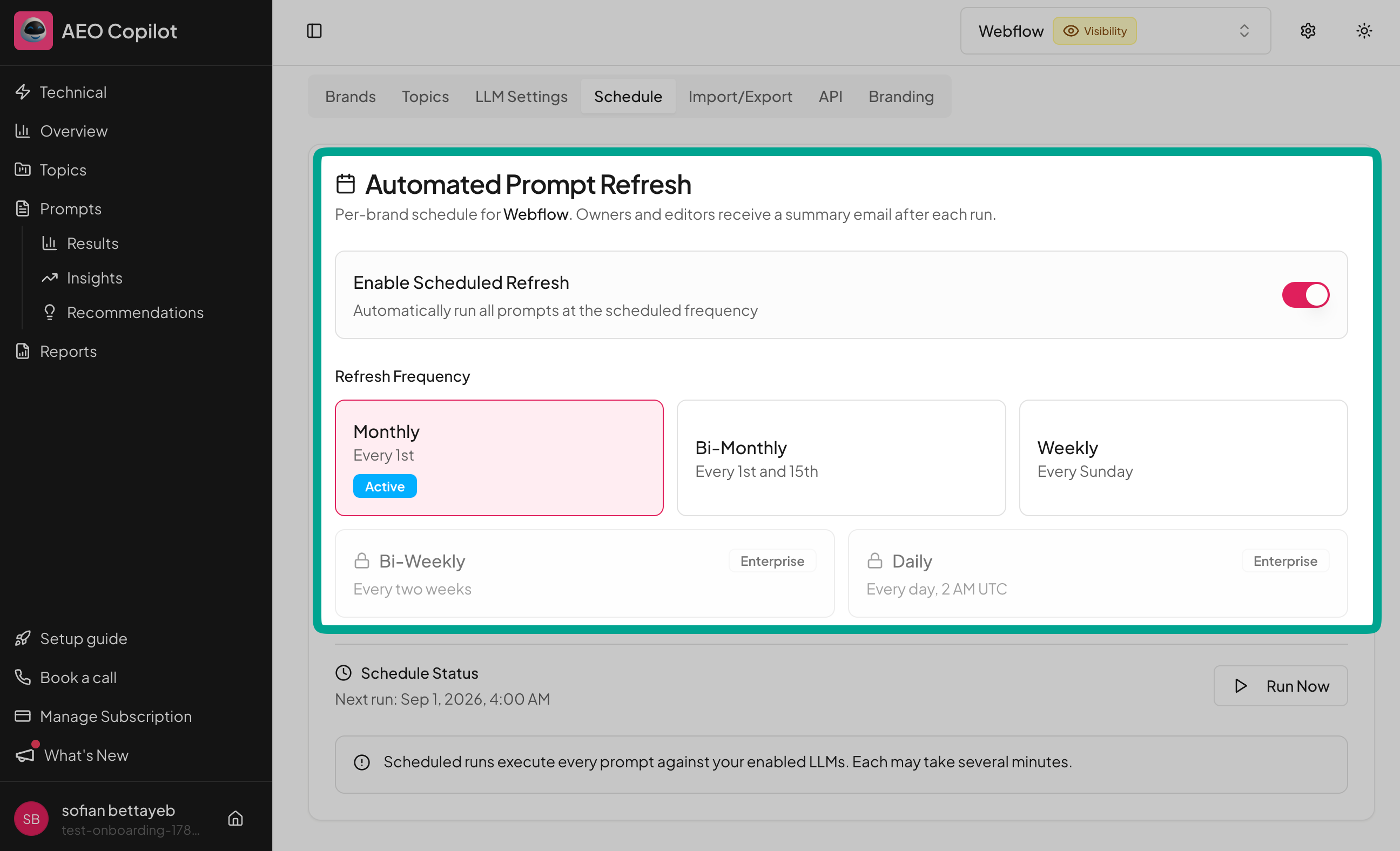
- Runs monthly, twice a month or weekly, or any prompt manually
- Emails you after each run with what moved and which competitors gained
- Bulk prompt import from a spreadsheet, export to xlsx, CSV or JSON
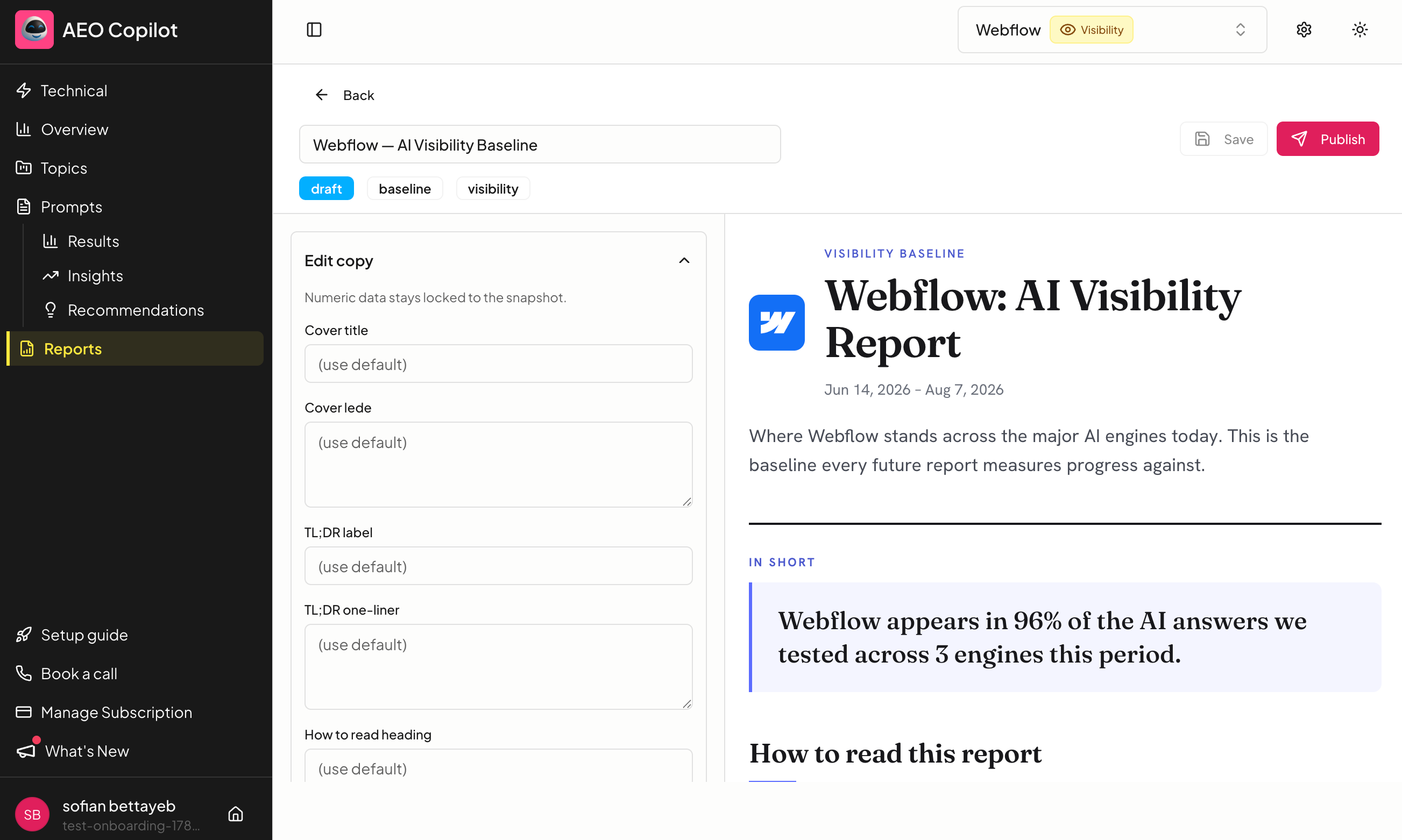
- Baseline and Pulse reports as a PDF or a shareable link, white-label on Freelancer and Agency
- API and MCP server on paid plans, set up with 1 command in Claude Code
Use Cases
- Startups checking whether AI engines recommend them when buyers ask about their category
- SEO freelancers who want to prove and bill AI search work, with a Baseline report for new clients and a monthly Pulse report for retainers
- Webflow and web agencies tracking AI visibility for every client without paying per brand
- Marketing teams checking whether AI answers about their brand are accurate and positive
- Founders who use Claude Code and want visibility data in their agent rather than in another dashboard
Fazier Deal

Comments



Hi everyone, I'm Sofian, the maker of AEO Copilot. I do SEO and organic growth work for founders and agencies,. Over the last year, almost every client conversation came around to the same question: "Does ChatGPT recommend us?" I had no good way to answer it. I could check a few prompts by hand, but that doesn't scale, and the tools that do it properly start at around $500 a month. That's fine for a company with a procurement team. It's too much for a startup or a freelancer with 5 clients. So I built the tool I wanted. It runs your prompts across ChatGPT, Claude, Perplexity and Google AI Overview. For each answer it records whether you were named, where you ranked, which sources were cited and the sentiment. Then it tells you what to fix first. One decision shaped the whole product: AEO Copilot isn't the brain. I work every day with Claude Code, and I didn't want my data stuck in another dashboard. So paid plans come with an API and an MCP server. Your agent can pull the visibility data, cross it with Search Console and draft the work for you. Some things to know up front: - The free plan has no card and no expiry. It covers 1 brand, 50 prompts a month, ChatGPT and Claude. - Paid plans are $9, $34 and $99. I set those prices by what the tool costs to run, not by what the market will bear. - I answer support myself on every plan, in a shared Slack. I'd love your feedback, especially on 2 things: which prompts you'd track first, and what's missing for your workflow. Ask me anything below.


The part that stands out to me is ranking the fixes by impact and tying each one to the prompt behind it. Most visibility reports just show a score going up or down and leave you guessing what to change. A question from the small-site side: for a niche tool site with almost no brand searches yet, do the recommendations still find useful gaps, or does it mainly become useful once there is already some prompt volume? Either way, a $9 entry point against $500-a-month tools is a real gap in the market.
Refreshing to see AI visibility priced for people without a procurement team. Recording whether the brand was named, which sources were cited and the sentiment is the useful part - most tools stop at one visibility score and leave you guessing what to change. Two questions: how many prompts does the free plan cover per month, and does the MCP server expose the cited-source list so an agent can go and fix the weak pages itself?

The pricing is the honest differentiator here — most AI visibility tools are built for teams with procurement budgets, so a free plan with no card and a $9 starting tier actually opens this up for indie makers. Ranking fixes by impact and tying each one back to the prompt behind it is also the right design; a raw visibility score alone rarely tells you what to do next. Curious: does it distinguish between being merely named in an answer versus being cited with a link, and does sentiment get tracked separately per engine?


Recording which sources each answer cited, not just whether the brand was named, is the useful part, since it tells you where to go fix things. Do you track how stable answers are across repeated runs of the same prompt? We've seen ChatGPT and Claude give pretty different lists day to day, so one run can mislead.


Refreshing to see AI visibility priced for people without a procurement team. Recording whether the brand was named, which sources were cited and the sentiment is the useful part - most tools stop at one visibility score and leave you guessing what to change. Two questions: how many prompts does the free plan cover per month, and does the MCP server expose the cited-source list so an agent can go and fix the weak pages itself?
The impact-ranked recommendations tied back to specific prompts is what most AI-visibility dashboards skip. For a founder checking whether ChatGPT names their brand at all, the free plan covering ChatGPT and Claude with no card is a practical entry point—curious how often weekly runs change the top fix compared with monthly.



This is a powerful and practical tool for tracking brand visibility across major AI search engines. I particularly like how it goes beyond simply checking whether your brand is mentioned — it also tracks recommendation rankings, cited sources, sentiment, and competitor movements. The automated reports, prompt-level recommendations, and flexible scheduling make it much easier to understand how your brand is perceived and discovered by AI platforms. The API and MCP integration are also great additions, especially for teams looking to build AI-driven monitoring and optimization workflows. Overall, a well-designed tool that turns AI visibility tracking into actionable insights. Highly recommended for anyone serious about improving their brand's presence in AI search.


I like the idea of making AI visibility tracking more accessible for startups and smaller businesses. Tracking brand mentions, rankings, cited sources, and sentiment across ChatGPT, Claude and Perplexity in one place sounds particularly useful. I also appreciate that the recommendations are prioritized by impact rather than just presenting another visibility score. One question: Can AEO Copilot help identify which website pages or content need improvement when a brand is missing from AI-generated answers? Great concept!

Premium Products
































Fazier Deal
Sponsors
Buy
Awards
View all
Awards
View allMakers
Makers
Comments
Hi everyone, I'm Sofian, the maker of AEO Copilot. I do SEO and organic growth work for founders and agencies,. Over the last year, almost every client conversation came around to the same question: "Does ChatGPT recommend us?" I had no good way to answer it. I could check a few prompts by hand, but that doesn't scale, and the tools that do it properly start at around $500 a month. That's fine for a company with a procurement team. It's too much for a startup or a freelancer with 5 clients. So I built the tool I wanted. It runs your prompts across ChatGPT, Claude, Perplexity and Google AI Overview. For each answer it records whether you were named, where you ranked, which sources were cited and the sentiment. Then it tells you what to fix first. One decision shaped the whole product: AEO Copilot isn't the brain. I work every day with Claude Code, and I didn't want my data stuck in another dashboard. So paid plans come with an API and an MCP server. Your agent can pull the visibility data, cross it with Search Console and draft the work for you. Some things to know up front: - The free plan has no card and no expiry. It covers 1 brand, 50 prompts a month, ChatGPT and Claude. - Paid plans are $9, $34 and $99. I set those prices by what the tool costs to run, not by what the market will bear. - I answer support myself on every plan, in a shared Slack. I'd love your feedback, especially on 2 things: which prompts you'd track first, and what's missing for your workflow. Ask me anything below.
The part that stands out to me is ranking the fixes by impact and tying each one to the prompt behind it. Most visibility reports just show a score going up or down and leave you guessing what to change. A question from the small-site side: for a niche tool site with almost no brand searches yet, do the recommendations still find useful gaps, or does it mainly become useful once there is already some prompt volume? Either way, a $9 entry point against $500-a-month tools is a real gap in the market.
Refreshing to see AI visibility priced for people without a procurement team. Recording whether the brand was named, which sources were cited and the sentiment is the useful part - most tools stop at one visibility score and leave you guessing what to change. Two questions: how many prompts does the free plan cover per month, and does the MCP server expose the cited-source list so an agent can go and fix the weak pages itself?
The pricing is the honest differentiator here — most AI visibility tools are built for teams with procurement budgets, so a free plan with no card and a $9 starting tier actually opens this up for indie makers. Ranking fixes by impact and tying each one back to the prompt behind it is also the right design; a raw visibility score alone rarely tells you what to do next. Curious: does it distinguish between being merely named in an answer versus being cited with a link, and does sentiment get tracked separately per engine?
Recording which sources each answer cited, not just whether the brand was named, is the useful part, since it tells you where to go fix things. Do you track how stable answers are across repeated runs of the same prompt? We've seen ChatGPT and Claude give pretty different lists day to day, so one run can mislead.
Refreshing to see AI visibility priced for people without a procurement team. Recording whether the brand was named, which sources were cited and the sentiment is the useful part - most tools stop at one visibility score and leave you guessing what to change. Two questions: how many prompts does the free plan cover per month, and does the MCP server expose the cited-source list so an agent can go and fix the weak pages itself?
The impact-ranked recommendations tied back to specific prompts is what most AI-visibility dashboards skip. For a founder checking whether ChatGPT names their brand at all, the free plan covering ChatGPT and Claude with no card is a practical entry point—curious how often weekly runs change the top fix compared with monthly.
This is a powerful and practical tool for tracking brand visibility across major AI search engines. I particularly like how it goes beyond simply checking whether your brand is mentioned — it also tracks recommendation rankings, cited sources, sentiment, and competitor movements. The automated reports, prompt-level recommendations, and flexible scheduling make it much easier to understand how your brand is perceived and discovered by AI platforms. The API and MCP integration are also great additions, especially for teams looking to build AI-driven monitoring and optimization workflows. Overall, a well-designed tool that turns AI visibility tracking into actionable insights. Highly recommended for anyone serious about improving their brand's presence in AI search.
I like the idea of making AI visibility tracking more accessible for startups and smaller businesses. Tracking brand mentions, rankings, cited sources, and sentiment across ChatGPT, Claude and Perplexity in one place sounds particularly useful. I also appreciate that the recommendations are prioritized by impact rather than just presenting another visibility score. One question: Can AEO Copilot help identify which website pages or content need improvement when a brand is missing from AI-generated answers? Great concept!
Premium Products
New to Fazier?

Find your next favorite product or submit your own. Made by @FalakDigital.
Copyright ©2026. All Rights Reserved