
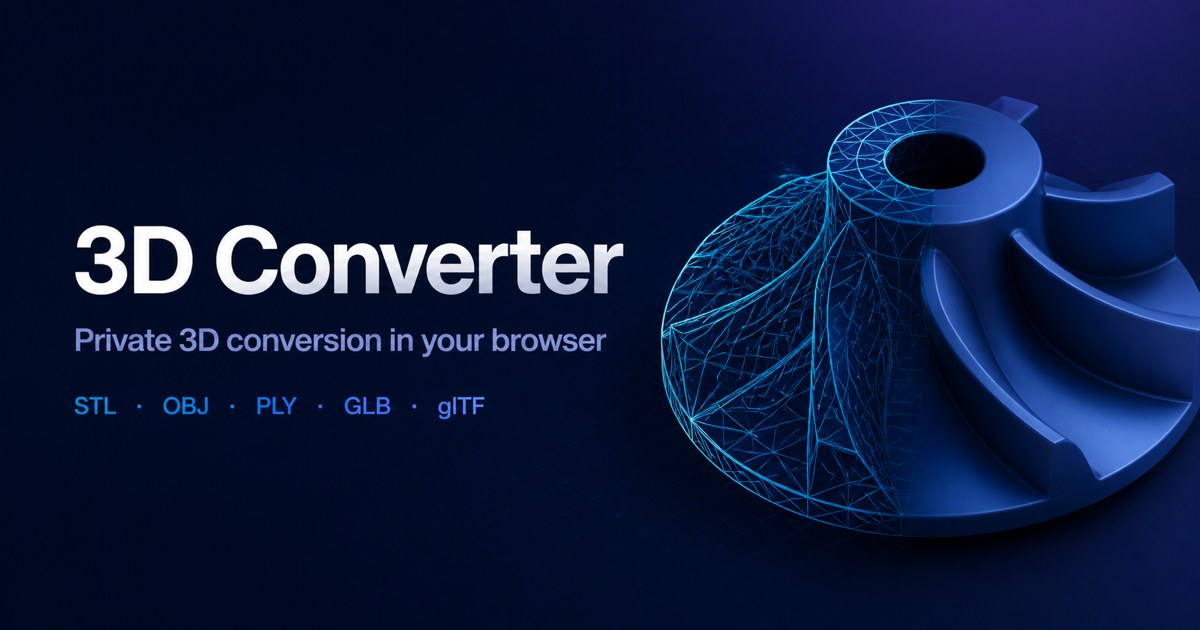
3DConverter is a free online 3D model converter and viewer for common mesh and scene formats. Open an STL, OBJ, PLY, GLB, or glTF file, inspect the model in your browser, choose an enabled conversion route, and download the result after the output has been loaded again for validation.
The active mesh workflows run locally in your browser. Selected model files and package dependencies are parsed in browser memory, so local conversion does not require an account or a model upload. OBJ and glTF workflows can include related MTL, BIN, and image files; keep their original names so references resolve correctly. For each route, the tool shows what the target format can preserve and what may change.
Features
- Browser-based preview for STL, OBJ, PLY, GLB, and glTF
- Local conversion across enabled mesh routes using STL, OBJ, PLY, GLB, and glTF
- Support for multi-file OBJ and glTF packages with material, texture, and buffer dependencies
- Route-aware options such as transforms, normal recalculation, hierarchy, units, axes, and STL encoding where supported
- Before-and-after reports for dimensions, vertices, triangles, objects, materials, textures, units, and axes when available
- Output re-parsing that rejects unreadable files or files with no renderable triangles
- A free local workflow for 3D-printing, WebGL, and asset handoff checks
Use Cases
3DConverter is built for creators, developers, 3D-printing workflows, and anyone who needs a clearer handoff between modeling, web, and visualization tools.

Comments


Keeping OBJ/glTF dependencies named so MTL, BIN, and texture references resolve is exactly the kind of detail that prevents a successful conversion from looking broken later. The before-and-after reports and re-parsing check should make handoffs safer; could you add an option to package the converted output and its referenced textures into one downloadable archive? It would help when moving assets between a modeling tool and a web project.

Rejecting files with no renderable triangles before export is a nice touch, most converters fail silently there. How do you handle large meshes in the browser? We convert video files client side and the main problem was memory: big files crashed the tab until we stopped loading everything at once. Is there a size limit, or do you process in chunks?

Converting OBJ/glTF locally in the browser instead of uploading files is a real win for anyone handling client IP. The route-aware options (normal recalculation, unit handling, axis transforms) are exactly where cheap converters silently break meshes, so surfacing them up front is smart. One question: is there a batch queue for converting a folder of files in one go?
Premium Products
































Sponsors
Buy

Makers

Makers
Comments
Keeping OBJ/glTF dependencies named so MTL, BIN, and texture references resolve is exactly the kind of detail that prevents a successful conversion from looking broken later. The before-and-after reports and re-parsing check should make handoffs safer; could you add an option to package the converted output and its referenced textures into one downloadable archive? It would help when moving assets between a modeling tool and a web project.
Rejecting files with no renderable triangles before export is a nice touch, most converters fail silently there. How do you handle large meshes in the browser? We convert video files client side and the main problem was memory: big files crashed the tab until we stopped loading everything at once. Is there a size limit, or do you process in chunks?
Converting OBJ/glTF locally in the browser instead of uploading files is a real win for anyone handling client IP. The route-aware options (normal recalculation, unit handling, axis transforms) are exactly where cheap converters silently break meshes, so surfacing them up front is smart. One question: is there a batch queue for converting a folder of files in one go?
Premium Products
New to Fazier?

Find your next favorite product or submit your own. Made by @FalakDigital.
Copyright ©2026. All Rights Reserved