
Fortune Teller Online
Fortune Teller Online – Love, Career, and Future Questions
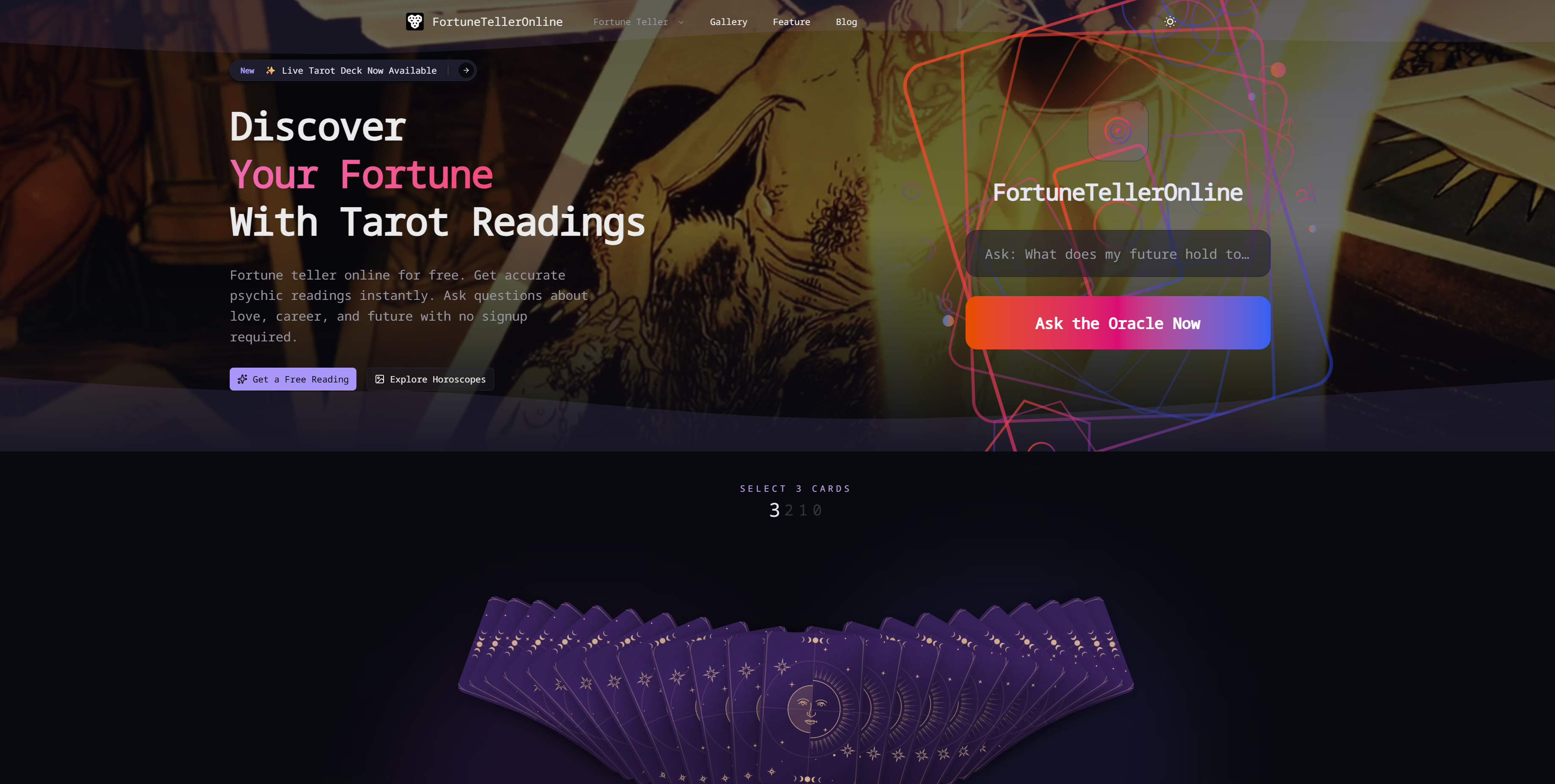
[fortune teller online](https://www.fortunetelleronline.app/) lets you explore a personal question through an interactive tarot reading. Ask about love, career, choices, or the future, draw from a 78-card deck, and receive an AI-assisted interpretation designed for reflection rather than guaranteed prediction. The core reading is free to start.
Features
- AI-assisted personalized tarot readings
- Complete 78-card Rider–Waite deck
- Manual three-card drawing experience
- Upright and reversed card meanings
- Past, present, and possible future spread
- Three-card, five-card, and Celtic Cross layouts
- Interpret cards drawn from a physical deck
- Love, career, decision, and future questions
- Nuanced yes-or-no tarot reflection
- Multiple international divination traditions
Use Cases
- Love and relationship reflection
- Nuanced yes-or-no decision support
- Career and work-choice exploration
- Physical tarot spread interpretation
- Three-card and Celtic Cross analysis
- Tarot learning and card-relationship study
- A second perspective on personal readings
- Journaling and self-reflection prompts
- Beginner-friendly online tarot practice
- Future-path and personal-choice exploration
Comments


[fortune teller online](https://www.fortunetelleronline.app/) is a free-to-start destination for people who want to explore a personal question through tarot and other traditional divination experiences. The site is designed around a simple idea: a useful reading should begin with the visitor’s real question, make the interaction understandable, and present the result as a perspective for reflection rather than as an unavoidable prediction. Visitors can ask about love, relationships, career, decisions, personal direction, or future possibilities, then choose an experience that fits the kind of insight they are seeking. The interactive tarot experience uses a complete 78-card Rider–Waite deck. After entering a question, the visitor shuffles an animated deck and manually selects three cards. Cards may appear upright or reversed, and the reading places them in a past, present, and possible future structure. The AI-assisted interpretation connects the traditional meaning of each card with its orientation, position, and the subject of the question. This produces a more coherent response than a list of isolated card definitions while still allowing the visitor to decide what feels relevant. That distinction matters when using an online fortune teller. FortuneTellerOnline does not present a symbolic reading as a guaranteed statement of fact. A reading may draw attention to a repeated pattern, a source of tension, an opportunity, or a choice that deserves more thought. It cannot know another person’s private thoughts, guarantee a relationship outcome, promise financial results, or replace medical, legal, financial, or mental health advice. The experience is intended for entertainment, curiosity, learning, and self-reflection, with responsibility for real-world decisions remaining with the visitor. Relationship questions can be framed around communication, boundaries, emotional patterns, expectations, and the actions available to the person asking. Career readings can help someone reflect on priorities, obstacles, tradeoffs, and possible next steps without pretending that one card fixes a professional future. Questions about a difficult choice can be explored through the past conditions that shaped it, the situation now, and one possible direction if current patterns continue. This approach gives the cards enough context to be thought-provoking without turning them into claims of certainty. The broader site also introduces several traditions beyond the main tarot reading. Someone may be curious about I Ching, Chinese Liuyao, Japanese Omikuji, Korean fortune-telling traditions, or a paper fortune teller. Keeping these experiences together makes the site useful as a starting point for visitors who want to compare symbolic systems or discover a format they have not tried before. Each tool has its own interaction and cultural frame, so the site is more than a single generic answer box. Visitors who already drew tarot cards elsewhere can use the separate online fortune reading tool. Instead of drawing a new spread, they select the cards already in front of them, record whether each card is upright or reversed, and choose a three-card, five-card, or Celtic Cross layout. The AI-assisted interpretation then considers the meaning of each position and the relationships across the complete spread. This is useful for physical-deck readers who want a second perspective or learners who want help connecting individual symbols into a larger story. The core experience is available without requiring an account to begin, which makes it easy to try a reading when a question is fresh. The interface guides the visitor from question to card selection to interpretation, rather than requiring prior knowledge of tarot terminology. At the same time, the full deck, reversed orientations, and spread positions preserve enough structure to be useful for people who already understand the basics. The goal is not to make every reading sound mystical; it is to turn a symbolic draw into a clear, readable reflection. FortuneTellerOnline is therefore a practical choice for directories that list tarot tools, self-reflection resources, entertainment experiences, spiritual-interest websites, or interactive AI applications. It offers a defined product rather than a vague promise: visitors ask a question, make their own card selections, and receive an interpretation based on the chosen cards and spread. The range of topics and traditions makes it suitable for curious first-time visitors, while the dedicated card-entry tool gives returning tarot users another reason to use the site. For the most useful result, visitors should ask one focused, open question and approach the response as material to think with. They can notice which themes match their experience, which assumptions deserve reconsideration, and which choices remain under their control. A reading may suggest a possible direction, but it does not remove uncertainty or decide the future. Visitors can return with a different question when circumstances change, compare the new themes with observable facts, and keep only the parts that genuinely support clearer thinking. That grounded framing is what makes this fortune teller online useful: an accessible digital experience with meaningful interaction, clear limits, and room for the visitor’s own informed judgment.
Premium Products

























Sponsors
Buy

Makers
Makers
Comments
[fortune teller online](https://www.fortunetelleronline.app/) is a free-to-start destination for people who want to explore a personal question through tarot and other traditional divination experiences. The site is designed around a simple idea: a useful reading should begin with the visitor’s real question, make the interaction understandable, and present the result as a perspective for reflection rather than as an unavoidable prediction. Visitors can ask about love, relationships, career, decisions, personal direction, or future possibilities, then choose an experience that fits the kind of insight they are seeking. The interactive tarot experience uses a complete 78-card Rider–Waite deck. After entering a question, the visitor shuffles an animated deck and manually selects three cards. Cards may appear upright or reversed, and the reading places them in a past, present, and possible future structure. The AI-assisted interpretation connects the traditional meaning of each card with its orientation, position, and the subject of the question. This produces a more coherent response than a list of isolated card definitions while still allowing the visitor to decide what feels relevant. That distinction matters when using an online fortune teller. FortuneTellerOnline does not present a symbolic reading as a guaranteed statement of fact. A reading may draw attention to a repeated pattern, a source of tension, an opportunity, or a choice that deserves more thought. It cannot know another person’s private thoughts, guarantee a relationship outcome, promise financial results, or replace medical, legal, financial, or mental health advice. The experience is intended for entertainment, curiosity, learning, and self-reflection, with responsibility for real-world decisions remaining with the visitor. Relationship questions can be framed around communication, boundaries, emotional patterns, expectations, and the actions available to the person asking. Career readings can help someone reflect on priorities, obstacles, tradeoffs, and possible next steps without pretending that one card fixes a professional future. Questions about a difficult choice can be explored through the past conditions that shaped it, the situation now, and one possible direction if current patterns continue. This approach gives the cards enough context to be thought-provoking without turning them into claims of certainty. The broader site also introduces several traditions beyond the main tarot reading. Someone may be curious about I Ching, Chinese Liuyao, Japanese Omikuji, Korean fortune-telling traditions, or a paper fortune teller. Keeping these experiences together makes the site useful as a starting point for visitors who want to compare symbolic systems or discover a format they have not tried before. Each tool has its own interaction and cultural frame, so the site is more than a single generic answer box. Visitors who already drew tarot cards elsewhere can use the separate online fortune reading tool. Instead of drawing a new spread, they select the cards already in front of them, record whether each card is upright or reversed, and choose a three-card, five-card, or Celtic Cross layout. The AI-assisted interpretation then considers the meaning of each position and the relationships across the complete spread. This is useful for physical-deck readers who want a second perspective or learners who want help connecting individual symbols into a larger story. The core experience is available without requiring an account to begin, which makes it easy to try a reading when a question is fresh. The interface guides the visitor from question to card selection to interpretation, rather than requiring prior knowledge of tarot terminology. At the same time, the full deck, reversed orientations, and spread positions preserve enough structure to be useful for people who already understand the basics. The goal is not to make every reading sound mystical; it is to turn a symbolic draw into a clear, readable reflection. FortuneTellerOnline is therefore a practical choice for directories that list tarot tools, self-reflection resources, entertainment experiences, spiritual-interest websites, or interactive AI applications. It offers a defined product rather than a vague promise: visitors ask a question, make their own card selections, and receive an interpretation based on the chosen cards and spread. The range of topics and traditions makes it suitable for curious first-time visitors, while the dedicated card-entry tool gives returning tarot users another reason to use the site. For the most useful result, visitors should ask one focused, open question and approach the response as material to think with. They can notice which themes match their experience, which assumptions deserve reconsideration, and which choices remain under their control. A reading may suggest a possible direction, but it does not remove uncertainty or decide the future. Visitors can return with a different question when circumstances change, compare the new themes with observable facts, and keep only the parts that genuinely support clearer thinking. That grounded framing is what makes this fortune teller online useful: an accessible digital experience with meaningful interaction, clear limits, and room for the visitor’s own informed judgment.
Premium Products
New to Fazier?

Find your next favorite product or submit your own. Made by @FalakDigital.
Copyright ©2025. All Rights Reserved