
WebauditOS
Website audits with evidence, not just a score
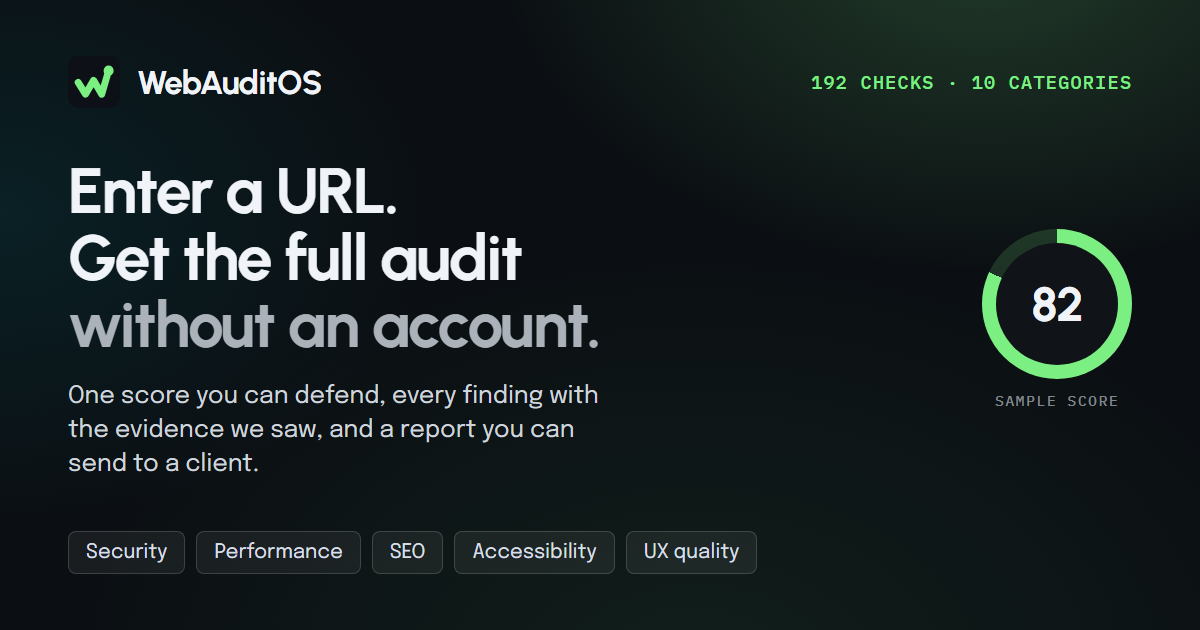
WebAuditOS audits any website across 9 areas: security, performance, SEO, accessibility, UX, technical health, GDPR compliance, mobile and browser compatibility. You get one 0–100 score with transparent math, a prioritized list of issues, and raw evidence for every finding. Free to start.
Features
- 199 automated checks across 9 categories
- Real-browser rendering (mobile + desktop), Core Web Vitals
- Accessibility testing (WCAG, axe-core)
- Security headers, TLS, cookie and GDPR pre-consent checks
- Evidence and confidence level for every finding
- Prioritized fix list written in plain language
- White-label PDF reports and client workspaces
- Scheduled monitoring with regression-only alerts
- Scan comparison and history
- REST API
Use Cases
Digital agencies, freelancers, in-house product and marketing teams, developers, AI/no-code builders, small business owners.

Comments

The regression-only alerts plus scan comparison are the part I'd actually keep open week to week. Most audit tools dump a fresh 100-item report every run, so the useful signal (what broke since the last scan) gets buried. Pairing a confidence level with raw evidence on each finding also makes it easier to defend a flag when a client asks why a security header or WCAG item matters. One thing I'm not sure about from the feature list: can the REST API trigger a scan on deploy and return just that delta, or is comparison only in the UI?

Showing the evidence and confidence level behind each finding is a smart call, since a bare score is hard to defend to a client. I'd be curious how you handle pages behind a login, as those are often where accessibility and security issues hide. Would a simple authenticated-scan option fit your roadmap?



Showing the raw evidence and a confidence level for every finding is exactly what most audit tools miss — a bare score doesn't tell you what to fix first. The regression-only alerts also seem genuinely useful for monitoring: nobody wants a ping for every tiny fluctuation. I'm curious how the 0–100 score weights the 9 areas — is a security failure weighted more heavily than, say, a UX nitpick?


Premium Products



















































Sponsors
Buy

Makers

Makers
Comments
The regression-only alerts plus scan comparison are the part I'd actually keep open week to week. Most audit tools dump a fresh 100-item report every run, so the useful signal (what broke since the last scan) gets buried. Pairing a confidence level with raw evidence on each finding also makes it easier to defend a flag when a client asks why a security header or WCAG item matters. One thing I'm not sure about from the feature list: can the REST API trigger a scan on deploy and return just that delta, or is comparison only in the UI?
Showing the evidence and confidence level behind each finding is a smart call, since a bare score is hard to defend to a client. I'd be curious how you handle pages behind a login, as those are often where accessibility and security issues hide. Would a simple authenticated-scan option fit your roadmap?
Showing the raw evidence and a confidence level for every finding is exactly what most audit tools miss — a bare score doesn't tell you what to fix first. The regression-only alerts also seem genuinely useful for monitoring: nobody wants a ping for every tiny fluctuation. I'm curious how the 0–100 score weights the 9 areas — is a security failure weighted more heavily than, say, a UX nitpick?
Premium Products
New to Fazier?

Find your next favorite product or submit your own. Made by @FalakDigital.
Copyright ©2026. All Rights Reserved