
protonURL
Share sensitive content through one-time, self-destructing l
Secure one-time sharing for sensitive content
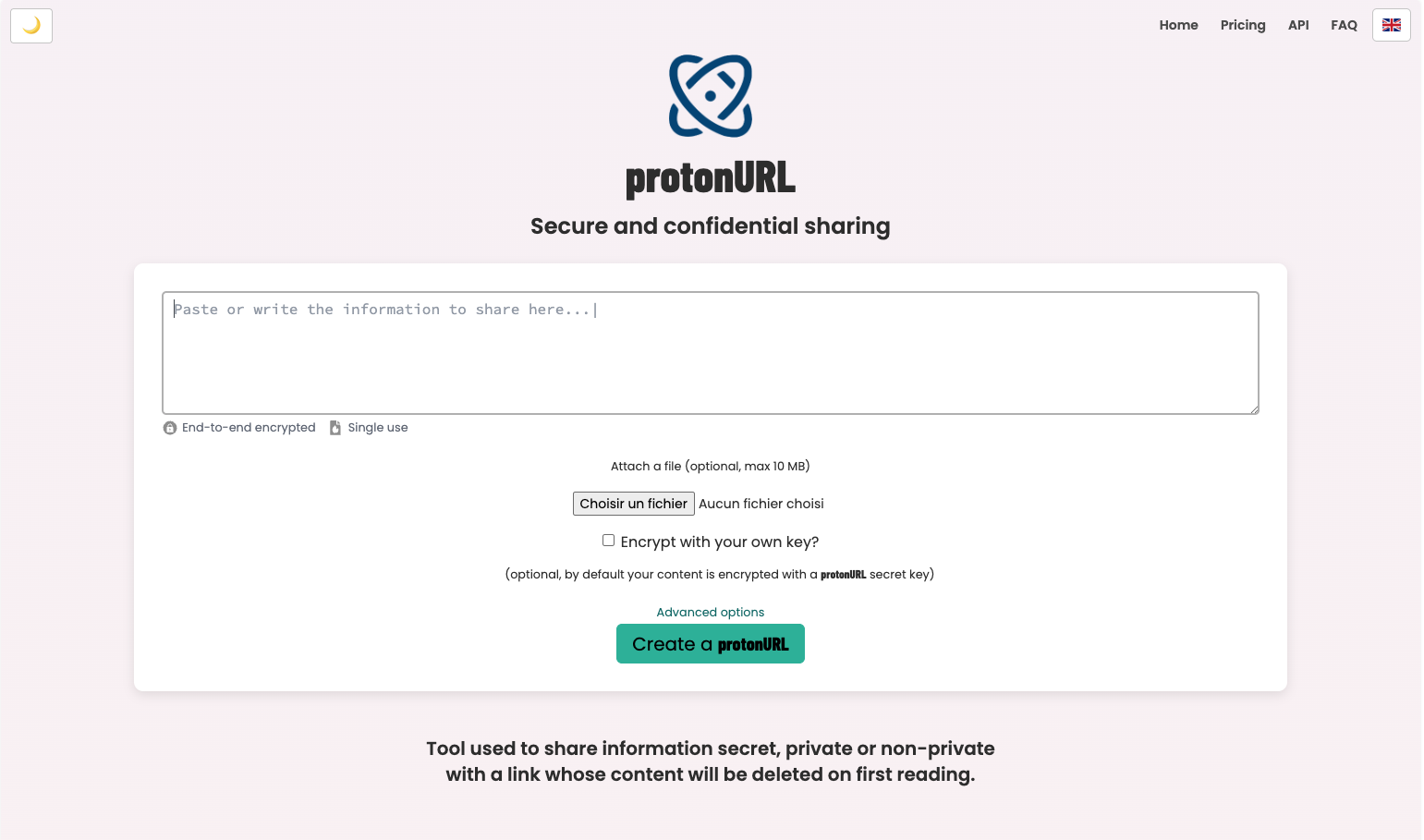
protonURL is a secure and confidential sharing service that lets you send sensitive information through temporary, single-use links. Instead of sharing passwords, private notes, access codes, confidential messages, documents, or files through email or chat, protonURL creates a protected link that can be opened only once before it is permanently destroyed.
The service is designed for privacy-conscious users, freelancers, developers, companies, and teams that need a simple way to share sensitive content without leaving it available indefinitely online.
How protonURL works
- Create a protonURL with the text, secret, message, URL, or file you want to share.
- Send the generated temporary link to the intended recipient.
- The recipient opens the link once to access the content.
- After the first read, the protonURL and its content are permanently deleted.
- If the link is never opened, it automatically expires after the selected lifetime.
Features
- One-time read links that self-destruct after opening.
- AES-256 server-side encryption before storage.
- Automatic deletion after first access or expiration.
- Cryptographic deletion proof using ECDSA P-256.
- Custom encryption passphrase support.
- Temporary file attachments.
- No account required for everyday use.
- No tracking of the shared content.
- REST API access for developers and automation.
Use Cases
protonURL is not a traditional URL shortener. Its purpose is not tracking, analytics, redirects, or marketing attribution. Its purpose is to make sensitive sharing safer by ensuring that the content is temporary, encrypted, accessible only once, and deleted as soon as it is no longer needed.
Sponsors
Buy
Comments


Hey Fazier, I built protonURL from a very simple observation: people still share sensitive information through emails, SMS, chat messages, or tools that were never really designed for that. A password, a private note, a bank detail, a temporary access code, a confidential message, a file, a link… once it is sent through a classic channel, it often stays there forever. protonURL was created to solve that problem in the simplest possible way: paste your sensitive content, generate a temporary one-time link, share it, and once it has been opened, the content is destroyed. The goal was not to build another heavy productivity platform, but a small, fast, privacy-first tool that anyone can use without creating an account. The core experience is intentionally minimal: no tracking, no ads, no Google Analytics, no unnecessary friction, and no content kept after reading or expiration. Behind the simplicity, I wanted protonURL to remain serious technically: encrypted storage, custom private passphrase support, adjustable link lifetime, public cryptographic deletion proof, multilingual interface, strong security headers, lightweight architecture, and a very low environmental footprint. I see protonURL as a discreet utility that people should keep in their bookmarks — the kind of tool you may not need every day, but when you do, you are glad it exists. I would love to hear feedback from makers, developers, privacy-conscious users, and anyone who has ever thought: “I really should not send this sensitive info by email.”
Premium Products





















Sponsors
Buy

Makers
Makers
Comments
Hey Fazier, I built protonURL from a very simple observation: people still share sensitive information through emails, SMS, chat messages, or tools that were never really designed for that. A password, a private note, a bank detail, a temporary access code, a confidential message, a file, a link… once it is sent through a classic channel, it often stays there forever. protonURL was created to solve that problem in the simplest possible way: paste your sensitive content, generate a temporary one-time link, share it, and once it has been opened, the content is destroyed. The goal was not to build another heavy productivity platform, but a small, fast, privacy-first tool that anyone can use without creating an account. The core experience is intentionally minimal: no tracking, no ads, no Google Analytics, no unnecessary friction, and no content kept after reading or expiration. Behind the simplicity, I wanted protonURL to remain serious technically: encrypted storage, custom private passphrase support, adjustable link lifetime, public cryptographic deletion proof, multilingual interface, strong security headers, lightweight architecture, and a very low environmental footprint. I see protonURL as a discreet utility that people should keep in their bookmarks — the kind of tool you may not need every day, but when you do, you are glad it exists. I would love to hear feedback from makers, developers, privacy-conscious users, and anyone who has ever thought: “I really should not send this sensitive info by email.”
Premium Products
New to Fazier?

Find your next favorite product or submit your own. Made by @FalakDigital.
Copyright ©2025. All Rights Reserved