
MockBase
Free Mock API Server with a Live Inspector
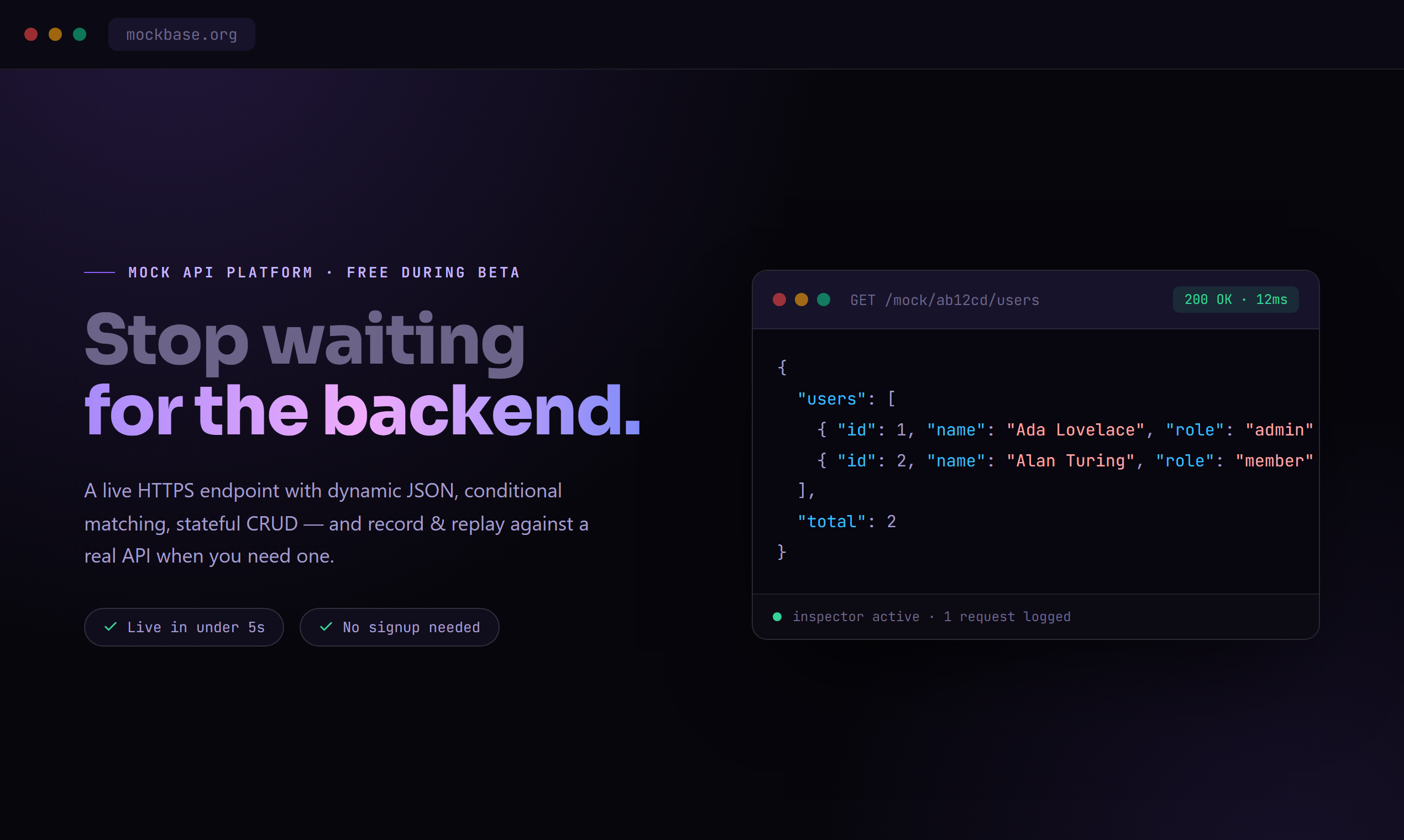
MockBase is a hosted mock API server that gives you a real, live HTTPS endpoint before your backend even exists — no signup required to try it. Point your frontend, mobile app, or test suite at a MockBase URL and it answers exactly how you configure it: conditional responses, stateful CRUD, deliberate failures, and a live inspector showing every request as it arrives. It supports REST, GraphQL, and SOAP, and every save is versioned so a bad edit is always one click from undone.
Features
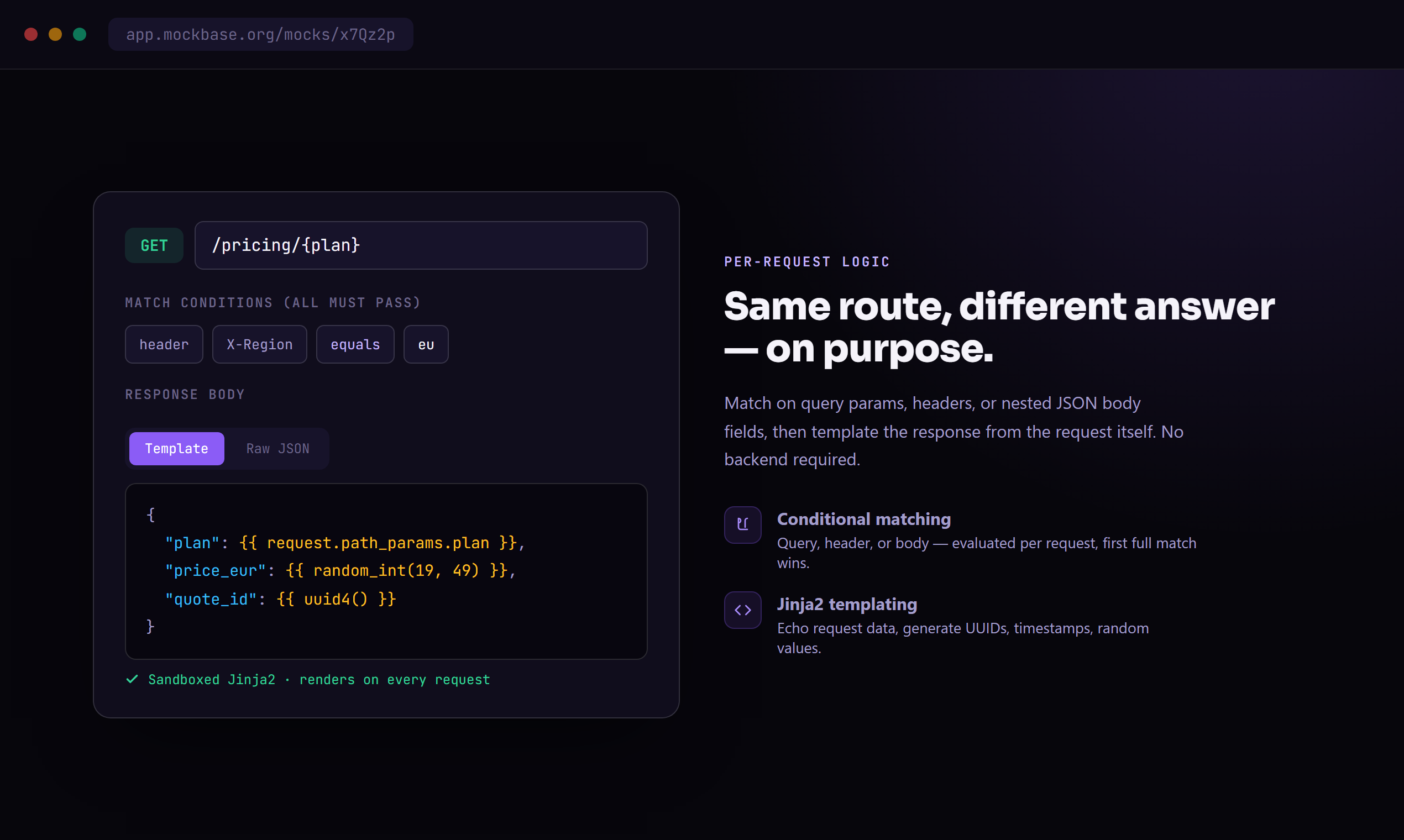
Conditional matching — route on query params, headers, a JSON body path, a GraphQL operation name, or a SOAP envelope element, with priority ordering
Dynamic templating — sandboxed Jinja2 to echo the request, mint a UUID, or stamp a timestamp
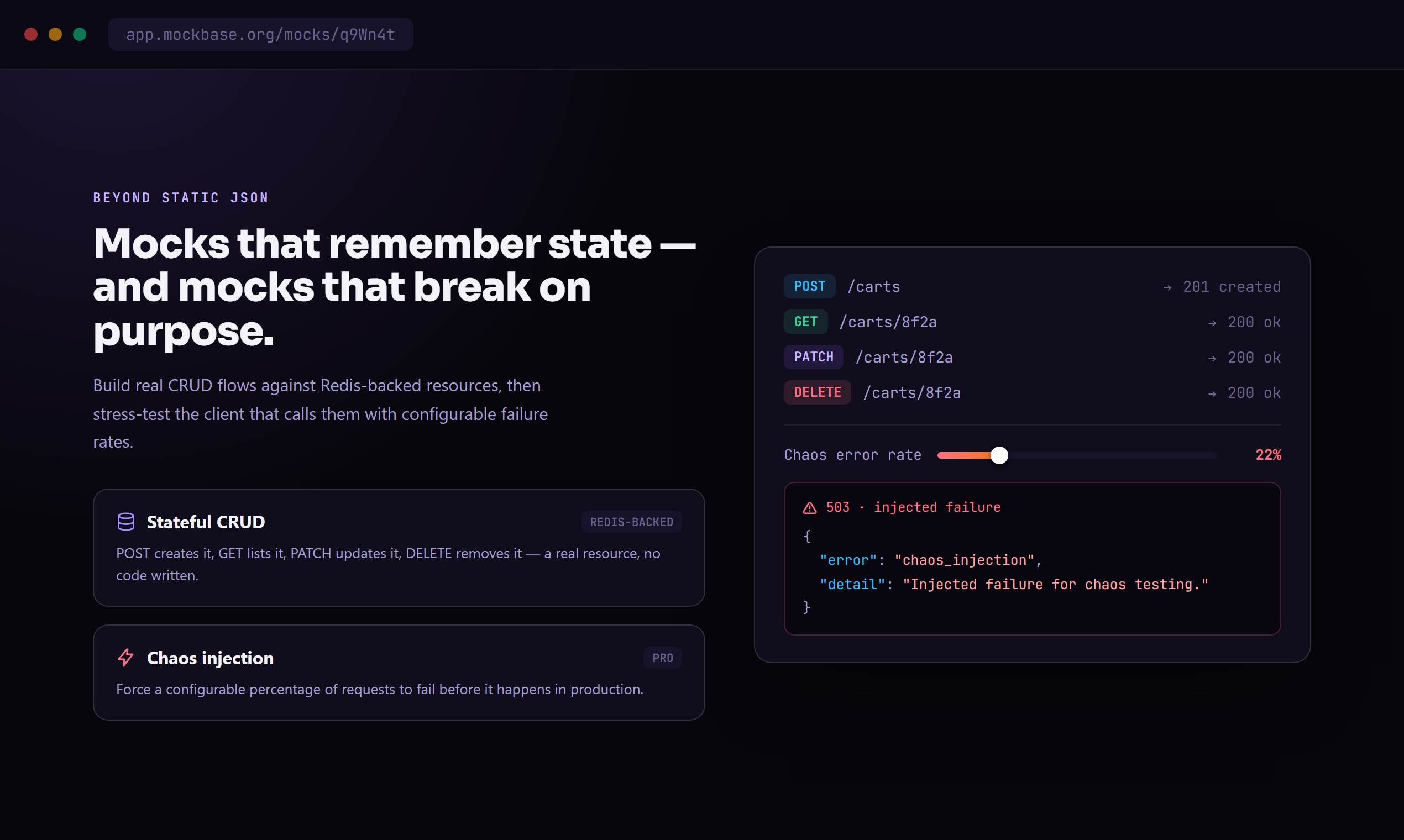
Stateful CRUD — a POST is actually there when you GET it, Redis-backed, no code
Chaos injection — fail requests on purpose: slow timeouts, truncated bodies, empty responses, or a dropped connection
Rate limit simulation — deterministic 429s after N requests in a window
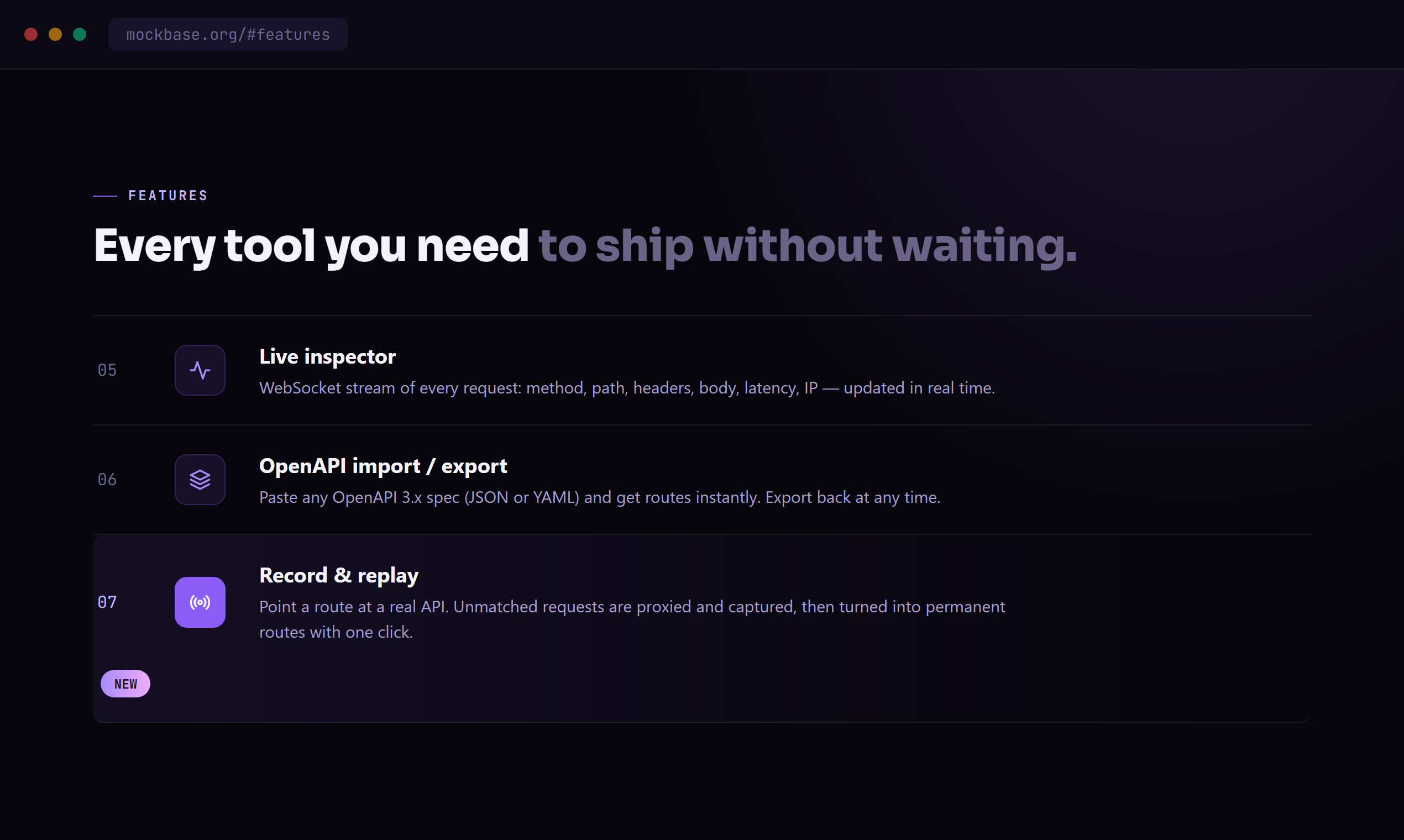
Live request inspector — every call streams over WebSocket, copyable as cURL, fetch, axios, and more
OpenAPI import/export — scaffold routes from a spec or regenerate one from a mock
Mock as code — a personal API key drives a CLI and an MCP server for CI/AI-agent workflows
Use Cases
Building the frontend while the backend team is still designing the API
Testing retry logic, timeouts, and error states that a happy-path backend never triggers
Writing integration tests against a stable, versioned endpoint instead of a flaky shared dev server
Demoing a product to stakeholders before any real data exists
Reproducing a third-party API's behavior for local development, without hitting their rate limits
Giving an AI agent or CI pipeline a mock it can create, edit, and inspect on its own via the CLI or MCP server

Comments


Hey! Maker here. I built MockBase because I kept hitting the same wall on every project: the frontend is ready to go, but the backend isn't — and "just wait" or "hardcode some JSON" both get old fast, especially once you need to test what happens when the real API times out, rate-limits you, or your app is expected to survive a request in a weird order. So instead of another static mock tool, I wanted something that behaves like a real API would: different responses depending on what you send it, state that actually persists between calls, and the ability to break it on purpose — a slow timeout, a truncated response, a dropped connection — since those are the paths that never get tested until they happen in production. It's still very much a living project, so if you hit something that doesn't work the way you'd expect, or there's a use case I haven't thought of, I'd genuinely like to hear about it here.

The live request inspector paired with stateful CRUD is a smart combination. Being able to see every call stream in as it happens, and then copy it straight to cURL or fetch, would save a lot of debugging time when frontend and backend are out of sync. Chaos injection for truncated bodies and dropped connections is also a useful addition that most mock tools skip.

The chaos injection is the part I'd use most. Timeouts and truncated bodies are exactly the paths that never get tested until production. Can a chaos rule fire only on every Nth request, or only after a certain stateful CRUD call? That would make it easy to reproduce "works the first time, fails on retry" bugs in CI.

Chaos injection plus stateful CRUD is the combination most mock servers skip: everyone handles the happy path, then you end up hand-rolling timeouts and 429s just to test retry logic. Two things I would want to pin down before pointing CI at this. Does a versioned save fork the stored state, so rolling back a bad edit cannot leave orphaned records behind? And can you seed a fixture set so each pipeline run starts from a deterministic state? Also curious whether the rate-limit simulation counts per endpoint or globally per API key.

The chaos injection plus live inspector combo is exactly what frontend testing usually lacks — being able to see the request stream while simulating timeouts and truncated bodies makes flaky-scenario testing way less painful. Rate limit simulation with deterministic 429s is another gap most mock servers ignore. Curious whether conditional matching supports GraphQL operation names out of the box.
The chaos injection options (truncated bodies, dropped connections, deterministic 429s after N requests) are exactly what's missing from most mock servers, which only ever return the happy path. Being able to test retry and backoff logic against a stable HTTPS URL, with every request streaming into the live inspector, looks really handy. Does the stateful CRUD reset between sessions, or can you snapshot it?
OpenAPI import paired with sandboxed Jinja2 is the part I would actually use when scaffolding a mock from a spec that already exists. If the spec uses oneOf with a discriminator, does import keep those as separate conditional routes, or does it flatten them to a single example body? And can a template read other Redis-backed CRUD records, or is the sandbox limited to the current request so it cannot leak another resource's state?
OpenAPI import paired with sandboxed Jinja2 is the part I would use when scaffolding a mock from an existing spec. If the spec uses oneOf with a discriminator, does import keep those as separate conditional routes, or flatten them to one example body? Can a template read other Redis-backed CRUD records, or is the sandbox limited to the current request?

For the live inspector, a useful safeguard would be automatic masking of Authorization headers, cookies, and common secret fields before requests are copied as cURL or shared with teammates. Synthetic fixtures can still accidentally include a real token. Does the inspector offer configurable redaction, and does that also apply to saved request history?
Mock as code is the piece that would sell this to my team. Pointing an MCP server at a mock means an agent can spin up and inspect its own endpoints in CI instead of maintaining fixture files by hand. One question on the versioned saves: can a CLI run pin to a specific version, so a pipeline reproduces the exact mock a failing test was written against?

The live inspector showing every request as it arrive is what would sell me — it turns a mock server into a debugging tool during frontend work. Have you considered a shareable inspector link so a teammate can watch requests without an account? That would make it handy for pair-debugging a flaky integration.


OpenAPI import/export is the feature that would get my team to adopt this — scaffolding a mock straight from our spec, and regenerating the spec as the mock evolves, closes the loop between API design and frontend work. One thing I'd love to see: versioning mocks alongside spec versions, so a frontend pinned to v1 of an API doesn't silently receive v2 responses when the spec changes. Also curious whether the personal API key supports scoped keys for CI, so a token leaked in build logs can't rewrite shared mocks.

Tried it without signing up: "Create your first mock" gave me a demo API with four routes and a live HTTPS URL right away. I called GET /users from my terminal and the request showed up in the inspector instantly (200, about 15 ms). Stateful CRUD and the failure modes are what I'd come back for, since retry and timeout paths rarely get tested. Question: how long does a mock created without an account stay alive?
Chaos injection plus deterministic 429s is the part I'd use most, since retry and timeout paths are exactly what a happy-path backend never exercises. Can a mock route accept multipart/form-data uploads and return a binary body (e.g. image/webp)? Mocking an image upload endpoint with a slow or truncated response would cover a lot of upload-UI testing.
Premium Products






























Sponsors
Buy

Comments
Hey! Maker here. I built MockBase because I kept hitting the same wall on every project: the frontend is ready to go, but the backend isn't — and "just wait" or "hardcode some JSON" both get old fast, especially once you need to test what happens when the real API times out, rate-limits you, or your app is expected to survive a request in a weird order. So instead of another static mock tool, I wanted something that behaves like a real API would: different responses depending on what you send it, state that actually persists between calls, and the ability to break it on purpose — a slow timeout, a truncated response, a dropped connection — since those are the paths that never get tested until they happen in production. It's still very much a living project, so if you hit something that doesn't work the way you'd expect, or there's a use case I haven't thought of, I'd genuinely like to hear about it here.
The live request inspector paired with stateful CRUD is a smart combination. Being able to see every call stream in as it happens, and then copy it straight to cURL or fetch, would save a lot of debugging time when frontend and backend are out of sync. Chaos injection for truncated bodies and dropped connections is also a useful addition that most mock tools skip.
The chaos injection is the part I'd use most. Timeouts and truncated bodies are exactly the paths that never get tested until production. Can a chaos rule fire only on every Nth request, or only after a certain stateful CRUD call? That would make it easy to reproduce "works the first time, fails on retry" bugs in CI.
Chaos injection plus stateful CRUD is the combination most mock servers skip: everyone handles the happy path, then you end up hand-rolling timeouts and 429s just to test retry logic. Two things I would want to pin down before pointing CI at this. Does a versioned save fork the stored state, so rolling back a bad edit cannot leave orphaned records behind? And can you seed a fixture set so each pipeline run starts from a deterministic state? Also curious whether the rate-limit simulation counts per endpoint or globally per API key.
The chaos injection plus live inspector combo is exactly what frontend testing usually lacks — being able to see the request stream while simulating timeouts and truncated bodies makes flaky-scenario testing way less painful. Rate limit simulation with deterministic 429s is another gap most mock servers ignore. Curious whether conditional matching supports GraphQL operation names out of the box.
The chaos injection options (truncated bodies, dropped connections, deterministic 429s after N requests) are exactly what's missing from most mock servers, which only ever return the happy path. Being able to test retry and backoff logic against a stable HTTPS URL, with every request streaming into the live inspector, looks really handy. Does the stateful CRUD reset between sessions, or can you snapshot it?
OpenAPI import paired with sandboxed Jinja2 is the part I would actually use when scaffolding a mock from a spec that already exists. If the spec uses oneOf with a discriminator, does import keep those as separate conditional routes, or does it flatten them to a single example body? And can a template read other Redis-backed CRUD records, or is the sandbox limited to the current request so it cannot leak another resource's state?
OpenAPI import paired with sandboxed Jinja2 is the part I would use when scaffolding a mock from an existing spec. If the spec uses oneOf with a discriminator, does import keep those as separate conditional routes, or flatten them to one example body? Can a template read other Redis-backed CRUD records, or is the sandbox limited to the current request?
For the live inspector, a useful safeguard would be automatic masking of Authorization headers, cookies, and common secret fields before requests are copied as cURL or shared with teammates. Synthetic fixtures can still accidentally include a real token. Does the inspector offer configurable redaction, and does that also apply to saved request history?
Mock as code is the piece that would sell this to my team. Pointing an MCP server at a mock means an agent can spin up and inspect its own endpoints in CI instead of maintaining fixture files by hand. One question on the versioned saves: can a CLI run pin to a specific version, so a pipeline reproduces the exact mock a failing test was written against?
The live inspector showing every request as it arrive is what would sell me — it turns a mock server into a debugging tool during frontend work. Have you considered a shareable inspector link so a teammate can watch requests without an account? That would make it handy for pair-debugging a flaky integration.
OpenAPI import/export is the feature that would get my team to adopt this — scaffolding a mock straight from our spec, and regenerating the spec as the mock evolves, closes the loop between API design and frontend work. One thing I'd love to see: versioning mocks alongside spec versions, so a frontend pinned to v1 of an API doesn't silently receive v2 responses when the spec changes. Also curious whether the personal API key supports scoped keys for CI, so a token leaked in build logs can't rewrite shared mocks.
Tried it without signing up: "Create your first mock" gave me a demo API with four routes and a live HTTPS URL right away. I called GET /users from my terminal and the request showed up in the inspector instantly (200, about 15 ms). Stateful CRUD and the failure modes are what I'd come back for, since retry and timeout paths rarely get tested. Question: how long does a mock created without an account stay alive?
Chaos injection plus deterministic 429s is the part I'd use most, since retry and timeout paths are exactly what a happy-path backend never exercises. Can a mock route accept multipart/form-data uploads and return a binary body (e.g. image/webp)? Mocking an image upload endpoint with a slow or truncated response would cover a lot of upload-UI testing.
Premium Products
New to Fazier?

Find your next favorite product or submit your own. Made by @FalakDigital.
Copyright ©2026. All Rights Reserved