
Incentise
Turn SaaS incentives into public social proof
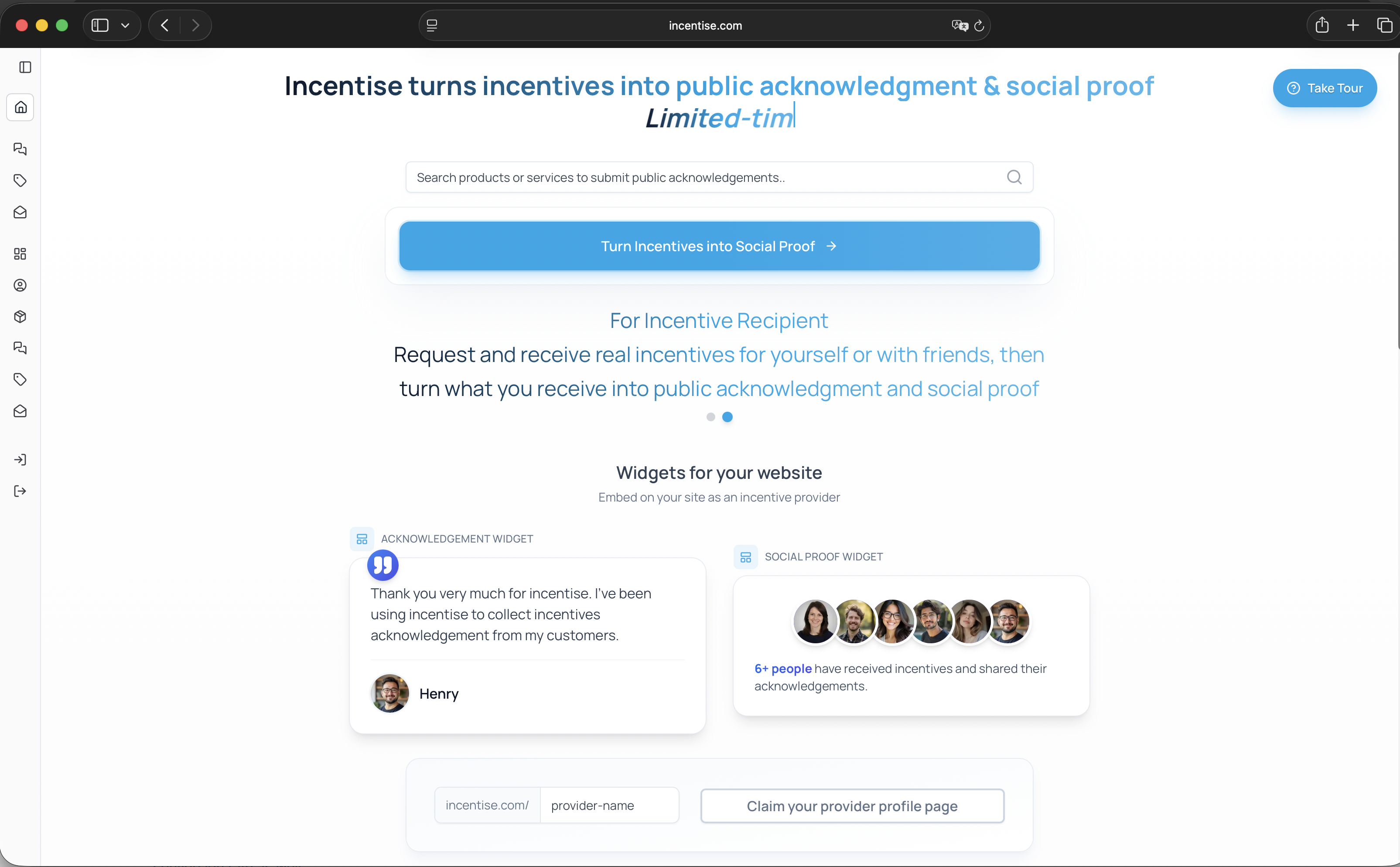
Features
- Track Incentive Requests
- View Available Offers
- Make Public Acknowledgments
- Receive Incentive Requests
- Create Incentive Offers
- Manage Your Business Profile
- Manage Your Product or Services
- View Performance Dashboard
- Receive Public Acknowledgments
Use Cases
- Affiliate / Publisher
- Agency
- Brand
- Content Creator
- Influencer
- Merchant
- Restaurant
- SaaS Provider
- Service Provider
- Clinic

Comments




Really interesting approach to turning incentives into visible social proof. The distinction between traditional testimonials and public acknowledgment of received value is smart — it feels more authentic because it’s tied to a real exchange rather than a generic review. I can see this being especially useful for SaaS founders running freemium models who struggle to convert free users into advocates. How do you handle the verification side to ensure acknowledgments are genuine?

Hi everyone 👋 I built Incentise after realizing something simple: Many SaaS founders offer incentives free trials, extended credits, discounts, freemium access but rarely receive public recognition for it. Incentise turns private incentives into public acknowledgements. Instead of a testimonial written after a purchase, Incentise allows users to publicly recognize the value they received. That acknowledgment becomes social proof you can actually use. Why this matters for SaaS founders: • You get authentic social proof from real users • Your free trials and discounts don’t disappear silently • Incentives become visible marketing assets • Public acknowledgment builds trust with future customers • It creates a positive, transparent relationship between founders and users Incentise isn’t about asking for reviews. It’s about giving users a simple way to say, “I received value, thank you.” If you're a SaaS founder experimenting with distribution, early traction, or brand trust, I’d love your feedback. Let’s make incentives visible, not invisible.

Turning private incentives into visible public acknowledgment is a clever inversion of the traditional review flow. Most testimonials feel like they're asked for after the fact — this ties social proof directly to a real value exchange, which reads as more authentic. The use case for early-stage SaaS is clear: your free trial users actually have an incentive to say something. What does the public acknowledgment page look like to a visitor who's never heard of the product?
The gap between "someone is incentivized to say this" and "someone genuinely means this" is where most referral and ambassador programs fall apart. We've been building a micro-influencer program for a mobile app and the biggest friction is exactly this: performance-based compensation signals inauthenticity to audiences who are getting increasingly good at spotting it. Curious whether Incentise has features to let creators disclose the incentive transparently without killing conversion — counterintuitively, disclosed incentives with a genuine testimonial often convert better than hidden ones. Does the platform support that kind of nuanced social proof framing?
Premium Products








Sponsors
Buy


Makers
Makers
Comments
Really interesting approach to turning incentives into visible social proof. The distinction between traditional testimonials and public acknowledgment of received value is smart — it feels more authentic because it’s tied to a real exchange rather than a generic review. I can see this being especially useful for SaaS founders running freemium models who struggle to convert free users into advocates. How do you handle the verification side to ensure acknowledgments are genuine?
Hi everyone 👋 I built Incentise after realizing something simple: Many SaaS founders offer incentives free trials, extended credits, discounts, freemium access but rarely receive public recognition for it. Incentise turns private incentives into public acknowledgements. Instead of a testimonial written after a purchase, Incentise allows users to publicly recognize the value they received. That acknowledgment becomes social proof you can actually use. Why this matters for SaaS founders: • You get authentic social proof from real users • Your free trials and discounts don’t disappear silently • Incentives become visible marketing assets • Public acknowledgment builds trust with future customers • It creates a positive, transparent relationship between founders and users Incentise isn’t about asking for reviews. It’s about giving users a simple way to say, “I received value, thank you.” If you're a SaaS founder experimenting with distribution, early traction, or brand trust, I’d love your feedback. Let’s make incentives visible, not invisible.
Turning private incentives into visible public acknowledgment is a clever inversion of the traditional review flow. Most testimonials feel like they're asked for after the fact — this ties social proof directly to a real value exchange, which reads as more authentic. The use case for early-stage SaaS is clear: your free trial users actually have an incentive to say something. What does the public acknowledgment page look like to a visitor who's never heard of the product?
The gap between "someone is incentivized to say this" and "someone genuinely means this" is where most referral and ambassador programs fall apart. We've been building a micro-influencer program for a mobile app and the biggest friction is exactly this: performance-based compensation signals inauthenticity to audiences who are getting increasingly good at spotting it. Curious whether Incentise has features to let creators disclose the incentive transparently without killing conversion — counterintuitively, disclosed incentives with a genuine testimonial often convert better than hidden ones. Does the platform support that kind of nuanced social proof framing?
Premium Products
New to Fazier?

Find your next favorite product or submit your own. Made by @FalakDigital.
Copyright ©2025. All Rights Reserved