
GAIM
Give AI a memory that stays with you.
I got tired of explaining myself to AI over and over again.
Different AI tools, different chats, different contexts - and every time I had to start from zero.
So I built GAIM as a portable memory layer for AI.
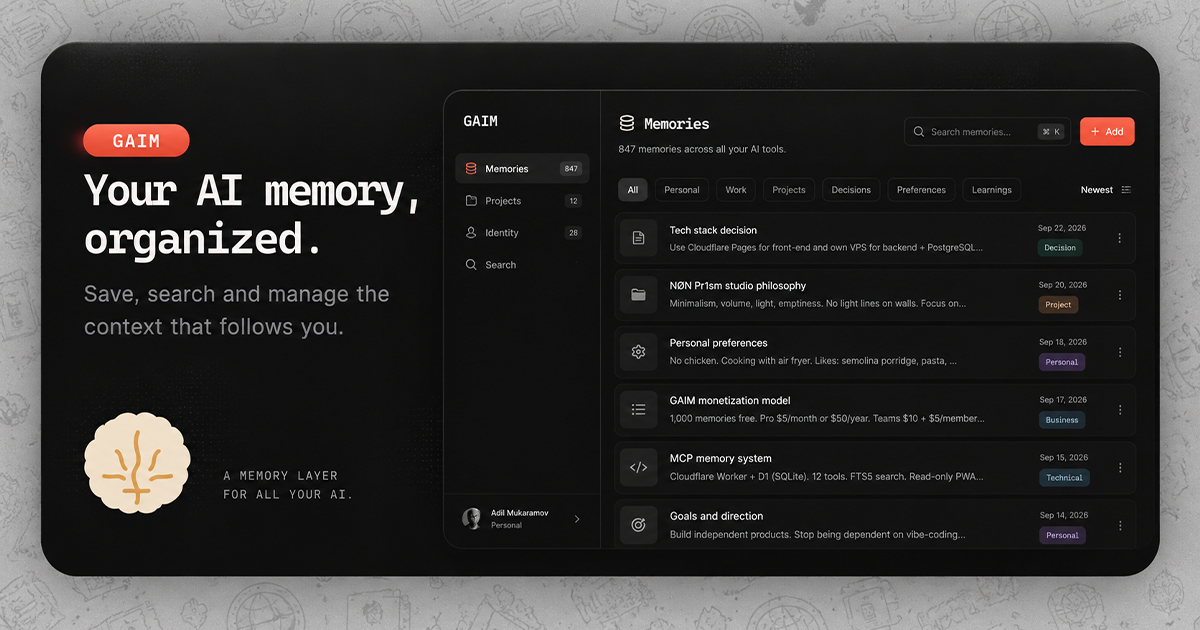
GAIM lets you save, search and manage the context you want AI to remember, and make it available across the AI tools you already use.
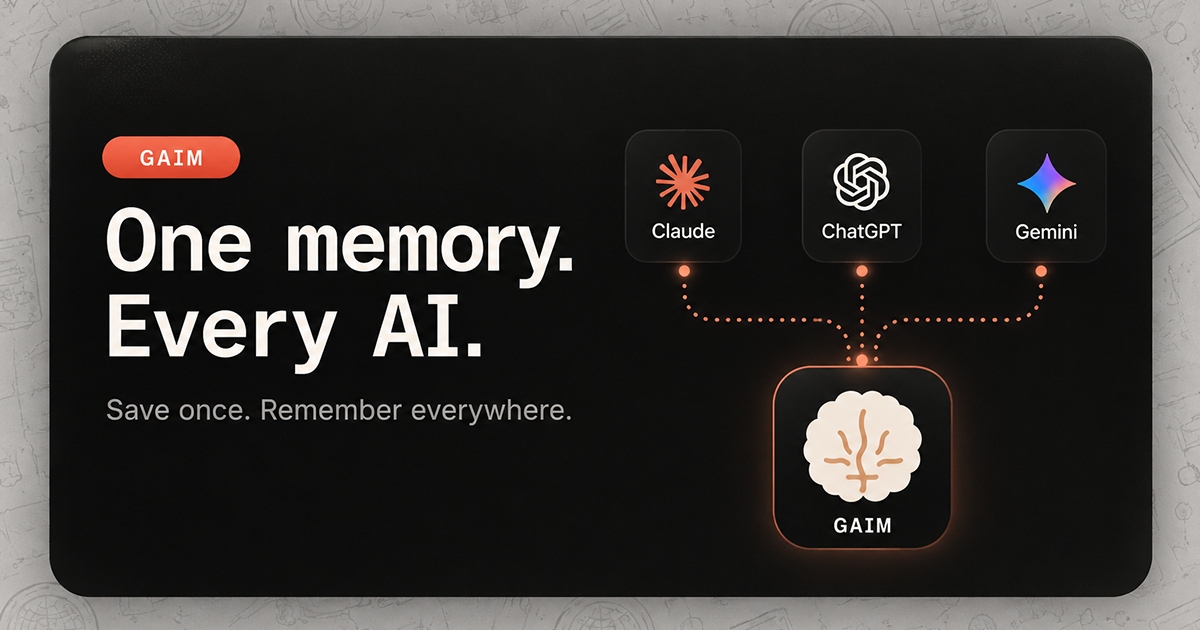
Connect Claude, ChatGPT, Gemini, Codex and other MCP-compatible AI clients to the same memory layer.
Your memory stays portable and under your control. You can export it whenever you want.
Start free with up to 1,000 memories.
Features
One memory layer - Keep your AI memories in one place instead of scattering context across different tools and chats.
Cross-AI compatibility - Connect Claude, ChatGPT, Gemini, Codex and other MCP-compatible AI clients.
Persistent context - Save important facts, decisions, preferences and project context so you don't have to repeat them.
Searchable memory - Retrieve relevant memories when needed instead of relying on entire conversation histories.
Portable by design - Your memory belongs to you and can be exported whenever you want.
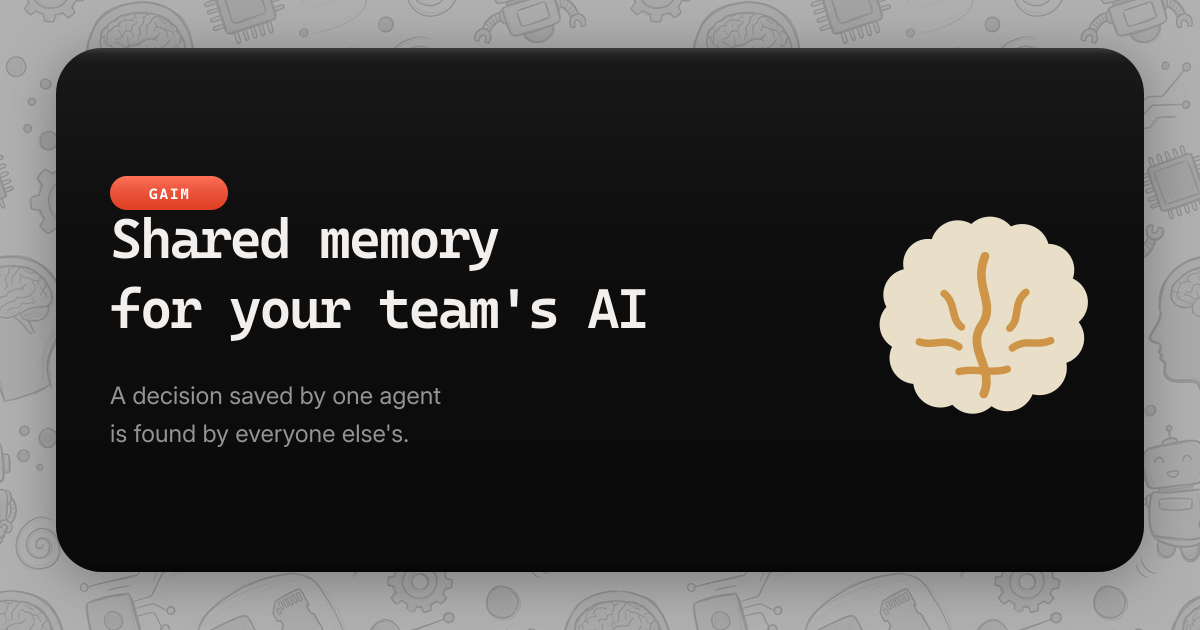
Team memory - Share selected project knowledge with your team while keeping personal memories private.
Use Cases
Personal AI memory - Keep your preferences, background, projects and important context available across different AI tools.
AI-assisted development - Give coding agents persistent context about your projects, architecture, decisions and workflow.
Cross-AI workflows - Use Claude, ChatGPT, Gemini, Codex and other AI clients without rebuilding your context from scratch.
Long-term projects - Keep important context available across conversations, tools and sessions.
Team knowledge - Share project decisions and knowledge so team members and AI agents can work from the same context.

Comments


As someone running a marketing agency, I switch between ChatGPT, Claude and Gemini all day, and re-pasting brand guidelines, tone notes and client background into every new chat is a real time sink. A single MCP memory layer that all of them can read from would remove a lot of that. Do memories get saved only when I add them manually, or can GAIM pick up important context from my chats on its own? And is there a way to import the memory I've already built up inside ChatGPT or Claude so I'm not starting from zero?
As someone running a marketing agency, I switch between ChatGPT, Claude and Gemini all day, and re-pasting brand guidelines, tone notes and client background into every new chat is a real time sink. A single MCP memory layer that all of them can read from would remove a lot of that. Do memories get saved only when I add them manually, or can GAIM pick up important context from my chats on its own? And is there a way to import the memory I’ve already built up inside ChatGPT or Claude so I’m not starting from zero?

I got tired of explaining myself to AI over and over again. I use multiple AI tools in my daily work, and every one of them had a different version of my context. ChatGPT knew one thing, Claude knew another, and coding agents had their own isolated context. So I started building GAIM as a memory layer that sits outside the AI itself. The idea is simple: save the context I want to keep, and make it available to the AI tools I choose through MCP. I've been using GAIM myself for the past two months, and that's what pushed me to launch it publicly. I'm curious whether other people have the same problem - and, more importantly, whether persistent AI memory is something people will actually use long-term.

Persistent memory is the most-requested missing piece in AI assistants, so this hits a real pain point. Two questions: can users see and edit what GAIM remembers about them, and does the memory carry across different AI models or stay tied to one? Transparency and control over stored memories would be a big trust signal, especially for anyone sharing personal details like goals or routines.

We run most of our work through MCP agents too, so the "start from zero every chat" problem is very real. For memories that conflict across tools (e.g. a preference saved from Claude that ChatGPT would phrase differently), does GAIM resolve that automatically or surface the conflict for the user to pick?





This is such a relatable problem—re-explaining project stacks and personal preferences to Claude, ChatGPT, and coding agents every single day becomes exhausting. Having a portable, tool-agnostic memory layer via MCP makes total sense. Love the focus on data control and exportability too. Great launch

This is such a relatable problem—re-explaining project stacks and personal preferences to Claude, ChatGPT, and coding agents every single day becomes exhausting. Having a portable, tool-agnostic memory layer via MCP makes total sense. Love the focus on data control and exportability too. Great launch
This is such a relatable problem—re-explaining project stacks and personal preferences to Claude, ChatGPT, and coding agents every single day becomes exhausting. Having a portable, tool-agnostic memory layer via MCP makes total sense. Love the focus on data control and exportability too. Great launch

Rebuilding project context every time I switch between Claude, ChatGPT and a coding agent is a real pain, so one MCP-based memory layer makes a lot of sense. How do you deal with stale memories? If a project decision changes, can older entries be marked as replaced so an agent doesn't act on outdated context?

The portable-memory idea is compelling because it addresses a real friction point: rebuilding context when switching between Claude, ChatGPT, and coding agents. I am curious how you handle conflicts when the same fact changes across tools, and whether team memory permissions let a user keep personal memories fully separate from shared project knowledge.


Portable memory across Claude, ChatGPT and Gemini via MCP solves a real annoyance. I'm curious how you handle stale or conflicting memories (e.g. a decision that changed later), and whether memories can be scoped per project so client context doesn't leak into personal chats. The 1,000-memory free tier seems generous for trying it out.



This addresses a real pain point. The "start from zero in every new chat" problem gets worse the more AI tools you use, and a portable memory layer is a smart way to solve it — especially the MCP-compatible angle, since that means it works with the tools people already have rather than forcing them into a new ecosystem. Two things I'd want to know more about: how memory relevance is determined during search (is it semantic retrieval, or more like tagged snippets?), and how the team-memory feature handles permissions between shared project context and private memories. The export-anytime promise is a good trust signal too — that's often the first thing people ask about with memory products. Solid concept.
A single portable memory layer across Claude, ChatGPT, Gemini and Codex via MCP is the right idea — rebuilding project context in every chat is the friction that makes AI assistants feel forgetful. The exportable, user-controlled angle matters too. One question: how does GAIM handle stale or conflicting memories when a project decision changes, and can a memory be corrected or deleted from every connected client at once?
Keeping personal memory and team memory in separate stores, with team records staying when someone leaves, is a smart call for teams that use coding agents. How do you handle stale memories, like an architecture decision that later gets reversed? Does a coding agent see the old record next to the new one, or is there a way to mark a memory as replaced?
Premium Products















































Sponsors
Buy

Awards
View all
Awards
View allMakers
Makers
Comments
As someone running a marketing agency, I switch between ChatGPT, Claude and Gemini all day, and re-pasting brand guidelines, tone notes and client background into every new chat is a real time sink. A single MCP memory layer that all of them can read from would remove a lot of that. Do memories get saved only when I add them manually, or can GAIM pick up important context from my chats on its own? And is there a way to import the memory I've already built up inside ChatGPT or Claude so I'm not starting from zero?
As someone running a marketing agency, I switch between ChatGPT, Claude and Gemini all day, and re-pasting brand guidelines, tone notes and client background into every new chat is a real time sink. A single MCP memory layer that all of them can read from would remove a lot of that. Do memories get saved only when I add them manually, or can GAIM pick up important context from my chats on its own? And is there a way to import the memory I’ve already built up inside ChatGPT or Claude so I’m not starting from zero?
I got tired of explaining myself to AI over and over again. I use multiple AI tools in my daily work, and every one of them had a different version of my context. ChatGPT knew one thing, Claude knew another, and coding agents had their own isolated context. So I started building GAIM as a memory layer that sits outside the AI itself. The idea is simple: save the context I want to keep, and make it available to the AI tools I choose through MCP. I've been using GAIM myself for the past two months, and that's what pushed me to launch it publicly. I'm curious whether other people have the same problem - and, more importantly, whether persistent AI memory is something people will actually use long-term.
Persistent memory is the most-requested missing piece in AI assistants, so this hits a real pain point. Two questions: can users see and edit what GAIM remembers about them, and does the memory carry across different AI models or stay tied to one? Transparency and control over stored memories would be a big trust signal, especially for anyone sharing personal details like goals or routines.
We run most of our work through MCP agents too, so the "start from zero every chat" problem is very real. For memories that conflict across tools (e.g. a preference saved from Claude that ChatGPT would phrase differently), does GAIM resolve that automatically or surface the conflict for the user to pick?
This is such a relatable problem—re-explaining project stacks and personal preferences to Claude, ChatGPT, and coding agents every single day becomes exhausting. Having a portable, tool-agnostic memory layer via MCP makes total sense. Love the focus on data control and exportability too. Great launch
This is such a relatable problem—re-explaining project stacks and personal preferences to Claude, ChatGPT, and coding agents every single day becomes exhausting. Having a portable, tool-agnostic memory layer via MCP makes total sense. Love the focus on data control and exportability too. Great launch
This is such a relatable problem—re-explaining project stacks and personal preferences to Claude, ChatGPT, and coding agents every single day becomes exhausting. Having a portable, tool-agnostic memory layer via MCP makes total sense. Love the focus on data control and exportability too. Great launch
Rebuilding project context every time I switch between Claude, ChatGPT and a coding agent is a real pain, so one MCP-based memory layer makes a lot of sense. How do you deal with stale memories? If a project decision changes, can older entries be marked as replaced so an agent doesn't act on outdated context?
The portable-memory idea is compelling because it addresses a real friction point: rebuilding context when switching between Claude, ChatGPT, and coding agents. I am curious how you handle conflicts when the same fact changes across tools, and whether team memory permissions let a user keep personal memories fully separate from shared project knowledge.
Portable memory across Claude, ChatGPT and Gemini via MCP solves a real annoyance. I'm curious how you handle stale or conflicting memories (e.g. a decision that changed later), and whether memories can be scoped per project so client context doesn't leak into personal chats. The 1,000-memory free tier seems generous for trying it out.
This addresses a real pain point. The "start from zero in every new chat" problem gets worse the more AI tools you use, and a portable memory layer is a smart way to solve it — especially the MCP-compatible angle, since that means it works with the tools people already have rather than forcing them into a new ecosystem. Two things I'd want to know more about: how memory relevance is determined during search (is it semantic retrieval, or more like tagged snippets?), and how the team-memory feature handles permissions between shared project context and private memories. The export-anytime promise is a good trust signal too — that's often the first thing people ask about with memory products. Solid concept.
A single portable memory layer across Claude, ChatGPT, Gemini and Codex via MCP is the right idea — rebuilding project context in every chat is the friction that makes AI assistants feel forgetful. The exportable, user-controlled angle matters too. One question: how does GAIM handle stale or conflicting memories when a project decision changes, and can a memory be corrected or deleted from every connected client at once?
Keeping personal memory and team memory in separate stores, with team records staying when someone leaves, is a smart call for teams that use coding agents. How do you handle stale memories, like an architecture decision that later gets reversed? Does a coding agent see the old record next to the new one, or is there a way to mark a memory as replaced?
Premium Products
New to Fazier?

Find your next favorite product or submit your own. Made by @FalakDigital.
Copyright ©2026. All Rights Reserved