
BrewPage
Free HTML/Markdown/KV/JSON/file hosting, no signup
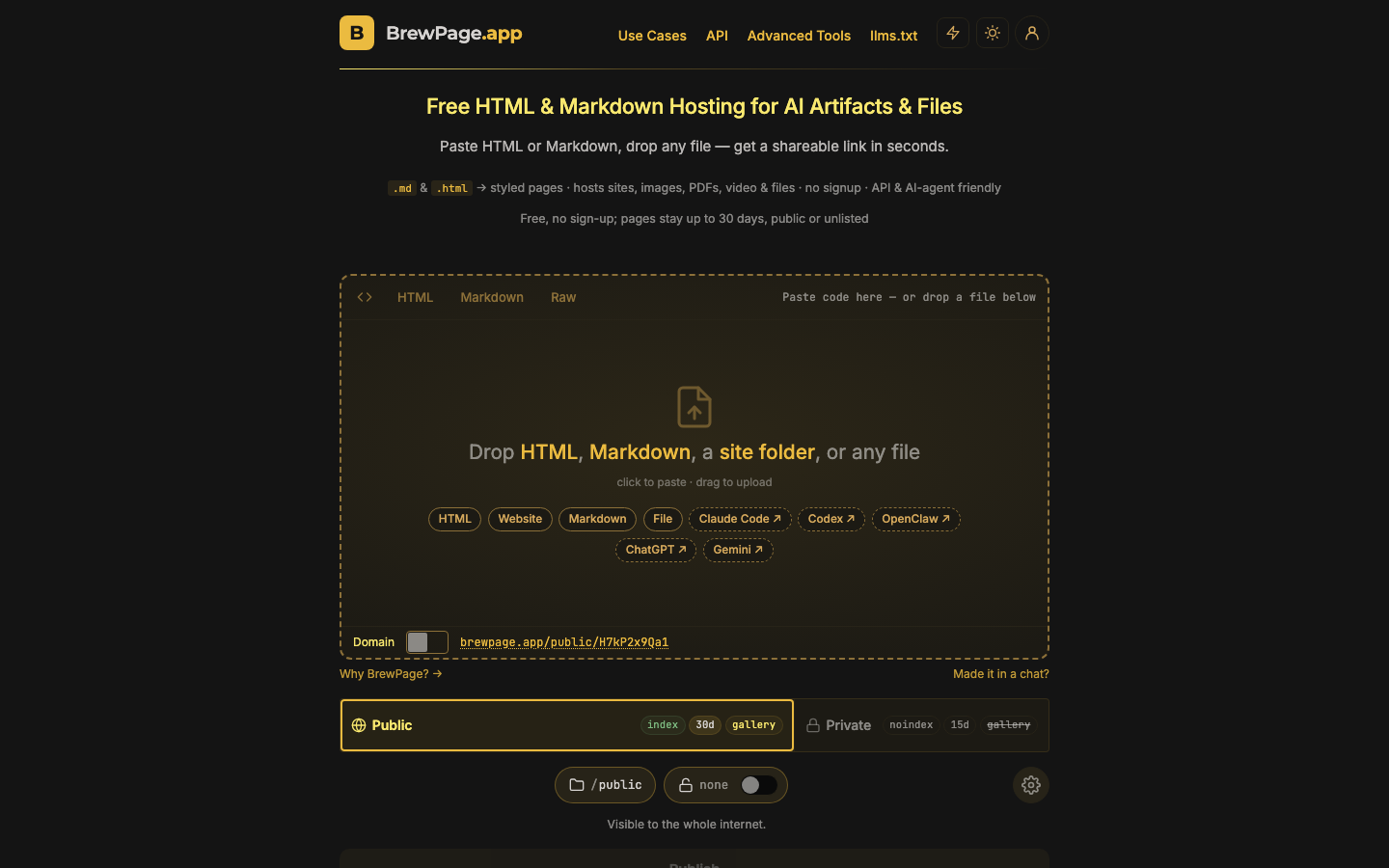
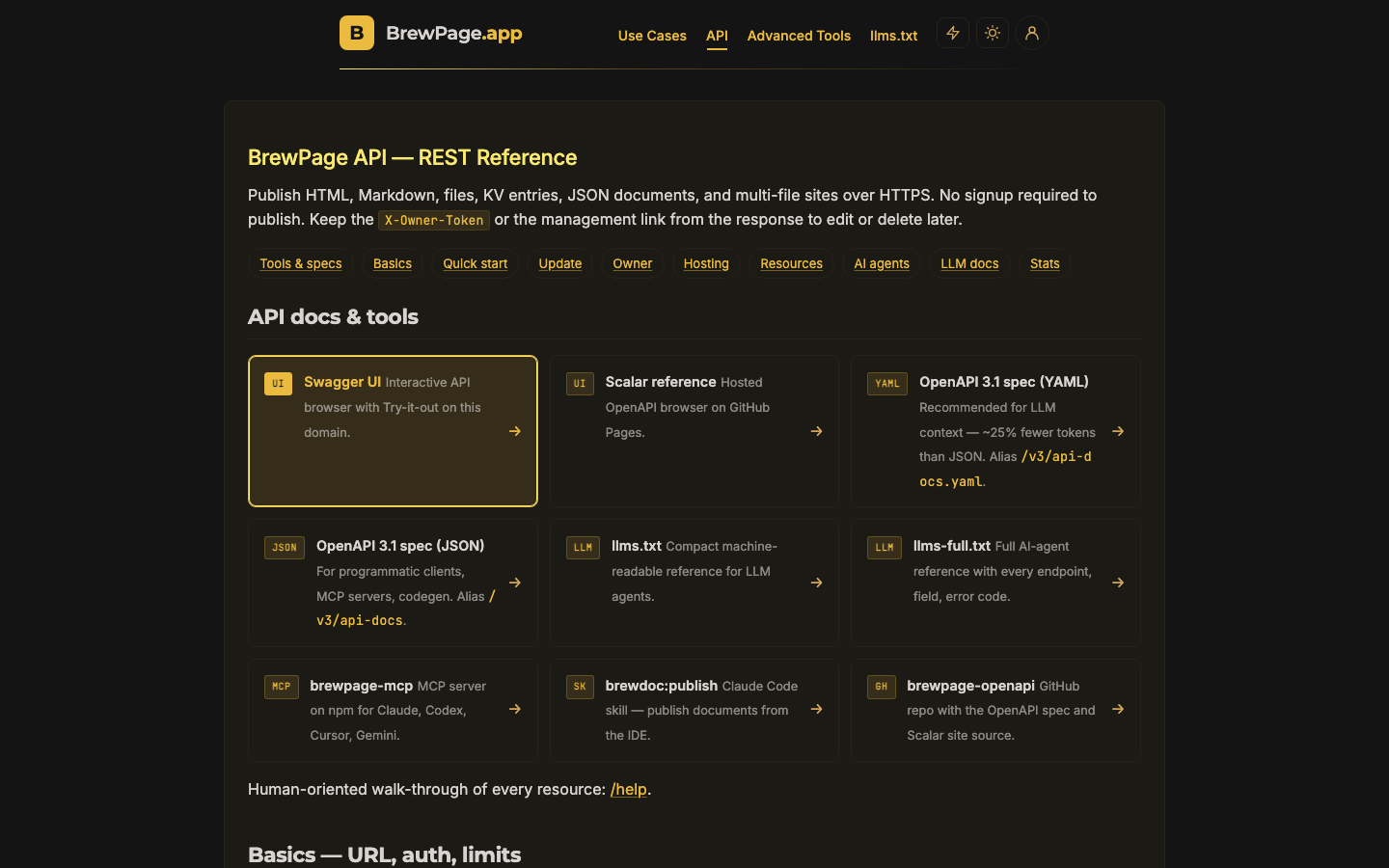
BrewPage publishes HTML pages, static sites, AI artifacts, Markdown and files and gives back a shareable HTTPS link in seconds, free and without signup. Paste or drop content on brewpage.app, or send one POST request to the REST API. JSON and key-value hosting cover small data an app or agent needs to read back. An OpenAPI contract, an MCP server (npm brewpage-mcp or the remote endpoint https://brewpage.app/mcp) and a GitHub Action let AI agents such as Claude and ChatGPT publish on their own. Publications expire: up to 30 days without an account, or up to 90 days with an optional free profile.
Features
Publish HTML, Markdown, files and multi-file static sites without signup
REST API with an OpenAPI contract, plus JSON and key-value hosting
MCP server and GitHub Action for AI agents and CI
Owner token to update or delete at the same URL; optional password
Use Cases
Share a Claude or ChatGPT HTML artifact as a link
Publish CI test reports from GitHub Actions
Let an AI agent publish its output through MCP
Host a quick static demo or prototype

Comments




The expiry split is the part I would want clearer: 30 days with no account versus 90 days with a free profile. If an agent publishes through the MCP server (npm brewpage-mcp or the remote /mcp endpoint) without a profile, does that page still expire at 30 days? And does the owner token still update the same URL only before expiry, or can a later GitHub Action overwrite a CI report link after it has lapsed?

Really impressive product! I love how BrewPage makes publishing and sharing HTML pages, Markdown files and static websites so simple without requiring an account or complicated deployment setup. The REST API and MCP integration are especially useful for developers and AI-powered workflows. It's a practical tool that saves time and removes unnecessary friction. Definitely worth checking out. Great work by the maker!


BrewPage is a really clever solution to a common developer workflow problem. Being able to publish HTML, Markdown, static sites or AI-generated artifacts and get an instant shareable HTTPS link without creating an account removes a lot of unnecessary friction. The REST API and MCP integration are particularly interesting. Allowing Claude, ChatGPT and other AI agents to publish content directly opens up some great possibilities for automated workflows, CI reports and quick prototypes. I also like the ability to update an existing publication without changing its URL. One question: have you considered adding optional custom domains or longer-term hosting for projects that outgrow the temporary publishing model? Really practical tool with a lot of potential!


The owner token for updating at the same URL is a nice touch for CI reports, because the link posted in a PR comment can stay the same across reruns. Is there a size cap for a multi-file static site upload? And can the JSON/KV hosting hand out a read-only key, so an agent can share data without exposing the token that can overwrite it?

The no-signup part is the real differentiator — most quick hosting tools still want an account before you can share a file. Pasting a static HTML export and getting an HTTPS link in seconds is exactly the right workflow for AI artifacts and one-off demos. A browser-generated key to list and revoke past links later would make it even safer to use without an account.
No-signup static hosting is a genuinely useful primitive - the friction drop from zero accounts is huge for quick shares and docs. The obvious tension is abuse: anonymous hosting attracts phishing pages and malware drops, and that eventually lands on your domain reputation and host. Worth thinking through upfront: rate limits per IP, a report path that's fast to act on, and maybe a content hash blocklist shared with other similar services. Cheap to add now, painful to retrofit once you're the go-to free host.


The MCP server is the interesting part for me. I run one for my own app, and the biggest lesson was that every write tool should return the full resulting state in structuredContent, not just "done". Otherwise the model guesses the rest and gets it wrong. For BrewPage that would mean returning the URL, the exact expiry timestamp and how to extend or delete it, so the agent can tell the user "this link dies on Dec 1" instead of inventing it. How are you handling abuse with no-signup hosting? Phishing pages tend to show up fast on open hosts.

Anonymous HTML hosting with scripts allowed is a natural target for phishing pages, so I am curious how uploads are isolated. Are user pages served from a separate origin than brewpage.app, so an uploaded script cannot reach the profile session or the owner-token UI? A short note on that in the docs would help anyone deciding whether to publish agent output here.


Sharing a generated report as a plain HTTPS link is a real pain point; we ship PDF and HTML reports from a browser app and clients often just want a link they can open on a phone. How does the page behave when the HTML references external CSS or images that are not in the upload, for example a report that pulls a font from a CDN? I would also find it useful if the API response said whether a page is still within its expiry window, so a CI job could re-publish only when needed.
The one-POST-request flow is a nice touch for AI-generated reports. On the API feedback: returning the expiry date in the response (someone asked above) would make it easy for agents to warn users before a link dies. A small thought for shared pages: an option to add a noindex tag, so a temporary report doesn't end up in search results by accident.



The no-signup flow with a 30-day expiry (90 days with a free profile) makes BrewPage handy for sharing AI-generated HTML artifacts quickly. I like that the MCP server lets an agent publish on its own. Is there a rate limit or size cap for anonymous uploads, and can the owner token be rotated if it leaks?
BrewPage has an interesting approach to making content publishing simple while also supporting API and MCP workflows. Turning HTML, Markdown, JSON, and AI-generated artifacts into shareable HTTPS links could be especially useful for developers and AI agents. I'm curious, what's the best way to manage published links for projects that need to stay accessible over a longer period?



Free file hosting with no signup is the kind of zero-friction tool I reach for when I just need to publish a changelog, a JSON config or a quick Markdown page without touching a repo. Two things that would make this a primary instead of a backup: signed URLs with an expiry for anything that sho my own dashboard. Are the published paths predictable (e.g. your-slug.brewpage.app), and is t here an API key or token flow for CI pipelines that want to push updates without touching the site?uldn't be cached forever, and a webhook callback when a hosted file is fetched so I can hook a lightweight analytics page into
The 30/90-day expiry is the design choice I'd want to hear more about - it frames this as a link you hand someone rather than hosting, and it keeps the abuse surface small. Does an expired page return 410, or redirect to a notice explaining what happened? The second is friendlier for anyone who saved the link.
Premium Products





















































Sponsors
Buy



Makers
Makers
Comments
The expiry split is the part I would want clearer: 30 days with no account versus 90 days with a free profile. If an agent publishes through the MCP server (npm brewpage-mcp or the remote /mcp endpoint) without a profile, does that page still expire at 30 days? And does the owner token still update the same URL only before expiry, or can a later GitHub Action overwrite a CI report link after it has lapsed?
Really impressive product! I love how BrewPage makes publishing and sharing HTML pages, Markdown files and static websites so simple without requiring an account or complicated deployment setup. The REST API and MCP integration are especially useful for developers and AI-powered workflows. It's a practical tool that saves time and removes unnecessary friction. Definitely worth checking out. Great work by the maker!
BrewPage is a really clever solution to a common developer workflow problem. Being able to publish HTML, Markdown, static sites or AI-generated artifacts and get an instant shareable HTTPS link without creating an account removes a lot of unnecessary friction. The REST API and MCP integration are particularly interesting. Allowing Claude, ChatGPT and other AI agents to publish content directly opens up some great possibilities for automated workflows, CI reports and quick prototypes. I also like the ability to update an existing publication without changing its URL. One question: have you considered adding optional custom domains or longer-term hosting for projects that outgrow the temporary publishing model? Really practical tool with a lot of potential!
The owner token for updating at the same URL is a nice touch for CI reports, because the link posted in a PR comment can stay the same across reruns. Is there a size cap for a multi-file static site upload? And can the JSON/KV hosting hand out a read-only key, so an agent can share data without exposing the token that can overwrite it?
The no-signup part is the real differentiator — most quick hosting tools still want an account before you can share a file. Pasting a static HTML export and getting an HTTPS link in seconds is exactly the right workflow for AI artifacts and one-off demos. A browser-generated key to list and revoke past links later would make it even safer to use without an account.
No-signup static hosting is a genuinely useful primitive - the friction drop from zero accounts is huge for quick shares and docs. The obvious tension is abuse: anonymous hosting attracts phishing pages and malware drops, and that eventually lands on your domain reputation and host. Worth thinking through upfront: rate limits per IP, a report path that's fast to act on, and maybe a content hash blocklist shared with other similar services. Cheap to add now, painful to retrofit once you're the go-to free host.
The MCP server is the interesting part for me. I run one for my own app, and the biggest lesson was that every write tool should return the full resulting state in structuredContent, not just "done". Otherwise the model guesses the rest and gets it wrong. For BrewPage that would mean returning the URL, the exact expiry timestamp and how to extend or delete it, so the agent can tell the user "this link dies on Dec 1" instead of inventing it. How are you handling abuse with no-signup hosting? Phishing pages tend to show up fast on open hosts.
Anonymous HTML hosting with scripts allowed is a natural target for phishing pages, so I am curious how uploads are isolated. Are user pages served from a separate origin than brewpage.app, so an uploaded script cannot reach the profile session or the owner-token UI? A short note on that in the docs would help anyone deciding whether to publish agent output here.
Sharing a generated report as a plain HTTPS link is a real pain point; we ship PDF and HTML reports from a browser app and clients often just want a link they can open on a phone. How does the page behave when the HTML references external CSS or images that are not in the upload, for example a report that pulls a font from a CDN? I would also find it useful if the API response said whether a page is still within its expiry window, so a CI job could re-publish only when needed.
The one-POST-request flow is a nice touch for AI-generated reports. On the API feedback: returning the expiry date in the response (someone asked above) would make it easy for agents to warn users before a link dies. A small thought for shared pages: an option to add a noindex tag, so a temporary report doesn't end up in search results by accident.
The no-signup flow with a 30-day expiry (90 days with a free profile) makes BrewPage handy for sharing AI-generated HTML artifacts quickly. I like that the MCP server lets an agent publish on its own. Is there a rate limit or size cap for anonymous uploads, and can the owner token be rotated if it leaks?
BrewPage has an interesting approach to making content publishing simple while also supporting API and MCP workflows. Turning HTML, Markdown, JSON, and AI-generated artifacts into shareable HTTPS links could be especially useful for developers and AI agents. I'm curious, what's the best way to manage published links for projects that need to stay accessible over a longer period?
Free file hosting with no signup is the kind of zero-friction tool I reach for when I just need to publish a changelog, a JSON config or a quick Markdown page without touching a repo. Two things that would make this a primary instead of a backup: signed URLs with an expiry for anything that sho my own dashboard. Are the published paths predictable (e.g. your-slug.brewpage.app), and is t here an API key or token flow for CI pipelines that want to push updates without touching the site?uldn't be cached forever, and a webhook callback when a hosted file is fetched so I can hook a lightweight analytics page into
The 30/90-day expiry is the design choice I'd want to hear more about - it frames this as a link you hand someone rather than hosting, and it keeps the abuse surface small. Does an expired page return 410, or redirect to a notice explaining what happened? The second is friendlier for anyone who saved the link.
Premium Products
New to Fazier?

Find your next favorite product or submit your own. Made by @FalakDigital.
Copyright ©2026. All Rights Reserved